


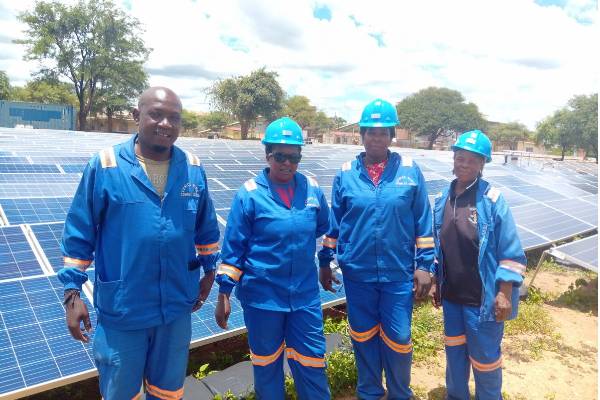

As Zimbabwe’s mining sector continues to battle electricity shortages, rising costs, and operational disruptions, a new energy model is quietly gaining ground — one that could reshape how mines access power. A Build-Operate-Transfer (BOT) solar solution, spearheaded by Seke Energy in partnership with Chinese multinational SANY International, is being rolled out as a zero-upfront-cost alternative tailored to miners using one megawatt and above.
By Rudairo Mapuranga
This development comes at a critical time. Zimbabwe’s miners, particularly in the Platinum Group Metals (PGM) sector, are facing compounded pressures — from crippling load shedding and rising energy tariffs to foreign currency losses and excessive taxation. According to the Chamber of Mines Zimbabwe, the country’s mining operations are becoming less competitive, with electricity accounting for up to 30 percent of total production costs.
The new BOT model offers an alternative: a solar power plant fully funded, installed, and operated by Seke Energy and SANY for an agreed period (typically 8–12 years), after which full ownership of the plant is transferred to the miner. During the BOT period, miners pay a fixed rate — currently between 10 and 13 US cents per kilowatt-hour — which is comparable to or lower than ZESA tariffs. After ownership is transferred, costs drop to around 4 US cents per kilowatt-hour, covering only maintenance.
“We’re targeting miners with proven reserves and stable operations,” says Ashley Maumbe, Managing Director of Seke Energy. “If a mine uses one megawatt or more, we set up a solar system with backup storage at no upfront cost. Once the BOT period is over, the plant becomes theirs.”
The model has also been adapted to support small-scale miners. Where a single operator may not meet the minimum threshold, clusters of five or more miners operating in the same area can be grouped to share a system.
“Small-scale miners usually lack access to reliable energy and can’t afford to invest in solar independently,” Maumbe explains. “But if they come together, we can install a one- or two-megawatt system and deliver shared power under the same BOT arrangement.”
This shift comes as the PGM sector, once a strong contributor to national export earnings, now struggles with viability. In a recent Mining Zimbabwe article, Chamber of Mines CEO Isaac Kwesu cited electricity disruptions, currency conversion losses, and a 77% effective tax burden as key factors threatening the survival of PGM mines. He warned that if urgent interventions are not introduced, some operations could scale down or shut entirely.
The Ministry of Energy and Power Development has acknowledged the need for private-sector solutions to ease pressure on the national grid, which continues to struggle with demand far outstripping generation capacity. The BOT model provides one such solution — decentralized, predictable, and affordable power, installed on-site and managed under contract.
Unlike diesel generators, which have become a common — but expensive and environmentally unfriendly — fallback, solar offers long-term sustainability. With the systems designed to last up to 25 years, the benefit to miners extends well beyond the BOT period.
Crucially, the model also shields miners from foreign currency volatility and policy inconsistencies. Currently, miners are paid 75% of their earnings in forex, yet many services, including electricity, are billed in USD at rates determined by ZESA. The solar BOT model locks in pricing, giving miners cost stability.
Industry observers note that the BOT model represents a broader shift in mining operations — from reliance on central utilities to self-sustained, private energy systems that enhance production reliability and reduce downtime.
While adoption is still in its early stages, interest is growing, particularly in regions like Mashonaland West, Midlands, and Matabeleland South, where power challenges have consistently disrupted output.
The financing structure also aligns with the challenges miners face in accessing credit or capital for infrastructure. By covering all upfront costs, Seke Energy removes a major barrier to entry for solar adoption, especially among small-to-medium-sized producers.
“You don’t need to go to the bank or raise funding. We take on the risk and the capital burden. The miner only pays for power used and eventually owns the plant,” Maumbe says.
As Zimbabwe continues its push toward a US$40 billion mining economy, energy remains one of the most pressing constraints. Solutions like the BOT solar model present a practical, scalable approach that could help unlock production capacity while contributing to the country’s renewable energy targets.
What sets this model apart is not just its technical viability, but its fit-for-purpose design: built around the needs, limitations, and realities of Zimbabwe’s miners.
“This isn’t about selling solar. It’s about solving a structural problem. If miners can’t operate due to power shortages, the entire economy suffers. What we’re offering is energy security — and a pathway to ownership.”
With miners increasingly seeking stable, affordable, and independent power sources, zero-upfront solar systems under BOT may soon become the norm — not the exception — in Zimbabwe’s evolving mining landscape.