


- Arcadia Mine Targets Year-End Crude Lithium Carbonate Output, Adding to Zimbabwe’s Processed Lithium Arsenal

Barely a month after making history with Africa’s first lithium sulphate exports, Prospect Lithium Zimbabwe (PLZ)‘s Arcadia Lithium Mine in Goromonzi is already moving to expand its processed lithium portfolio, with plans to produce crude lithium carbonate by the end of 2026, Mining Zimbabwe can report.
By Rudairo Mapuranga
In an exclusive interview with Mining Zimbabwe, PLZ General Manager Haijun Zhu confirmed that the company, a wholly owned subsidiary of China’s Zhejiang Huayou Cobalt, is actively adding new equipment to its Arcadia Lithium Mine in Goromonzi District to enable the production of crude lithium carbonate. Once operational, PLZ aims for a 50/50 output split between lithium sulphate and lithium carbonate.
“Yes, we are trying to move forward,” Zhu said. “We hope that by the end of this year, we should be able to produce crude lithium carbonate. We need to add some equipment.”
The announcement signals the next phase of Zimbabwe’s rapid ascent in the global battery supply chain, building on the government’s strategic push, which has already achieved a 106% quarterly revenue surge on virtually flat export volumes despite a full-month March ban.
From Sulphate to Carbonate: A Natural Progression
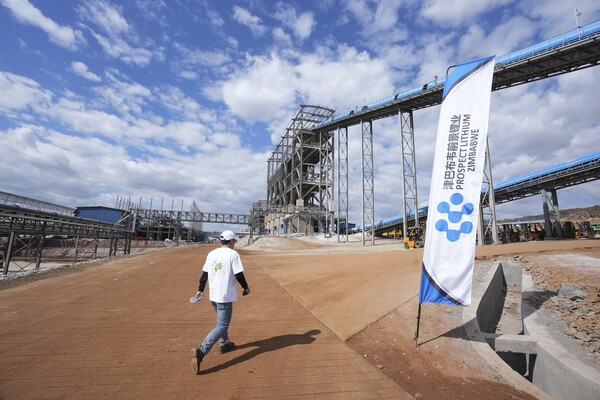
PLZ’s Arcadia mine represents the country’s most advanced downstream lithium facility. After commissioning a US$400 million processing plant in late 2025, the company officially began exporting lithium sulphate in April 2026, a high-value intermediate salt used to produce lithium hydroxide and lithium carbonate for EV batteries, grid storage, and consumer electronics.
The plant currently has a nameplate production capacity of 50,000 tonnes per annum of lithium sulphate, with early exports already moving to international markets.
Adding crude lithium carbonate would mark a decisive broadening of PLZ’s product suite. Crucially, unlike the company’s flagship lithium sulphate, which has been the subject of milestone exports, the proposed carbonate would be crude lithium carbonate, a distinct intermediate product that requires further refining to reach battery-grade purity.
Zhu’s planned 50/50 split would position PLZ as one of the most diversified battery mineral processors in Africa, capable of supplying multiple chemical pathways to downstream refineries.
What Is Crude Lithium Carbonate? Understanding the Value Chain
To fully appreciate PLZ’s ambition, it is essential to understand where crude lithium carbonate fits in the production chain from mine to battery.
Crude lithium carbonate (Li₂CO₃) is an intermediate product obtained from the processing of lithium-containing minerals such as spodumene or from the recycling of lithium-ion battery waste. It represents a midway point in the value chain – more refined than raw spodumene concentrate but not yet pure enough for battery applications.
The global benchmark for battery-grade lithium carbonate is a purity of 99.5% or above, with stringent limits on metallic and chemical impurities to ensure electrochemical stability and battery cycle life. Crude lithium carbonate typically falls below this threshold, requiring further purification to meet the specifications for EV and energy storage batteries.
The carbonisation method is one common refinement route: crude lithium carbonate reacts with carbon dioxide and water to form lithium bicarbonate, which is then thermally decomposed to regenerate lithium carbonate at battery-grade purity.
Once refined, lithium carbonate serves as a critical raw material for lithium-iron-phosphate (LFP) batteries, a chemistry that dominates energy storage systems and is rapidly gaining market share in the EV sector due to its lower cost, longer cycle life, and superior thermal stability. In contrast, PLZ’s existing lithium sulphate is typically refined into lithium hydroxide, the preferred feedstock for nickel-rich cathodes such as NMC (nickel-manganese-cobalt), used in premium EVs.
Thus, PLZ’s planned 50/50 portfolio would position the company to supply both major battery chemistries: crude lithium carbonate as an input for LFP-oriented refineries and lithium sulphate as an input for NMC-oriented refineries. This flexibility reduces dependency on any single downstream market segment, a crucial strategic hedge given fluctuating EV adoption rates and shifting battery chemistries.
Perfect Timing: Lithium Market Enters Deficit
PLZ’s crude lithium carbonate timeline coincides with a tightening global lithium market that analysts now characterise as structurally supply-constrained.
UBS recently raised its 2026 China lithium carbonate spot price forecast by 18% to RMB200,000 per tonne (US$28,200/t), with projections that spot prices could reach RMB250,000/t between May and June 2026. The upgrade reflects a 60% year-on-year surge in energy storage battery demand alongside tightening ore supply following Zimbabwe’s February concentrate export ban.
By March 2026, UBS estimated a global supply-demand deficit of approximately 65,000 tonnes LCE for the full year, driving a significant re-rating of lithium equities. The bank raised 2026 earnings forecasts for leading Chinese lithium stocks by 10% to 40%, exceeding market consensus by 56% to 211%, and maintained “Buy” ratings across the sector.
Data from InfoLink confirms the rally. As of mid-May, battery-grade lithium carbonate was trading in a range of RMB190,000–200,000/MT, up 12.7% week on week, with spodumene concentrate (SC6) CIF prices reaching US$2,750–2,850/MT, a 12.4% weekly gain.
China’s lithium carbonate output remains in a ramp-up cycle, with leading smelters maintaining high operating rates. However, lithium ore supply remains relatively tight. April–May seaborne cargoes are largely locked in, leaving limited room for spot replenishment, while ore-side inventory drawdowns continue.
Demand from energy storage systems (ESS) has emerged as the core driver of this market revaluation. UBS estimates global ESS battery demand will grow by 60% year on year, accounting for 17% of total lithium consumption compared to EV batteries’ 53% share.
This market backdrop makes PLZ’s carbonate timeline strategically significant. Each month of production delay risks leaving money on the table as rising prices increase the value of every tonne of processed material.
Beyond Carbonate: A Fully Integrated Power Play
PLZ’s downstream ambitions extend well beyond chemistry diversification. The company has constructed a 70-megawatt on-site power plant capable of supplying electricity to both PLZ and its sister company, Arcadia Technology Zimbabwe (ATZ).
“The power plant is meant to supply electricity to both PLZ and ATZ, and we are hopeful that by the second half of 2026 both entities will be fully operational,” PLZ Public Relations Manager Patience Chizodza said during a government tour of the facility.
The Arcadia complex now employs 2,000 workers directly and another 2,000 indirectly, with the majority drawn from surrounding communities. The company is also rehabilitating roads, constructing dams, building schools and clinics, and implementing community development programmes covering health enhancement, vocational education for youth, women’s empowerment, and energy equity.
The Bigger Picture: Zimbabwe’s Lithium Industry Takes Shape
PLZ’s Arcadia mine is now fully owned by Zhejiang Huayou Cobalt after the Chinese group acquired the remaining minority stake in 2025, bringing its ownership to 100%.
Additional exploration at Arcadia has increased the mine’s remaining lithium carbonate equivalent (LCE) resources from 1.5 million tonnes to 2.45 million tonnes, while ore grade has risen to 1.34%, significantly above the global spodumene average of 1.0–1.2%.
This upgraded resource base gives PLZ considerable runway for expanded downstream processing beyond the current 50,000 tpa sulphate capacity. Should the crude carbonate line prove successful, the company could scale towards its earlier stated ambition of producing more than 60,000 tonnes of processed lithium annually.
Zimbabwe as a whole is expected to produce about 124,000–180,000 tonnes of LCE in 2026, representing roughly 7–8.4% of global supply. The country remains a key supplier to China, providing around 15% of its spodumene imports.
Under the government’s Mineral Classification and Declaration gazetted on 22 May 2026, lithium is formally designated as a “critical mineral” alongside nickel, cobalt, graphite, copper, rare earth elements, chrome, PGMs, and eight others, banning raw or unbeneficiated exports without a conditional transitional plan. The framework mandates state shareholding through special-purpose vehicles (SPVs) and requires prior ministerial approval for all mining rights relating to critical minerals.
PLZ’s early compliance, from lithium sulphate production to the planned carbonate line, positions it as a model partner in Zimbabwe’s beneficiation-driven resource strategy.
Zhu’s year-end target for crude lithium carbonate is ambitious but achievable, requiring additional equipment to be sourced, installed, and commissioned over the coming six to seven months. The company’s existing infrastructure, including the 70 MW power plant, provides a solid foundation for this expansion.
If successful, PLZ will become Africa’s first producer of multiple lithium salt products from a single facility. For Zimbabwe, that success would further entrench the country’s position as a vertically integrated partner for the world’s leading battery manufacturers, not just a source of raw rock.
For investors and mining executives watching Zimbabwe’s lithium transformation, the question is no longer whether local processing will happen, but how fast it can scale. PLZ’s crude carbonate timeline, along with competitor moves such as Bikita Minerals’ US$400 million lithium sulphate plant, suggests that Zimbabwe’s downstream lithium industry is accelerating faster than almost anyone had projected.

