



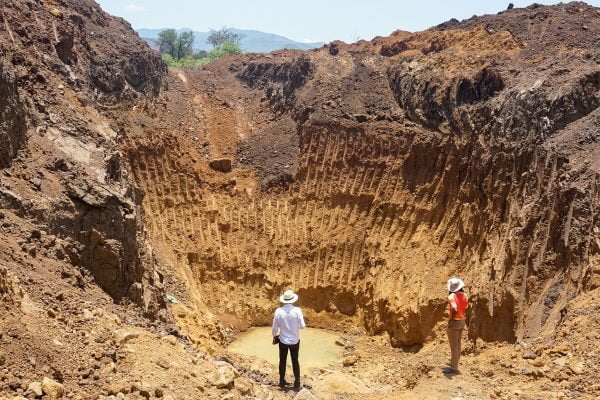

Four artisanal miners are trapped underground after a shaft collapsed at Rowdy Boys Mine, popularly known as PaJudah, early Friday morning, in the latest tragedy to expose the worsening safety crisis gripping Zimbabwe’s artisanal and small-scale mining (ASM) sector.
Mashonaland West Minister of State for Provincial Affairs and Devolution, Honourable Marian Chombo, confirmed that eight miners were underground when the shaft gave way. While four escaped unharmed, rescue teams are racing against time to locate and retrieve the remaining four, whose condition remains unknown.
The accident occurred around midnight on Thursday, with authorities from the Minerals Flora and Fauna Unit (MFFU) leading emergency response efforts. Investigations into the cause of the collapse have been launched.
This latest incident comes against a grim statistical backdrop. According to Mines and Mining Development Minister Dr Polite Kambamura, 64 artisanal and small-scale miners died in Zimbabwe during the first quarter of 2026 alone — a six per cent increase from the same period last year.
Ground collapses remain the leading cause of fatalities, accounting for 54 per cent of all mining deaths in Q1 2026 and claiming 35 lives. Improper use of explosives and gas-related incidents caused 25 per cent of fatalities, while falls into abandoned and unprotected shafts contributed 15 per cent. Electrocution and equipment-related incidents made up the remaining six per cent.
“The figures that must command our attention this morning are not the figures of production. They are the figures of loss,” Minister Kambamura told mining inspectors recently, emphasising that “these deaths are, in the overwhelming majority, preventable. They are not acts of God.”
The ASM sector’s safety record continues to lag behind that of large-scale mines due to a lack of critical safety infrastructure and technology. While the Ministry is rolling out digital inspection platforms, drone-assisted surveillance, and advanced geotechnical monitoring to anticipate fall-of-ground incidents, ASM operations remain largely unregulated and lack basic safety systems.
Mine rescue capacity also remains concentrated in large-scale operations. The Mine Rescue Association of Zimbabwe, established after the 1972 Hwange Colliery disaster, which killed 427 miners, coordinates rescue teams across four zones, with protocols that include map reading, emergency procedures, physical fitness, and leadership during crises. However, these resources are rarely available to the informal miners who suffer the highest fatality rates.
Mashonaland West Minister Chombo has previously called for artisanal miners to insure their operations to cushion families against tragedies, noting that while artisanal mining contributes more than 60 percent of national gold output, “we cannot celebrate its strength at the expense of human life.”
The rescue operation at Rowdy Boys Mine is ongoing. Authorities have urged all miners to adhere to safety regulations under the Mines and Minerals Act [Chapter 21:05] to prevent avoidable loss of life.

