

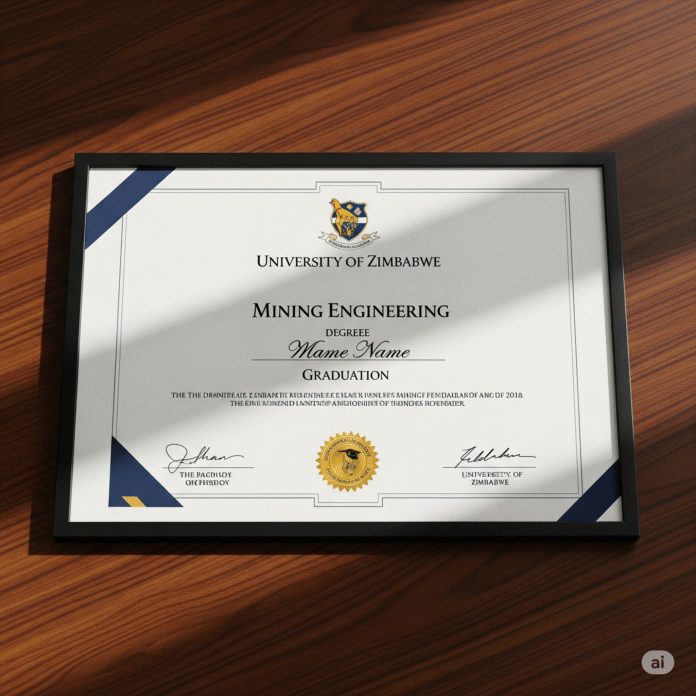
A mining operation in Zimbabwe has sparked widespread condemnation after advertising a senior leadership role that appears to undermine the value of Zimbabwean mining engineering qualifications.
By Ryan Chigoche
The vacancy, posted by Precision Recruitment International, calls for a General Manager with a Mining Engineering degree “preferably obtained from a university outside Zimbabwe.”
This phrasing has provoked fierce backlash within the mining sector, with local professionals viewing it as a direct devaluation of Zimbabwe’s hard-earned educational credentials.
Zimbabwe’s mining sector has long relied on locally trained engineers to lead its operations. Many earned their degrees during periods when Zimbabwean universities were regarded as producing some of the best mining engineering graduates in the region.
These qualifications have served as the foundation for decades of success, with local mine managers steering operations through some of the country’s toughest economic and operational challenges, including hyperinflation, power shortages, and regulatory uncertainty.
Today, most senior managers at active mines hold Zimbabwean qualifications and have risen through years of hands-on experience, leveraging deep practical knowledge of local geology and regulatory frameworks. This expertise remains crucial and difficult to replace.
Global Recognition of Zimbabwean Engineers
Zimbabwean mining engineers are not just valued at home; their skills and leadership are sought after internationally. Many hold senior roles such as Mine Managers, Operations Directors, and even Chief Operating Officers across Southern Africa and Australia.
Their success in jurisdictions with more stringent safety and environmental standards challenges the notion that Zimbabwean qualifications are inferior.
Against this backdrop, the insistence on a foreign degree for a role requiring at least 10 years of senior experience raises important questions.
Candidates of this seniority graduating from Zimbabwean universities around or before 2005 were educated under systems still highly respected internationally.
Critics argue that preferring foreign degrees unfairly sidelines qualified local professionals and perpetuates an outdated bias against Zimbabwean education.
Adding to that, such a preference often leads to the appointment of expatriates, who come with added costs like relocation packages, expatriate allowances, and higher salaries.
In an industry increasingly focused on cost optimisation and value for shareholders, this approach risks financial inefficiency and operational disruption.
Contradiction With Government Policy and Local Content Framework
Zimbabwe’s mining policy strongly supports local content and skills development, encouraging foreign investors to employ and promote Zimbabwean professionals.
By prioritising foreign degrees, the company risks running afoul of these policies, potentially attracting regulatory scrutiny and harming its standing with government authorities.
This recruitment language echoes colonial-era attitudes that equate foreign education with superiority, undermining years of progress in decolonising Zimbabwe’s mining leadership.
It also perpetuates harmful stereotypes that unfairly diminish local professionals despite their proven capabilities.
By choosing to bypass local talent rather than investing in mentoring and upskilling, the company signals a lack of commitment to the long-term growth of Zimbabwe’s mining workforce.
This approach is short-sighted and jeopardises the sustainability of the sector’s human capital.
This development comes at a time when Zimbabwe’s mining industry is entering a growth phase, with new lithium, gold, and platinum projects coming online.
At this pivotal moment, it is important that investors act as partners in local empowerment, nurturing and elevating local leadership rather than sidelining it.
As the debate intensifies, many are calling on regulators, professional bodies, and government agencies to step in and ensure recruitment practices are fair, transparent, and aligned with Zimbabwe’s national development goals.
Zimbabwe’s mining sector deserves leadership that recognises and values its own engineering professionals who have proven their mettle on both the local and global stages.

