

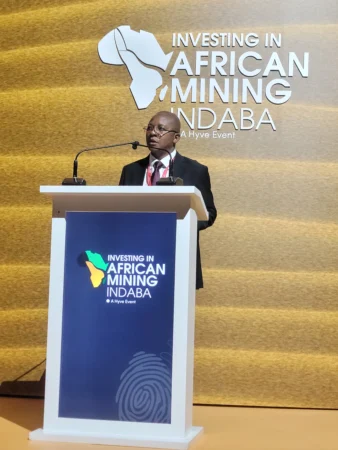
CAPE TOWN – In a stirring address that framed the continent’s critical minerals endowment as both a responsibility and an opportunity, Zimbabwe’s Minister of Mines and Mining Development, Hon. Dr Polite Kambamura, has challenged Africa to move decisively from being a raw material supplier to a co-owner of the global energy transition, Mining Zimbabwe can report.
By Rudairo Mapuranga
Speaking at the Sustainable Energy for All roundtable on Financing Value Addition in Africa, held on the sidelines of the Investing in African Mining Indaba, the Minister delivered an unvarnished assessment of the continent’s position in global value chains and a clear prescription for change.
“The reality is that there is no global energy transition without African minerals,” Kambamura stated. “The question is whether Africa will simply supply the transition—or co-own it.”
The Minister painted a sobering statistical picture of Africa’s underweight position in global trade. Drawing from UNCTAD data, he noted that while Africa’s population share is rising to approximately 16% of the world’s total, the continent accounts for less than 3% of world trade as of 2024.
“The gist of the lesson is very clear: Africa is a major future market but still sits too low in global trade and value chains,” he said.
Yet he pointed to green shoots of recovery. FDI inflows to Africa jumped 75% to US$97 billion in 2024, representing about 6% of global FDI. “Again, the message is very clear: Africa is investable,” Kambamura asserted. However, he cautioned that investment patterns remain “heavily concentrated on specific projects and remain deal-driven,” calling for the deepening of “repeatable value-adding pipelines, not celebrating one-offs.”
“The central constraint we must confront is finance—not just the availability of capital, but the right kind of capital, deployed at the right stages of the value chain and aligned with national and regional industrial policies,” he explained.
From early-stage exploration to processing facilities, manufacturing plants, and enabling infrastructure, Dr. Kambamura argued that each segment of the mining value chain “requires tailored financing solutions and risk-sharing mechanisms.”
In a departure from conventional narratives that look exclusively outward for capital, the Minister spotlighted two largely untapped domestic sources:
Remittances: Citing World Bank estimates, he noted that Sub-Saharan Africa remittances reached US$56 billion in 2024. “The good news is that these remittances are not charity; they are patient capital,” Kambamura said. He urged the conversion of these flows into savings, mortgages, mining project value chain finance, and infrastructure funding.
African Sovereign Wealth Funds: While GlobalSWF reports that African state-owned institutions manage nearly US$1 trillion in assets, African sovereign wealth funds account for only 1% of global SWF assets. “The key message is that Africa has meaningful domestic pools—in the form of pensions, central banks, and SWFs,” he stated. “The opportunity is to mobilise them into the development of mining value chains, infrastructure, trade finance, and industrial capacity—with proper risk instruments.”
For Zimbabwe, the Minister positioned these continental ambitions within ongoing domestic reforms. “We are implementing deliberate policy reforms to promote local beneficiation, value addition, and investment in downstream industries, while strengthening transparency, governance, and sustainability,” he said.
He acknowledged that unlocking these opportunities at scale “demands closer collaboration between governments, development finance institutions, export credit agencies, and private investors.” Blended finance, catalytic capital, and de-risking instruments, he argued, “must move from theory into practice.”
The roundtable, convened by Sustainable Energy for All, the Council for Critical Minerals Development in the Global South, and UNIDO’s Global Alliance for Responsible and Green Minerals, provided a platform to interrogate framework conditions that attract long-term investment.
Kambamura urged participants to remain focused on practical outcomes: “how we mobilise capital, how we align finance with industrial policy, and how we ensure that Africa emerges not as a peripheral player, but as a competitive and indispensable partner in global clean energy supply chains.”
His closing message was both a challenge and an invitation: to translate Africa’s mineral wealth into jobs, industries, and shared prosperity—not as a passive supplier, but as an equal architect of the green energy future.

