



Ariana Resources says its updated pre-feasibility study (PFS) for the Dokwe Gold Project in Zimbabwe has significantly strengthened the project’s economics, with the mine now carrying a pre-tax net present value (NPV10) of US$1.06 billion, Mining Zimbabwe can report.
By Ryan Chigoche
The revised study positions Dokwe among Zimbabwe’s emerging large-scale gold development projects, underpinned by higher reserves, improved production forecasts, and stronger returns driven by elevated gold prices.
According to the updated PFS, the project is expected to produce 1.06 million ounces of gold over a 20-year life-of-mine through a two-phase development plan.
The first phase will involve a 12-year open-pit mining operation producing approximately 80,000 ounces of gold annually, while a second eight-year stockpile processing phase is projected to yield around 20,000 ounces per year. Peak annual production is forecast to reach 100,000 ounces.
Managing Director Kerim Sener described the updated study as a significant step forward for the project.
“A major milestone” as Ariana progresses the definitive feasibility study, which is due in the first quarter of 2027.
He added that the reserve increase “sets the scene for a significantly expanded mining and processing rate”.
The company said ongoing metallurgical and geotechnical drilling programmes are already ahead of schedule and are expected to support further reserve upgrades during the second half of 2026, potentially strengthening the project economics further ahead of the definitive feasibility study.
The updated study already reflects a significant increase in the project’s mineral inventory, with ore reserves at Dokwe North rising 42% to 1.13 million ounces of gold, while the combined mineral resource estimate for Dokwe North and Dokwe Central increased 13% to 1.6 million ounces.
Ariana estimates pre-production capital expenditure for the project at US$164 million, with the mine projected to achieve payback within one year of commissioning, underscoring the project’s strong financial profile.
Using a gold price assumption of US$4,250 per ounce, Dokwe delivers a pre-tax internal rate of return (IRR) of 92%, highlighting the project’s substantial leverage to elevated bullion prices.
The strengthened economics come at a time when global gold prices continue trading near historic highs amid sustained investor demand, central bank buying, and ongoing geopolitical uncertainty, conditions that have improved financing appetite for high-margin gold development projects globally.
Benchmarking Dokwe Against Zimbabwe’s Leading Gold Producers
At peak production of 100,000 ounces per year, Dokwe would rank among Zimbabwe’s larger gold mining operations and place Ariana Resources PLC within the country’s emerging mid-tier producer category.
By comparison, Caledonia Mining Corporation’s Blanket Mine produced 76,213 ounces in 2025, making it one of the country’s most consistent large-scale underground operations.
Padenga Holdings Limited’s Dallaglio gold business also remained a key mid-tier contributor, producing about 82,000 ounces in 2025 across its Eureka and Pickstone operations, supported by strong gold prices and improved plant stability.
At the upper end of Zimbabwe’s gold industry, state-linked Mutapa Gold Resources, which operates Freda Rebecca, Shamva, and Jena, produced approximately 104,000 ounces in the 12 months to March 2026, according to company reporting.
However, Mutapa is already in an aggressive expansion phase. The group is targeting a major production ramp-up to around 300,000 ounces per year within the medium term, driven by optimisation at Freda Rebecca and a planned US$150 million redevelopment of Shamva Mine, alongside upgrades at Jena aimed at lifting recoveries and throughput.
Against this backdrop, Dokwe’s projected 100,000-ounce peak output would sit just below the current Mutapa cluster but above most individual Zimbabwean gold mines, positioning it firmly within the country’s strategic mid-tier production band and underscoring its potential importance in expanding national output capacity.
Meanwhile, the advancement of Dokwe also comes as Zimbabwe continues pushing to expand large-scale gold mining capacity, with gold remaining the country’s single largest mineral export earner and a major source of foreign currency.
Zimbabwe’s gold production reached an all-time high of 46.7 tonnes in 2025, surpassing the government’s 40-tonne target and marking a 17% increase from the 36.48 tonnes produced in 2024.
For 2026, the government and Fidelity Gold Refinery have set a national production target of 50 tonnes, underscoring the country’s drive to expand output through both existing producers and new large-scale projects.
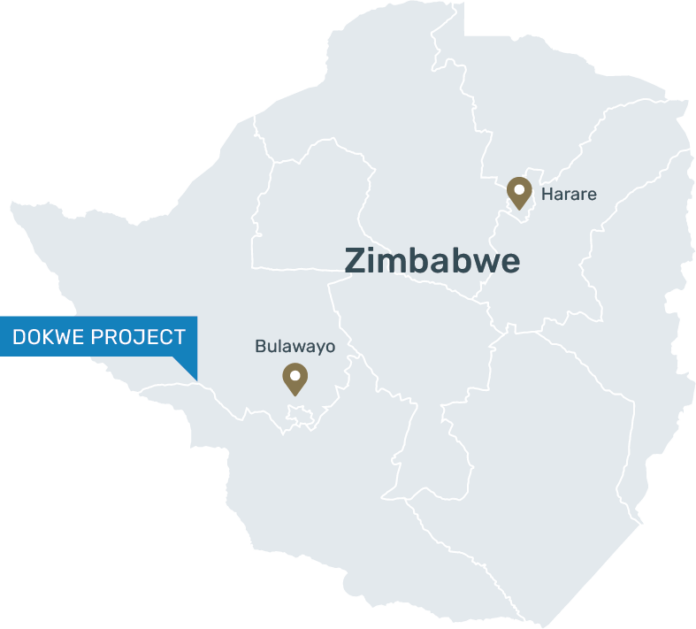
Dokwe is located approximately 110 kilometres west-northwest of Bulawayo and is held under mining claims wholly owned by an Ariana subsidiary.

