

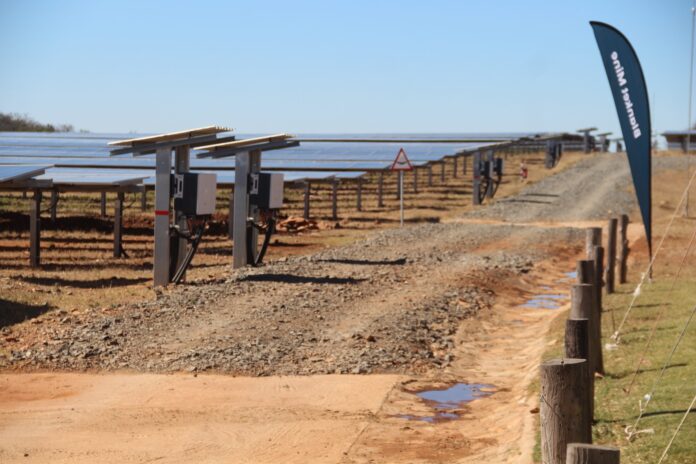
In a landmark transaction that signals a deepening shift toward cleaner, decentralised power in Zimbabwe’s extractive industries, Caledonia Mining Corporation has formally handed over its 13.9MW solar photovoltaic plant at Blanket Mine to CrossBoundary Energy under a 17-year power purchase agreement (PPA).
By Ryan Chigoche
The deal represents one of the most mature public-private renewable energy transactions in Zimbabwe’s mining history and is being hailed as a benchmark for how mines can manage energy security, decarbonization, and economic efficiency all at once.
“This project is a demonstration of the impact that distributed energy can have right here in Zimbabwe,” said Tessa Lee, Managing Director of CrossBoundary Energy, during the handover ceremony. “It also marks the beginning of what we hope will be a long and impactful partnership.”
Powering a Greener Mining Sector in a Challenging Energy Landscape
Zimbabwe’s mining industry, which accounts for more than 60% of export earnings and is central to the country’s Vision 2030, is no stranger to power challenges. Aging infrastructure, recurrent load shedding, and fuel import costs continue to weigh heavily on operations. In this context, the Blanket Mine solar plant — which has already produced over 57,000 megawatt-hours (MWh) of electricity since its 2023 commissioning — stands as a critical buffer against national grid disruptions.
With global mining under pressure to cut emissions, Zimbabwe’s miners are increasingly being nudged by international investors and buyers to clean up their energy use. Gold producers like Caledonia, as well as lithium players in Bikita, Kamativi, and Goromonzi, are responding with innovative solutions.
Tessa Lee noted that Blanket Mine’s solar system has already reduced dependence on diesel generators, lowering operating costs and shrinking the mine’s carbon footprint. The plant supplies about 25% of the mine’s power, supporting operations at a time when Zimbabwe’s national utility ZESA, continues to grapple with chronic power deficits.
Public-Private Energy Partnerships Gaining Momentum
The transaction reflects a maturing model of energy delivery for African mines. While many mining companies have invested in building solar and hybrid systems to reduce costs and improve reliability, few have successfully transitioned those assets to specialised energy firms.
In this case, Caledonia Mining constructed the solar facility, while CrossBoundary Energy — one of Africa’s leading IPPs — now takes over long-term ownership and operations. The PPA ensures stable, predictable pricing for Blanket Mine over the next 17 years, while allowing Caledonia to redeploy capital into core mining projects.
“This allows miners to focus on productivity and growth, while we handle the power,” said Lee.
CrossBoundary’s portfolio now exceeds 600 megawatts of distributed solar and hybrid projects across Africa, serving clients in sectors such as mining, manufacturing, and agro-processing in markets like Ghana, Kenya, Nigeria, and Madagascar.
Tangible Gains: Cutting Costs and Carbon
The switch to solar has had clear financial and environmental benefits. Diesel generation, often used as a backup in Zimbabwe, costs more than 30 US cents per kilowatt-hour, compared to solar’s average of 6–10 cents. The fuel must also be imported, adding forex pressure and logistical complexity.
By reducing diesel use, Blanket Mine has not only cut costs but also mitigated carbon emissions. While exact figures were not disclosed, similar 13.9MW systems elsewhere in Africa reduce CO₂ emissions by more than 15,000 tonnes per year, according to estimates from the International Renewable Energy Agency (IRENA).
This aligns with broader ESG expectations. Caledonia, listed on the NYSE and London’s AIM, is under increasing investor pressure to improve its sustainability profile, especially as fund managers tighten screening for mining equities.
Zimbabwe’s Distributed Energy Revolution Gathers Pace
Blanket Mine’s solar handover is not a one-off — it’s part of a wider decentralised power movement in Zimbabwe. As of mid-2025, ZERA had licensed close to 200MW of captive solar capacity for mines, factories, and farms. These include lithium miners in Bikita and Goromonzi, ferrochrome smelters in Selous, and even shopping malls in Harare and Bulawayo.
This movement has been enabled by regulatory reforms. In recent years, ZERA introduced net metering, power wheeling frameworks, and Independent Power Producer (IPP) licensing pathways — all of which have made it easier for private players to enter the energy space.
Government Backing and Investor Confidence
Behind the success of the Blanket Mine project lies deliberate policy alignment and institutional support. Agencies like the Zimbabwe Investment and Development Authority (ZIDA), the Reserve Bank of Zimbabwe (RBZ), and the Ministry of Energy and Power Development played facilitative roles in the transaction.
Tessa Lee praised Energy Minister Edgar Moyo’s consistent support, referencing a recent conversation at the African Energy Forum in Cape Town. “Your vision of distributed energy complementing centralised power positions Zimbabwe as a compelling destination for clean energy investment,” she said.
CrossBoundary’s involvement is a testament to growing investor confidence in Zimbabwe’s renewable energy space — confidence that will be critical if the country hopes to unlock billions in green infrastructure over the next decade.
Phased Expansion on the Horizon
Although the plant currently powers a quarter of Blanket Mine’s needs, both Caledonia and CrossBoundary have confirmed plans to explore additional phases of development. This could take the form of battery storage, increased PV capacity, or hybridisation with other renewables such as wind.
“The opportunity to expand will unlock further efficiencies and align with Caledonia’s long-term energy strategy,” said Lee. This would not only enhance energy resilience but also future-proof the mine against rising electricity tariffs and regional energy shocks.
As lithium, nickel, and gold demand rise globally, Zimbabwe’s ability to supply responsibly will hinge on its energy strategy, making such expansions more than just technical upgrades. They are strategic moves in a shifting global mining landscape.
Beyond electrons, the Blanket Mine solar handover is symbolic. It shows what’s possible when governments, miners, financiers, and technical partners work toward a shared goal. It also positions Zimbabwe as a regional reference point in integrating distributed power in the mining sector.
“This project perfectly aligns with national and continental goals for energy security, economic development, and environmental stewardship,” Lee concluded. “It’s not just about power — it’s about progress.”
Background: Blanket Mine and Caledonia Mining
Blanket Mine, located in Matabeleland South, is one of Zimbabwe’s longest-operating gold mines. Acquired by Caledonia Mining Corporation plc in 2006, the mine has undergone significant expansion, including the recent completion of a US$67 million central shaft project. Caledonia is now targeting an annual gold output of 80,000 ounces, supported by increased mechanisation, underground development, and improved power security.
The company is dual-listed on the New York Stock Exchange, London’s AIM, and the Victoria Falls Stock Exchange, making it one of Zimbabwe’s most visible mining stocks internationally.

