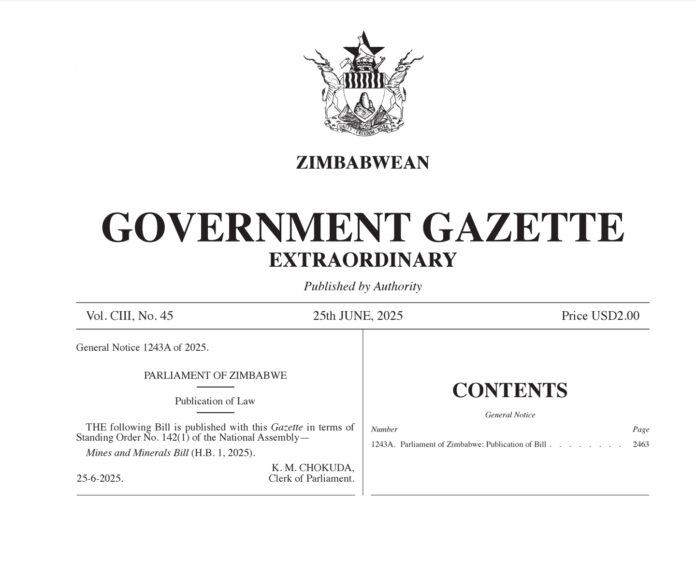
The long-awaited Mines and Minerals Bill (H.B. 1, 2025) has officially been gazetted, marking the latest chapter in Zimbabwe’s drawn-out journey to reform its colonial-era mining legislation, Mining Zimbabwe can report.
By Rudairo Mapuranga
Published in today’s Government Gazette by Clerk of Parliament K. M. Chokuda, the Bill is being introduced in terms of Standing Order No. 142(1) of the National Assembly. The development is significant as Zimbabwe’s mining industry—key to the country’s economy—continues to operate under the outdated Mines and Minerals Act of 1961, which stakeholders have for years described as unfit for the current socio-economic and environmental context.
This is not the first time the Mines and Minerals Bill has been gazetted. Over the past decade, several versions have been tabled, debated, and shelved—either lapsing in Parliament or stalling before receiving Presidential assent. This has fuelled uncertainty in the mining sector, especially among investors seeking a consistent and transparent legal framework.
What the 2025 Mines Bill Seeks to Address
The newly gazetted Bill proposes to:
- Replace the Mines and Minerals Act [Chapter 21:05] with a more modern framework aligned with national development goals.
- Establish a Mining Affairs Board to guide decision-making processes.
- Introduce clearer rules on mining title management, particularly in terms of cadastre and exploration rights.
- Strengthen environmental compliance and land rehabilitation obligations.
- Improve governance through transparency and accountability mechanisms in the allocation of mining rights.
- Define and protect community rights, including benefit-sharing and land access protocols.
- Address concerns about exclusive prospecting orders (EPOs) and introduce frameworks that enable small-scale and artisanal miners to be formally recognised and supported.
- Align the mining law with Zimbabwe’s Vision 2030 and other international obligations, particularly in the extractives sector.
While the Bill appears comprehensive, stakeholders are expected to scrutinise it heavily, especially in light of past concerns that previous versions lacked adequate provisions on resource nationalism, community participation, and state equity in major mining operations.
Will This Be the Final Push?
Despite having gone through various iterations under different Ministers of Mines and multiple parliamentary sessions, the Mines Bill has yet to be signed into law by the President. Its continued failure to cross the final legal threshold has drawn criticism from civil society, miners, and lawmakers alike, who argue that its passage is crucial to unlocking the full potential of Zimbabwe’s US$12 billion mining economy.
As the latest version of the Bill enters the parliamentary process, hopes are high but cautious. The big question remains: Will this be the year the Mines and Minerals Bill finally becomes law?