


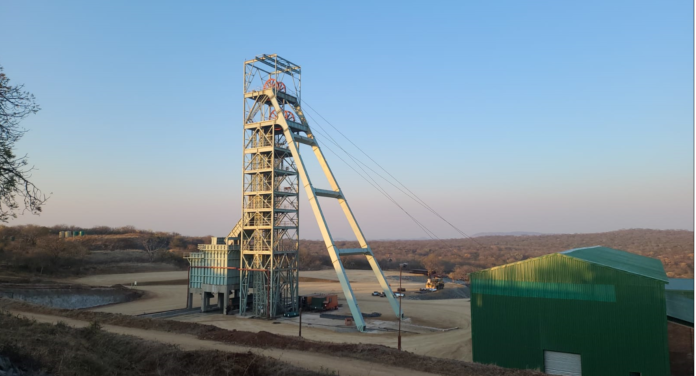

In a bold declaration of intent, Caledonia Mining Corporation has unveiled an ambitious strategy to transform from a successful single-mine operator into the largest gold producer in Zimbabwe, targeting a scale-up to over 300,000 ounces of annual production within the next decade, Mining Zimbabwe can report.
By Rudairo Mapuranga
The announcement was made by Caledonia’s Chief Executive Officer, Mark Learmonth, during a press conference in Harare, where he outlined a 25-year vision to build a “multi-asset, mid-tier, environment-focused” gold producer on Zimbabwean soil.
“We’ve shot the lights out for a little Zimbabwean gold producer,” Learmonth stated, reflecting on the company’s remarkable journey. “When I joined this business in 2008, we were capitalised at just US$3 million, and now we’re at about US$700 million. Over that period, all we’ve done is we’ve pretty much increased production from 40,000 ounces to 80,000 ounces. So, just by doubling production, we’ve added huge value.”
The company’s growth strategy is built on a two-pillar approach. Its cornerstone asset, the Blanket Mine, will continue to be a consistent performer, reliably producing between 75,000 and 80,000 ounces of gold annually.
The real step-change, however, will come from the development of its broader portfolio, notably the Bilboes project. With Bilboes “up and running,” the company aims to replicate the model of major mid-tier producers.
“The idea is to create a business that looks pretty similar to Sentinel, which had about 350,000 to 450,000 ounces a year,” Learmonth explained, pointing to the long-term goal. “Over the course of the next 10 years, I’d be very disappointed if we don’t go from 80,000 ounces to 300,000 ounces. So, the rate of growth, the rate of profitability and return is exponential.”
The CEO bolstered his ambitious forecasts with hard data, highlighting Caledonia’s exceptional returns for its investors. Over the past decade, the company has delivered a staggering 1,000% US dollar-denominated return to shareholders—a tenfold increase in value.
“This massively outperforms both the gold price, which has only gone up three times, and the GDXJ index of smaller gold producers, which has only gone up four times over the same period,” Learmonth noted.
Central to Caledonia’s expansion philosophy is a deep commitment to being more than just an extractive industry. Learmonth emphasized that mining is fundamentally about building partnerships with all stakeholders, including employees, local communities, and the government.
He presented figures demonstrating the company’s growing contribution to the Zimbabwean economy through dividends to the Gwanda Community Share Ownership Trust, which owns 10% of Blanket Mine, royalties, taxes, and direct community investments. These contributions have seen a substantial increase in 2025, a trend expected to accelerate significantly with the higher gold price and expanded production.
“The critical point is we’ve given a great return to our shareholders, but we’re also contributing handsomely to the Zimbabwean economy,” Learmonth concluded.
This confident roadmap from Caledonia signals a new chapter for Zimbabwe’s gold sector, demonstrating how home-grown success stories are evolving to compete on a global scale while anchoring their growth and partnerships firmly within the nation.

