


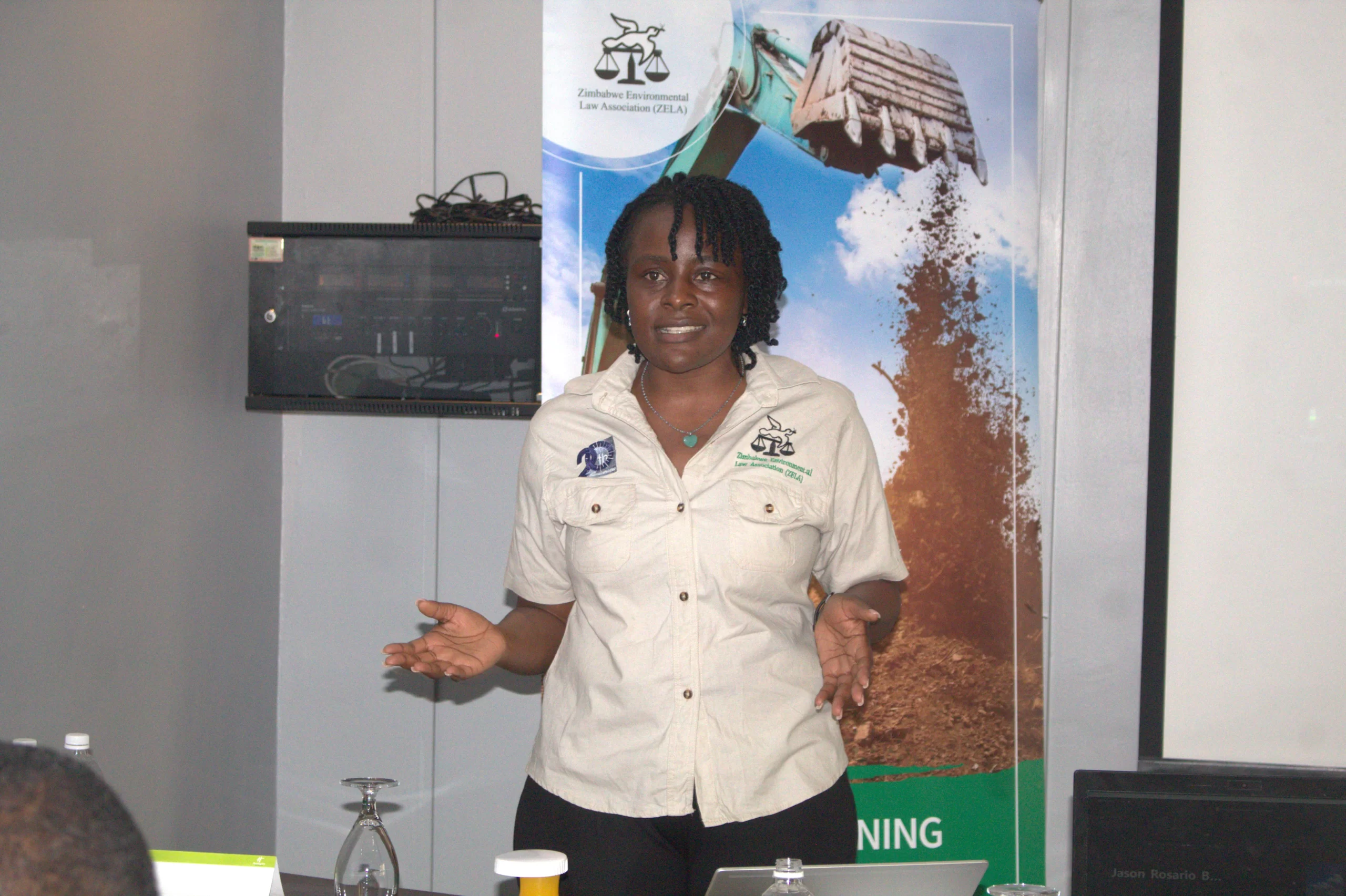

Through a combination of civil society organisations’ efforts, miners’ advocacy, and responsive government action, Zimbabwe is undertaking significant reforms to formalise and improve the management of its Artisanal and Small-scale Mining (ASM) sector, the Zimbabwe Environmental Law Organisation (ZELO) has said.
By Rudairo Mapuranga
In an address at the Zimbabwe Miners Federation (ZMF) conference during Mine Entra 2025, Fadzai Midzi of ZELO detailed how this partnership is driving progress in formalisation, policy reform, and responsible mining practices.
Midzi revealed that her organisation has been actively working with both miners and the government to shape a more sustainable and profitable future for the sector.
“Our organisation has been focusing on working with small-scale miners’ associations, like the Zimbabwe Miners Federation, which is a key stakeholder in our work,” Midzi stated. “As part of this, we have also been working with the government to support the formalisation of ASM and the improvement of artisanal and small-scale mining sector governance and management.”
This collaborative effort, she explained, extends to promoting alternative livelihoods and skills for miners while championing responsible and traceable mining practices.
“Part of what we have also been doing is to promote responsible mining, responsible sourcing, and sustainable, traceable, profitable, and accountable artisanal and small-scale mining practices,” Midzi told the conference. “This we have done personally with different government stakeholders, such as the Zimbabwe School of Mines and the Minerals Marketing Corporation of Zimbabwe in the gemstone sector.”
A major focus of the collaboration has been on enhancing environmental protection and safety, with ZELO assisting miners directly.
“We have also been working to enhance environmental protection by assisting miners to develop their responsible sourcing toolkits and to implement safety and health practices,” she said.
Midzi highlighted that this important sector is key to improving livelihoods, a goal being supported by proactive government policy.
“Part of this has been the current work and interest the government has been pushing for some of the key policies, such as local content principles, and also the recent amendments that have been alluded to, such as the Mines and Minerals Bill, which seeks to make sure that the country benefits from the mineral resources that it has,” she said.
The ultimate goal, she noted, is to ensure the nation’s mineral wealth translates into real development. “So that we can be able to see the minerals—the richness that we have in the ground—turn into profits, turn into development that can benefit us.”
A critical area of ZELO’s work is assisting the government in its legal and policy reforms, with a specific focus on the licensing regime, which Midzi identified as a key gap.
“Part of the key work that we have also been doing, which we see as very important and as a gap that needs to be addressed for the profitability and empowerment of artisanal and small-scale mining, is the issue of the licensing regime and the administration of the ASM sector,” she explained.
While acknowledging progress, she emphasised that more can be done, particularly in finalising the government’s ASM strategy.
“We have seen a lot of improvements and new regulations coming in, but we believe more can be done. We have also seen the Minister of Mines developing an ASM strategy. And we think, as a starting point, if the ASM strategy can be finalised and coupled with the value addition strategy, we can see ASM benefiting many rural people, especially women.”
Midzi concluded with a call to action, urging miners to actively participate in shaping the new laws.
“We also urge and call to action all miners here to recognise that we have an opportunity to continue influencing, starting with the Mines and Minerals Bill,” she said. “It’s important that we make sure our issues and concerns are addressed—not only for our benefit, but for the benefit of future generations.”