

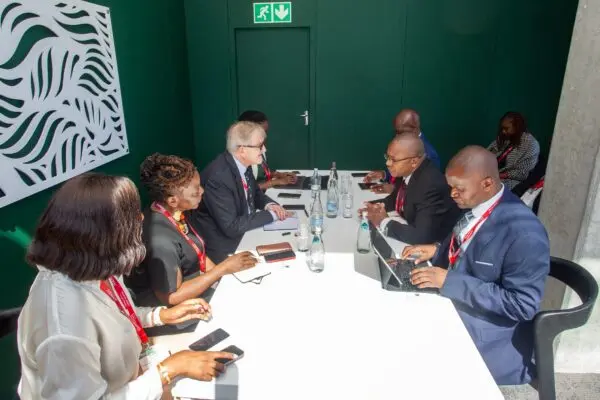
The United Kingdom has confirmed that it held productive discussions with Zimbabwe’s Ministry of Mines and Mining Development, focusing on geological surveying expertise sharing and the management of the country’s mining and minerals environment to ensure Zimbabwe maximises the benefits of its natural resources, Mining Zimbabwe can report.
By Ryan Chigoche
The discussions come amid a growing wave of interest from Western countries in Zimbabwe’s mining sector, with nations such as the United States and the United Kingdom increasingly drawn to the country’s rich deposits of critical minerals, including lithium, platinum, and gold.
Despite Zimbabwe’s rich mineral endowment, the country faces challenges in turning its potential into investment-ready opportunities.
Much of the nationwide geological mapping remains outdated, with the last comprehensive map completed in the 1970s. Limited access to reliable data, gaps in technical capacity, and insufficient modern surveying technology have made it difficult for investors to make well-informed decisions.
At the same time, Zimbabwe continues to grapple with how best to manage its mining and minerals environment to ensure the nation derives maximum benefit.
Outdated data systems, the absence of a clear strategy for critical minerals, and ongoing regulatory uncertainty continue to undermine investor confidence and slow value-adding initiatives, including beneficiation and local processing of resources such as lithium and platinum.
Against this backdrop, UK Trade Commissioner for Africa John Humphrey, in an interview on the sidelines of the ongoing Mining Indaba, reviewed details of a fruitful meeting with Minister Polite Kambamura, emphasising the critical role of reliable geological data in attracting investment.
“I’ve met the new Minister of Mines. We had a very fruitful discussion about the exchange of expertise in geological surveying and also talked about how you manage your mining and minerals environment to ensure that the country is getting the maximum benefit… If you have good geological data that is open and available to people, and they can trust that information, then it encourages investment,” Humphrey said.
The Geological Society of Zimbabwe (GSZ) has long advocated for modernised geological mapping, updated databases, and technical capacity building to support mineral exploration and investment.
Recent initiatives, including collaborations with the British Geological Survey, aim to digitise maps, train local surveyors, and make geological data more accessible.
By promoting research, education, and knowledge sharing, the GSZ is helping bridge gaps in expertise and ensuring Zimbabwe’s mineral wealth is fully understood and responsibly managed.
The meeting underscores a broader push for international collaboration and knowledge exchange.
By combining modern surveying techniques, open access to reliable data, and strengthened technical expertise, Zimbabwe can attract investors while ensuring that the country fully benefits from its mineral resources, turning knowledge into tangible economic growth.

