


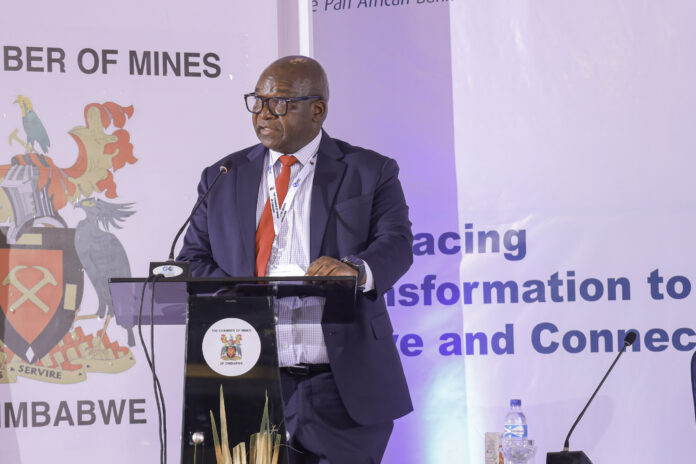

GOLD has emerged as the bedrock of the Zimbabwean economy, contributing significantly to the country’s socio-economic development and accounting for approximately 8 percent of the national Gross Domestic Product (GDP), Chamber of Mines of Zimbabwe Chief Executive Officer Isaac Kwesu has said.
By Rudairo Mapuranga
Speaking at the Chamber of Mines Gold Symposium, sponsored by Mutapa Gold Resources, Chamber of Mines of Zimbabwe CEO Dr Kwesu said gold has become a key subsector of the economy.
“You can’t talk of the Zimbabwean economy, you can’t talk of Zimbabwe’s social development agenda without mentioning gold,” Dr Kwesu said.
As of 2025, gold accounted for 54 per cent of mining exports and 44 percent of national exports, with around 20 percent of gold earnings paid out as taxation to Government coffers, he said.
“Gold accounts for approximately 8 per cent of the national GDP, which is a very large number by any conventional measure,” Dr Kwesu said.
The sector employs approximately 18,000 people in the formal sector, with an estimated 500,000 people involved in artisanal and small-scale mining. Approximately 2 million people survive directly on gold earnings and, with a multiplier of around three, nearly 6 million people have a stake in the sector’s fortunes.
“The sector generates impetus for economic activities in other sectors of the economy through its linkages. As I’ve said, with a strong multiplier of around 3, it has a stronger impetus compared to other mining sub-sectors,” Dr Kwesu said.
Small-scale miners drive output
The contribution of small-scale miners to the country’s gold output has been increasing over the years, accounting for more than 60 percent of total gold output in 2025.
Zimbabwe has attractive geological prospectivity comparable to other mining jurisdictions, including Ghana and South Africa. The country used to rank number two in Africa until 1988, when it lost this position to Ghana, and was number three up to 2000 before losing ground to Tanzania and later Burkina Faso.
“Today, we have Ghana as the largest gold producer, and that is why we have called my friend Dr Akibe to share with us what lessons we can learn from Ghana as we drive our gold sector to another level,” Dr Kwesu said.
Underexplored potential
The country’s gold potential remains underexplored, and there is huge potential to discover more gold assets using modern exploration technologies, he said.
“This symposium will create a platform to deliberate on how best Zimbabwe can unlock its full potential and maximise gold’s contribution to the socio-economic agenda of our country,” Dr Kwesu said.
The symposium brought together experienced international and local speakers, with a special appearance by the CEO of the Ghana Chamber of Mines, Dr Engineer Akibe, who shared Ghana’s journey to becoming the top gold-producing country in Africa.
Thematic areas covered during the symposium included exploration, formalising the small-scale sector, financing gold projects, and governance matters in the gold sector.
“We have confidence that the speakers will adequately articulate all these thematic areas. It is also our view and hope that you delegates will have the opportunity to interact with the speakers should you require further clarification on specific areas that may also shape our policy as we develop our gold sector to greater heights,” Dr Kwesu said.
#Gold #ZimbabweMining #MiningZimbabwe #GoldMining #ChamberOfMines #EconomicGrowth #ASM #MiningIndustry #ZimbabweEconomy

