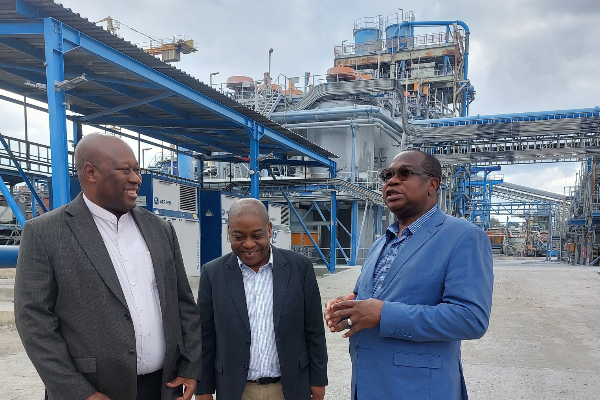
The Ministry of Finance, Economic Development and Investment Promotion has revised Zimbabwe’s 2025 growth projection to 6.6%, up from the initial 6% outlined in the National Budget, with mining, particularly gold, as one of the major sectors expected to play a key role in driving the economy forward, Mining Zimbabwe can report.
By Ryan Chigoche
The announcement was made by Minister Mthuli Ncube at the Zimbabwe Economic Development Conference (ZEDCON) 2025 in Bulawayo, running under the theme “Macroeconomic and Sectoral Policies for Broad-Based Economic Transformation.”
This upward revision comes as gold has enjoyed a bullish run on international markets for most of the year, providing strong revenues for the fiscus, while agriculture has rebounded following the drought-induced slowdown of 2024.
Speaking at the conference as he projected growth of 6.6% and a nominal GDP of slightly over US$50 billion, Ncube emphasised that mining and agriculture (tobacco) remain the backbone of Zimbabwe’s economic transformation.
“Zimbabwe stands at a critical juncture. Despite global headwinds, as well as exogenous shocks, including climate change, commodity price fluctuations and energy supply constraints, the resilience of our economy and the strength of our resource endowment give us immense reason for optimism,” Ncube added.
“Economic growth for 2025 is now projected above the original projection of 6% to around 6.6%, with an expected nominal GDP of approximately US$52.3 billion. The higher projection is on account of more-than-anticipated output in the agricultural sector, particularly tobacco, following favourable climatic conditions, and mining sector growth buoyed by high commodity prices, notably gold.”
Meanwhile, data from the Zimbabwe National Statistics Agency (ZIMSTAT) shows that GDP stood at US$45.7 billion in 2024, demonstrating positive economic momentum.
Ncube added that the recovery trajectory will be supported by beneficiation, value addition, and investment in energy infrastructure, which are key to sustaining growth and creating jobs, as he urged the private sector to capitalise on renewable energy projects to expand production capacity and attract fresh investment.
The mining sector, while a key driver of growth, continues to face challenges around policy consistency, high operational costs, and multiple taxes and levies, according to the Chamber of Mines of Zimbabwe.
The industry body has repeatedly called for streamlined licensing, predictable fiscal policies, and affordable energy tariffs to enhance competitiveness and attract investment into this critical sector.
In a positive development, Ncube added that the government is currently undertaking an exercise to enhance the ease of doing business through cost reductions, among other measures.
“In line with our commitment to foster a more enabling business climate, the Government is undertaking a comprehensive exercise to reduce the cost of doing business and enhance competitiveness. This includes systematically cutting levies, fees and charges across all sectors in order to encourage efficiency, productivity and growth. The goal is to cut red tape, eliminate overlapping charges and create a more enabling environment for investment and business expansion,” Ncube said.
The Minister also encouraged stakeholders to submit policy proposals towards the crafting of the National Development Strategy 2 (NDS2) and to leverage opportunities presented by the African Continental Free Trade Area (AfCFTA) to grow exports and integrate Zimbabwe more deeply into regional and global value chains.