



By Ryan Chigoche
The transition reflects a broader attempt to close a persistent financing gap in a sector that plays a critical role in gold output and foreign currency generation, yet has historically operated outside formal banking structures.
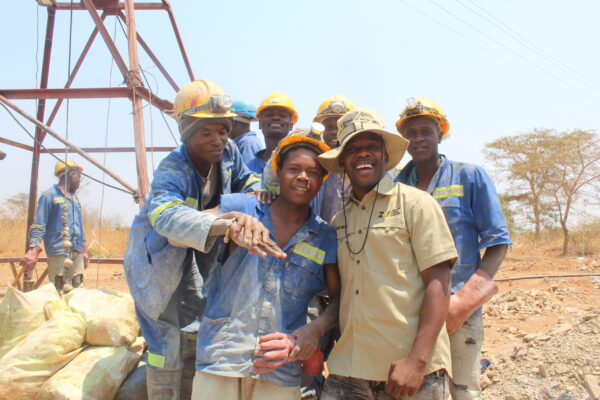
The shift was evident at MINEX 2026 in Zvishavane, where financial institutions used the platform to deepen engagement with small-scale miners and present structured entry points into formal banking.
At the centre of this transformation is a long-standing constraint: although Zimbabwe’s commercial banking sector holds an estimated US$6 billion lending capacity, small-scale miners have largely remained excluded due to limited collateral, informal production records, and weak integration into formal financial systems.
Banking exposure in Zimbabwe’s mining sector is increasingly segmented, reflecting different risk profiles and scales of operation across the industry.
At the top end, Stanbic Bank Zimbabwe is active in large-scale syndicated mining finance, including its role in structuring funding for major gold developments such as Caledonia Mining’s Bilboes Gold Project, alongside other consortium-backed mining transactions. This segment of financing is heavily project-driven, often linked to infrastructure, energy security, and long-term production expansion.
Alongside it, CBZ Holdings has established itself as one of the most active local financiers in the mining sector, committing approximately US$254 million toward mining-related financing across Zimbabwe’s extractive industry.
A significant portion of this funding has been directed toward Dallaglio Investments’ Pickstone Peerless and Eureka Gold Mine operations, where CBZ-backed facilities have supported plant refurbishments, production restart initiatives, and working capital requirements aimed at stabilising and scaling output.
Beyond gold, CBZ is also playing a strategic enabling role in the Karo Platinum Project, where structured financing supports contractor mobilisation, supplier development, and broader infrastructure rollout within the large-scale platinum mining ecosystem.
At the mid-tier level, NMB Bank Zimbabwe focuses on export-oriented mining operations, extending offshore-backed credit lines sourced from regional and European financiers. These facilities are primarily used for machinery imports and production scaling among established mining companies.
At the base of the sector, ZB Financial Holdings is targeting artisanal and small-scale miners through financial inclusion strategies designed to integrate informal operators into the formal banking system.
Rather than treating small-scale mining as peripheral, ZB has positioned it as a structured growth segment, using platforms such as MINEX to onboard miners, provide advisory services, and extend tailored financial products at the point of engagement.
From informal production to bankable cash flows
Behind this shift is a fundamental redefinition of how mining income is assessed.
Instead of relying on traditional collateral such as property or fixed assets, banks are increasingly using Fidelity Gold Refinery (FGR) deposit records as a proxy for creditworthiness.
Under this model, miners who consistently deliver gold through formal channels build a verifiable production history that is then used to assess income stability and determine access to credit.
This allows financial institutions to structure microfinance and asset-based loans, in some cases up to around US$20,000, based on production performance rather than physical assets.
For many small-scale operators, this marks a shift from informal cash trading to traceable financial behaviour, forming the basis for gradual integration into the formal economy.
Equipment financing reshapes access to machinery
Beyond direct lending, banks are increasingly relying on capital equipment leasing models to reduce risk while expanding access to mining machinery.
Under this structure, banks do not disburse cash directly. Instead, they purchase equipment such as compressors, stamp mills, or excavators from suppliers and retain ownership of the assets.
The miner repays the cost through structured monthly instalments funded by mineral sales, while the bank retains the right to repossess equipment in the event of default.
This model reduces credit exposure while enabling miners to access machinery that would otherwise be difficult to finance under conventional lending terms.
Building formal systems around informal mining
Taken together, these mechanisms reflect a steady shift toward formalising Zimbabwe’s small-scale mining sector through financial integration rather than exclusion.
Digital platforms are being used to improve transaction tracking and encourage financial discipline, while gold buying centres continue to draw mineral flows into regulated markets.
Access to larger facilities is increasingly tied to compliance requirements, including mine registration documents, Environmental Management Agency (EMA) certificates, and Environmental Impact Assessments (EIA), particularly for higher-value lending.
The direction is clear: access to capital is becoming inseparable from compliance and traceability.
What is unfolding is not just an expansion of banking services into mining, but a restructuring of how the sector itself operates.
Financial institutions are increasingly shaping the rules of engagement, from how miners document production, to how equipment is acquired, to how output is channelled into formal markets.
For miners, the shift opens a pathway into structured finance that did not previously exist at scale. For banks, it represents a calculated expansion into a high-output but historically informal sector.
MINEX 2026 captured that transition in practical terms, not as a future ambition, but as a system already taking shape in real time across Zimbabwe’s mining landscape.

