


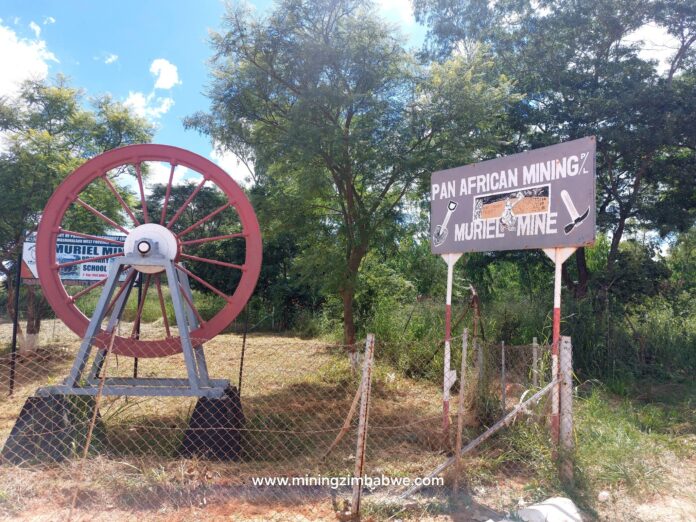

Pan African’s Muriel Mine has more than quadrupled gold production over two years through an intensive dump retreatment operation, while a sustained exploration campaign has extended the underground life of mine to five years, according to figures presented during a technical visit by the Association of Mine Managers of Zimbabwe (AMMZ).
By Rudairo Mapuranga
Production climbed from 3,600 ounces (approximately 120 kilograms) in 2023 to 15,000 ounces (425 kilograms) in 2024, reaching 20,000 ounces (630 kilograms) in 2025, management reported to visiting industry peers. The surge was driven entirely by hydrosluicing of historical tailings—a distinction mine officials emphasised during the AMMZ tour. Underground ore from newly delineated resources is not yet being processed; a crusher is currently under construction to handle the harder primary material once the dump is exhausted.
Cash costs per ounce held steady at roughly US$1,000 in 2023, US$1,021 in 2024, and US$1,004 in 2025, demonstrating operational efficiency despite inflationary pressures across Zimbabwe’s mining sector.
The production turnaround follows a sustained exploration campaign that has extended Muriel’s underground mine life to approximately five years, according to figures presented at the technical visit. This contrasts sharply with the operation’s historical struggles: a 2015 assessment showed Muriel required ore grades of 4 to 5 grams per tonne to remain viable but was mining at around 2.5 grams per tonne in the absence of new exploration and development.
However, the underground resources that provide this extended life are not yet being mined. The operation is currently focused on processing the remaining tailings dump, which now has only five months of material left. Revenue from dump retreatment is helping to fund underground development and the construction of a crushing circuit for the harder primary ore.
“When you stop exploring, you’re actually getting closer to expiry,” a geologist told the delegation. “Muriel Mine is an example where exploration has been very much key to the livelihood of the mine.”
Separate 30-Year Resource at Aysha
The presentation also highlighted a separate resource—identified as Aysha Mine—which holds an estimated 30 years of material. The Aysha deposit contains approximately 1.3 million ounces of resources, further strengthening Pan African’s long-term position in Zimbabwe.
Hydrosluicing: A Technical Showcase
During the technical visit, Senior Plant Metallurgist Webster Chemhuru led delegates through the hydrosluicing operation. High-pressure water jets at 1,500 to 1,800 kilopascals break down the consolidated dump material, forming a slurry that is pumped to a carbon-in-leach plant. Water is sourced 60% from Chawara Dam and 40% recycled from the tailings storage facility.
The processing plant includes four 8-by-16-foot mills, a 35,000-cubic-metre thickener, and a 10-tank CIL circuit providing 36 hours of residence time. Elution is handled by two Zadra vessels with a combined capacity of 4.5 tonnes of carbon per day.
Metallurgical challenges include copper levels of up to 0.5% in some zones and preg-robbing carbonaceous material, which have contributed to a decline in recovery from 80% in 2023 to approximately 70–75% currently. The operation manages these issues through selective mining and blending.
AMMZ President Gift Mapakame praised the operation’s approach, noting that retreating materials with efficient technologies offers an opportunity for greener mining. “There is no mobile equipment—just pumping and processing, and then tailings storage,” he said.
Vice President George Wayeni of RZM Murowa added that revenues from the dump retreatment project are funding exploration for the future, with the construction of the front end of the plant now underway. “Lots of other operations can take a leaf from this initiative,” he said.
The shift from exclusive dump processing to a future blend of underground mining represents a strategic pivot for an operation that struggled with declining grades a decade ago. The workforce was rationalised during the transition period, with Muriel’s staff complement falling from 368 to approximately 200 employees following a restructuring exercise in late 2015, though some workers were absorbed at the company’s nearby Ayrshire operation.
For Zimbabwe’s gold sector, Muriel’s turnaround offers a case study in using surface retreatment to fund exploration and underground development. The mine now operates with a five-year underground life secured by exploration, while the Aysha deposit provides a further 30-year resource in the pipeline.

