


MBERENGWA – In a powerful demonstration of its commitment to sustainable development, Sandawana Mines has disclosed an investment of approximately $475,000 in Corporate Social Responsibility and Management (CSRM) in 2025, targeting critical infrastructure, social cohesion, and community welfare in the Mberengwa district, Mining Zimbabwe can report.
By Rudairo Mapuranga
The detailed breakdown of these initiatives was a central pillar of the address by General Manager William Gambiza during the recent Sandawana Mines Build, Operate, and Transfer (BOT) update meeting held at the mine on Wednesday.
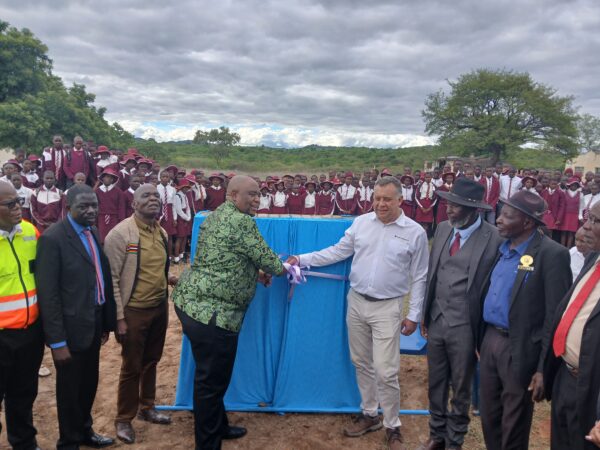
The gathering, which also covered production updates, served as a platform for the company to reaffirm its role as a “good corporate citizen” and to showcase its tangible contributions to the communities that host its operations.
The most substantial portion of the CSRM expenditure, close to $400,000, has been dedicated to a critical infrastructure project: the repair and upgrade of the 60-kilometre gravel road connecting the mine to the main highway at Beitbridge. Gambiza reported that this project is now 75% complete, following three months of intensive work.
He provided a vivid picture of the scale of this undertaking, noting the deployment of a dedicated fleet of road equipment, including graders, compactors, excavators, loaders, tippers, and a water bowser. This is not a mere stopgap measure but a serious, long-term investment in the region’s transport infrastructure, which benefits the mine and the local communities equally. Furthermore, Gambiza announced that the company is already mobilising equipment to commence work on another 53-kilometre section from Yorks to Sandawana, fulfilling a commitment made in a previous stakeholder meeting.
Beyond roads, the mine has addressed the fundamental need for clean water. A significant part of the $475,000 fund was used to drill three solar-powered boreholes, each reaching a depth of 100 meters to ensure a guaranteed water supply for the community. This initiative moves beyond temporary solutions, providing a sustainable and modern water source powered by renewable energy, which Gambiza described as “part of modernising the rural communities.”
The mine’s CSRM strategy extends far beyond physical infrastructure into direct support for social institutions. A key example is the renovation of a classroom block at the Tjepvute Secondary School, whose roof was destroyed by strong winds. Gambiza explained that restoring the roof was urgent to provide a “secure learning environment” for students, especially with the rainy season and year-end examinations approaching. The commitment extends further, with plans to assist with painting, replacing doors and frames for safety, providing water, and installing tiles.
The mine also operates through local partnerships, reinforcing community structures. Gambiza highlighted support for RIDA, a local organisation, by repairing its road maintenance equipment and providing fuel. This empowers a local entity to continue maintenance work independently, creating a sustainable model for upkeep beyond the mine’s direct involvement.
Perhaps the most nuanced and impactful initiative discussed was the launch of the inaugural “Culture Exchange Day” on March 27, 2025. Gambiza candidly revealed that this event was launched following “previous adverse reports” about relations between local employees, villagers, chiefs, and the Chinese nationals working at the mine. The event was designed as a proactive intervention to bridge cultural gaps and foster mutual understanding.
The results, according to Gambiza, have been transformative. “Consequently, we are reaping the fruits of such timely interventions as the mine has not recorded a single previous case since launch,” he stated. This success has been so significant that the Culture Exchange Day will become a permanent fixture in the mine’s annual calendar, with plans to expand it to include wellness and sporting programmes. This represents a strategic investment in social capital, which is often as critical as financial investment for the long-term stability of a mining operation.
Gambiza urged all stakeholders to “guard against malicious social media reports that seek to derail the social cohesion we enjoy and achievements made to date.” This statement reflects the modern challenges faced by corporations, where online narratives can quickly undermine years of painstaking community engagement and tangible investment.
He framed the mine’s commitment through the concept of a “social licence to operate”—an unwritten contract that goes beyond legal permits and is granted by the community based on trust and demonstrated benefit. Sandawana Mines, he asserted, “jealously guards its hard-earned social licence secured through working together with all its various stakeholders.”
The comprehensive CSRM update at the BOT meeting made it clear that Sandawana Mines views its responsibilities as extending far beyond the mine’s fence line. The $475,000 investment in roads, water, schools, and social programmes is a concrete manifestation of this philosophy. By tackling the real and pressing needs of the Mberengwa community—from the daily commute on a dusty road to the education of its children and the very social harmony of the area—the mine is strategically weaving itself into the social and economic fabric of the region.
This holistic approach to community development is not merely charitable; it is a core strategic imperative. For a project of the scale and longevity of the planned lithium concentrator, a stable, supportive, and prosperous community is not just a nice-to-have—it is the essential foundation upon which a “sustainable future,” as promised by its owners, is built.

