


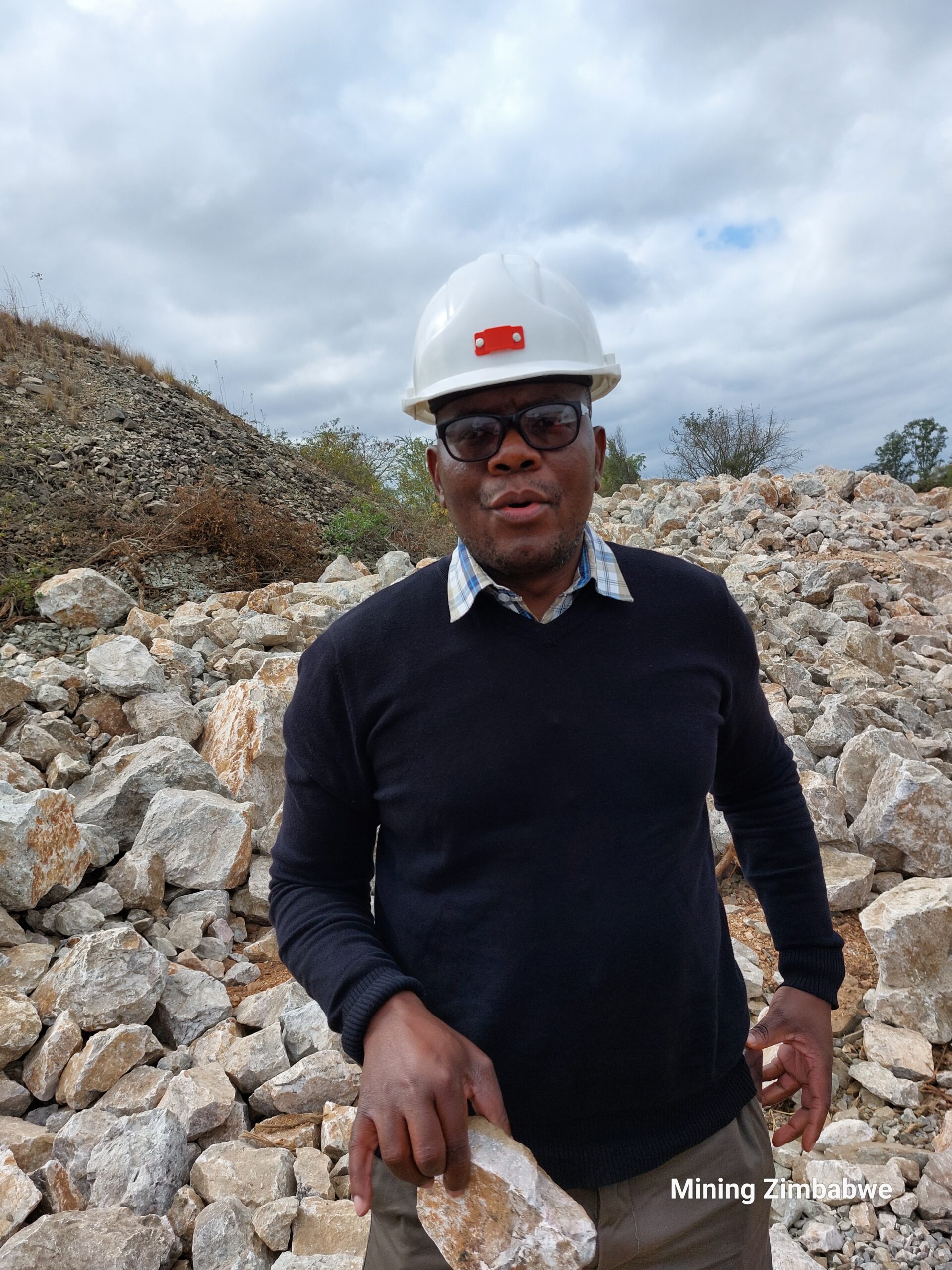
In a landmark revelation that underscores Zimbabwe’s potential as a global lithium powerhouse, Sandawana Mines has announced the discovery of a preliminary resource estimate of 60 million tonnes of lithium ore within just the first of three partitioned blocks of its vast mining claim, Mining Zimbabwe can report.
By Rudairo Mapuranga
The announcement was made by Sandawana Mines General Manager, Godwin Gambiza, during a detailed technical briefing on the sidelines of the recent Build, Operate, and Transfer (BOT) project update meeting held at the mine in Mberengwa. The update provides the most concrete data to date on the scale of the resource that underpins the planned $270 million lithium concentrator.
Gambiza detailed a methodical strategy for developing the mine’s 3,882-hectare (38.82 square kilometre) site. The company has partitioned the land into three distinct blocks:
Block A: Comprising 30% of the total area, and the current focus of exploration and the impending partnership with a Chinese consortium for the concentrator plant.
Block B: Encompassing 45% of the land.
Block C: Constituting the remaining 25%.
This phased approach allows the company to de-risk the project and attract targeted investment for each block.
“We are so far talking to other investors about Block B, talking to other investors about Block C,” Gambiza stated, highlighting the significant yet untapped opportunity that the partitioned strategy unlocks. “So you can see the opportunity that exists at Sandawana, how big and wide it is.”
The company’s exploration campaign, which commenced in late 2022 and early 2023, has been intensely focused on Block A. The work has been executed in two rigorous phases:
Phase One: Involved drilling an extensive 102,000 metres, which led to a JORC-compliant resource statement certifying 40 million tonnes of resource at an average grade of 1.4% lithium oxide.
Phase Two: Saw a further 27,000 metres of drilling, with all assays received from external ISO-certified labs.
The data from the second phase is now being used to update the block model, and preliminary indications point to a substantial increase in the resource.
“We are looking at increasing the resource size from the current 40 to sit at around 60 million tonnes of lithium ore,” Gambiza revealed. He emphasised the sheer scale of the find by noting, “And this is just Block A only… we only explored 45% of it.”
With a “bankable feasibility resource” now established in Block A, the project is poised to advance to the infrastructure and construction stage. The partnership with a consortium of Chinese firms, operating under a BOT model, is specific to developing Block A. The Chinese partners will finance, build, and operate the concentrator for a minimum of five years before transferring ownership back to Kuvimba.
This strategy allows Sandawana Mines to fund future exploration of Blocks B and C from the profits generated by Block A’s production. “Then, as we produce, from the profits that we generate, we also then allow or provide for CAPEX to embark on the next phase of exploration,” Gambiza explained, outlining a self-sustaining cycle of growth for the mine.
The planned concentrator, with a capacity to process 600,000 metric tonnes of ore annually, is slated for commissioning in early 2027, a timeline that Kuvimba CEO Trevor Barnard believes will coincide with a forecasted recovery in lithium prices.
This exploration success solidifies Sandawana’s position as a cornerstone of Zimbabwe’s mining future. As the only major lithium mine in the country that is wholly owned by Zimbabweans through its parent company, Kuvimba Mining House, its development is being closely watched as a barometer for the nation’s ambition to capture greater value from its mineral resources.

