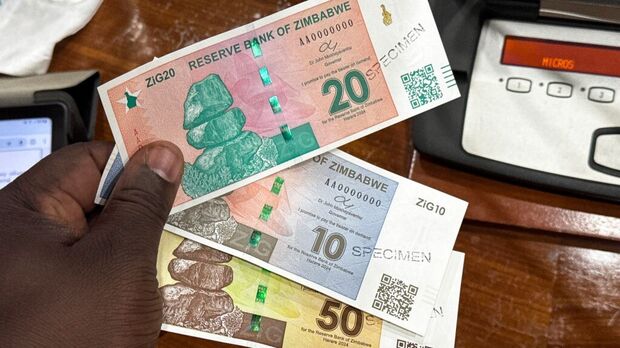
The Reserve Bank of Zimbabwe (RBZ)’s introduction of a 10% ZiG payment for small-scale gold miners was positioned as a move toward financial inclusion and fairness. But if the government truly wants to promote the ZiG and ensure gold flows through formal channels, it must confront an uncomfortable truth: Zimbabwe’s banks may be the weakest link in this chain.
By Rudairo Mapuranga
While Fidelity Gold Refinery has urged miners to submit their banking details to facilitate the new 90:10 payment structure, a cursory glance at the reality facing artisanal miners reveals a system designed for exclusion rather than inclusion. If a miner with a valid national ID cannot open a simple bank account to access his own money, the policy collapses, and with it, ZiG’s credibility.
Let’s be straight with each other.
The government wants gold. Fidelity Gold Refinery wants gold. The RBZ wants foreign currency and wants to promote the ZiG. Everyone agrees that small-scale miners are the engine of this sector, contributing over 75% of national deliveries.
But there is a brick wall standing between the miner and the formal system, and it is called the banking sector.
The new 90:10 payment structure requires miners to have bank accounts to receive their ZiG portion. On paper, this sounds reasonable. In reality, it is a demand that ignores how the small-scale mining sector actually works.
The ID Is All They Have. It Should Be Enough.
A small-scale miner is not a company. He does not have a board of directors. He does not have a company secretary. He does not have a fancy office with a water bill in his name.
What he has is a National ID. And with that ID, he can do everything the state requires of him:
He uses his ID to obtain a mining certificate from the Ministry of Mines.
He uses his ID to pay his taxes (royalties) at the Zimbabwe Revenue Authority (ZIMRA) counter.
He uses his ID to pay his fees to the Rural District Council (RDC).
He uses his ID to sell his gold to Fidelity Gold Refinery.
For every interaction with the government, the ID is sufficient. The state takes his money. The state issues his permits. The state buys his gold.
But when the state, through its banks, is asked to give him back his own money in ZiG, suddenly the ID is not enough.
Suddenly, the miner is told he needs:
Proof of residence (a utility bill for a man who lives in a tent next to his mine shaft).
Company registration documents (for a sole proprietor who works with his bare hands).
Tax clearance certificates (even though he pays his royalty at the point of sale, on the spot).
Affidavits.
Let’s be clear: this will not work.
You cannot treat a man as a legitimate economic actor when he is paying taxes and selling gold, and then treat him as a security risk when he tries to open a bank account. You cannot collect revenue from him using his ID and then refuse him service using the same ID.
The “Proof of Residence” Trap
The most absurd requirement is the “proof of residence.”
A miner from Shurugwi who is currently operating in Filabusi does not have a residence in the formal sense. He has a temporary shelter. He has a relationship with the local chief or village head.
But banks want a stamped letter from a council or a utility bill. They want a paper trail that assumes everyone lives in a suburban house with prepaid electricity meters.
This is not financial inclusion. This is financial exclusion dressed up in compliance jargon.
Bank Limits: The Silent Killer
Even if a miner jumps through these hoops and opens an account, the battle is not over.
Banks impose transaction limits. A card might be capped at US$2,000 per day, roughly the value of 12 grams of gold.
But a miner delivering to Fidelity is not just selling his own gold. He is often selling on behalf of a team of panners. A single delivery could represent the output of 10, 20, or 50 people. The payment might be US$10,000 or more.
How does he distribute that money when his bank card blocks him after US$2,000?
He cannot. The system grinds to a halt.
So he does what any rational person would do: he avoids the bank altogether. He takes cash. He stays informal. He keeps the cycle moving.
The Cycle of Gold
This is the part policymakers refuse to understand: miners do not hoard cash. They move it.
A miner receives payment. He buys fuel. He pays the crusher owner. He buys spares. He pays his labourers. The money flows back into the economy within hours or days.
The ZiG portion, if it is trapped in a bank account with low limits and high friction, becomes useless for this cycle. It becomes “dead money.” And miners will do everything they can to avoid dead money.
The Comparison That Stings
Think about this: a miner can walk into a bar and buy a round of drinks for his entire team using EcoCash. He can send money to his family instantly via mobile money. The private sector has solved instant value transfer.
But he cannot walk into a bank and access his own gold proceeds without a letter from the village head confirming he lives somewhere.
Mobile money agents do not ask for proof of residence. Why do the banks?
The Way Forward
If the government is serious about the ZiG and serious about formalising gold deliveries, the message to the banks must be simple and uncompromising:
- A National ID must be enough.
- Drop the proof of residence requirement for Tier 1 gold miner accounts.
- Drop the company registration requirement for individual producers.
Create a “Gold Miner” account class with dynamically adjusted limits based on verified Fidelity deliveries.
If you can open a bank account with an ID in South Africa, Botswana, or Kenya, you should be able to do the same in Zimbabwe.
The banks will cry “compliance” and “risk management.” But let’s be honest: the real risk is not the miner. The real risk is driving millions of dollars in gold into the black market because the formal system is too slow to adapt.
The Bottom Line
- The miners are not asking for favours. They are asking for consistency.
- You trust my ID to tax me. You trust my ID to license me. You trust my ID to buy my gold.
- Trust my ID to give me my money.
Until that happens, the banks will remain the weakest link in the gold value chain. And the ZiG will remain a currency that miners admire from a distance but refuse to touch.
December is coming. The outcome will speak for itself.