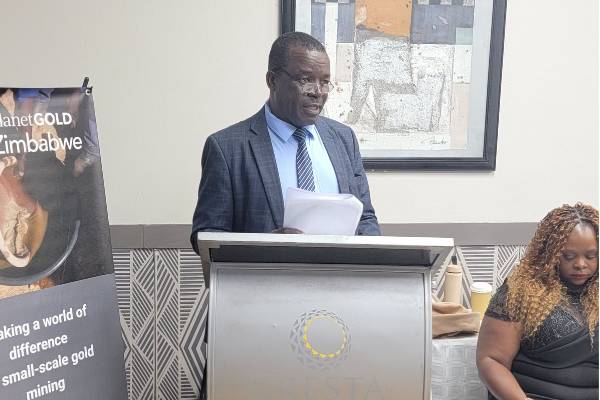
The Ministry of Mines and Mining Development has urged artisanal and small-scale miners (ASM) to formalise their operations to gain access to government support, including technical assistance and funding.
By Ryan Chigoche
This call was made by Chief Government Mining Engineer (CGME) Michael Munodawafa during the Artisanal and Small-Scale Gold Mining (ASGM) Draft Strategy Dialogue held recently in the capital.
He emphasised that formalisation is the key that unlocks opportunities for miners under various government schemes.
One of the primary pillars of Zimbabwe’s ASGM strategy is “Mobilising Finance for ASGM.”
To ease access to capital, the strategy proposes innovative financial models tailored to the sector.
These include using mining certificates as collateral, setting up mining-focused financial institutions, and exploring barter systems where minerals are exchanged for equipment.
In 2024, the Treasury allocated US$10 million to the already established Mining Industry Loan Fund to support small-scale miners in boosting gold production.
However, many miners are unable to access these facilities due to their informal status.
Speaking at a Planet Gold Zimbabwe ASGM Strategy Dialogue workshop held in Harare, Eng. Munodawafa reiterated the importance of registration and formalisation.
“As a ministry, at the moment we are providing some technical assistance and a bit of financial assistance, in the form of loans which are given to small-scale miners (through a fund that is called the Mining Industry Loan Fund, which is administered through the Department of Equipment and Mining).”
“We have got the equipment that we have developed for small-scale miners. But to do that, we encourage small-scale miners to formalise. That is the key. If you are not a formalised miner, we can’t help you. We are also trying to encourage all our miners to be registered. It’s like when you move in the street and you give someone a loan—you don’t know where they reside or where they’re coming from. That loan is gone. It has just gone down the drain,” he said.
Zimbabwe’s ASGM sector plays a critical role in the national economy, with more than a million people depending on it for their livelihoods. In 2024, the sector accounted for 65% of the country’s total gold production, contributing 36 tons to the national output.
Such a massive contribution highlights the importance of properly supporting and regulating the sector.
Yet, despite its value, the ASGM sector continues to face numerous challenges. These include informality, lack of geological data, unsafe mining practices leading to fatal accidents, limited access to financing and modern equipment, inefficient recovery methods, gender disparities, violence, lack of coordination among miners’ associations, and the use of hazardous chemicals like mercury.
The Africa Mining Vision describes the ASM sector as complex, and Zimbabwe’s experience affirms this. However, complexity should not be a barrier to progress.
The ASGM Strategy aims to transform the sector into a sustainable, formalised industry that not only improves safety and environmental standards but also promotes inclusivity—particularly for women and other special interest groups in mining.