

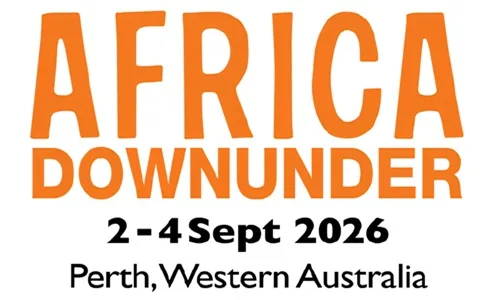

PERTH, AUSTRALIA – The mining world’s attention turns to Perth tomorrow as the 24th edition of the Africa Down Under (ADU) Conference gets underway, bringing together investors, mining executives, governments, exploration companies and technology providers for three days of business, deal-making and discussions around Africa’s mineral potential, Mining Zimbabwe can report.
By Kelvin Sungiso
Running from September 2 to 4 at the Pan Pacific Perth, ADU has become one of the most important meeting points between Africa’s resource-rich mining jurisdictions and Australia’s globally established mining investment, exploration and mining services industry.
For Zimbabwe, the conference presents an opportunity to take a compelling investment proposition directly to the heart of Australia’s mining capital.
That proposition goes beyond the country’s existing mines and well-known mineral deposits.
Zimbabwe is taking to Perth the opportunity to unlock what could be one of Africa’s most significant underexplored mineral frontiers, while simultaneously creating new investment opportunities in electricity generation to support beneficiation and value addition.
At the centre of that exploration story is the Zimbabwe Craton.
Zimbabwe sits on one of the world’s ancient Archaean geological terrains, the Zimbabwe Craton, a mineral-rich province that shares important geological characteristics with Australia’s Yilgarn Craton in Western Australia.
The comparison is particularly relevant because Perth sits at the centre of one of the world’s most successful mining and exploration ecosystems.
The Yilgarn Craton has produced some of Australia’s most significant mineral discoveries and hosts major deposits of gold, nickel, lithium and other commodities. Decades of sustained exploration, geological mapping, geophysical surveys, drilling and investment in geological knowledge have helped transform Western Australia into a global mining powerhouse.
The Zimbabwe Craton, meanwhile, contains extensive granite-greenstone terrains and has already demonstrated its enormous mineral endowment through centuries of gold mining and the development of major mineral deposits.
Yet the important question for investors is not simply what Zimbabwe has already found.
Zimbabwe’s mining industry has historically been built around known deposits, particularly gold deposits associated with its greenstone belts. But compared with the sustained exploration effort that has transformed Western Australia’s mining industry, significant parts of Zimbabwe’s geological terrain remain inadequately explored using modern exploration technologies.
That difference represents an opportunity.
The Zimbabwe Craton should not be viewed simply as an old mining province where everything worth finding has already been discovered.
Western Australia’s experience demonstrates that mature geological terrains can continue producing major discoveries when exploration technology, geological knowledge and investment improve.
Even in the highly explored Yilgarn Craton, Australia continues investing in new geological datasets, mapping and technologies designed to identify deposits hidden beneath cover.
For Zimbabwe, where exploration investment has not consistently matched the country’s geological potential, the opportunity could be even greater.
Some of Zimbabwe’s next major mines may not be found by simply following the old workings.
They could lie beneath cover, in deeper geological environments or in areas that were never adequately investigated using modern geophysics, remote sensing, three-dimensional geological modelling and sophisticated data analysis.
This is where the Perth connection becomes particularly important.
Australia has developed globally recognised expertise in discovering deposits in difficult geological environments.
Modern exploration increasingly combines airborne geophysics, satellite imagery, geochemical analysis, geological modelling, artificial intelligence and advanced data analytics to identify targets that previous generations of exploration may have missed.
These technologies are changing the definition of what it means for a mining jurisdiction to be “explored.”
A country may have been extensively prospected using traditional methods while still remaining largely unexplored according to modern geological standards.
That could be Zimbabwe’s hidden opportunity.
The country’s known mineral wealth — including gold, platinum group metals, lithium, chrome, nickel and other strategic minerals — provides evidence of a highly endowed geological system.
But known deposits may represent only part of the story.
New exploration could uncover extensions of existing mineral systems, deeper deposits, entirely new gold belts and mineral provinces that have received limited modern investigation.
For Australian junior exploration companies and mining investors, Zimbabwe therefore offers an opportunity to apply modern exploration knowledge to a geological terrain with a proven history of mineral discovery but substantial scope for further investigation.
From Exploration to the Next Generation of Mines
A strong mining industry cannot rely indefinitely on existing operations and known deposits.
New discoveries must continually enter the pipeline if production is to grow and the industry is to remain competitive.
Zimbabwe’s opportunity is therefore to turn geological potential into a new generation of exploration projects and eventually new mines.
That will require risk capital, advanced technology, reliable geological information and experienced exploration companies.
Africa Down Under provides Zimbabwe with direct access to exactly that ecosystem.
Perth is home to mining companies, exploration specialists, financiers, drilling companies, geological consultants and mining technology providers with experience operating across some of the world’s most challenging mineral provinces.
The opportunity is to connect that expertise with Zimbabwe’s largely untapped geological potential.
Power: The Investment Opportunity Behind Value Addition
But discovering new mineral deposits is only part of Zimbabwe’s next mining chapter.
The country is also pursuing greater beneficiation and value addition, creating another major investment opportunity: electricity generation.
Zimbabwe’s ambition is increasingly to move beyond the extraction and export of raw minerals towards greater local processing and the development of industries around its mineral resources.
However, beneficiation requires power.
Processing minerals into concentrates, refined products and higher-value materials requires significantly more reliable and affordable electricity than simply extracting and exporting ore.
As Zimbabwe develops more mines and processing facilities, demand for energy will inevitably increase.
This creates opportunities for investors in captive power generation, independent power projects, renewable energy, energy storage and other electricity solutions designed to support mining and mineral processing.
The relationship between mining and energy will become even more important as Zimbabwe pursues deeper beneficiation.
A mine may produce ore, but a modern mineral economy requires electricity to crush, concentrate, process, refine and manufacture.
Investment in power generation could therefore become one of the foundations upon which Zimbabwe builds its value-addition ambitions.
More Than Just Mining
Zimbabwe’s opportunity also extends beyond exploration, mines and electricity.
Every new mining project creates demand for drilling, engineering, equipment, logistics, water infrastructure, environmental services, technology, financial services and specialised skills.
New discoveries could therefore create an entirely new generation of businesses around the mining industry.
Australian companies attending ADU have expertise across virtually every stage of the mining lifecycle, from exploration and drilling to mine development, engineering, processing and environmental management.
Connecting this expertise with Zimbabwe’s geological potential could create partnerships that extend far beyond the extraction of minerals.
As Africa Down Under gets underway, Zimbabwe’s strongest investment message may therefore be that its mining story is far from complete.
The country has already demonstrated its mineral wealth.
Its gold mines, platinum resources, lithium projects and other mineral operations provide evidence of what its geology is capable of producing.
But the comparison with Western Australia’s Yilgarn Craton raises an even more important question.
If sustained exploration investment and advanced technology helped unlock Western Australia’s geological potential, what could still be waiting beneath the Zimbabwe Craton?
For investors gathering in Perth, that question could represent one of Zimbabwe’s most compelling opportunities.
The next generation of Zimbabwean mining projects may not yet have names.
They may still be hidden beneath the surface, waiting for modern exploration technology, capital and expertise to reveal them.
And once they are discovered, Zimbabwe will need the electricity, infrastructure and industrial capacity to transform those discoveries into mines, processing plants and higher-value industries.
That is the opportunity Zimbabwe takes to Africa Down Under: to discover the hidden, power the future and build greater value from one of Africa’s most prospective mineral landscapes.

