


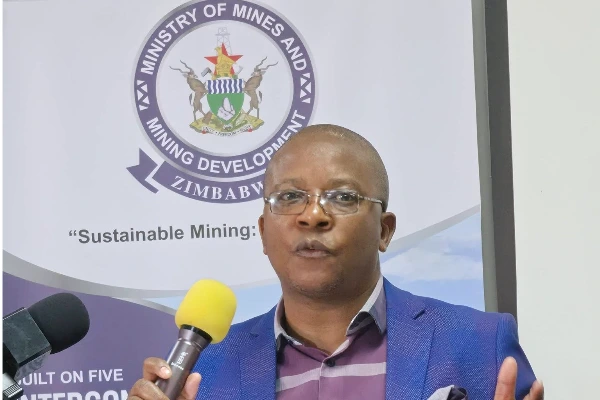

Zimbabwe’s Ministry of Mines and Mining Development has outlined a slate of second-half priorities aimed at accelerating value addition and beneficiation, as senior officials gathered on Monday for a mid-year review workshop, Mining Zimbabwe can report.
By Rudairo Mapuranga
The three-day session at Ranch Hotel in Kadoma comes as the ministry takes stock of its first-half performance and develops catch-up plans to close identified gaps before year-end.
The mining sector generated approximately US$5.73 billion in mineral export earnings during the first half of 2026, putting the industry on track to surpass last year’s record US$8.6 billion, according to figures presented at the workshop. Gold accounted for US$3.2 billion of the total, while other minerals contributed US$2.53 billion, marketed through the Minerals Marketing Corporation of Zimbabwe.
“We are not here to defend positions; we are here to improve delivery,” Secretary Dr T.U. Wushe told directors, provincial mining heads, and senior technical staff assembled for the strategic planning meeting.
Second-half priorities laid out
Mines Minister Hon. Dr Eng. P. Kambamura directed departments to convert outstanding policy issues into measurable actions before the end of the year, acknowledging that several strategic policies remain unlaunched despite having been completed years ago.
Key priorities for the remaining months of 2026 include:
- Finalising amendments to the Mines and Minerals Act.
- Completing the E-Mine Cadastre System to improve transparency in mineral title administration.
- Launching policies covering mineral development, beneficiation, and artisanal and small-scale mining.
- Formalising the ASM sector to improve access to finance, training, safety, and environmental compliance.
- Strengthening enforcement of Environmental Impact Assessment regulations and mine rehabilitation.
Kambamura also signalled a renewed focus on energy minerals after the Government classified coal as a Special Critical Mineral. Idle coal concessions held for speculative purposes will be repossessed, while investment will be directed towards clean coal technologies, coal-to-liquid fuel projects, coal-bed methane development, and gas exploration in Muzarabani.
Performance review
Gold deliveries reached 21.4 tonnes between January and June, with artisanal and small-scale miners contributing 14.9 tonnes, representing 70 per cent of total deliveries and underscoring the sector’s critical role in supporting more than one million Zimbabweans.
Excluding gold, mineral exports surged by 84.7 per cent compared to the same period in 2025, marking one of the strongest performances by the sector in recent years.
Wushe reported notable progress against the Ministry’s four programme outcomes.
The Client Satisfaction Index rose to 71.6 per cent, surpassing the mid-year target of 44 per cent and well above the 2025 baseline of 37 per cent, a testament, he said, to frontline officers’ professionalism and ethical conduct.
The Ministry also made progress in capacitating its Metallurgical Laboratory towards ISO 17025 accreditation, servicing small-scale miners, conducting inspections in Mashonaland West and East, and steadily delivering gold bullion to Fidelity Gold Refinery.
However, self-assessments revealed several lagging targets. SHE training, mercury abatement outreach, national inspection roll-outs, and fleet and ICT servicing have fallen behind schedule, largely due to logistical and resource constraints rather than a lack of effort, Wushe acknowledged.
“That is precisely why we have set aside these three days: to confront these gaps openly and agree, as one Ministry, on the interventions and resources needed to close them in the second half,” he said.
Beneficiation at the centre
The workshop is being held under the theme “Accelerating Value Addition and Beneficiation for Economic Transformation,” reflecting the Government’s push to move beyond exporting raw minerals.
Kambamura described beneficiation as the foundation of Zimbabwe’s industrialisation agenda. The Government’s February 2026 ban on the export of unbeneficiated minerals remains central to this strategy.
“We are moving away from exporting high mineral volumes of low value to exporting small mineral volumes of high value,” the Minister said.
Ongoing investments supporting the policy include:
- The integrated steel complex at Manhize.
- The Arcadia lithium sulphate plant, which exported Zimbabwe’s first locally produced lithium sulphate in April.
- Additional lithium processing facilities under construction at Kamativi and Sinomine Bikita.
Kambamura also announced plans to establish regional beneficiation hubs aligned with mineral endowments, allowing chrome-producing areas to specialise in ferrochrome and chromium alloys, while iron ore regions focus on steel production.
2026 projections
Industry forecasts point to continued momentum. The Chamber of Mines projects mining sector growth of 10 per cent in 2026, with export earnings potentially reaching between US$7.5 billion and US$11 billion, depending on commodity prices.
Gold output is projected to reach between 50 and 55 tonnes by year-end, driven largely by the ASM sector, which has consistently delivered more than 70 per cent of total gold. Lithium production is expected to more than double to 4.67 million tonnes in 2026 before increasing to 20 million tonnes by 2030.
Stakeholder engagement
Wushe expressed gratitude to stakeholders and partners present at the workshop, including the Chamber of Mines of Zimbabwe, the Zimbabwe Miners Federation, Fidelity Gold Refinery, the Minerals Flora and Fauna Unit, the Environmental Management Agency, and sister ministries.
“Our progress would not be possible without your continued collaboration,” he said.
As he declared the workshop officially open, Wushe challenged delegates to leave with catch-up plans that are specific, owned by named individuals, and matched to realistic timelines and budgets.
“Let us reconvene at year-end with confidence,” he said.
The Minister’s closing remarks echoed the broader ambition: “I look forward to fruitful deliberations and a united Ministry ready to accelerate value addition and beneficiation for our nation’s economic transformation.”

