


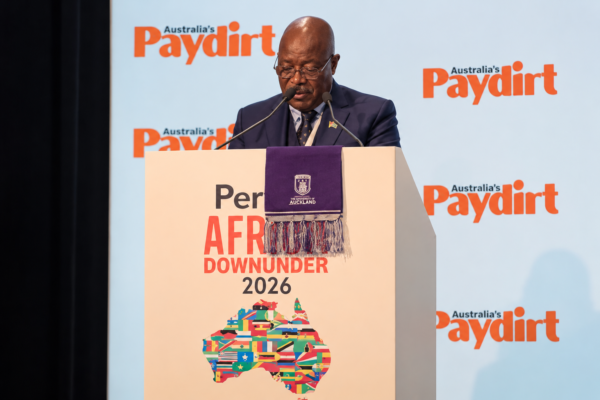

Deputy Minister Makwiranzou told Australian investors that raw ore exports are yesterday’s game—offering smelting, refining, and lithium conversion deals to those willing to think beyond the next quarter.
PERTH, Australia — Zimbabwe has identified platinum refining, lithium processing and ferrochrome smelting among key investment gaps it wants international capital to help fill as the country pushes to move further up the mining value chain.
By Rudairo Mapuranga
Deputy Minister of Mines and Mining Development, Dr Eng. C. Makwiranzou, outlined the commodity-specific opportunities during the Zimbabwe Mining Investment Seminar at the Africa Down Under 2026 conference in Perth on Thursday.
Rather than making a general call for investment, Makwiranzou detailed opportunities across lithium, platinum group metals, chrome, gold, iron and steel, coal and other minerals, while also identifying patient capital as a critical requirement for Zimbabwe’s beneficiation ambitions.
PGM Refining Opportunity
In the platinum group metals sector, Makwiranzou said Zimbabwe’s growing production base had created opportunities beyond mining and exploration.
With Zimplats, Mimosa, Unki and Karo among the country’s major PGM operations and projects, he said there was scope for further exploration along the under-explored margins of the Great Dyke.
He also identified a gap in downstream processing.
“There is a genuine gap in local refining capacity that is waiting for the right partner,” Makwiranzou said.
Days before travelling to Perth, President Emmerson Mnangagwa officiated at the signing of a Special Mining Lease for the Karo Platinum Project. According to Makwiranzou, the project’s first phase represents an investment of about US$545 million, with more than US$240 million already deployed.
The project is expected to increase Zimbabwe’s platinum group metals output by about 20% over a mine life exceeding 50 years.
Lithium Focus Shifts Towards Processing
Makwiranzou said Zimbabwe was also seeking investment in lithium processing and conversion capacity.
He identified opportunities beyond the country’s established lithium operations and said the Government was actively inviting investors into midstream activities, including spodumene concentration, sulphate production, and hydroxide and carbonate conversion.
“In lithium, beyond the established operations at Bikita, Arcadia, Kamativi, Sandawana and Zulu, we are actively inviting investment into midstream capacity,” he said.
The Deputy Minister said Zimbabwe ultimately wanted to develop further downstream industries, including precursor and cathode material production.
He pointed to the Arcadia lithium sulphate plant, which he said exported Zimbabwe’s first locally produced lithium sulphate in April, as well as additional lithium processing facilities under construction at Kamativi and Sinomine Bikita.
Chrome Smelting Capacity Sought
Zimbabwe is also looking for investment in ferrochrome and chromium alloy production as part of efforts to increase beneficiation of the country’s substantial chrome resources.
Makwiranzou said chrome reserves along the Great Dyke remained significantly under-beneficiated.
“We are actively seeking partners to build ferrochrome and chromium alloy smelting capacity that captures the premium currently exported alongside raw ore,” he said.
The Government is establishing regional beneficiation hubs aligned to mineral endowments, with chrome-producing areas expected to specialise in ferrochrome and chromium alloys, while iron ore regions focus on steel and steel products and lithium districts develop conversion chemistry.
“This is industrial policy with a map attached,” Makwiranzou said.
Opportunities in Gold, Steel and Energy Minerals
The Deputy Minister also highlighted opportunities arising from the formalisation and modernisation of Zimbabwe’s small-scale and artisanal gold mining sector.
Zimbabwe delivered 21.7 tonnes of gold to the national refinery during the first half of 2026, according to figures presented by Makwiranzou, with 14.9 tonnes coming from small-scale and artisanal producers.
He said the sector was creating opportunities in mining equipment, financing, custom milling and off-take arrangements.
In iron and steel, Makwiranzou said the Manhize integrated steel complex was opening downstream and supply-chain opportunities across the region.
He also pointed to coal and coking coal, as well as investment opportunities in clean coal technologies, coal-to-liquid fuel projects, coal-bed methane development and gas exploration.
Zimbabwe is also seeking investment across minerals including tungsten, kyanite, antimony, graphite, rare earth elements and battery-grade nickel.
Patient Capital Identified as Key to Beneficiation
One of the clearest messages from Makwiranzou’s address was that Zimbabwe’s beneficiation ambitions require investors willing to take a longer-term view.
He identified patient capital as a key missing ingredient in the country’s efforts to establish smelters, refineries and mineral conversion facilities.
“A mine can return capital quickly; a smelter, a refinery or a conversion plant cannot,” he said. “The investor Zimbabwe is looking for is the investor whose horizon matches the asset.”
Makwiranzou said Zimbabwe was open to a range of financing structures, including blended finance, project finance, streaming and off-take arrangements, equity joint ventures and private greenfield investment.
Government Promises Follow-Up
Makwiranzou said the Zimbabwean delegation in Perth would follow up on serious expressions of interest raised during Africa Down Under.
“Every serious expression of interest raised with my delegation this week will be followed up in writing, with a named official from my Ministry assigned to walk your team through the specific licence, project or joint-venture structure you wish to pursue,” he said.
He added that where facilitation through the Zimbabwe Investment and Development Agency was required, the process would be initiated before investors left Perth.
The Deputy Minister’s address signalled a more targeted investment pitch from Zimbabwe, focusing not simply on the country’s mineral wealth but on the specific gaps the Government wants investors to help address.
For Australian mining companies, exploration firms, mining technology providers and investors gathered in Perth, the opportunities identified ranged from under-explored ground and mineral processing to refining, smelting and the infrastructure required to support Zimbabwe’s next phase of mining development.