


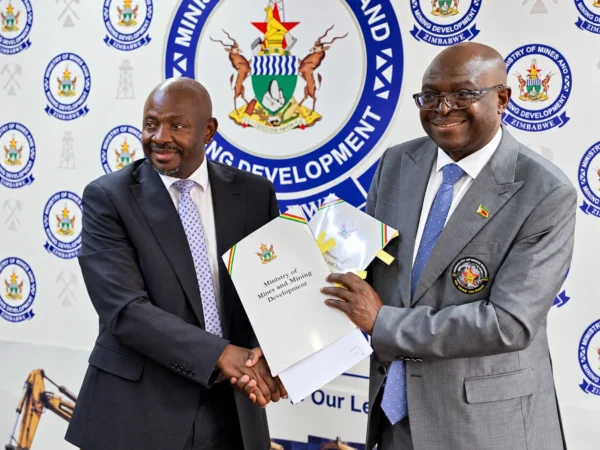

The Zimbabwe Anti-Corruption Commission (ZACC) and the Ministry of Mines and Mining Development have signed a Memorandum of Understanding (MOU) to strengthen corruption prevention, information sharing, risk management and accountability across the mining administration system, Mining Zimbabwe can report.
By Rudairo Mapuranga
The agreement will introduce an integrity pledge programme covering ministry officials, including provincial mining directors and inspectors, while providing for mandatory systems reviews, risk audits, reciprocal training and a joint steering committee to oversee implementation.
ZACC Chairperson Michael Reza said the initiative followed a request from Mines and Mining Development Permanent Secretary Dr Thomas Utete Wushe, describing the agreement as an important step in strengthening the fight against corruption in a sector central to Zimbabwe’s economy.
Reza said the MOU aligned with the mandate given to him by President Emmerson Mnangagwa when he was appointed ZACC chairperson in March 2024.
“His instructions to me were very simple, straightforward and unambiguous. It was to fight corruption and to assist in putting up structures and measures that fight against corruption,” Reza said.
He warned ministry officials involved in the anti-corruption drive to expect resistance from individuals targeted by the measures.
“Corruption is a tendency of fighting back. When you fight against corruption, it fights back,” Reza said.
He urged officials to remain prepared for retaliation from individuals who could be affected by the new controls.
“People who are corrupt, they have marked you. They will come for you,” he said, while expressing confidence that the partnership would strengthen the fight against graft.
Reza said the importance of cleaning up the mining administration extended beyond the ministry itself because of the sector’s contribution to the wider economy.
“In Zimbabwe, mining is one of the key drivers of the economy. If mining is sick, then very clearly the other arms of government will fall sick also in sympathy with the demise or the problems that may be happening in the Ministry of Mines,” he said.
Reza called on officials and stakeholders to “refuse, resist and report corruption.”
Wushe said the agreement was intended to move the ministry from general commitments on integrity to concrete systems for preventing and addressing corruption.
“The agreement that we have, therefore, is a proactive, decisive step. It moves beyond just mere rhetoric that we want to be an organisation with high integrity to something concrete with positive steps towards creating that workforce that delivers the mining sector,” Wushe said.
He said the MOU was driven by the need to create a mining environment that supports investment while maintaining integrity in the administration of the sector.
“We are here to work together to make sure that we create that environment that is good for investors, that is good for miners, that is good for the people of Zimbabwe who wish to go and carry out business in the mining sector,” Wushe said.
The Permanent Secretary outlined four key areas underpinning the partnership.
The first is corruption prevention, which includes an integrated integrity pledge programme for ministry officials, including provincial mining directors and inspectors.
The agreement will also introduce mandatory systems reviews and risk audits aimed at identifying areas considered vulnerable to corruption and strengthening controls around them.
“We are building a culture of ethics and proactive risk management within the ministry,” Wushe said.
The second pillar is cooperation and information sharing.
Wushe said the MOU establishes a formal framework through which the ministry and ZACC can exchange information and provides a protocol for the referral of allegations of corruption.
The third pillar is capacity building, with the two institutions committing to reciprocal training.
Under the arrangement, ministry officials will provide ZACC with technical knowledge on mining law, administration and practice, while ZACC will train ministry personnel in anti-corruption methodologies.
“Our ministry will provide the Anti-Corruption Commission with technical expertise on the intricacies of the mining law and administration and its practice, while ZACC will also equip our personnel with necessary skills in anti-corruption methodologies,” Wushe said.
He said the training was necessary because corruption could involve multiple institutions and required officials to understand how to respond to risks both within the ministry and in its dealings with stakeholders.
The fourth pillar is oversight and accountability, which will be supported by the establishment of a joint steering committee.
The committee will monitor progress under the agreement, identify implementation challenges and ensure that the commitments made by the two institutions translate into practical results.
Wushe also stressed that the partnership would not compromise ZACC’s constitutional independence.
“We recognise and fully respect your constitutional independence, which is vital for the effective execution of your mandate,” he said.
“This agreement is built on that principle. A partnership of mutual respect, not a subversion of your authority. We are not here to impede on your work, but to support it by making our system more robust and our officials more vigilant.”
The integrity pledge, Wushe said, would be treated as a substantive commitment rather than a ceremonial exercise.
“The integrity pledge we will take is not merely a formality, we mean it. It is a solemn vow to serve our nation with honour and to be steadfast in our duty,” he said.
He said the ministry’s position was that corruption should have no place in the administration of Zimbabwe’s mineral resources.
“Today, the Ministry of Mines is sending a clear and unambiguous message that the mining sector is not and will not be a safe haven for corruption,” Wushe said.
“We are building a system defined by integrity, where opportunity is driven by merit and compliance, not by illicit deals.”
The agreement comes as Zimbabwe continues to seek increased investment in the mining sector, which the government regards as a key contributor to its broader economic development objectives.
For the mining industry, the effectiveness of the partnership will ultimately depend on how the proposed integrity pledges, risk audits, information-sharing mechanisms, training programmes and joint oversight structures are implemented across the ministry and its provincial operations.

