


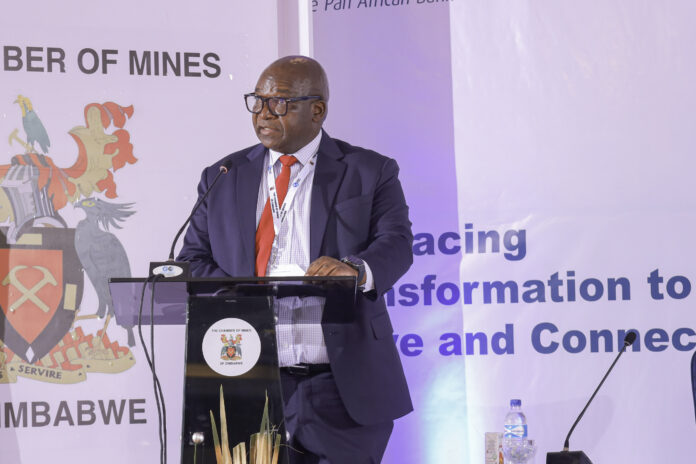

Zimbabwe’s mining industry has warned that high electricity costs and an impending power supply gap could undermine production growth, with Chamber of Mines Chief Executive Officer Isaac Kwesu saying local electricity tariffs are significantly higher than those prevailing in competing regional markets.
By Rudairo Mapuranga
Kwesu said Zimbabwe would need to expand electricity supply while making power more affordable if the mining sector was to achieve its growth ambitions.
Addressing the Chamber of Mines’ State of the Mining Industry event, he said electricity demand was rising across the economy, meaning mining companies were competing with other sectors for an increasingly constrained resource.
He warned that substantial additional generation capacity would be required over the coming years, alongside improvements to transmission infrastructure and increased investment in the power sector.
In the short term, Kwesu said regional electricity imports could help bridge the supply gap. However, he argued that a sustainable long-term solution would require investment in domestic generation and supportive policy measures.
The cost of electricity was an equally pressing concern.
Kwesu put Zimbabwe’s electricity costs at approximately US$0.14 per kilowatt-hour, compared with regional rates of less than US$0.08 per kWh, arguing that the disparity placed local producers at a competitive disadvantage.
Figures contained in the Chamber of Mines’ Mining Prospects 2027: The State of the Mining Industry Survey Report put Zimbabwe’s general mining electricity tariff at USc14.21 per kWh, against a regional average of USc7.80.
This represents an approximately 82% cost premium over the regional average.
Mining companies sell minerals into international markets where prices are largely determined globally, leaving limited room to pass higher electricity costs on to customers.
The cost differential is particularly significant for energy-intensive operations such as ferrochrome production and mineral processing, where electricity accounts for a substantial share of operating expenditure.
Kwesu said the industry needed adequate and cost-effective electricity to translate its projected growth into actual production.
His concerns are reflected in the Chamber of Mines’ Mining Prospects 2027 survey, which identifies electricity reliability and affordability among the major risks facing the sector.
The report projects mining industry capacity utilisation to increase from 76% in 2026 to 91% in 2027. However, achieving that improvement will depend partly on the availability of reliable electricity at competitive prices.
Mines and Mining Development Minister Dr Polite Kambamura said Government was engaging the Ministry of Energy and Power Development on the electricity requirements of the mining industry.
The engagement comes as Government seeks to support the sector’s expansion, with mining companies also exploring captive power generation and regional supply arrangements to reduce their exposure to domestic electricity shortages.
However, Kwesu indicated that regional imports would provide only a short-term response unless Zimbabwe also addressed constraints in generation capacity and transmission infrastructure.
The power challenge is linked to the sector’s broader investment requirements. The Chamber’s survey estimates that mining companies will require more than US$1.9 billion in capital in 2027, while access to finance, the fiscal framework and foreign exchange arrangements will also need attention to make new projects viable.
For Zimbabwe, the challenge is therefore not only to generate enough electricity to meet rising demand, but also to deliver it at prices that allow local mines to compete with producers in the region.
Without progress on both supply and affordability, the mining sector’s production and investment targets for 2027 could prove difficult to achieve.