

Home Blog Page 208

Only Four Companies Submit Lithium Beneficiation Plans – Government Extends Deadline

0

The government of Zimbabwe, through the Ministry of Mines and Mining Development, has extended the submission deadline for beneficiation plans from lithium producers by two months. This decision comes after receiving only four proposals from large-scale lithium miners, according to Deputy Minister of Mines and Mining Development, Engineer Polite Kambamura.

The initial deadline for the submission of beneficiation plans was March 31, but miners requested more time from the Ministry to consult their head offices abroad and to incorporate beneficiation into their annual budgets.

This extension underscores the government’s commitment to transforming the local lithium industry from merely producing lithium concentrate to generating battery-grade lithium, which has a significantly higher value.

Eng Polite Kambamura stated, “There is no going back; the government has said lithium producers should bring their plans for beneficiation. They need to produce lithium salts, such as lithium carbonate and lithium hydroxide, which are better products for battery manufacturing in the country. We need to be prepared. We are not only going to end with concentrated lithium carbonates, but we also want batteries to be manufactured here so that Zimbabwe will be the hub.”

He added, “Yes, they are coming forward with the plans, but these are mostly long-term plans.”

Currently, four large-scale lithium producers have submitted their beneficiation plans.

“We are yet to sit down to consider their proposals. It’s still work in progress. We extended the period by another two months,” Dr. Kambamura noted.

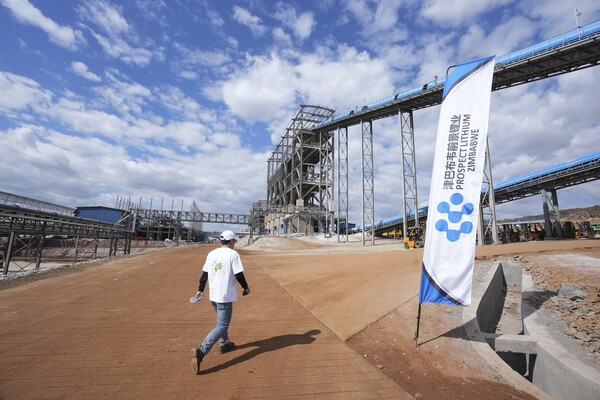
Zimbabwe hosts over ten large-scale lithium mining companies, including the Arcadia Lithium Mine, which is owned by Prospect Lithium Zimbabwe. Arcadia boasts the largest hard rock lithium processing plant in Africa and the second largest globally for lithium concentrates.

Other notable lithium mines include Sabi Star Lithium Mine owned by Max Mind Investments, Bikita Minerals owned by Sinomine, Sandawana Mines owned by Kuvimba Mining House (KMH), Gwanda Lithium Company, Mutoko Lithium Mine, and Kamativi Lithium Mine owned by Kamativi Mining Company (KMC).

The directive for lithium beneficiation is part of a broader strategy to boost government revenue and ensure that the country benefits more significantly from its vast mineral resources. Finance Minister Professor Mthuli Ncube has mandated that lithium companies submit beneficiation plans before receiving operating licenses. With numerous lithium mining projects underway, Zimbabwe, which holds the largest lithium reserves in Africa, is poised to become a key player in the global lithium market.

However, there are challenges. One significant impediment to the establishment of battery-grade lithium processing plants is the fluctuating price of lithium. Moreover, companies like Zhejiang Huayou Cobalt have expressed concerns about the local conditions for producing battery-grade lithium. Huayou pointed out that Zimbabwe lacks the necessary resources such as reliable renewable energy, natural gas, and sulphuric acid, which are critical for the production process.

Zimbabwe’s substantial hard-rock lithium reserves have attracted over $1 billion in investments from Chinese companies, including Zhejiang Huayou Cobalt, Sinomine Resource Group, Chengxin Lithium Group, Yahua Group, and Canmax Technologies. Despite this influx of investment, the establishment of local beneficiation plants remains a complex issue.

Last year, the value of lithium exports reached US$878.44 million, a figure that helped offset the decline in gold and PGM (platinum group metals) revenue, according to Zimstat data. In the first quarter of this year, lithium exports were valued at US$76.3 million. These figures highlight the potential economic benefits of developing a robust lithium beneficiation industry in Zimbabwe.

The government has long struggled to persuade PGM miners to refine their metals locally. These miners typically ship concentrates to South African refineries, citing insufficient local electricity and mineral supplies to support the significant capital investment required for building refineries. This situation has prompted a renewed focus on ensuring that the lithium sector does not follow a similar path.

As the government pushes for the beneficiation of lithium, the success of this initiative will depend on addressing the infrastructural and economic challenges that currently hinder the production of battery-grade lithium. The ongoing engagement with mining companies and the extension of the submission deadline are steps towards achieving this goal and positioning Zimbabwe as a central hub in the global lithium market.


Zimbabwe gold buying prices per gram 23 May 2024

Fidelity Gold Refinery (FGR) official gold buying prices/ gram. See the Zimbabwe gold buying prices per gram today 23 May 2024.

SG 90% AND ABOVE US$73.15/g
SG ABOVE 85% BUT BELOW 90% US$72.38g
SG ABOVE 80% BUT BELOW 85% US$71.60/g
SG ABOVE 75% BUT BELOW 80% US$70.83/g
SAMPLE BELOW 10g BUT ABOVE 5g US$69.67/g

Fire Assay CASH $73.54/g

NB: Fire Assay cash price is for gold above 100gs, no sample is deducted.
For the Fire Assay Transfer price, a sample of not more than 10g is deducted
A 2% royalty is charged on all deposits (Small-scale miners)
A 5% royalty is set for Primary Producers

Cash available. Fidelity Gold Refinery prices will be changing daily to match world market prices.

Kuvimba Seeks Investment to Develop Its Mining Portfolios

0

Kuvimba Mining House (KMH), the country’s biggest mining asset holder, is actively seeking investment to advance its mining portfolios, KMH Acting Group CEO Trevor Barnard has said.

Barnard highlighted that KMH’s primary focus is on operationalizing its existing projects, rather than acquiring new ones or selling current assets.

“Currently, our main focus is on bringing our existing project portfolio into operation. We are not considering any further acquisitions in the immediate future; instead, we are prioritizing putting our current projects into operation as quickly as possible,” Barnard said.

This strategic focus is a clear indication of KMH’s commitment to maximizing the potential of its existing resources.

Barnard was explicit about KMH’s stance on asset management:

“We are certainly not looking to sell our assets. We aim to develop these assets in partnership with potential investors. This is our strategy moving forward.”

By choosing not to sell its assets, KMH is retaining control over its valuable resources, ensuring that the benefits of development are kept within the company.

This approach of focusing on developing existing projects rather than acquiring new ones is a strategic move that aligns with sound business practices. Acquiring too many assets can often lead to several disadvantages, which KMH is keen to avoid. One significant disadvantage is the dilution of focus. When a company spreads its resources too thinly across too many projects, it can lead to inefficiencies and a lack of deep, concentrated expertise on any single project. This can ultimately slow down the progress and success of each initiative.

Moreover, acquiring new assets often requires significant capital outlay, which can strain a company’s finances and reduce its ability to invest in the development of existing projects. High acquisition costs can lead to increased debt levels and financial risk, potentially jeopardizing the company’s stability.

Additionally, the integration of new assets can pose substantial operational challenges, including cultural clashes, differing management practices, and logistical complexities.

By avoiding these pitfalls, KMH is positioning itself to leverage its current assets effectively. This approach also allows KMH to build strong, strategic partnerships with investors who are interested in contributing to the development of these assets.

Barnard noted, “We will retain ownership of the resources, and the shareholding will be negotiated based on the level of investment. We are not considering selling any of our assets.”

Another significant advantage for KMH is its incorporation into the Mutapa Investment Fund, Zimbabwe’s sovereign wealth fund.

This relationship provides KMH with substantial support and cooperation from various government ministries and agencies, which is crucial for the successful implementation of its projects.

“From their perspective, we have significant support since the Mutapa Investment Fund is Zimbabwe’s sovereign wealth fund. This relationship provides us with considerable backing and cooperation from various ministries and government agencies to help implement our projects and operations,” Barnard highlighted.

Zimbabwe gold buying prices per gram 22 May 2024

Fidelity Gold Refinery (FGR) official gold buying prices/ gram. See the Zimbabwe gold buying prices per gram today 22 May 2024.

SG 90% AND ABOVE US$73.74/g
SG ABOVE 85% BUT BELOW 90% US$72.96g
SG ABOVE 80% BUT BELOW 85% US$72.18/g
SG ABOVE 75% BUT BELOW 80% US$71.40/g
SAMPLE BELOW 10g BUT ABOVE 5g US$70.23/g

Fire Assay CASH $74.13/g

NB: Fire Assay cash price is for gold above 100gs, no sample is deducted.
For the Fire Assay Transfer price, a sample of not more than 10g is deducted
A 2% royalty is charged on all deposits (Small-scale miners)
A 5% royalty is set for Primary Producers

Cash available. Fidelity Gold Refinery prices will be changing daily to match world market prices.

Chamber of Mines Annual Conference 2024 program unveiled

0

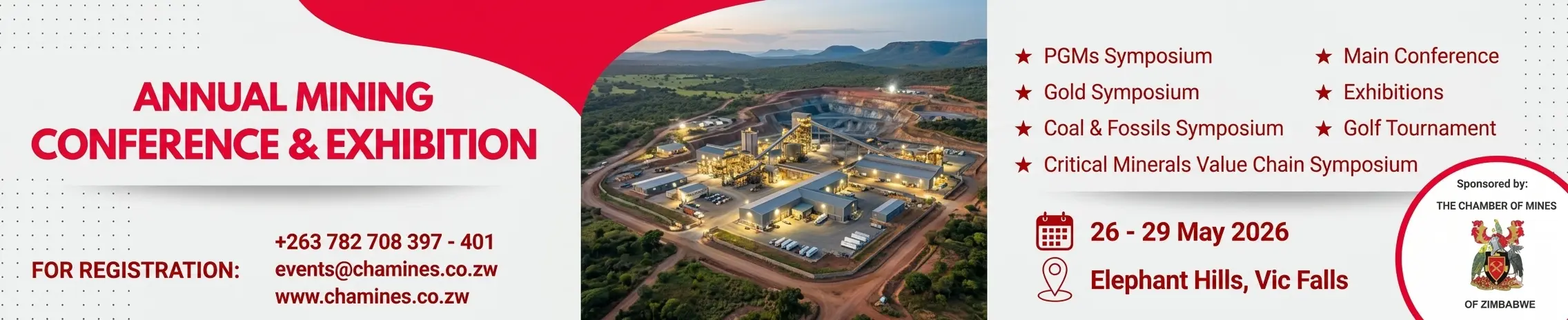
The Chamber of Mines of Zimbabwe has announced its upcoming annual mining conference and AGM program with a comprehensive agenda designed to cover all critical issues for the mining industry.

Set to take place from May 28th to May 30th, 2024, and themed “Unlocking Growth Potential for the Zimbabwe Mining Industry,” the event aims to foster a sustainable growth environment that aligns with Zimbabwe’s Vision 2030.

President of the Chamber of Mines, Thomas Gono, highlighted the conference’s significance: “As is our tradition, we invite you to an update on our upcoming annual mining conference and AGM. The theme is driven by the desire to create an environment that sustains growth and achieves the economic transformation we all aspire to.”

The program includes a critical minerals symposium, a PGMs Indaba, the main conference, exhibitions, and various side events such as dinners, cocktails, and a golf tournament.

Isaac Kwesu, CEO of the Chamber of Mines, provided a detailed overview of the four-day event: “On the first day, which is the 28th of May, we will have our traditional constitutional meetings, the annual general meeting, and council meetings. These meetings address our internal governance issues in the mining industry.”

Day two will feature two key symposiums. The Critical Minerals Symposium will explore the global production and markets of critical minerals, particularly those driving clean energy.

“Critical minerals have become a major driving force in clean energy, and Zimbabwe is endowed with many of these minerals. We found it desirable to host this symposium to discuss critical issues, such as policy matters, operational matters, and markets,” said Kwesu.

Honourable Minister Chitando will be the guest of honour, with a keynote speaker from SFA Oxford providing insights into global critical mineral markets.

In the afternoon, the focus will shift to the Platinum Group Metals (PGMs) Symposium. Given the global developments in the PGM industry, particularly with depressed commodity markets, this session promises to be crucial.

“PGMs constitute the largest chunk of Zimbabwe’s export earnings. Delegates and other critical stakeholders are keen to learn about the future of the platinum markets and how Zimbabwe can navigate the current challenges,” Kwesu noted.

The symposium will feature contributions from current operators, new investors, and industry experts from South Africa.

The main conference, or Indaba, on May 30th, will be officially opened by His Excellency Dr. E.D. Mnangagwa. Senior government officials, including the Minister of Finance, the Minister of Mines, the ZIMRA Commissioner General, and representatives from the energy sector and financial markets, will discuss the industry’s growth imperatives and how it can harness capital from financial markets.

“Senior government officials and industry leaders will cover various aspects of the mining industry, providing updates from mineral sub-sectors such as gold, PGMs, and ferrochrome,” Kwesu added.

The event will conclude on May 31st with a networking day, featuring activities such as golf and other events at Victoria Falls, offering ample opportunities for informal engagement among delegates.

With a comprehensive agenda designed to cover all critical issues for the mining industry, the upcoming conference is set to drive significant advancements and foster collaboration across the sector.

For more information and to register for the conference, visit the [Chamber of Mines of Zimbabwe’s website].

Chamber: Gold Production to Increase Due to Rising Prices

0

The Chamber of Mines of Zimbabwe anticipates a significant increase in gold production driven by rising gold prices and the strengthening of the Zimbabwe Gold (ZiG) currency.

by Rudairo Mapuranga

This positive outlook was shared by the Chamber’s CEO, Isaac Kwesu, who highlighted the dual benefits of attractive prices and improved viability for mining operations.

“Naturally, most mines will increase output because, apart from being attractive, viability issues will be addressed. Mines that may not have been operating due to viability challenges will see higher prices as an opportunity to come back to life,” said Kwesu.

Kwesu further explained that the sector expects increased production from current mining operations and the initiation of new projects, along with fresh investments in gold entities.

“We expect increased production from current entities through their current operations. Additionally, new projects and investors with an appetite for gold entities will support gold output. This presents a positive outlook for our gold sector,” he added.

Positive Impact on the Zimbabwe Investment Group (ZiG)

The surge in gold production is set to benefit the newly introduced Zimbabwe Gold (ZiG) currency, designed to stabilize the nation’s economy.

Kwesu elaborated on the mechanism, noting that the increase in gold production will directly boost the gold reserves, which underpin the ZiG currency.

“As you know, the gold reserve is an offshoot of the royalty paid by gold producers. Half of this royalty is paid in kind. Therefore, as gold output increases, the royalty automatically increases, as it is a function of total production. Half of that royalty will be paid in physical gold, thus increasing the gold reserve to support the ZiG, naturally leading to an increase,” Kwesu stated.

Growth in Gold Deliveries

Recent data underscores the upward trend in gold production. Deliveries by large-scale gold miners rose by approximately 11.78 percent, reaching 1,168.7022 kilograms in March, up from 1,045.5575 kilograms the previous month.

Large-scale miners accounted for 51.995 per cent (3,143.0683 kilograms) of the total deliveries in the first quarter of 2024, surpassing Artisanal and Small-Scale Mining (ASM) contributions of 48.004 per cent (2,901.8006 kilograms). Historically, ASM has been the primary gold deliverer to Fidelity Gold Refinery (FGR), contributing over 61 per cent of total gold deliveries.

Strategic Introduction of the ZiG Currency

The introduction of the ZiG currency in April marks a strategic move by the government to stabilize the economy. The central bank governor, John Mushayavanhu, assured that the ZiG would be set at a market-determined exchange rate and backed by gold reserves to avoid the hyperinflation that has plagued previous currencies. The government aims to ensure that the local currency in circulation is matched by an equivalent value in precious minerals or foreign exchange.

This robust approach, combined with increased gold production and responsible sourcing, aims to create a stable and valued currency, driving Zimbabwe towards economic recovery and growth. Zimbabwe’s mining sector is thus making significant strides in ramping up gold production, a critical measure aimed at bolstering the newly introduced ZiG currency.

Backed by gold reserves, the ZiG currency represents the government’s latest effort to stabilize an economy that has faced inflation and currency devaluation for the past 25 years. The combined efforts of the mining sector and monetary policies are set to pave the way for a more stable and prosperous economic future for Zimbabwe.

Plans to Set Up Internationally Certified Metallurgical Laboratory Underway

0

Zimbabwe is set to bolster its mining sector with the establishment of an internationally recognized metallurgical laboratory.

By Rudairo Mapuranga

The Deputy Minister of Mines and Mining Development, Engineer Polite Kambamura, confirmed the government’s plans to create a laboratory that meets global standards, ensuring the country’s mineral exports are certified under the Joint Ore Reserves Committee (JORC) code.

“Currently, we are working to capacitate the Ministry of Mines and Mining Development MetLab, but there are plans to construct and establish an internationally recognized metallurgical laboratory, which meets international standards so that some players who want their lab results internationally recognized under JORC will have no problems. So it’s a work in progress. The government is going to come up with a proper internationally recognized METLab,” stated Eng Kambamura.

The existing government lab, MetLab, is primarily used for testing and sampling minerals for control purposes. However, international clients do not accept its reports, potentially costing Zimbabwe millions of US dollars in lost revenue. This gap underscores the urgent need for a certified laboratory to verify mineral quality before export.

At a recent meeting aimed at gathering input from producers, miners expressed the critical need for local laboratories capable of certifying minerals to international standards. Eng Kambamura acknowledged this challenge, emphasizing the potential financial benefits for the country. “We note the concern that miners are getting a variance on the quality of their product when it gets to the international market compared to their expectations before export,” he said. “Obviously, this calls for internationally certified local testing laboratories which can then certify our minerals before export, and we are guaranteed that what we would have gotten here cannot be disputed anywhere in the world.”

A representative from Zimlabs, a local testing firm, highlighted that they possess state-of-the-art technology that remains underutilized due to low uptake by miners. Zimlabs specializes in gold fire assay, base metal analysis, coal analysis, sample preparation, and analysis of lithium and rare elements. “We have state-of-the-art machinery to do that job for you, where if we give you our results, you are sure even if you export you will get the same results,” stated the Zimlabs director.

This initiative is particularly significant for sectors like chrome and chromium, where discrepancies between local and international quality assessments have led to financial losses for producers. Accurate mineral testing is crucial for geologists to determine the mineral’s quality and ensure it meets the necessary standards for export.

The establishment of an internationally certified metallurgical laboratory aligns with President Mnangagwa’s vision of economic turnaround through agriculture and mining. As Zimbabwe strives to become an upper-middle-income economy by 2030, the enhancement of its mineral certification capabilities will play a vital role in maximizing export earnings and boosting the mining sector’s contribution to the national economy.

FGR’s Full Supply Chain Traceability System Set to Combat Gold Smuggling

0

The country’s sole gold buyer and exporter, Fidelity Gold Refinery (FGR), is taking significant strides to ensure the integrity and transparency of its gold supply chain.

by Rudairo Mapuranga

Speaking at the gold mobilization deployment workshop held at Cresta Jameson Hotel in Harare on Monday,  FGR General Manager Mr Peter Magaramombe, highlighted the company’s initiatives to promote responsible sourcing and combat the pervasive issue of gold smuggling.

Full Supply Chain Traceability System

One of the cornerstone developments at FGR is the implementation of a system that allows for full supply chain traceability. “Fidelity Gold Refinery is developing a system that allows full supply chain traceability. The system allows for real-time monitoring from bullion weighing by the producers,” stated Mr. Magaramombe.

This system, expected to go live by September 30, 2024, will enable detailed tracking of gold from the point of production through to its final market destination.

This real-time monitoring is crucial for verifying the source of gold and ensuring compliance with ethical standards. By integrating this advanced system, FGR aims to enhance transparency and accountability across the supply chain, making it significantly harder for illegally sourced gold to enter the market.

Increasing Gold Deliveries

In his speech, Mr Magaramombe also reported a notable increase in gold deliveries.

“For the month of April, gold deliveries to Fidelity recorded an increase of 32% from the March 2024 position of 1.8 tons to close at 2.4 tons,” Magaramombe said.

This surge reflects the effectiveness of FGR’s strategies and the growing compliance among miners with the responsible sourcing policies implemented by the gold buyer and exporter.

Combating Gold Smuggling

Zimbabwe has long struggled with gold smuggling, which deprives the nation of substantial revenue. The government and FGR are working diligently to minimize this illegal activity. Magaramombe emphasized the importance of responsible sourcing in this effort.

“Responsible sourcing means the incorporation of ethical, sustainable, and socially conscious principles into sourcing, procurement, and overall supply chain management practices during the sourcing of gold from various suppliers,” he explained.

FGR’s approach includes rigorous customer due diligence, mandatory record-keeping, and ensuring funds used in transactions are from legitimate sources. These measures align with national regulations on anti-money laundering and crime prevention.

Training and Policies

FGR has also prioritized training for its gold-buying agents. In April 2024, the company conducted a comprehensive training workshop focusing on responsible sourcing practices. This training covered aspects such as proper record-keeping, customer due diligence, and understanding the legal implications of non-compliance.

Moreover, FGR has established a robust Responsible Sourcing Policy, which guides all stakeholders in ensuring that gold is mined and traded ethically. This policy is publicly available on FGR’s website and underscores the company’s commitment to sustainable and conflict-free gold sourcing.

Government Collaboration

The government’s role in supporting these initiatives is pivotal. By collaborating with FGR and other stakeholders, the government ensures that policies and regulations are effectively enforced, thereby strengthening the fight against gold smuggling.

China Gold Congress to Help Zimbabwe Attract Capital: Chitando

0

The Minister of Mines and Mining Development, Hon. Winston Chitando, invited to be one of the key speakers at the China Gold Congress and Expo, sees it as an opportunity for Zimbabwe’s gold industry to attract capital for growth and development.

Speaking on the sidelines of the gold mobilization deployment workshop held at Jameson Hotel in Harare on Monday, Minister Chitando said the event will help the country attract capital investment for its growth.

“I think it is relevant to the extent that if you look at our gold sector, or the mining industry in general, and the gold sector in particular, you can see how this can help us. It can help us through interaction with stakeholders and by attracting the necessary capital for people to invest in the industry. So, it is relevant to that extent,” Hon. Chitando said.

The mining industry in Zimbabwe requires capital for exploration and mine development. Zimbabwe used to be in the top five gold producers, but at the moment it is not in the top 20 due to limited investment in exploration.

The China Gold Congress and Expo will be held on July 26-28 at the National Convention Center in Shanghai and will be hosted by the China Gold Association and the World Gold Council.

Through a letter seen by Mining Zimbabwe, Andy Yu, writing on behalf of the Chairman of the China Gold Association and the CEO of the World Gold Council, invited the Minister of Mines and Mining Development, Hon. Winston Chitando, to be one of the key speakers at the event. The invitation was also extended to ZMF and the country’s gold mining industry.

The China Gold Congress and Expo covers the entire value chain, including exploration exchange, mining and technology, investment and market, and jewelry and consumption.

As one of the largest industrial gatherings, the China Gold Congress is a commercial event for gold mining and investment development. It offers a range of business opportunities, bringing together gold mining companies and suppliers for exchanges and collaborations.

Commenting on the invite, the ZMF President, Ms. Rushwaya, said it was a life-changing opportunity for ZMF and will empower the mining industry towards growth and development as the country moves towards the achievement of an upper-middle-income economy by 2030.

“This is a life-changing opportunity for ZMF, enabling our growth, especially in the gold sector, as we interact with world leaders and exchange information. We look forward to this event, which will market our miners and country. We are positive that we will forge exciting collaborations as we attend and speak at this event,” Rushwaya said.

Restoration of Large-Scale Mining at Mazowe Meets Resistance

0

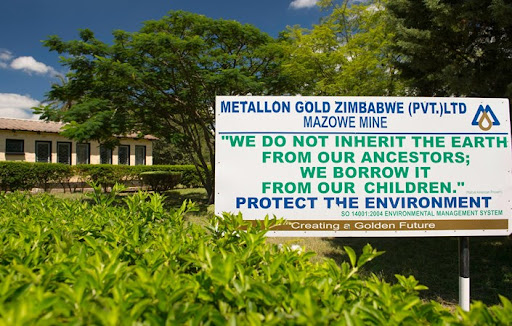
Efforts to restore large-scale mining operations at Mazowe Mining Company (MMC)’s Mazowe Mine have encountered significant resistance from local operators, MMC owners, Metallon Corporation, highlighted in a press release.

By Rudairo Mapuranga

According to Metallon, the development to start large-scale operations follows the Ministry of Mines and Mining Development’s directive to shut down unsafe areas managed by artisanal and small-scale miners.

“On January 27, 2024, MMC announced its plans to resume underground shaft operations as part of a broader strategy to reintroduce safer mining practices and extensively rehabilitate the mining areas. MMC’s initiative aligns with the Government of Zimbabwe’s emphasis on safe and sustainable mining practices and its investment in the growth of the critical mining sector.

In a further update, MMC reported that on March 11, 2024, the Ministry of Mines Inspectorate conducted a safety inspection of pit mining operations around Mazowe Mine. The inspection led to the suspension of all unsafe mining practices in the affected areas, effective March 24, 2024. This suspension was intended to halt hazardous operations and pave the way for formal, regulated mining activities.

According to Metallon, despite the legal mandate and MMC’s plans to restore organized mining, there has been notable resistance from some operators in the region. These actions have impeded MMC’s efforts to urgently rehabilitate mining pits and commence safer, large-scale mining operations.

Metallon stated that MMC expressed regret over the obstruction faced in implementing the Government’s order and advancing their rehabilitation initiatives.

“We regret that this legal Government order and the Mine’s plans to restore organized mining have faced resistance from some operators in the area. These actions have hindered MMC’s efforts to urgently rehabilitate mining pits and commence large-scale, safer mining operations. Mazowe Mine is committed to collaborating with all stakeholders to achieve the following goals:

– Ending all unsafe pit mining and transitioning Mazowe Mine to secure shaft mining, thereby preventing loss of life and protecting local communities and the environment.
– Resuming large-scale underground shaft operations to align with the national goal for responsible and safer mining practices.

“MMC is fully cooperating with all parties to support the Government of Zimbabwe’s vision for safer, sustainable, formal mining,” Metallon Corporation said.