Home Blog Page 216

James Mufara Joins Caledonia Mining as COO

0

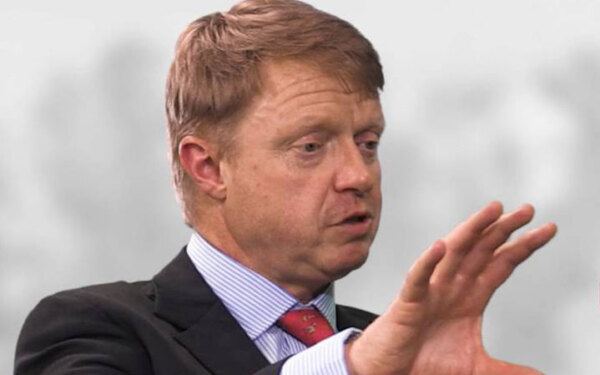
Caledonia Mining Corporation Plc has announced that James Mufara has joined the Caledonia group as Chief Operating Officer, effective May 1, 2024.

Mark Learmonth, Chief Executive Officer of Caledonia Mining, said he is looking forward to working with James Mufara considering the experience he has in developing the company within the mining industry.

“I am delighted James will soon be starting his new role at Caledonia. He will be joining us at a pivotal moment in Caledonia’s development, and I know the team will benefit from his wealth of experience. I very much look forward to working with him.”

James Mufara commented, “I am excited to be joining Caledonia and look forward to working with the talented team to drive operational performance across the group’s high-quality portfolio.”

James (49) was previously employed at Harmony Gold Mining Company Limited, where, as Regional General Manager, he headed a complex portfolio of operations consisting of five mines and 15,000 staff, mining 450koz of gold per annum.

James has over 25 years of experience in the mining sector in Southern Africa, including 13 years in leadership roles. His career has been primarily gold-focused, but he also has exposure to nickel, copper, and chrome mining.

His experience includes deep-level underground mining and open-pit operations, which is relevant to the existing underground operation at Blanket Mine and Caledonia’s development projects at Bilboes and Motapa, which will be open-pit. He holds a BSc in Mining Engineering and an MBA.

JCMZ vows to reduce operations costs, promote SHE issues

0

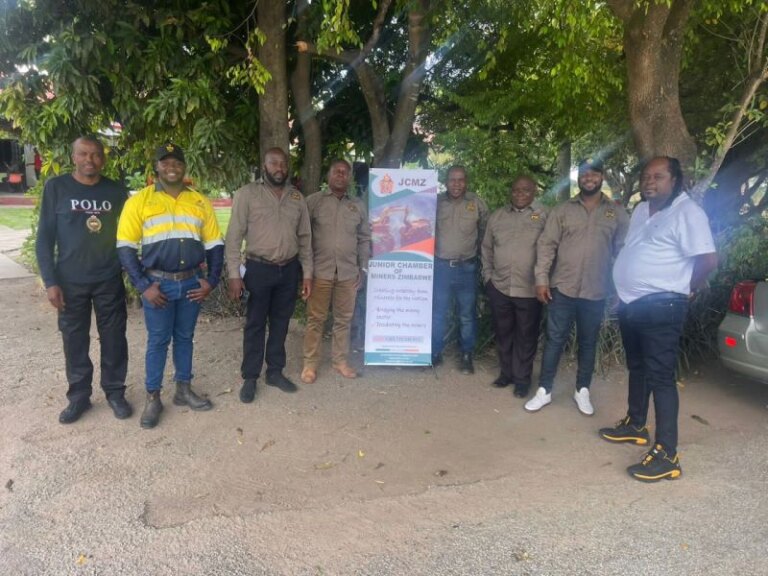
The Junior Chamber of Mines of Zimbabwe (JCMZ) has vowed to reduce operational costs and promote safety, health, and environmental (SHE) issues within the medium-scale mining industry.

Speaking at the association’s first quarterly meeting in Gweru on Friday, JCMZ President Mr Brian Samuriwo stated that they would implement measures to lower the cost of conducting business while emphasizing safety, health, and environmental concerns.

Samuriwo explained that JCMZ plans to introduce mechanization models to increase mineral output and production efficiency at reduced costs. Additionally, the organization will actively seek SHE training initiatives for the medium-scale sector and encourage responsible mining practices among miners to adhere to set standards.

He emphasized JCMZ’s commitment to addressing workers’ welfare, and ensuring fair treatment of employees within the industry.

Mr. Samuriwo outlined key focus areas stating, “We are committed to reducing the cost of doing business in the mining sector by establishing local mechanisms through JCMZ committees. This includes optimizing mining consumables, equipment, machinery, ensuring fair labour practices, and prioritizing employee welfare.”

“We must operate as professional and organized miners and understand the cost implications of our business. This is why we have established the Committee of Safety, Health, Environment, and Training, led by the Zimbabwe School of Mines, to conduct technical mining visits and facilitate mutual learning and development,” Samuriwo added.

He further advocated for the establishment of a miners’ bank aimed at financing the mining industry, particularly the medium-scale sector, through crowdfunding initiatives involving medium-scale miners and stakeholders.

Samuriwo stressed the importance of financial sustainability within the mining sector, asserting, “We need to establish a miners’ bank to support our operations. We must crowd-fund and finance ourselves to ensure liquidity within the Junior Chamber. The Reserve Bank of Zimbabwe, Fidelity Gold Refinery, and banks will witness the positive initiatives led by JCMZ.”

He urged equipment and consumable suppliers to innovate and develop local solutions to reduce the mining sector’s significant import bill.

“The mining sector currently bears the highest import bill of USD$3 billion, which we aim to reduce by 20% in the short term. I urge local industries to collaborate with JCMZ and leverage opportunities within the mining value chain,” Samuriwo concluded.

About The Junior Chamber of Mines Zimbabwe (JCMZ)

is the primary advocate for medium-scale miners in Zimbabwe. It operates as a member-funded, not-for-profit organization representing the interests of medium-scale miners and advocating on their behalf. JCMZ’s membership includes medium-scale miners, suppliers of machinery, spare parts, and chemicals, as well as service providers such as banks, insurance companies, consulting experts, engineers, and other mining-related professionals.

JCMZ plays a vital role in policy development affecting the sector, promoting its value within the mining community, and facilitating collaboration among members and stakeholders. The organization aims to provide a unified voice for medium-scale miners, ensuring their priorities are understood and supporting their role as key drivers of Zimbabwe’s mining economy. JCMZ also serves as an incubator for developing medium-scale miners who may transition into large-scale operations under the Chamber of Mines Zimbabwe (CoMZ).

Falling PGM prices puts Thousands of Jobs on the line

0

The global platinum mining industry is facing significant challenges amidst a period of declining prices, leading to widespread job losses across various critical roles within mining operations.

The effects of these job losses extend beyond the individuals directly affected, impacting families and the broader economies.

According to Zimplats’ Directors’ Report and Condensed Consolidated Interim Financial Statements (Reviewed) for the half-year ended 31 December 2023, the company made a post-tax loss of US$8.8 million, down from a profit of US$159.6 million, marking a 105% loss in earnings.

Zimplats’ pre-tax profit also decreased by 94% from US$221.5 million to US$14.2 million.

Of the six platinum group minerals that Zimplats produces, the biggest price losses were in palladium, which fell 42%, and rhodium, down 70%. Platinum suffered a 1% decline, while ruthenium decreased by 11%. Gold and Iridium were positive, with Iridium posting a 24% increase, while gold increased by 13%.

Jobs loses at ZIMPLATS

ZIMPLATS has now resorted to cutting jobs after initially offering voluntary retrenchment packages in a bid to protect the miner from the impact of a sharp fall in platinum group metal (PGM) prices.

Some of those who have lost their Jobs include Projects, Transport, Contracts Managers, SHEQ (Safety, Health, Environment, and Quality), Geologists, Resource Evaluation Specialists, Training Instructors, Development and Training Officers, HRD (Human Resources Development) Managers, and Materials Managers Departments among others.

Job losses in South Africa and Zimbabwe

Amplats

Anglo-American Platinum (Amplats) plans to cut 3,700 jobs in South Africa. This is in a bid to reduce costs and turn around fortunes for one of the company’s most troubled divisions.

Recently, the company said it would reduce its workforce by almost a fifth, after a 71% fall in annual profitability following a sharp drop in platinum group metal prices. The company also said it was planning to review contracts with 620 service providers, which could mean an even larger number of cuts which will affect the entire value chain.

Amplats CEO Craig Miller said the job cuts would have a “socio-economic impact”, adding that it was “important to understand that this has been a decision taken as a last resort for the company.

The group’s earnings fell to R14bn, from R48.8bn in 2022.

Anglo owns Unki mine. So far no price slump-related jobs have been cut at the Shurugwi mine.

Sibanye-Stillwater

Sibanye said that it could restructure lossmaking PGM mines including potentially shutting them down which will cost more than 4,000 jobs. Sibanye owns 50% of Zvishavane-based Mimosa Mine with the other 50% belonging to Implats which owns ZIMPLATS.

Mimosa recently undertook a significant workforce reduction, retrenching 33 managers and supervisors due to a persistent 35% decline in metal prices since April 2023. In response to the challenging market conditions, nine of the affected employees opted for early retirement, while 24 chose voluntary separation packages, as detailed in a company statement released on the 5th of February 2024.

“In response to these challenging market conditions, we have implemented several measures to ensure the viability of our business in the low-price metal environment. These proactive steps include capital expenditure curtailment, cost reduction initiatives, and cash conservation efforts,” the company said.

Implats

ZIMPLATS’ parent company Impala Platinum earlier this year said profit plunged 88% in the first half of its current financial year, and reported much lower earnings because of softening prices in the PGMs.

The miner announced that basic earnings dropped to R1.6 billion in the six months through December.

CEO Nico Muller joined a chorus of mining CEOs warning that more job cuts are imminent as reducing costs becomes a strict requirement to keep the industry afloat. This has now become a reality at its Zimbabwean unit, ZIMPLATS. Muller told eNCA that if Implats cannot reduce its costs, the miner risks undergoing significant restructuring or absolute closure.

Zim introduces another new currency, the”ZiG”

0

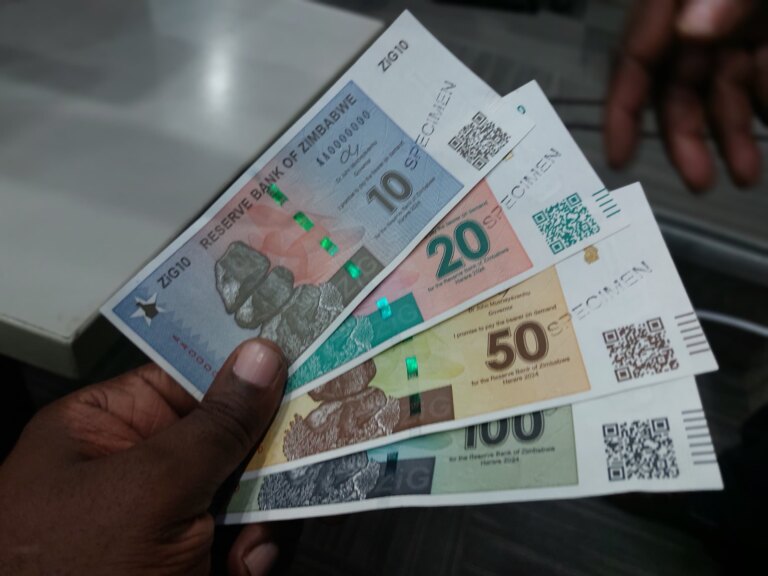
The new Reserve Bank of Zimbabwe (RBZ) governor Dr John Mushayavanhu today unveiled the new structured currency, the “ZiG”.

Patricia Rwafa

Addressing the country, Mushayavanhu said the ZiG is a “structured currency”. He said unlike typical fiat money, the ZiG will not rely solely on the government trust, instead, it will be supported by a concrete asset, like the gold reserves that were recently presented to President Mnangagwa by the RBZ.

The new currency will replace bond notes, which have been in freefall since 2019, losing 800% of value against the United States dollar in 2023 alone.

“Denominations of such would be similar to any other fiat currency meaning ZW$1, ZW$2, ZW$5, ZW$10, ZW$50, ZW$100, ZW$200, and others. The RBZ can call them structured currency or ZiG, a name they have already been using (Zimbabwe Gold).

According to John Mushayavanhu, dividing the current ZWL rate by today’s gold price of 1 ZiG is just US 6 cents. Meaning USD1 is Approximately 17 ZiG.

Starting Monday, all Zimdollar balances will be converted to the new gold-backed ZiG currency at Z$1=13.5686 ZiG.

“With effect from today, banks shall convert the current Zimbabwe dollar balances to ZiG. Zimbabweans have 21 days to exchange ZWL notes for ZiG.

“I don’t believe in taking people’s money. The ZiG will circulate with other currencies in the basket,” he said.

Meanwhile, street money changers in Westgate, Harare were not optimistic about the new currency labelling it “the usual”.

“We have seen this so many times and in no time this new currency will follow suit. Within a month the rates will be different from the ones announced,” one money changer said.

The new ZiGs will be backed by foreign currency and by gold reserves, meaning the currency is tied to the value of a specific amount of gold.

37 accidents, 33 fatalities, 27 injuries first two months of 2024

0

The mining sector experienced a total of 37 incidents resulting in 33 fatalities and 27 serious injuries during the first two months of 2024, according to official statistics.

Of the 33 fatalities reported, 15 were attributed to fall-of-ground incidents, 8 resulted from shaft accidents, 5 were classified as sundry incidents while gassing and blasting incidents each accounted for 3 fatalities. Hoist rope failure, slippery ground, TAT (tracking and tramming), fall from height, and accidental detonation incidents each contributed to a single fatality.

The fall-of-ground incidents occurred at the following mines: Gold Fields (2 fatalities, 2 accidents), Rosa J (1 fatality), Atlas 11 (1 fatality), Jim 6 (2 fatalities), Bibibi 3 (1 fatality), Peace Mine (1 fatality), Cambridge Mining Syndicate (1 fatality), J&M Mining Syndicate (1 fatality), Master Cecil (2 fatalities), Dalny Mine (2 fatalities), Imperani 7 (2 fatalities), Black Bird North (0 fatalities, 1 serious accident), Mimosa Mine (0 fatalities, 1 serious accident), and Haygold Nee (1 fatality).

In January, Mashonaland Central province recorded a total of 3 fatalities (Gold Fields and Rosa J Mine), while in February, the province recorded 1 fatality (Botha Mine).

Mashonaland West recorded 1 fatality and four serious injuries in January (Rondor 8 Mine, Whitewash 42 & 43, Ascot Mine, Brompton Mine) and in February, the province recorded 8 fatalities and 3 serious injuries (Cam and Motor, Dalny Mine, One Step 16, Imperani 7, Makona, Trafalgar 119, Alladin, Elvington Mine).

Matabeleland South reported 2 fatalities in January (Atlas 11 and Vumbachikwe) and 1 fatality in February (New Eclipse Central Mine).

Midlands recorded 7 fatalities in January (Jim 6 Mine, Tibilikwe 5 Mine, Bibibi 3 Mine, Nkomo Mine, Peace Mine), and in February, the province recorded 5 fatalities and 1 serious injury (Chengxie Mine, By Chance Mine, Charcoal 17 Mine, Mimosa Mine, Gwandamadhuvu Mine, Haygold Nee Mine).

Mashonaland East reported 2 fatalities in January (Cambridge Mining Syndicate and JM Mining Syndicate) 1 fatality and 18 serious injuries in February (Acturus Gold Syndicate, MJ Mining Syndicate, Beatrice Mine).

Matabeleland North reported 2 fatalities from Master Cecil Mine in January and zero incidents in February.

Manicaland did not report any incidents during the first two months of the year, according to the report.

Zim has 2.5 tonnes of gold reserves

0

Zimbabwe has a total of 2.5 tonnes of gold reserves ahead of the launch of the country’s new currency, which will be backed by the nation’s gold reserves.

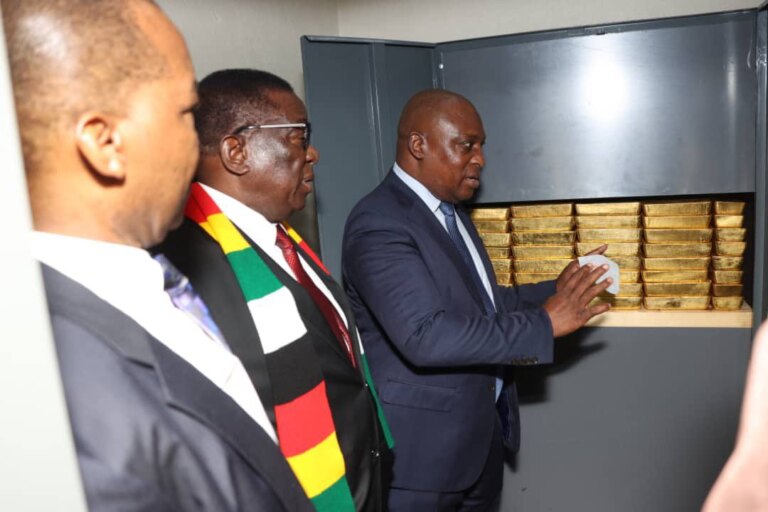
President Emmerson Mnangagwa yesterday toured the Reserve Bank of Zimbabwe (RBZ)‘s vaults on Thursday in anticipation of the unveiling of a new gold-backed currency by Governor John Mushayavanhu on Friday.

The vaults currently house 1.1 tonnes of gold. Other precious minerals, such as diamonds, when converted to gold (value), would contribute an additional 0.4 tonnes. This brings the total held in the vaults to 1.5 tonnes, with an additional 1 tonne held offshore, making it a total of 2.5 tonnes of gold reserves.

“I can confirm that we have 1.1 tonnes of gold and other precious minerals in the form of diamonds which, if converted to gold, would equal 0.4 tonnes, making a total of 1.5 tonnes in our possession.

“We also have another tonne of gold held offshore. In total, when considering our gold reserves, we are talking about 2.5 tonnes, valued at about US$225 million, along with US$100 million in cash,” stated RBZ Governor John Mushayavanhu.

Speaking about the tour, President Mnangagwa emphasized the significance of displaying the gold reserves, underscoring the importance of this precious metal for Zimbabwe’s economic stability and progress. Gold has always been a valuable asset, and its effective management is crucial for securing a stable financial future for the country.

“In the past, we did not possess any reserves in commodities at the RBZ. The Reserve Bank’s gold reserves represent a crucial step in backing our new structured currency. This move reinforces our commitment to economic stability and lays the foundation for a prosperous future,” President Mnangagwa said.

ZIMPLATS Cuts Jobs

0

ZIMPLATS has released scores of workers from various departments of its mines as global platinum players move to cut costs amid falling prices.

The platinum miner follows other platinum players after profits slumped as metal prices plummeted over the past year due to weak auto production and concerns about a global economic slowdown.

Mimosa, the second biggest platinum miner recently released managers and supervisors in an attempt to lower its wage bill.

Platinum prices fell last year and are trading lower this year, threatening the profitability for miners of the metal despite persistently tight supplies.

More to follow…


African Development Banks likely to fund Zim’s $250 million gold mine

0

African development banks are seen as the most likely funders of Caledonia Mining Corporation’s planned $250 million gold mine in Zimbabwe, the mining company’s CEO Mark Learmonth told Reuters on Wednesday.

Caledonia, which already owns the Blanket gold mine in Zimbabwe, is updating a feasibility study ahead of the planned construction of a new mine at Bilboes to produce at least 170,000 ounces annually, making it potentially the country’s biggest gold mine.

The southern African country has significant mineral resources, including platinum group metals, gold, and lithium, but has struggled to attract investment due to economic instability and jitters over property rights after the government seized white-owned farms at the turn of the century. Caledonia, backed by investors including BlackRock and Cape Town-based fund manager Allan Gray, is one of the few foreign investors – along with Anglo American Platinum and Impala Platinum – to brave Zimbabwe’s tough economy marked by foreign currency shortages and episodes of hyperinflation.

The company is in preliminary talks with the “most likely lenders,” Learmonth said during a conference call.

“They are going to be African development banks who have indicated a high degree of interest in this project,” he said.

Learmonth said debt would form the bulk of the funding for the Bilboes project.

“We will not be approaching the market for any non-debt funding until we’ve got a better idea of what the debt capacity is because, frankly, nothing is going to be as cheap as debt funding,” Learmonth said.

He said once funding was in place, “optimistically” a year from now, construction of the mine would likely take two years after financial close.

Caledonia’s operating profit plunged 62% to $15.18 million in 2023, from $40.28 million a year earlier, mainly due to higher administrative and production costs.

Sishen and Kolomela Mines Achieve IRMA 75 Performance on Responsible Mining

0

Anglo-American subsidiary Kumba Iron Ore’s Sishen and Kolomela mines, in South Africa, have been assessed against the Initiative for Responsible Mining Assurance’s (IRMA) comprehensive mining standard, achieving the IRMA 75 level of performance.

Patricia Rwafa

The IRMA 75 achievement level means that environmental resource management certification and verification confirmed that the operations at least substantially met all 40 critical requirements of the IRMA Standard, as well as at least 75% of the standard’s criteria in each of the four principal areas: social responsibility, environmental responsibility, business integrity, and planning for positive legacies.

According to Mpumi Zikalala, Chief Executive of Kumba Iron Ore:

“We are proud of our teams’ efforts and the outstanding progress made across both of our operations to promote responsible mining practices. As part of our commitment to leading in ESG practices, we are dedicated to delivering premium quality iron ore products that help to reduce carbon emissions in the steel-making process, while helping our customers meet the growing demand for responsibly sourced materials in an efficient and independently verified way. Through the IRMA assurance process, we have been able to evaluate our sustainability performance at Sishen and Kolomela mines, identify areas for improvement and ensure that we strive to adhere to the highest standards of responsible mining.”

Themba Mkhwanazi, Anglo-American’s Regional Director – Africa and Australia, said:

“We are pleased that Kumba is the first iron ore producer in Africa to complete the IRMA audit, providing stakeholders with a way of accounting for sustainability practices that is transparent, verifiable, and comparable. Launched last year, our digital traceability platform Valutrax™ is available to customers purchasing Anglo-American mined products, helping them to trace metals and minerals through a tailored selection of key provenance and sustainability indicators, including third-party assurance such as IRMA. The IRMA results demonstrate further progress on our Sustainable Mining Plan commitment of having all our operations undergo third-party audits against responsible mine certification standards by 2025. IRMA improves our ability to build an understanding of areas where we can continue to improve our ESG performance.”

In the same vein, Aimee Boulanger, Executive Director of IRMA, said: “Through detailed IRMA audit reports, mining companies, communities, and companies that purchase mined materials can gain the information they need to decide what’s going well — and what may require more attention — at specific mines. The Sishen and Kolomela reports demonstrate that these mines can point to transparent, independent evaluations of their environmental and social performance.”

The IRMA scoring system recognizes four levels of performance: IRMA Transparency, in which a mine is third-party-assessed and publicly shares its scores; IRMA 50, 75, or 100, signifying that a mine meets a core set of critical requirements together with at least 50%, 75%, or 100% of the requirements in each of the four sections of the Standard for Responsible Mining being met respectively.

IRMA’s Standard for Responsible Mining has been developed over a decade through a public consultation process with more than 100 different individuals and organizations, including mining companies, customers, and the ultimate downstream users of mined products, NGOs, labour unions, and communities, and is considered to be one of the most rigorous certification processes.