

Home Blog Page 244

The Association of Mine Managers of Zimbabwe conducts last technical visit for 2023

0

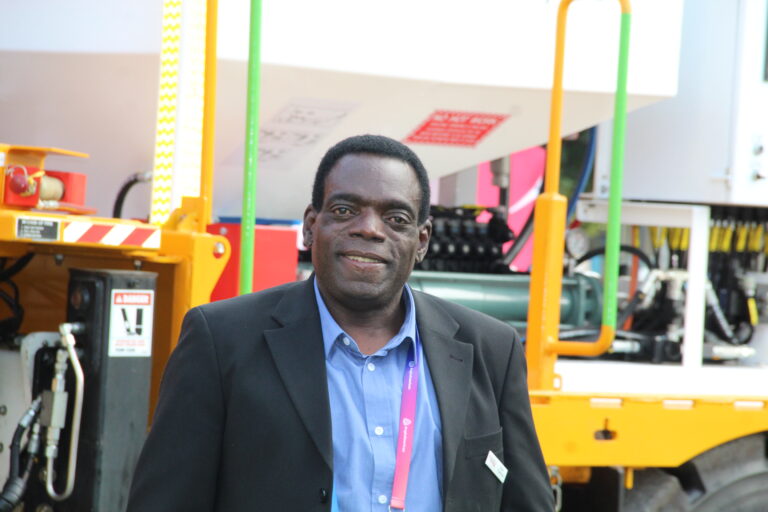
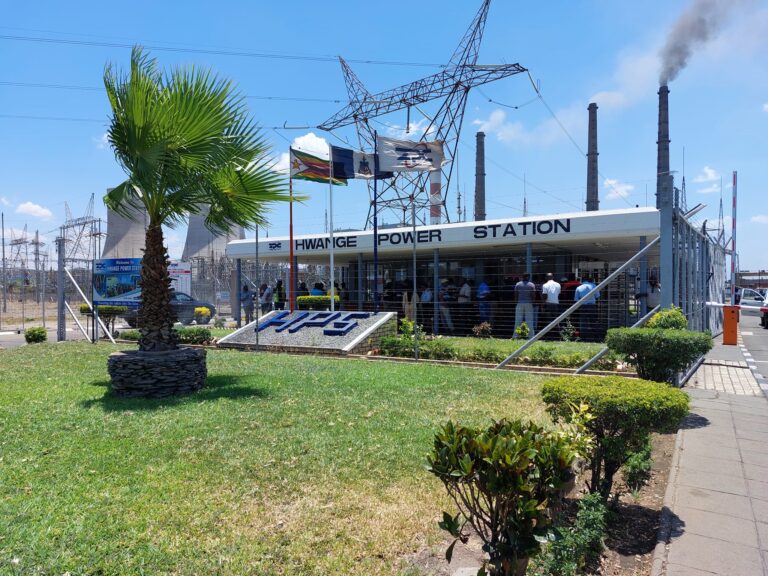
The Association of Mine Managers of Zimbabwe (AMMZ) yesterday conducted its last Technical visit for the 4th quarter of 2023 at the Zimbabwe Power Company (ZPC) in Hwange.

The team of Mine Managers of Zimbabwe, accompanied by various stakeholders visited the Zimbabwe Power Company (ZPC)’s joint venture project with Sinohydro which aims to upgrade and expand the country’s power generation capabilities.

The massive project makes one of Zimbabwe’s biggest Mines, ZIMPLATS appear minified.

With Sinohydro owning 36% and ZPC owning 64% of the venture, the Giant project increased the installed capacity to the grid from the two new units, named Unit 7 and Unit 8.

Giving an overview of how power is generated at the plant the Acting Facility Site Manager Lucia Chibanda said her team is responsible for units 7 and 8 which have an installed capacity of 670 megawatts.

“The scope of the project is that we’ve got two units, that’s unit 7 and unit 8. The existing power station, or the old power station, has got an installed capacity of 920, that’s units 1 to 6. The one that I’m talking about specifically is the new units 7 and 8, which were then officially commissioned on the 3rd of August, 2023. These are two units which are similar in nature. Each generates 335 megawatts,” Chibanda said.

Chibanda said a SADC standard 400kV line was used to transmit power to substations in Bulawayo and Kwekwe.

“We had a line for over 340 kilometres from here, which is Hwange, up to Nsukamini in Bulawayo. Then we had a shorter line, which joined Nsukamini and Marvel. These are substations within Bulawayo. This new line is a 400 kV line. That is what is used in our SADC region. So it enables us to get power from either of our neighbouring countries. The old power lines were 330 kV. So there was new technology for matching the SADC region, the 400 kV line. But we then put two new substations, so that we have redundancy. The 330 line can turn in, going to the 400 kV substation, and then use the 400 kV to be transmitted. So we have a new substation in Kwekwe, which is Sherwood B. It’s basically there to interface the 330 kV lines and the 400 kV lines. Here in Hwange, it’s the same,” Chibanda continued.

A re-allocation program had to be implemented and houses built for relocated families to pave the way for the 400kV line according to Chibanda.

“But for this line to be there, there were people who were already staying in the vicinity. So we had to do what we call RAP. That’s a reallocation program, where we relocate the people to go and live elsewhere. We had to build them houses. These were people along the lines. Those were part of the project. Then we have other feeder projects into the main project, which include the houses that we built for workers. That’s in Mpumalanga and Baobab,” Chibanda continued.

The AMMZ President Engineer Elton Gwatidzo said the technical visit was to ensure the AMMZ would have an appreciation of issues to do with energy supply as energy supply.

“Today we started off with a technical visit to one of our stakeholders, the Hwange power company (Hwange Thermal Power Station) so that the association would have an appreciation of issues to do with energy supply as energy supply is our main driver to our production. We also understand their challenges as well,” Gwatidzo said.

Running under the Theme ‘Zimbabwean Mining Landscape – Transition Towards the Present-Day 4th IR’ the AMMZ’s AGM and Conference today entered its second day. The conference will be a full-day event running concurrently with the AGM (AMMZ annual general meeting). The day will end with the President’s 51st anniversary dinner which is to start at 7 pm,” Gwatidzo concluded.
ZIMPLATS’ Ngwarati Mine wins AMMZ SHE audits

0

ZIMPLATS‘ Ngwarati Mine emerged as the shining safety example reporting zero fatalities, zero Total Recordable Injury Frequency Rate, zero Lost Time Injury Frequency Rate, and zero Lost Time Injury Severity Rate, Chamber of Mines Safety, Health and Environment (SHE) Committee Report has revealed.

Presenting to delegates at the Debut of this year’s Association of Mine Managers of Zimbabwe (AMMZ) AGM and Conference, Butholezwe Dube, a committee member who is also the SHEQ Manager Hwange Colliery Company Limited said in May of 2023, a total of 17 companies and 4 smelting and processing facilities participated in the AMMZ SHE audits, marking a positive start after the lifting of the Covid-19 induced lockdown.

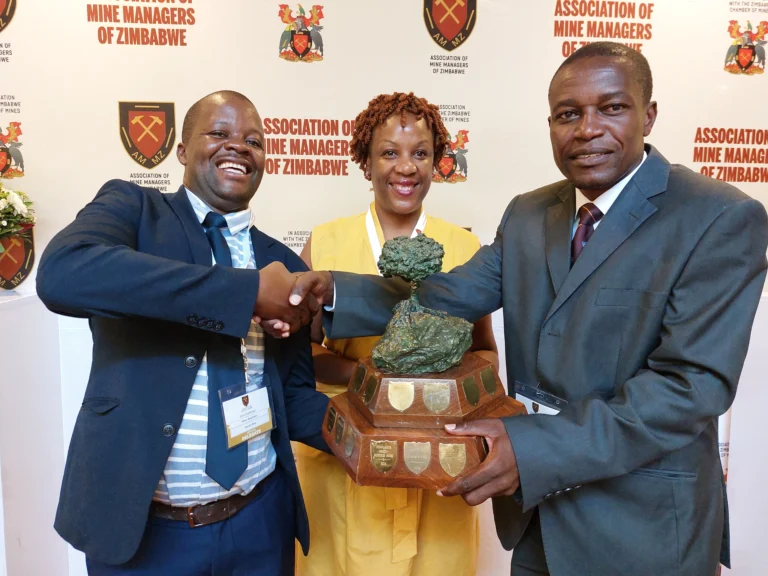
“The audits were conducted in May 2023, 17 Companies and 4 smelting and Processing facilities participated in the audits. This was a good start considering we were coming from lockdown. The criteria used was the revised Audit Protocol. Two mines had zero (0) fatalities, (0) Total Recordable Injury Frequency Rate, (0)Lost Time Injury Frequency Rate and (0) Lost Time Injury Severity Rate and these were Ngwarati Mine and Mupfuti Mine,” Dube said in part.

Ngwarati walked away with a winner’s trophy after attaining the best results, scoring 97 %, with Mupfuti hot on the heels with 94% on the audit checklist.

Dube said the SHE Committee was implementing a new approach towards audits. Instead of competition among companies, it will evolve into a continual improvement program.

“Going forward the SHE Committee is changing the Audits from being a competition to being a continual improvement program. Companies will no longer compete against each other but compete with their previous year’s performance,” Dube said.

These audits demonstrate the importance and effectiveness of prioritizing safety and continual improvement. With their success, the industry is taking significant strides towards creating a safer and more secure work environment.

The Association of Mines Managers of Zimbabwe (AMMZ) was assigned the responsibility of nominating the committee’s vice Chair.

Over and above other activities the SHE Committee has set priorities, these include.

  • Fostering leadership to achieve sustainable resource stewardship.
  • Protecting the health and safety of employees, contractors, and communities.
  • Biodiversity and climate change.
  • Capacity development -i.e. enhancing capacity and competency in SHE matters
  • Continual improvement on standards and systems.

To achieve compliance obligations across the mining industry the SHE committee works in close liaison with regulatory bodies such as EMA, NSSA, SAZ, Radiation Protection Authority and the Ministry of Mines and Mining Development.

The Association of Mine Managers of Zimbabwe (AMMZ) AGM and Conference will continue today. A new President will be voted into power taking over reigns from Engineer Elton Gwatidzo who has been at the helm of the Association for the past two years.

BREAKING: Rushwaya fined us$5000, gold forfeited, gets non custodial sentence

0

Henrietta Rushwaya has been fined us$5000, her 6kgs of gold forfeited to the state and has been given a non-custodial sentence by the high court in Harare today.

The level 15 fine she received of us$5000 is due on the 17th of November 2023 or 12 months in jail.

Her gold was forfeited to the State in terms of Section 62(1)(a ) of the Criminal procedure.

Henrietta had been held in custody for a 2020 case where she was caught at the airport with 6kgs of gold. Rushwaya maintains that she had picked the wrong bag.

More to follow…

Interview: Alois Kwenda, MD AECI Mining Zimbabwe & Mozambique

0

Mining Zimbabwe (MZ): Good day Mr Alois Kwenda (AK), a big congratulations to you and your team for being one of the suppliers of service products that has stood the test of time and continued to supply the mining industry and of course for achieving a momentous safety record and scooping several safety awards at the recently held SHEQ conference.

Alois Kwenda: Thank you. These achievements are testimony to the highly dedicated and motivated team that we have in Zimbabwe. The success of any business is a direct result of the combined efforts of its employees.

MZ: Before we get into the Safety achievement and the subsequent awards, please tell me who is AK?

AK: I am a mining engineer born and bred in Zimbabwe. After initially working in the mining industry in Zimbabwe I joined AECI Zimbabwe in February 1994 and rose through the ranks to head up the company in May 1999. I was relocated to South Africa in September 2002 where I held several positions until I was appointed general manager for Latin America in May 2015. I returned to Zimbabwe in August 2018 following the conclusion of my assignment in Latin America. However, this time I returned with the additional accountability for Mozambique.

MZ: You are the MD for AECI Mining Zimbabwe and Mozambique, tell me more about AECI. (a brief on AECI Mining)

AK: AECI is a diversified group of companies comprising 4 main pillars namely, mining, water, agrihealth and chemicals. It has regional and international businesses in Africa, Europe, North America Latin America, South East Asia and Australia.  I am within the mining pillar which focuses on providing optimized blasting solutions consisting of explosives, equipment and technical expertise as well as metallurgical chemicals for the extraction of minerals with the attendant expertise to optimise the use of the chemicals.              

MZ: You have been the MD for over 5 years now, how has been the experience?

AK: As already mentioned I was MD of AECI Zimbabwe previously. However, I returned to a more exciting and bigger business where mining was and continues to be on a growth trajectory. The environment is quite competitive with a number of local and international players. but as ACEI we have held our own as we are providers of holistic mining solutions rather than mere explosives suppliers or traders.

MZ: Apart from your distinguished products, what sets AECI apart from other suppliers of explosives?

AK: ACEI provides holistic blasting solutions consisting of products, equipment and technical expertise. We work with our customers in partnership to optimise blasting practices in order to meet each individual customer’s specific requirements. To this end, we put our money where our mouth is by entering into service level agreements with specific key performance indicators against which our peroducts and services are measured.

MZ: You are overseeing AECI Mining business in Zimbabwe and Mozambique, what is the operating environment like in the two countries?

AK: The operating environment in Zimbabwe is very dynamic in terms of monetary and economic policies. As a result we have had to be a flexible and adaptive organisations in order to be able to sustain our business in the current environment. We take a long term view of our business in Zimbabwe and we believe that the economy is headed in the right direction and sustained stability will be brought about over time.

MZ: AECI is very visible in the big mining corporations. What AECI Mining’s strategy with regards to small-scale miners?

AK: We understand that the small-scale miners are an integral part of the Zimbabwean mining industry and constitute a significant part of the explosives market. Our strategy is to supply this market through local distributors of our products who have the support of our technical personnel to ensure the safe and efficient application of our products.

MZ: Let’s talk about the 20 years LTI free, this achievement confirms Zero harm is possible. Please tell me the secret to achieving Zero harm.

AK: The secret to our achievement lies in the organizational culture that has been built over the years. Our employees are empowered to make decisions about safety at every level. There is constant engagement with our employees around safety and we have an environment where each employee feels free to raise concerns about anything that may impact negatively on safety but most importantly, we reward them for coming up with new ideas on how to improve safety. The safety message is driven from the top of the organisations downwards as well as from the shop floor upwards. This is how a culture of engagement on safety has been built over time.

MZ: Daily, what messages do you convey to yourself and your team regarding safety?

AK: It is that Zero Harm is achievable and that no job is so important that it cannot be done unsafely. If it cannot be done safely then it should not be done.

MZ: You and your team scooped three awards at the recently held AECI SHEQ conference, tell us more about these awards and what they mean to the business.

AK: In summary these awards were in recognition of the team’s achievements in the areas of safety, environmental protection and quality within the AECI group.

MZ: Let’s talk about explosives security. How do you keep explosives safe considering the large volumes you handle in-country?

AK: Our main strategy has been to develop bulk explosives for all applications. This type of explosive requires 2 components which are non-explosive and only become explosive upon mixing using specialised equipment. This has reduced the quantity of explosives which are kept in locked and guarded magazines.

MZ: Innovation is the key to success, what innovations are coming up in the industry and how is set AECI towards achieving success?

AK: AECI is a leading innovator in the field of explosives and blasting which is recognised worldwide. There are a number of innovations currently in development, some of which I am not at liberty to disclose. However the most exciting one is the wireless electronic detonator which will bring about safe blasting in surface and underground applications. These are programmable wireless detonators which have the potential to be set off remotely via satellite from unlimited distances from the blast. AECI has successfully tested its prototype although without the use of satellites.

MZ: Does AECI offer any courses for blasting

AK: Indeed, we offer what is known as a blasting competency course and several of our customers in Zimbabwe have already benefited from this.

MZ: Alois you are a seasoned miner. What advice would you give to an 18-year-old who is passionate about mining and thinking of becoming one?

AK: Mining is a very interesting field where science is applied constantly. It has many opportunities but it is also a tough and unforgiving environment where compromising safety will have far reaching consequences than the majority of other occupations.

MZ: Outside work, what occupies Alois?

AK: Outside work I am an avid golfer. I also believe in keeping up to date with world affairs as well new developments in science. I read a variety of business and science journals quite regularly and the area of quantum physics is very fascinating for me particularly teleportation. I believe that the next life changing invention will come from this field of science and I hope it will be in my lifetime.

MZ: What are your parting words to our readers?

AK: As individuals and organisations it is important to set goals and actively work towards achieving them. Strategies need to be adjusted when faced with obstacles but focus should remain on the goals. Our main one as AECI is to achieve Zero harm to the environment and anyone ever and as the Zimbabwean team we have demonstrated that it is possible over a 20 year period. Our challenge is to sustain it and we are up to that challenge.


This article first appeared in the Mining Zimbabwe issue 68 

CSR initiatives in ASM, what should be done?

0

The activities of small-scale mining (ASM) companies have come under great scrutiny in Zimbabwe due to bad public image and perception, threatening the sustainability of the sector with stakeholders advocating that the sector adopt a clear Corporate Social Responsibility (CSR) strategy or policy that will ensure Environment, Social and Governance (ESG) issues are adopted by the sector.

CSR is when a company operates ethically and sustainably and deals with its environmental and social impacts. This means careful consideration of human rights, the community, the environment, and the society in which it operates.

CSR includes interactions with communities, suppliers, employees, consumers and the Government. There is growing interest in CSR worldwide given the concern with social equity, socially and environmentally sustainable development and corporate roles. The industry today can no longer operate without taking into consideration the needs and interests of the community and society at large.

The ASM sector in Zimbabwe is however accused of blowing money, and degrading the environment with no mine rehabilitation, CSR, mine closure and ESG strategies.

What should be done to ensure ASM adhere to CSR?

Speaking to Mining Zimbabwe, Mineral resource governance expert Mr Tapuwa O’bren Nhachi, said the challenge with the Zimbabwe ASM sector is that it is not formalized and is done haphazardly. He said the miners are in the community to maximise their profits at the expense of the community and the environment.

According to Nhachi, to ensure that small-scale and artisanal miners in Zimbabwe give back to the community, several actions can be taken which include, capacity building, formalisation, access to finances, and regulatory framework.

He said to ensure there is a sustainable CSR strategy within the ASM industry, there was a need to provide training and education programs to improve the miners’ skills and knowledge in sustainable mining practices, environmental protection, and community engagement. He also said that there was a need for the ASM to have access to financial services and credit. He said this can help them invest in safer and more efficient mining equipment and technologies, as well as support community development initiatives and they will pay tax as well.

According to Nhachi to ensure the ASM sector has a working CSR strategy there is a need for the government to support the formalization of small-scale mining operations by providing legal recognition and licenses to help ensure compliance with regulations and promote responsible mining practices.

“Formalizing the ASM sector would bring it into the formal sector through legal, regulatory, and policy frameworks

“Formalizing the sector would also result in the inclusion of marginalized miners throughout the process of developing, adapting, and revising legal frameworks and support. If well designed, this process fosters the conditions to integrate ASM into the formal economy, potentially transforming the lives and safety of millions of people in the country who depend on the sector

“The initial process is to develop conducive and Comprehensive Legal Frameworks through creating a platform for positive and regular dialogue between ASM stakeholders and government to provide a conduit for consultation on changes, informing dialogue based on research on mining communities to understand the complexities of the ASM sector and establishing a co-created roadmap outlining,” he said.

Zimbabwe Diamond and Allied Mineral Workers Union (ZDAMWU) General Secretary Mr Justice Chinhema said it was important for the government to develop and enforce regulations that promote responsible mining practices, community inclusion and protect the rights of small-scale miners. He said the strategy includes, measures to prevent child labour, fair working conditions, prevention of environmental degradation and to punish those who do not abide by the law.

“At the moment there is a lack of regulatory enforcement by the relative authorities due to political patronage and corruption

“There is need for government to urgently come up with a law.

“Without an enabling legislation that speaks about ASM participating in CSR, communities and Workers will always be at a disadvantage,” Chinhema said.

What are ASM currently doing?

While there is a lot of talk about the ASM not doing anything in terms of corporate social responsibility, Communities in the gold-rich area of Kadoma are applauding the efforts being made by the miners to empower young people and help in the growth and development of their communities.

The miners in the gold-rich area are taking CSR seriously aiming to take a leaf from activities done by Zimplats but at a small-scale venture.

Speaking in an interview with this publication, Thembonkosi Mangena, an employee for one of the small-scale mining companies in Kadoma applauded the efforts made by miners in their district to empower young people.

“A lot of families are benefitting from these initiatives. I work here on the mine but I have a family also benefiting so I am grateful for that. If I was not employed by this mine, i don’t know where my life would be, “he said.

According to the Managing Director of Tshuma Milling, Mr Spencer Tshuma his company has been doing a lot for the communities making sure that they benefit from the resources which are being mined in the area they live.

His company is known for promoting upcoming small-scale miners with equipment such as jackhammers, compressors and excavators.

“We have recently drilled boreholes for the communities around and rooftops at Gweshe Primary School and we are paying school fees for the less privileged,” Tshuma said.

Also, to see the growth and development of the artisanal and small-scale mining sector Mrasta Mining, a mining and milling company in Kadoma has been donating equipment to miners. Mrasta Mining Milling Manager Oliver Hlupayi said his company has been supporting miners to promote formalization.

“We are providing equipment for miners to support their growth and development,” Hlupayi said.

The company’s Managing Director, Mr Johannes Sithole said his company was paying fees for the best pupils at Sanyati and Alabama primary school.

“We paying school fees for the top 2 pupils in every class at Alabama Primary School and Sanyati Primary School. In addition, the company employs over 90 per cent of its employees from Kadoma” Sithole said.

Conclusion

While stakeholders within the mining industry have their view on what should be done to ensure that the ASM adopt CSR initiatives for the benefit of communities. It is crucial to understand the operations of small-scale miners in order to develop a concise Corporate Social Responsibility (CSR) policy for them.


This article was first published in the Mining Zimbabwe Magazine issue 68

Chrome to replace REE in luminescent materials and catalysts

0

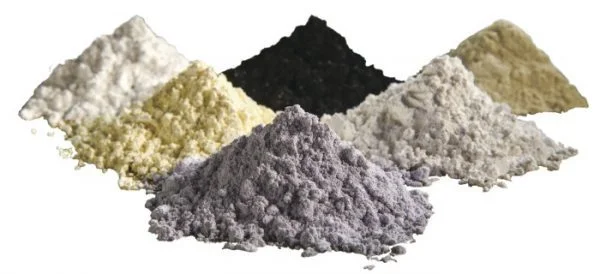
Chemists at the University of Basel have succeeded in replacing the rare earth elements (REE) found in illuminating screens with Chromium which is significantly a cheaper metal.

Rudairo Mapuranga

Luminescence may be seen in neon and fluorescent lamps; television, radar, and X-ray fluoroscope screens; organic substances such as luminol or the luciferins in fireflies and glowworms; certain pigments used in outdoor advertising; and also natural electrical phenomena such as lightning and the aurora borealis.

The Researchers in a paper in the journal Nature Chemistry, said they developed chromium compounds that can replace the noble metals osmium and ruthenium in luminescent materials and catalysts.

The team reports that the luminescent properties of the new chromium materials are nearly as good as some of the osmium compounds used so far. Relative to osmium, however, chromium is about 20,000 times more abundant in the earth’s crust—and much cheaper.

The new materials are also proving to be efficient catalysts for photochemical reactions, including processes that are triggered by exposure to light.

If the new chromium compounds are irradiated with a red lamp, the energy from the light can be stored in molecules which can then serve as a power source.

“Here, there’s also the potential to use our new materials in artificial photosynthesis to produce solar fuels,” lead researcher Oliver Wenger said in a media statement.

To make the chromium atoms glow and enable them to convert energy, the researchers built them into an organic molecular framework consisting of carbon, nitrogen, and hydrogen.

The group designed this organic framework to be particularly stiff so that the chromium atoms are well packaged. This tailor-made environment helps to minimize energy losses due to undesired molecular vibrations and to optimize the luminescent and catalytic properties. The disadvantage of the new materials is that chromium requires a more complex framework than noble metals—and further research will therefore be needed in the future.

Encased in its rigid organic framework, chromium proves to be much more reactive than noble metals when exposed to light. This paves the way for photochemical reactions that are otherwise difficult to initiate. A potential application could be in the production of active pharmaceutical ingredients.

Similar to noble metals

For a long time, the search for sustainable and cost-effective materials without noble metals focused primarily on iron and copper. Other research groups have already achieved promising results with both of these elements, and chromium has also been incorporated into luminescent materials in the past.

In many cases, however, the luminescent and catalytic properties of these materials lagged behind those of materials containing rare and expensive noble metals—therefore failing to represent a real alternative. The new materials made of chromium are different because they contain a form of chromium that is particularly similar to noble metals, thereby achieving luminescent and catalytic efficiencies that come very close to materials containing such metals.

“At the moment, it seems unclear which metal will ultimately win the race when it comes to future applications in luminescent materials and artificial photosynthesis,” Wenger said. “What is certain, however, is that the postdocs Dr. Narayan Sinha and Dr. Christina Wegeberg have made important progress together.”

Next, Wenger and his research group aim to develop their materials on a larger scale to allow broader testing of potential applications. By making additional improvements, they hope to achieve light emission in different spectral colors from blue to green to red. They also want to further optimize the catalytic properties to bring us a major step closer to converting sunlight into chemical energy for storage—as in photosynthesis.


This article was published in the Mining Zimbabwe magazine issue 68

Hogarths Successfully Completes Mimosa Plant Optimization Project

0

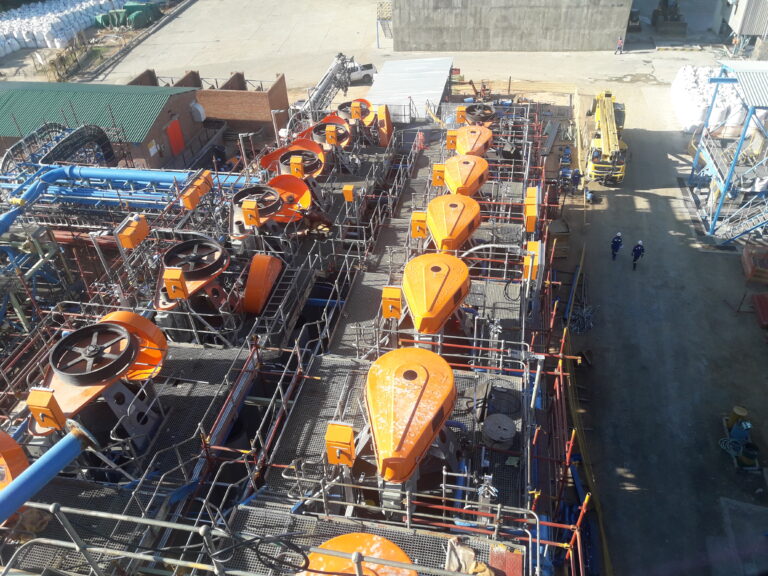
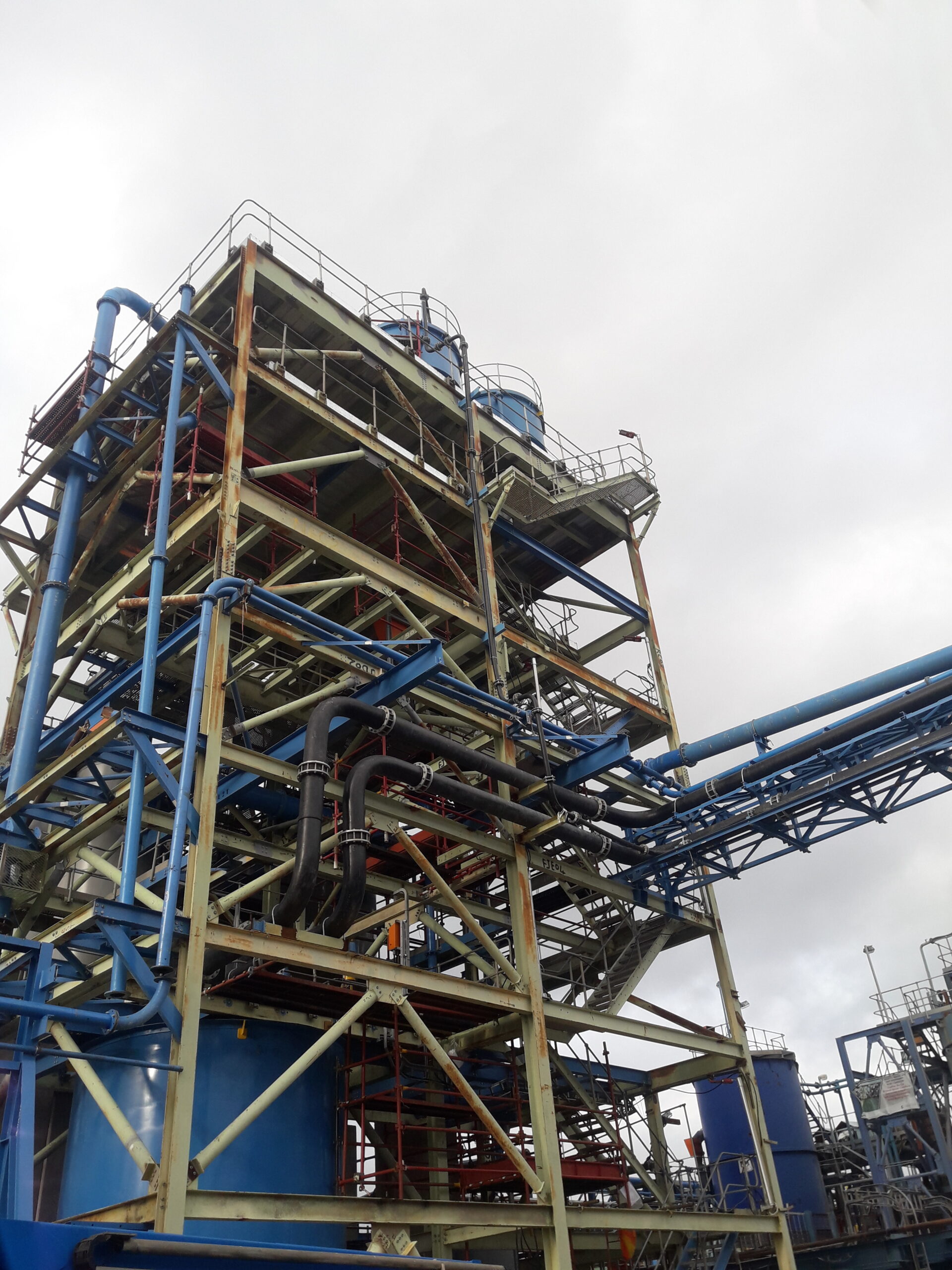
Hogarths which is an ISO 9001:2015 QMS Certified Organisation, a leading engineering and steel fabrication company based in Bulawayo, Zimbabwe recently successfully completed the Mimosa Plant Optimization Project. The project involved the construction of three processing plants, namely the milling area, primary roughers, and cleaners. (Structural steel fabrication & erection).

Mimosa Mine, one of the top three platinum mines in Zimbabwe contracted Hogarths for this project, with DRA Global as the Project Managers. The objective of the project was to optimize the mine’s platinum production by repurposing steelwork from a mine in South Africa. This trend is becoming prevalent because of sustainability, cost-effectiveness and versatility, which is an encouraging move by Mimosa as it aims at sustainability.

The project was completed within the Client’s budget even though there were overruns due to unknown complexities. Hogarths’ team of experienced engineers and steelworkers worked closely with the Mimosa Mine team and DRA team to ensure the smooth and efficient execution of the project. Hogarths achieved over 500 000 LTI free man-hours worked and received an achievement award from DRA. This shows a commitment to SHE by Hogarths.

The project involved a number of challenges, including:

  • The condition of the steelwork from the decommissioned mine. This steel work was painted after installation.
  • The need to modify the steelwork to fit the specific requirements of the Mimosa Mine plant.
  • The transportation of the steelwork to the Mimosa Mine site.
  • The installation of the steelwork, which was a complex and delicate process.

To overcome these challenges, Hogarths used a number of innovative solutions, including:

  • Using computer-aided design software to create the modifications.
  • Using an efficient logistics coordination setup in the pre-clearance and transportation to the installation site inside Mimosa mine premises.
  • Using a team of experienced steel fabrication experts to install the steelwork.

Hogarths has a strategic partnership with VIVA Engineering in South Africa, this partnership aims to benefit the client as both engineering companies pool resources to ensure a short project turnaround time. The successful completion of the Mimosa Plant Optimization Project is a testament to Hogarths’ expertise in engineering and steel fabrication. The company has a long history of delivering high-quality projects on time and within budget. Hogarths is a reliable partner for any mining company looking to optimize its production.

Defer export tax, Zim Platinum miners tell government

0

Zimbabwe platinum miners have asked the government to defer its planned 5% export tax on concentrates, pending the completion of smelters and the refurbishment of a refinery.

The producers want the tax-deferred until 2025, according to a proposal submitted by the Chamber of Mines of Zimbabwe to the finance ministry before the 2024 budget presentation later this month. After announcing the tax in 2020, the Treasury initially gave miners two years to prepare, before later deferring it until January 2024.

The government is introducing the levy on shipments of platinum group metals’ concentrates to spur the development of processing facilities in Zimbabwe. Impala Platinum Holdings Zimplats unit is on track to refurbish its base metal refinery and other smelters by 2025, the chamber said.

“To this end, we are appealing for further deferment of export tax on PGMs concentrates to align with Zimplats timelines for completion of their beneficiation projects,” it said.

Zimplats plans to spend $1.8 billion expanding mining and processing, including rehabilitating an old base-metals refinery built by BHP Group.

The chamber also said that an increase in the royalty on PGMs to 7%, from a previous rate of 2.5%, was impacting the viability of projects, especially after a decline in prices. It appealed for a lower royalty that could be adjusted with prices.

“We appeal for a royalty of around 3%,” the chamber said. “The royalty can be reviewed in line with movements in platinum prices up to a maximum of 5%.”

Zimbabwe holds the world’s third-largest known reserves of platinum.

Bloomberg

Rushwaya to be sentenced tomorrow

0

Zimbabwe Miners Federation (ZMF) President Ms Henrietta Rushwaya who is accused of attempting to smuggle 6kg of gold will be sentenced tomorrow at 14:30hrs, Mining Zimbabwe has learnt.

Rushwaya had been remanded to today (14 November 2023) for sentencing at the anti-corruption court at the High Court in Harare as the state waited for submission of evidence from the Reserve Bank of Zimbabwe (RBZ) and ZIMRA on how much the state was prejudiced.

As directed by the courts, ZIMRA and RBZ today submitted the required evidence and the judge announced that the ZMF leader will be sentenced tomorrow.

The court established that the gold Rushwaya was convicted for trying to smuggle belonged to her which might imply that the state could have been prejudiced by 1 per cent of the Gold translating to a total of US$3 300.

According to the law gold produced by small miners attract a 1 per cent royalty (for the first 0.5 kgs of gold delivered to a holder of a gold licence in a calendar month); 1 per cent (if the gold is delivered by a holder of a gold-buying agency permit to a holder of a gold-dealing licence in a calendar month), 2 percent (if the gold delivered to a holder of a gold dealing licence in a calendar month exceeds 0.5 kgs). And Gold produced by other miners attracts 3 percent (if the gold produced by them is sold at a time when its price is below US$1,200 per ounce) 5 percent (if the gold produced by them is sold at a time when its price is above US$1,200 per ounce).

Meanwhile ASGold Producers will now be paid as their large scale counterparts who get 75% of their payment in US dollars and the remaining 25% in local currency.

Prospect’s WinBin Discovery Rapidly Growing at Goromonzi’s Step Aside project

0

Australia Stock Exchange listed mining and exploration junior Prospect Resources’ Step Aside Lithium project continues to provide promising results at its high-rated WinBin discovery which has returned an intercept of 33m @ 1.18% Li2O from 81m, including 24m @ 1.41% Li2Ofrom 88m, the company Managing Director and CEO Sam Hosack has announced.

Rudairo Mapuranga

According to Hosack, WinBin potentially represents a feeder zone for the defined spodumene mineralisation identified further to the north during earlier phases of drilling.

“WinBin continues to provide very promising results which have our team very excited, particularly with the potential this body provides as a feeder system to the northern pegmatites. In addition, the belief that the WinBin feeder is yet to be fully understood makes this a very compelling geological process. We look forward to providing more news flow on Step Aside over the coming months,” Hosack said.

The Prospect Resource CEO said a 10.45m-wide zone of the WinBin pegmatite was also intersected 220m beneath the discovery holes, in a successful re-entry of drill hole CDD054.

“The second drill hole completed at its significant new WinBin lithium discovery at the Step Aside Lithium Project (Step Aside) (PSC90%) in Zimbabwe, has returned strong assay results. Vertical drill hole CDD056, collared 2m west of the angled discovery holeCDD055, intercepted33m @ 1.18% Li2Ofrom 81m downhole, including a higher-grade section of 24m @ 1.41% Li2Ofrom 88m.

“In addition, angled drill hole CDD054, collared 230m west of the discovery cluster, was reentered at 80m depth and has intersected a 10.45m wide zone of the projected WinBin pegmatite position at a downhole depth of 388m. Assays are pending for this zone, which contains visual spodumene crystals and is located approximately 300m vertically from surface.

“The deep intersection of mineralised pegmatite within drill hole CDD054, along with multiple further intercepts of strongly mineralised pegmatite in subsequent holes drilled to the south of the WinBin discovery has demanded this area of the Step Aside licence be subjected to further immediate follow-up drilling. With 3,750m of the expanded 5,000m Phase 3 programme having been completed to date, the remaining 1,250m is being deployed to this end. Furthermore, the exciting results of the Stage 3 diamond drilling programme are informing the design and optimisation of a planned Phase 4 programme to commence early in the New Year, focused on WinBin,” he said.

Hosack said XRD analysis from pulp samples of discovery hole CDD055 demonstrate that WinBin lithium mineralisation is predominantly spodumene(+95%).

“Recent XRD analysis of representative pulp samples from the lithium mineralised intersection of WinBin discovery hole CDD055 have also returned a compositional result that is more than 95% spodumene,” he said.

According to Hosack, Five (5)further drill holes targeting the extension of WinBin to the south have intersected strong intersections of coarse spodumene, with all assays pending.

He said new assays received from holes targeting the Pegmatite C deposit north of WinBin returned 5.62m @1.48%Li2O(CDD053) and 6.68m @ 1.17% Li2O(CDD057).

Hosack added that “the full structural position of the WinBin deposit, plus the narrower but well-mineralised pegmatites to the north, is still not entirely clear. However, there is mounting evidence that WinBin may be the potential feeder zone for the Colga pegmatite swarm (specifically Pegmatites A to F), which was targeted during the earlier phases of drilling completed by Prospect at Step Aside. Indirectly, the WinBin discovery itself may be “fed” from a larger (currently undefined) regional intrusive parent body in the broader Harare Greenstone Belt.”

Stage 3 Diamond Drilling Programme

The expanded diamond drilling programme of 5,000 metres is expected to be completed in early December, with most assays then available by mid-January 2024. Prospect is continuing to evaluate extensions of the WinBin deposit, with one drill rig dedicated to expanding the volumetric limits of this impressively coarse-grained and high-grade spodumene deposit(a distinct feature of this pegmatite intrusion). The second rig is regionally testing Pegmatite C northwards from positions where t appears to co-join WinBin and is currently interpreted to represent a splay from the latter.