Home Blog Page 263

Zimbabwe gold buying prices 2 August 2023

Fidelity Gold Refinery (FGR) official gold buying prices Wednesday 2 August 2023. See the Zimbabwe gold buying prices today.

SG 90% AND ABOVE US$59.16/g
SG ABOVE 85% BUT BELOW 90% US$58.53/g
SG ABOVE 80% BUT BELOW 85% US$57.90/g
SG ABOVE 75% BUT BELOW 80% US$57.28/g
SAMPLE BELOW 10g BUT ABOVE 5g US$56.34/g
FIRE ASSAY CASH US$59.47/g

NB: Fire Assay cash price is for gold above 100gs, no sample is deducted.
For the Fire Assay Transfer price, a sample of not more than 10g is deducted
A 2% royalty is charged on all deposits (small-scale miners)
A 5% royalty is set for Primary Producers

Cash available. Fidelity Gold Refinery prices will be changing daily about world market prices.

How the public benefits from Mining in Zimbabwe

0

One of the most common comments on the Mining Zimbabwe platform is “is Mining benefitting the country and its people?

While it is true that the environmental impact of mining activities is a concern, it is equally important to acknowledge the numerous socioeconomic advantages that mining brings to the public. From job creation and economic growth to improved infrastructure and technological advancements, mining offers astounding benefits that positively impact communities and entire nations.

In this article, Mining Zimbabwe sheds light on some of the key ways in which the public benefits from mining in Zimbabwe.

Job Creation and Economic Growth

Mining operations provide a substantial number of direct and indirect employment opportunities. These jobs encompass a wide range of positions, including mine workers, engineers, geologists, technicians, truck drivers, and more. Alongside these direct mining jobs, various supporting industries such as manufacturing, construction, logistics, and retail also thrive thanks to the demand generated by the mining sector. Media organisations like Mining Zimbabwe are also beneficiaries of the Mining Industry.

The resultant job creation not only bolsters the economy but also improves living standards. It empowers individuals to provide for themselves and their families, reducing unemployment rates and promoting overall economic stability. In turn, increased disposable income boosts consumption, further stimulating local businesses, and contributing to Zimbabwe’s economic growth. A good example is how Dallaglio’s revival of the Eureka Gold mine breathed life into the otherwise lacklustre town of Guruve.

Post-2000 has also seen the emergence and rise of Artisanal and Small-scale mining (ASM). It led to the formation of the Zimbabwe Miners Federation (ZMF), an organisation representing the ASM industry. It is the country’s biggest mining body with over 1.5 million members according to its website. This makes mining one of the biggest employers in the country with its membership making 100% remuneration in the much more stable us dollars.

Taxation and Government Revenue

The mining industry in Zimbabwe represents a significant contributor to the country’s tax income, which strengthens government finances and enables investment in various public services. Taxes associated with mining operations can include corporate income tax, royalties, and contributions to social programs. This revenue is crucial for funding education systems, healthcare services, infrastructure development, and other vital public projects. Consequently, mining facilitates the provision of better public facilities, improved healthcare access, and enhanced educational opportunities for citizens.

Infrastructure Development

Mining activities necessitate the development of essential infrastructure, including road networks, railways, ports, and power supply systems. These infrastructural developments not only support mining operations but also create vital transportation links, facilitating regional connectivity and accessibility. Improved transportation infrastructure benefits the public by enhancing trade, reducing logistical costs, and opening up previously isolated regions. Improved mining investments could be partly the reason why we have been seeing a reconstruction of major Highways like the Harare – Beitbridge road. Moreover, mining companies, as part of their social responsibility, often invest in community development projects such as schools, hospitals, and clean water initiatives, positively impacting local populations. ZIMPLATS a platinum giant owned by Impala Platinum has been leading in the construction of Clinics, Schools, roads and many others as part of its Corporate Social Responsibility (CSR).

Skills Development and Technological Advancements

Mining demands a diverse range of technical expertise. It provides ample opportunities for skills development and knowledge transfer. Mining operations require specialized training in engineering, geosciences, metallurgy, and environmental sciences, among others. By investing in training and education, mining companies contribute to the creation of a highly skilled workforce that can be utilized across various industries, driving economic diversification and innovation.

Furthermore, mining activities foster technological advancements. Mining companies invest heavily in research and development to enhance operational efficiency, minimize environmental impacts, and improve safety protocols. Such advancements often find wider applications beyond the mining sector, positively influencing other industries and further benefiting the nation as a whole.

Despite the valid concerns about environmental impact especially in the ASM sector, there is no denying that mining brings significant benefits to the public in Zimbabwe and many other countries. Job creation, economic growth, improved infrastructure, and technological advancements are just a few of the many advantages that mining operations offer.

While Zimbabwean communities (where mining is taking place) are now demanding a fixed percentage to be paid directly to them a lot still needs to be done to educate the public on how they benefit from mining. 

While mining has grown since 2017, it is crucial to note that we have barely scratched the surface therefore on its Mining cannot sustain the economy of Zimbabwe.

South Mining commended for its CSR strategy

0

HWANGE-based coking coal producer, South Mining (Pvt) Ltd was commended for its Corporate Social Responsibility (CSR) initiatives, including the construction of a state-of-the-art community library.

Rudairo Mapuranga

Education, in South Mining’s eyes, is a powerful tool for social cohesion, peace, and economic development. As such, they continue to invest in educational initiatives, believing it to be a vital instrument for poverty alleviation and progress.

Speaking at the South Mining Community Library Official Commissioning by First Lady DR. Auxillia Mnangagwa in Hwange on Thursday, the Minister of Mines and Mining Development Hon Winston Chitando said the CSR programs that South Mining has been doing are an indication for a company that is determined to promote government’s economic blueprint.

He also said that by investing in a library South Miming was concerned with the future Development of the country and called upon all Mines to emulate South Mining’s vision.

“What is important if you look for the economic history, no country started as developed, countries printed visions and developed themselves. The library came with a vision, and all the CSR statistics I have mentioned suggest that as a company South Mining is determined to help his Excellency the President in achieving his 2030 vision,” Hon Chitando said.

Capable of accommodating up to 100 pupils at a time, the library features a cutting-edge computer laboratory with internet access, online journals, and an extensive collection of books. The goal is to create a conducive environment for learning, laying a strong foundation for academic success and personal growth.

Speaking at the same event the First Lady Dr Auxillia Mnangagwa commended South Mining for coming up with a community library saying that it will cater for the changing world.

She also said that the library will help the girl child in breaking free from societal constraints to become leaders of tomorrow thereby helping in the achievement of the 2030 vision.

“This library will evolve with changing times, it will cater for the changing world. South Mining investing in this library is not only investing in the future but also assuring that the past is not forgotten.

“I come before you today to emphasize the importance for education for the girl child. Education is not only a fundamental right but a catalyst for social change and empowerment. When we educate the girl child, we equip them with the knowledge and skills they need to succeed to break free from societal constraints and become leaders in their communities. It is through education that we break the circle of inequality and discrimination, let us invest in the education of the girl child and in doing so we invest in the progress of our society as a whole,” Dr Mnangagwa said.

The CSR strategy

For South Mining to construct the state-of-the-art community library in Mpumalanga high-density suburb in Hwange. The Hwange local board donated 2 500m2 for this initiative. The library building itself takes up 700m2 and the librarian’s accommodation 100m2.

The construction of the community library as well as equipping it and the librarian’s four-roomed house was done at a cost of US$600 000. The well-equipped library will come in handy in offering a conducive environment for learners to study and lay a good foundation for them to excel in both their academic work and life in general.

To address the pressing issue of water access in rural areas, South Mining has drilled six boreholes, providing safe, clean drinking water for both humans and livestock. These boreholes have also facilitated the establishment of nutritional gardens, promoting food security and self-sustainability within the communities.

In addition to the library and water initiatives, South Mining has shown immense support for communal activities and social programmes. They constructed a community hall in Madumabisa, providing a gathering place for villagers during group activities, social support, and public information initiatives.

In addition to the above-mentioned community social responsibility actions by the company some activities that were undertaken include the construction of a football pitch in Madumabisa Village, the donation of a twin cab (Toyota Hilux) to the Hwange Rural District Council to enable its personnel to reach out to communities and areas with poor road networks.

Careen Madzore: Geology Technician to Business Dev Manager

0

Careen Madzore, began her career as a Geology Technician at Unki Mines in 2010, gradually advancing within the company’s Mineral Resources department before eventually relocating to South Africa where she now works as a Business Development Manager. Over the past three years, Careen held numerous management positions in Mining Business Development, both locally and internationally.

Mining Zimbabwe had a one-on-one interview with the Madzore and this is how it went.

Can you please tell me about yourself and how you ended up in your position (Mine Vision Systems)?

My name is Careen Madzore. I am employed by Mine Vision Systems as a Business Development Manager for Africa. I hold a Diploma in Mining Geology, Bachelor’s degree in Geology, a Certificate in Strata Control, a Post Graduate Diploma in Business Management and a Blasting licence. I am currently busy with my MBA.

I started my career at Unki Mines in 2010 as a Geology Technician. I held several positions within the Unki Mine Mineral Resources department before relocating to South Africa. Over the past 3 years, I held several management positions in Mining Business Development locally and internationally.

What does your company do and how has been business for the past 5 years?

Mine Vision Systems is a United States-based company which focuses on bringing vision-related technology and software algorithms to the mining industry. Mine Vision Systems is a pioneer in the underground 3D mapping space. The company aims to provide products and services which improve efficiency, safety, production and automation in mining through unmatched data collection and workflow. Mine Vision Systems invented the FaceCapture™ mapping system which utilizes world-class software to help acquire data for better and faster decisions. The FaceCapture™ mapping systems can be utilized in any underground mine.  Over the past 5 years, the company has been involved in a lot of research and design of better FaceCapture™mapping systems. The company has delivered more than 100 units worldwide.

What does it entail to be a Business Development Manager at Mine Vision Systems? 

As a Business Development manager, my role is to develop a strategy and roadmap for the sustainable growth of Mine Vision Systems in Africa by developing a network of contacts in the Mining Industry. I am also acting as an onsite technical expert working with existing customers to help them get the most out of the FaceCapture ™mapping system.

What is your strategy for future growth? 

Mine Vision System’s strategy is to grow the market share by developing new products to serve the mining industry. The company is also diversifying and developing in new markets. The goal is to have our FaceCapture™mapping system utilised in all the underground mines.

How have you responded to the increased regional competition?

Innovation- our product is innovative, unique and cost-effective which gives Mine Vision System a competitive advantage over competitors.

Do you see countries such as Zimbabwe becoming your major priorities for growth as a company? 

Zimbabwe is my priority, the mines are open to new technologies and innovative products. 60% of my sales come from Zimbabwe. The mining industry in Zimbabwe is expanding and the need for products and services is increasing.

You recently attended the Zimbabwe National Institute of Rock Engineering (ZINIRE) Annual General Meeting, what were the takeaways from the event? 

I was very impressed with the turnout of the Rock Engineering practitioners, almost all mines were represented. Rock Engineering is something which was lagging behind in the industry for long, through ZINIRE all mines are beginning to realise the importance of this event. As a supplier, I had an opportunity to meet my industry colleagues and showcase my company’s products and services.

Zimbabwe will host various mining events during the last quarter of 2023 like the Mine Entra, will your company be part of the gatherings? 

This is a good opportunity to showcase Mine Vision System products and services. Attending this event will allow me to network with my target clients, generate leads, attract new customers and build a good relationship with my customers.

As a woman, what advice can you give to young women who would want to be like you in future?

Own the decisions you make and own your career. If there’s something you want to do or an opportunity you want to take, go for it. Mining has nothing to do with gender. If you work hard you will excel. Through hard work, I rose from a mere technician to a continent representative. It’s a long and sometimes frustrating path, but keep on believing and developing yourself.

Zimbabwe gold buying prices today 1 August 2023

Fidelity Gold Refinery (FGR) official gold buying prices Tuesday 1 August 2023. See the Zimbabwe gold buying prices today.

SG 90% AND ABOVE US$59.87/g
SG ABOVE 85% BUT BELOW 90% US$59.23/g
SG ABOVE 80% BUT BELOW 85% US$58.60/g
SG ABOVE 75% BUT BELOW 80% US$57.97/g
SAMPLE BELOW 10g BUT ABOVE 5g US$57.02/g
FIRE ASSAY CASH US$60.18/g

NB: Fire Assay cash price is for gold above 100gs, no sample is deducted.
For the Fire Assay Transfer price, a sample of not more than 10g is deducted
A 2% royalty is charged on all deposits (small-scale miners)
A 5% royalty is set for Primary Producers

Cash available. Fidelity Gold Refinery prices will be changing daily about world market prices.

Court awards 1,4million to miners trapped underground for 2months

0

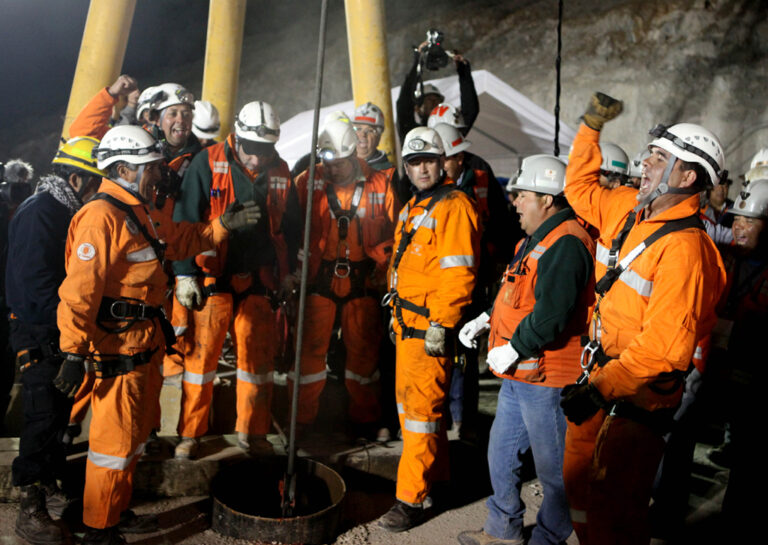
Chile’s Supreme Court awarded $1.4 million to 31 of the 33 miners that were trapped for two months in 2010, 700 metres below the surface in the San José mine located in the northern Atacama region.

The ruling of the top tribunal’s third courtroom notes that the Chilean State “incurred in a lack of service” as two of its agencies, the National Geology and Mining Service, Sernageomin, and the Labour Directorate, failed to comply with their legal obligation of conducting proper precautionary inspections.

According to the court, had such inspections been conducted, activities at the San José mine would not have been authorized.

On August 5, 2010, the San José gold and copper mine, a small deposit nestled among dusty, desert hills near the city of Copiapó, collapsed. The mine is owned by a company called San Esteban Primera.

No one knew whether the miners were alive or dead until they were able to convey a note to the surface in a probe sent down by authorities on August 22. “We are fine in the shelter, the 33 of us,” said the note, written in red ink.

Thirteen years after the accident, the Court issued the ruling in rejection of an appeal filed by the State Defense Council, which sought to reverse a ruling that ordered the treasury to compensate the rescued miners for moral damages. Thus, the men will receive about $48,000 each. The figure had been set in a resolution of the Santiago Court of Appeal in 2021.

Only two of the miners refused to take part in the legal action. The rest argued that proper monitoring and inspections from Sernageomin and the Labour Directorate would have prevented several safety and regulatory breaches by the company and, therefore, the incident that kept them underground for 69 days. The Supreme Court’s ruling, ultimately, upheld this argument.

In its final decision, the tribunal emphasized that Article 2, numeral 8 of Decree-Law No. 3,525, puts Sernageomin in charge of “guaranteeing that mining safety regulations are complied with and applying the respective sanctions to those who violate them; proposing the issuance of standards that tend to improve safety conditions in mining activities by technical and scientific developments; and requesting information about training programs and courses and sharing relevant information with those who work in extractive industries.”

Mining.com

New Alrosa Diamonds CEO hit by US sanctions

0

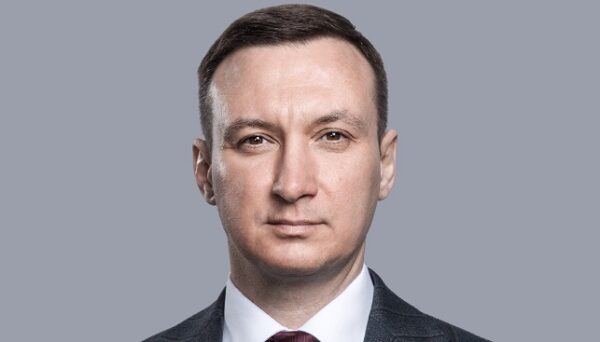
Pavel Marynichev, the recently appointed CEO of Alrosa, has been targeted by US sanctions, following in the footsteps of his predecessor Sergey Ivanov. According to IDEX Online, the US State Department revealed its decision earlier this month. The specific designation for Marynichev is linked to his involvement in the metals and mining sector of the Russian economy.

Marynichev, who previously served as a government official for the Republic of Sakha (Yakutia) with a focus on geology, assumed the role of Chairman and CEO at Alrosa for the next three years in May. The US State Department’s move forms part of its ongoing efforts to address Russia’s involvement in an “illegal war,” according to the piece.

While Alrosa has been officially under US sanctions since the onset of the war, the ban doesn’t apply to rough stones that are polished outside of Russia.

Source: israelidiamond

Fort Rixon Police Investigate Brutal Murder

0

Police in Fort Rixon have launched an investigation into the murder that took place on the 29th of July 2023 in the Claremont area. The victim, Lawrence Ngwenya, aged 30, was brutally attacked with machetes by five suspects identified as Kelvin Mpofu, Clayton Dube (28), Sibusiso Dube (25), Mayibongwe Ndlovu (21), and Tinashe.

In a statement on their X page (formerly Twitter), The Zimbabwe Republic Police (ZRP) said the incident took place after a longstanding dispute over mine ownership at the Claremont 26 mine between the victim and the suspects. Breaking into a violent confrontation, the suspects proceeded to unleash a barraging assault upon Ngwenya, resulting in fatal injuries across his body.

“Police in Fort Rixon are investigating a case of murder which occurred on 29/07/23 at Claremont area. The suspects identified as Kelvin Mpofu, Clayton Dube (28), Sibusiso Dube (25), Mayibongwe Ndlovu (21) and Tinashe struck the victim, Lawrence Ngwenya (30) with machetes all over the body. The victim and the suspects had a longstanding mine ownership dispute over Claremont 26 mine,” the statement reads.

How Mine, Hwange, Blanket Proto teams fitness excites judges

0

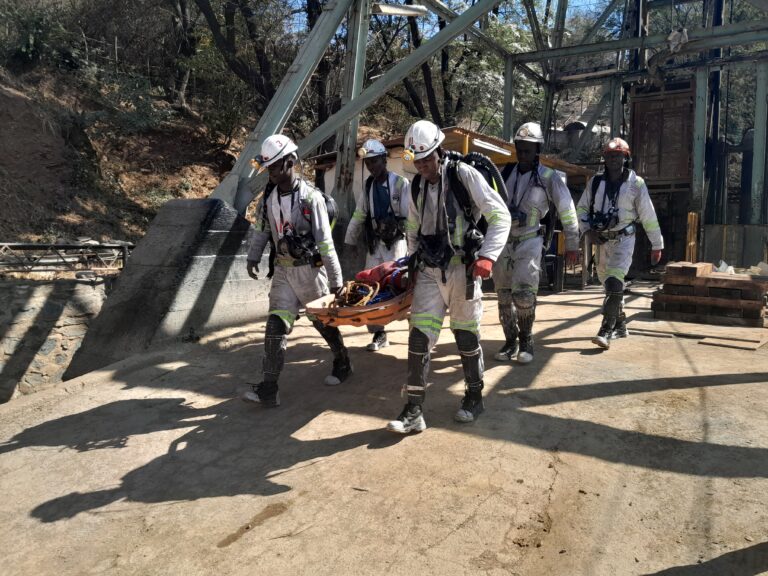
The level of fitness for the Proto teams which participated at the Mine Rescue Association of Zimbabwe Westzone Quarterly training exercise held at Metallon Corporation Zimbabwe’s Bulawayo Mining Company (How Mine) recently excited judges, however, the judges pointed out a lot of areas which needed to be improved by the teams in preparation of the National Rescue competitions to be held later this year.

Rudairo Mapuranga

The WestZone of the Mine Rescue Association of Zimbabwe (MRAZ) comprises of How Mine, Caledonia’s Blanket Mine and Hwange Colliery.

The teams were working on a written instruction that, “A three-man lashing crew was reported to have gone into the mine for an earlier shift at 15L20m Sub level 300N. Information received from the 14-level pump attendant is that there has been a reversal on the ventilation circuit. He noted foul air coming from the main access haulage towards where he was working at the pump station close to the North shaft. He checked that access drive but could not proceed further due to the ambient conditions.

Team Instruction

“You are expected to proceed underground and do the following:

  1. Assess the ambient conditions for 14 level, document and report your findings (Airflow, ground holing, visibility and temperature).
  2. Locate the missing employees and render the necessary help required. Assist the employees out of the mine.
  3. On completion of the task generate a report and submit it to the control official.

Judges from the Zimbabwe School of Mines, Ministry of Mines and Mining Development and How Mine ex brigades persons could not hide the fact that the teams’ fitness was good but were also disappointed by the teams’ shortfalls in different areas which need improvement.

Speaking to Mining Zimbabwe on the sidelines of the competition Proto teams National Coordinator who was also a judge at the training exercise, Jaffrey Sanudi said the teams needed to improve when it comes to map reading.

“The teams performed well in terms of fitness although there is a need for improvement. Key learning points that we noted, for example, we saw the need for improvement in terms of plan reading, in terms of articulation of sequence of events. We also noted that most teams did not pick the critical items they were supposed to identify as instructed,” Sanudi said.

The Zimbabwe School of Mines representative at the Event Mrs Ndiweni said the teams performed well in terms of first aid but needed to improve in other areas.

“The first area of improvement is findings, and updating our documents. Most teams were living out vital information right from the control room to back. There is also an issue of sequential asking of questions. First aid was done well but all the teams. On fitness, the teams were fairly good but we need to improve,” Mrs Ndiweni said.


This article first appeared in the Mining Zimbabwe Magazine issue 66. Download HERE

Mining in Zimbabwe, 5 years later (mining industry recap)

0

The mining sector in Zimbabwe has demonstrated steady growth since the appointment of Hon Winston Chitando as the Minister of Mines and Mining Development in November 2017 after the fall of the Robert Mugabe administration. Despite some visible challenges and setbacks, the industry’s overall progress has been remarkable.

Rudairo Mapuranga

In 2017, the mining sector’s contribution to the gross domestic product was about 9 per cent, and the figure rose to over 13 per cent in 2022.

The Mining sector achieved more than 100 per cent growth in earnings under President Emmerson Mnangagwa’s administration, evidenced by the massive jump in mineral exports to US$5,62 billion realised in 2022 when compared to about US$2,7 billion in 2017.

Official Government figures show the mining industry alone has attracted more than US$6 billion in new projects in the last four years, with a corresponding increase in output, export earnings, and massive job creation impact along the value chain.

The Emmerson Mnangagwa administration has worked tirelessly since taking office to revitalize the country’s mining sector. Despite facing numerous challenges, the government has implemented several commendable initiatives to develop the industry and attract investment. Here are ten things the Mnangagwa administration has done right in Zimbabwe mining and outstanding issues that need urgent reforms:


1) Mining Law Reforms

The government introduced comprehensive reforms in Zimbabwe’s mining laws to attract foreign investors and enhance transparency. The country opened up to doing business by scrapping the indigenisation and economic act which restricted heavily foreign capital in the country. Since the inception of the Mnangagwa administration, various world-class mining projects have been established including the Eureka Gold Mine project and processing plant, the Arcadia lithium project and processing plant, Sabi Star lithium project and processing plant among other projects. However, it should be noted that the sector has failed to reach deadlines for other legislative reforms which include the Mines and Minerals Amendment bill, and the Precious Stones Amendment bill, among others which are aimed at streamlining mining operations and reducing bureaucracy.


2) Investment Policies

The government has created a conducive investment environment by implementing policies that facilitate foreign direct investment (FDI). These policies include guarantees of property rights for investors and the relaxation of indigenization laws, allowing foreigners to hold controlling stakes in mining operations. Mining companies like Zimplats, Unki, Mimosa, and Caledonia have praised the government for allowing them to hold a controlling stake leading them to invest in mining growth and development. Zimplats has signed a Memorandum of Understanding with the government which will see the company investing US$1.8 billion for its expansion projects with over USD 0.5 billion already invested.


3) Exploration Support and Geological Data Availability

Access to accurate geological data is vital for attracting investment and developing the mining sector. The administration has committed significant resources to promote geological exploration. The government initiated the Geo-Data Information System, which consolidates all geological data to aid mining companies in making informed decisions about resource exploration and development. However, the government has not adequately invested in geological surveys or made the data easily accessible to potential investors.


4) Mining Infrastructure Development

The government has prioritized the development of critical infrastructure to support mining operations. This includes investing in road networks, power generation, railways, and water supply systems to ease transportation and reduce production costs. There is an improved power supply which has put on hold the gruelling power disruptions which have been engulfing the country for the first six months. Through the State of Mining Industry Survey Report of 2022, mining industry captains believe that the sector will grow significantly in 2023 but will be affected by power outages.


5) Engaging Stakeholders

The Mnangagwa administration has supported platforms for regular dialogue with mining industry stakeholders. These engagements have led to effective collaboration between the government, mining companies, communities, and civil society organizations, ensuring that all parties’ concerns are addressed. Examples of such gatherings include the Annual General Conference for the Chamber of Mines, the President and Mines Minister are also a permanent feature at Mine Entra every year. The Minister of Mines and Mining Development has also created a miners’ desk where he receives reports from Miners both large and small weeks through their respective Associations. The Ministry is also consistently in touch with Media Houses via some social media platforms, ensuring mining developments are made public. However, Mining has taken centre stage in Zimbabwe which has led to other voices in the industry advocating having the Mines Minister host regular independent press briefings once every week and answer questions related to the industry.


6) Initiatives for Responsible Mining

The government has introduced measures to promote responsible mining practices and sustainable development. This includes enforcing environmental protection laws, monitoring compliance with safety regulations, and promoting corporate social responsibility (CSR) initiatives to benefit local communities. However, the administration has not provided sufficient support and regulatory frameworks to promote responsible and sustainable artisanal and small-scale mining. This has resulted in informal mining practices, safety hazards, and a lack of fair working conditions for miners, increasing mine accidents.


7) Fostering Public-Private Partnerships

The administration has actively pursued partnerships with both local and international mining companies to accelerate investment in the sector. By partnering with the private sector, the government aims to take advantage of their resources, expertise, and technology to maximize the sector’s potential. The government has successful partnerships with various investors to form Kuvimba Mining House (KMH) which has been renewing some of the country’s biggest Mines which include Shamva Gold Mine and the newly discovered Sandawana Lithium.


8) Simplified Licensing Process

The government has simplified the process of obtaining mining licenses and permits. By reducing red tape and bureaucracy, this initiative has encouraged both local and foreign investors to initiate mining projects promptly, promoting economic growth and job creation. However, the small-scale miners in highly mineralised provinces e.g. Mashwest, Midlands have instructed the Portfolio Committee on Mines to craft a law that mandates the Ministry to ensure titles are out within 90 days.


9) Supporting Artisanal and Small-Scale Mining (ASM)

The administration recognizes the importance of the ASM sector in Zimbabwe’s mining industry. It has instituted programmes to formalize ASM operations, provide training, access to capital, and support services to empower small-scale miners, contributing to poverty alleviation and economic empowerment. The Zimbabwe Miners Federation (ZMF), a body representing artisanal and small-scale miners, regularly sits with the Minister of Mines and Mining Development to report on matters of concern in the industry. The ASM has been growing significantly accounting for over 67 per cent of gold deliveries to the country’s sole buyer and exporter Fidelity Gold Refinery (FGR). SSMiners have also lamented “exclusion” from key sectors like lithium.


10) Promoting Mineral Value Addition

The government has placed a strong emphasis on value addition and beneficiation of minerals. This involves encouraging mining companies to process minerals locally rather than exporting only raw materials, aiming to increase job opportunities, revenue generation, and industrial development. Recently the country commissioned the biggest hard rock lithium processing plant in Africa at Arcadia lithium mine with plans to establish lithium carbonates processing plant underway. In the Platinum Group of Metals (PMG) sector, plans to set up a smelter are underway. The establishment of Africa’s biggest iron and steel plant is also underway in Manhize where Dinson Iron and Steel Company (Disco) is establishing a world-class Iron and steel plant.

The Mnangagwa administration’s efforts towards revitalizing Zimbabwe’s mining sector are commendable. There are almost zero complaints from ASM on late gold payments and Large scale mines’ gold can now apply to export their gold.

These initiatives have attracted significant FDI, promoted responsible mining practices, empowered local communities, and enhanced the country’s overall economic development. Despite the challenges ahead, these accomplishments demonstrate the commitment of the government to leverage the mining sector’s potential to uplift the lives of ordinary Zimbabweans.