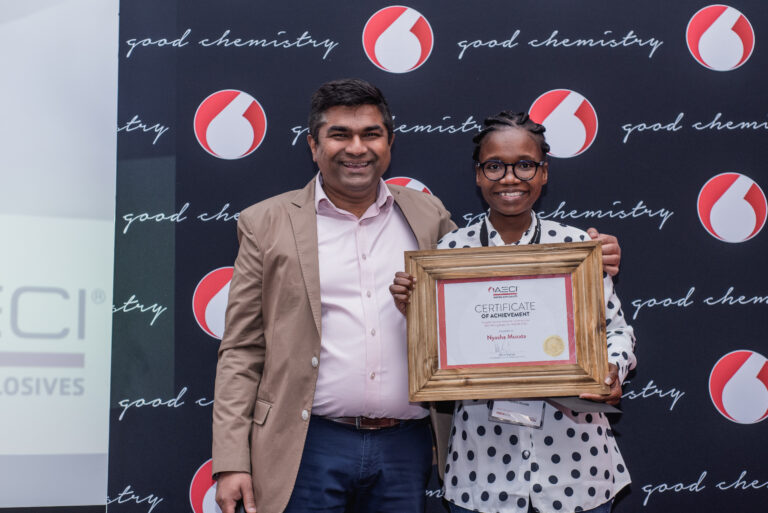
In issue 63, Mining Zimbabwe (MZ) interviewed Nyasha Muzata (NM) a highly motivated, focused and eloquent Mining Engineer at AECI Mining Explosives.
The young engineer holds a Bachelor’s Degree in Mining Engineering from the University of Annaba, Algeria. After completing her Blast Competence Programme with AECI, Nyasha then went on to pursue Explosives Engineering with Northwest University, South Africa. She has also completed a Foundation Management Development Programme with Stellenbosch Business School and a Sales Development Programme with Mercuri Sales International. She also holds a Train the Trainer Certification from the Zimbabwe Institute of Management.
Here is how the interview went!
MZ This is women’s month and we are privileged to have you Nyasha. I hope this interview will inspire other women, especially the young generation to take part in the mining industry. Let me begin by congratulating you on having your Technical paper win the 2022 AECI WEETR Conference, in South Africa.
NM Thank you Mining Zimbabwe for recognizing the significance of women in Mining and giving us an opportunity to air our views. Please keep it up! To me, it’s a great honour to feature in your magazine, especially in this women’s month. It gives me confidence that at least we are headed in the right direction.
MZ Before we get into our discussion, please tell me who is Nyasha and what do you do.
NM Nyasha is a young lady with big dreams. Dreams to impact the world positively. I was born and raised in Zimbabwe, a place called Chiweshe, in Mazowe District. Just like any other humble background African child, lacked career guidance but I should hasten to say academically I was in a safe place. At one point I wanted to be a Medical doctor, at another an Aeronautical engineer and the list goes on. But what aided my final decision to be a mining engineer is my strong relationship with my Father to whom I give credit for suggesting that I consider mining engineering. And so, I became a Mining Engineer who is now working for AECI Mining Explosives, a world leader in the manufacturing and supply of explosives and blasting solutions. I joined AECI in 2018 as a graduate trainee and am now part of the front-end engineering personnel, working as an Explosives Engineer.
MZ Back to the WEETR Conference, tell me a bit more about this conference, your achievement, your experience and the opportunities it opened for you?
NM WEETR stands for Workshop for Explosives Engineers and Technical Representatives, so this is a gathering of all the technical people in the field of Explosives Engineering for AECI. During the two-day conference, the delegates get to listen and participate in various discussions and technical presentations around best and next practices in the world of explosives and blasting from the different business units around the world. The theme for the conference was BETTER BLASTING with Sustainable Technology. The conference was held in September 2022, in Sandton South Africa.
So earlier during the year a call for papers was announced and I took the challenge. So from all the submissions from around the world, the technical committee gets to choose 5 presentations that will then be presented at the conference. My paper was about the Shock Tube initiation system and the value it was giving to one of our customer sites. I stood there among the giants in the industry, it was a tight contest and I give it to other presenters. My presentation was then voted the best and as part of the competition prize, I was sponsored to attend the International Society of Explosives Engineers Conference in San Antonio, Texas USA.
From the WEETR conference, I learnt that every presentation is a story. You as the presenter know the story better than everybody else so when it’s coming from you, it has to flow. You can’t be afraid to tell your story, not when every person is ready to listen to you and you have prepared for that. Seize the moment with your audience and leave them wanting more!
MZ You then had the privilege to attend the ISEE 49th conference on Blasting in San Antonio. What were the key highlights from this conference?
NM I loved the technical presentations more than anything else, they were perfectly designed to educate in a way many could relate to. I remember when I did the Train the Trainer course and the facilitator told us about the use of visual aids when presenting, and the presenter on Fly rock Control and Monitoring at the Conference did just that. He brought a piece of rock he had extracted from the fly rock incident he was once involved in decades ago and this just brought the moment back to life.
There was training, presentations from around the world, opportunities to network and share experiences with other delegates and access to the latest technology on display at the exhibition stands. What stood out the most about the conference was the opportunity to learn in a number of ways and be part of the ISEE Emerging Professionals. For someone who was in America for the first time, the experience was just exhilarating and having the opportunity to be in dialect with other professionals in the industry was also exciting and rich in experience. After this, I feel supercharged.
MZ Was this your first exposure to an international platform or audience?
NM This is definitely the biggest exposure to an international audience that I have had. I have always been someone who enjoys taking up challenges and giving my best to it. I remember back in 2014 whilst pursuing my undergraduate studies in Algeria I attended the Global Development Network Conference in Accra, Ghana. This was after the paper I had co-authored in an essay contest, Imagine-Africa-2025 won. However, everything at ISEE was bigger.
MZ We also hold several conferences here in Zimbabwe, comparing with what you saw in San Antonio are we far off? What advice would you give to conference organizers?
NM From my experience attending local conferences and exhibitions I don’t think we are far off. What I saw and emulated at the ISEE conference was the Introduction of engaging activities like the ISEE social where people meet, greet, chat and drink. There was an inclusion of spousal programs and families on the agenda where they get to engage in activities as spouses or families. This helps the spouses to understand the kind of industry their partners are in and who knows, this may be a way of cementing more families together. In terms of the technology on exhibition, we are almost there and let us just keep looking at opportunities to do it better.
MZ We have ISEE at an international level, do we also have similar local bodies or chapters?
NM ISEE is an international organization and they have members from around the world. They also have local chapters in different regions. Here in Africa at the moment, we don’t have a board such as ISEE which is focused on explosives engineering and there is no ISEE chapter as well but we have similar organizations such as the Southern African Institute of Mining and Metallurgy SAIMM that one can join and be a member. Going into the future, and now with the active involvement of Women (laughing) in the explosives engineering scene very soon we are going to see a chapter coming out of the African Continent.
MZ Is the Explosives Engineering profession a common profession in Zimbabwe? How does one become an explosives Engineer?
NM Explosives and blasting work are very common in Zimbabwe but the profession (qualified Explosives Engineers) is not very common. For one to be an explosives engineer, you need a mining or blasting background and training. Back in the day you needed to join explosives supplying companies like AECI and they would train you but now they are universities that can train one to be an Explosives Engineer. As for me, I did a mining engineering degree then I specialized in Explosives Engineering. I did the course with North-West University in South Africa in partnership with AECI. Other international bodies such as ISEE offer courses in the field of explosives engineering as well.
MZ Can you describe the working environment of an Explosives Engineer, the duties, tools, equipment and technologies you use in your day-to-day work?
NM Explosives Engineers work with explosives. They work in different environments such as mining and construction, military and other manufacturing industries. They use both science and engineering principles to safely design, initiate and monitor the use of explosives. In the mining industry, they play a pivotal role in the extraction of minerals that provide raw materials for industrial processes. Explosives are used to break ore or waste or to create space for other infrastructure.
Explosives Engineers use a lot of technology and tools in their day-to-day work. This includes drilling and charging equipment, blast design and predictive software, explosives and blasting performance monitoring equipment.
MZ Besides Explosives, what other specializations can one pursue in the mining industry? Are they all friendly to women?
NM There are lots of opportunities in the mining industry and slowly the world is moving from gender-based careers. One can get into production, mine planning and design, mine support services such as survey, geology, mine ventilation, and machine operation …. The list is endless. In all these areas, women have participated and matched their male counterparts. Remember in everything that a man can do, a woman can do better. There are many opportunities you just have to identify your area and pursue it with diligence.
MZ The art of blasting has evolved over a long period, from the discovery of gunpowder and the safety fuse to the current technologies. Is blasting going to continue into the future and which products and blasting systems are we going to be using? What are the factors that are shaping these changes?
NM In my opinion, blasting is the way to go for the foreseeable future, however, we are headed towards more sophisticated technologies, more than just electronics… Maybe a completely autonomous way of doing things! This is due to the need for not just more efficient but safer and more sustainable ways of mineral extraction.
MZ You are one of the few females who is leading in a male-dominated environment, what are some of the challenges you face and how do you overcome them?
NM Apart from the muscle power and deep voice (chuckles), I would want to believe am equally equipped. Situational leadership always wins! It’s true the world is in the process of accepting women in male-dominated industries. When you get appointed people around you would want to see if you really deserve the title and in some cases want to prove that. I apply the technical, management and soft skills that I have acquired over the years and I get results every time. That level of scrutiny pushes me to do better and to play my small part in convincing the world that women can do it. Why not.
MZ The mining environment is considered to be harsh, looking back in your career, do you sometimes regret ever choosing the mining profession?
NM Yes indeed mining is not for the faint-hearted. When the going gets tough, the tough get going. I could never regret the great decision I made, I wouldn’t be here today. In fact, I regret the time I wasted thinking I could do something else.
MZ What qualifications do you hold?
NM I hold a Bachelor’s Degree in Mining Engineering from the University of Annaba, Algeria. As part of my professional development, after completing my Blast Competence Programme with AECI, I then went on to pursue Explosives Engineering with Northwest University, South Africa. I have also completed a Foundation Management Development Programme with Stellenbosch Business School and a Sales Development Programme with Mercuri Sales International. I hold a Train the Trainer Certification from the Zimbabwe Institute of Management. Training is something I really enjoy; I come from rich training background – both my parents are teachers by the way. I am currently in my final MBA semester with the University of Zimbabwe.
MZ You did your first mining degree in Algeria, and you have done some qualifications locally and in South Africa as well. Based on your exposure to all these universities and colleges, how do you rate our education and curriculum? Are we producing students fit for the industry?
NM It’s true, I have had exposure to some courses with universities and colleges in different countries. My opinion is that we are producing fairly good students who are in demand on a global scale. Hardly a day passes without one of the Zimbabweans making it big on a global scale. Of course, we have our own challenges that need to be addressed. If you look at it right now, the industry is not really coming to the party and supporting the colleges to produce graduates that are fit for the industry. If you look at it now, only a few companies are investing in training and taking in students on attachment and graduate traineeship. The colleges should produce graduates who are entrepreneurial and not only look for work but focus on creating work. Look at graduates from universities like MIT and Harvard, they are geared and supported to create multibillion-dollar industries. Something which is lacking in our curriculum.
MZ Let us talk more about your career and development. What role did the companies you worked for play in moulding you to be the person you are?
NM I have worked at different companies from the days of my industrial attachment into my professional life. I have also been exposed to the different customer operations. This has allowed me to close the gap between theory and practice and an opportunity to be mentored and provide mentorship to others as well. My current employer invests in developing people and I am very grateful. The company’s strategy encompasses PASSIONATE, PURPOSE-LED PEOPLE as one of its strategic themes.
MZ You mention the issue of mentorship, why is it so important that one needs to have a mentor in their career?
NM That is very key, especially in the early days of one’s career. You need to have someone who has walked the path before you. It’s like you are doing it for the second, third or fourth time and yet you might just be giving it your first shot. Mentorship played a big role in my career and will continue to do so. Be intentional, choose a mentor and let them know that they will be mentoring you.
MZ Our small-scale miners are contributing significantly to the mining industry, in terms of blasting are they using the right technologies?
NM The small-scale mining industry is contributing immensely to the Zimbabwean economy. There is a need for continuous improvement in terms of the equipment and blasting technologies that they can adopt so that their mining can be sustainable (profit, people and planet). A lot has changed in the industry and the small-scale miners need to catch up. It’s the responsibility of those in the industry to assist this sector so that they can also reap the benefits of advances in technology. Some low-hanging fruits are the use of bulk explosives, the emulsion type using PCU pumps, remote blast initiation systems etc.
MZ What are some of the mistakes that young female mining professionals make in their early career and what do you think should be done to correct them?
NM Female mining professionals are not exempted from the mistakes that their male counterparts make. Over and above that, the females are intimidated by the dominance of male professionals to the extent that they don’t go all out to explore their full potential. They need to confront the environment positively just like any other working environment and they also have to keep the interactions professional.
MZ Let us talk about sustainability and impact. Besides your work contribution, what other roles are you playing to help in making the mining industry a better place for future generations?
NM Nowadays you can’t talk about running a business without talking about how the business is going to contribute positively to a better tomorrow. Companies are investing a lot in achieving this and individuals also have a role to play. In my small way, I am passionate about gender equality and the improvement of quality education. Whenever I get the opportunity to mentor, coach and develop young people I do it with passion. I will use my skill to better the profession and contribute to the sustainable development of my country.
MZ What opportunities are there for the young and innovative minds in the industry?
NM If the rate of change outside is faster than the rate of change inside, you know the end is near. – Jack Welch. The opportunities lie in optimized efficiency and productivity, establishing organized supply chains, promoting safety and sustainability, compliance obligations and even people’s welfare. The mining industry is an ever-changing working environment and hence there is a need to have evolving patterns in managing change to remain relevant and competitive in the region. You mentioned we started with gunpowder, who knows in the future we might be blasting in the comfort of our homes.
MZ Where do you see yourself in 5, 10 years from now?
NM I am shooting for a goal. I have very big dreams and the sky will never be my limit. I have been with AECI for 5 years now and looking at my journey thus far… As you have seen, I am honing my skills in both technical and business management. I am preparing myself for Senior Management or Executive role in the mining industry. I believe in the power of words.
MZ We are in the women’s month, what changes (if any) would you like to see in the work environment to promote women’s participation at all levels?
NM Participation begins with involvement and inclusion; the more women we have in some of these crucial positions, the more we will see more women motivated to participate. It calls for support not just from men but from other women as well, let us not be our own enemies. It’s a general tendency for women to shy away from seemingly harsh working environments but, believe me, women might just as be better suited for any environment just like our male counterparts or even better.
MZ Your word of advice to young women and young professionals?
NM Carpe diem – Seize the day! Every day is an opportunity to get you where you want, if you can imagine it you can achieve it. Put yourself out there like Steve Jobs said, “You can’t connect the dots looking forward, you can only connect them looking backwards”, at some point and time, it will all make sense. Never be afraid to try and if you want to try better, try with a mentor.
MZ Who is your role model in the mining sector?
NM I am challenged by women who have done so well in the mining industry. People like Mpumi Zikalala (Kumba Iron Ore CEO), Meagan Van Den Berg (AECI Executive for Southern Africa), the former Larfage CEO Precious Murena Nyika and the list goes on. These are the mighty women that I look up to and I believe one day I will also be there as a torch bearer for the girl child.
MZ Off the work environment, what occupies Nyasha?
NM I am an outdoor and quite adventurous person who loves nature walks and sightseeing. I enjoy spending quality time with family, as the family-oriented person that I am. I also think of myself as a very artistic person, visual art is my thing!