

Home Blog Page 311

Diamonds trade watchdog mulls fate of Russian gems

0

The Kimberley Process (KP), an international scheme that certifies rough diamond exports, is expected to decide this week whether Russian diamonds should be declared conflict gems.

Members of the KP are meeting in Gaborone, Botswana until Friday and one of the main topics on the agenda is to discuss whether Russian diamonds are funding the war in Ukraine.

The debate would be around whether to broaden the KP’s definition of conflict diamonds to include state actors.

The certification scheme, set up in the early 2000s, defines conflict diamonds as gems used to fund rebel movements seeking to undermine legitimate governments.

The KP has the power to ban gem exports from certain countries, as it did in 2013 when rebels seized power in the Central African Republic.

World Diamond Council president, Edward Asscher, believes the Russia-Ukraine conflict should be kept out of discussions held this week.

“As I stated publicly, irrespective of what I or my colleagues may feel personally about the dreadful events in Central Europe, a war between two sovereign states clearly falls outside the current mandate of the KP,” the industry body leader told the plenary.

“That is fact, and we would be compounding a tragedy if we allowed the war in Europe to damage what we are able to achieve in Africa,” Asscher said.

Back on the market

Russia’s Alrosa (MCX: ALRS), the world’s top diamond producer by output, has already been affected by sanctions from the United States and Britain. The Responsible Jewellery Council (RJC), the leading standards organization of the global jewellery and watch industry, suspended Alrosa’s membership in April.

The miner, which accounts for about a third of global rough-diamond supply, is back selling more than $250 million worth of diamonds a month, with sales currently only about $50 to $100 million a month below pre-war levels.

While there is no indication that Alrosa has breached sanctions or laws, there is still a widespread unease about the implications of dealing with Russian companies.

Based on estimates from the KP and the United Nations, the only current case of rebel forces controlling diamond-producing areas is in Côte d’Ivoire, in West Africa. That constitutes less than 0.1% of the world’s production.

Mining 

Implats hints at another extension of RBPlat buy-out

0

ZIMPLATS mother company, Impala Platinum (Implats) has advised that the outstanding Competition Tribunal approval of its offer to buy out all remaining ordinary shares of fellow platinum group metals miner Royal Bafokeng Platinum (RBPlat) will not be finalised by November 3.

Although it does still believe that the current date set for fulfilment or waiver of the conditions precedent the long-stop date of November 22 is still achievable, it notes that it reserves the right to further extend the long-stop date.

Only once Implats has more certainty on the commission’s approval process can it make further announcements on the dates and times for the offer.

The Competition Commission May recommended that the Tribunal approve the merger.

Implats has been steadily increasing its shareholding in RBPlat since it first mentioned its intention to take over the company in November 2021 at a value of R150 a share – R90 in cash and R60 in shares.

Implats’ current stake in RBPlat is 40.66%, while fellow platinum miner Northam Platinum holds a 35% stake.

Mining Weekly

Miner trapped 100 metres underground for 4 days

0

When 22-year-old Mr Rania Moyo left home at around 4 am on Thursday last week for work at Velocity 36 Mine in Silobela, he never bothered to bid his parents goodbye as he believed he would return home as usual.

There was no way he could have known that one hour later he was going to be trapped 100 metres underground for the next four days.

When he arrived at work that day, he met his workmates and they proceeded to enter the mine shaft at around 5 am. Soon after, the shaft started collapsing and his two workmates managed to navigate through the cave-in, to reach the entrance.

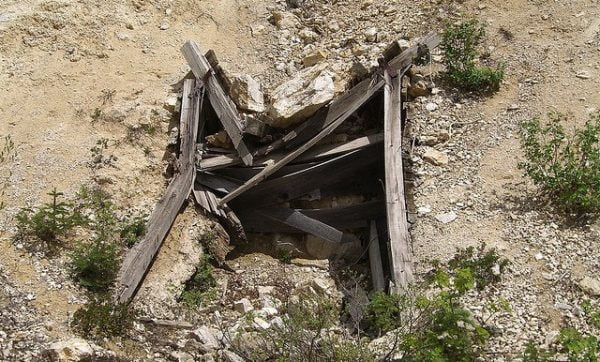
The shaft where Rania Moyo was trapped underground for four days at Velocity 36 Mine in Silobela

They escaped right before a big boulder fell and blocked the opening, trapping Mr Moyo inside the shaft.

“The moment l realised l was trapped underground in that shaft, l prayed to God asking him to accept my soul in heaven because l did not think l would come out alive,” said Mr Moyo, who was rescued on Monday afternoon and is recovering from his home in Silobela.

“It was around 5 am and we had just entered the shaft when the mine started caving in. We immediately moved towards the entrance trying to escape before it could get blocked,” he said.

Mr Moyo said he knew death was suddenly catching up with him when he was trapped in the shaft in a space so small that he could not even stretch his legs or sit up straight. He was trapped in a space so dark he could not even see his own hands. He said temperatures also dropped and he felt like he was going to freeze inside the shaft that Thursday morning.

“I could not even move a muscle and l knew screaming was not going to help. I do not know when was the last time l prayed, but on that day, l prayed really hard, asking God to accept my soul when l get to heaven. I apologised for all the wrong things that l have done in my life because l didn’t think I would survive,” said Mr Moyo.

The miner said he is not really sure what day or time it was when he finally heard movement and voices of people outside trying to communicate with him.

“Because l had no food or water, whenever I started feeling weak l would scoop a handful of soil and eat it to try and regain my energy,” Mr Moyo said.

He said the shaft became his home and toilet for what he has now been told were four days.

“On the day the entrance was opened l could not believe l had survived. It seemed like a dream because l have never heard of anyone who survives being underground for days without food and water,” he said.

The miner said he was taken to Silobela District Hospital where he was checked and given boosters to regain his energy. He was discharged on the same day and is still recovering from home.

Will this mine worker go back to the mine where he nearly died?

“I have no choice, but to go back to the shaft as soon as I regain my strength because this is the only source of income that l know. If l do not go back in the mine shaft, it means my family will go hungry,” he said.

The miner’s mother, Mrs Polite Moyo, said she arrived at the scene on Saturday and never thought she would ever see her son alive again

She said when he was rescued, he was taken for a medical check-up.

“He came out on Monday; it was on the fifth day. He did not eat anything. I never thought he would come out alive,” she said.

Kwekwe District Civil Protection Unit chairperson Mr Fortune Mpungu thanked everyone who came to rescue Mr Moyo.

“When l heard the news, I immediately put the word out that help was needed at the mine. The Ministry of Mines, police, small-scale miners, and the community came to help the CPU in saving the young man. This incident showed everyone that a community comes together in times of need and they assist each other,” he said.

He said the teams camped outside the shaft regularly engaging with the miner to ensure that he was still alive.

“I am urging all small-scale miners to ensure that their mines are regularly inspected to ensure the safety of their miners. Miners should avoid going underground when it is raining as the soil will be loose,” said Mr Mpungu. –

Chronicle

Zimbabwe exports 20,000 tons of coal to China

0

Zimbabwe shipped its first coal to China, exporting 20,000 tons as part of a trial run to a customer in the cement industry.

The coal was transported via the Mozambican port of Beira, Linos Masimura, chairman of the Zimbabwe Coal Producers Association, said in an interview.

“There are other orders which may come through,” said Masimura, who declined to give further details of the coal contract.

While a property slump has weighed on growth, there is speculation that China may seek to reopen the economy despite its Covid Zero policy. China is also building a vast array of new coal-fired power stations, amid concern over the global squeeze in energy supplies.

Zimbabwe usually reserves the country’s coal output for domestic electricity generation but started shipping the fuel last year after demand dipped from the Hwange power plant. Masimura said there has also been interest from European firms, but no deals have been concluded.

“We have had some inquiries from Europe, but these for now are coming through third parties who are mostly based in South Africa,” he said.

Bloomberg

Caledonia purchases another Gold mine

0

Caledonia Mining Corporation has continued on its expansion drive recently concluding the purchase of Bulawayo Mining Company (BMC) owned Motapa Gold Mine 75 km from Bulawayo.

Rudairo Mapuranga

With a recent purchase of Maligreen as well as a sale and purchase agreement to acquire Bilboes, Caledonia has almost cemented its position of becoming Zimbabwe’s biggest gold miner.

The Motapa Project was formerly owned and explored by AngloAmerican Zimbabwe before its exit from the Zimbabwean gold sector in the late 1990s. The Project is approximately 75km north of Bulawayo with a mining lease covering approximately 2,200hectares.

According to Caledonia Chief Executive Officer Mark Learmonth, the company considers Motapa to be highly prospective and strategically important to its growth ambitions in Zimbabwe in terms of both location and scale.

He said Motapa is a large exploration property which is contiguous to the Bilboes gold project. Caledonia announced that it had entered into a binding sale and purchase agreement in July 2022.

Learmonth is optimistic that since the Motapa asset has been mined throughout most of the second half of the 20th century and during this period, the region produced as much as 300,000oz of gold. Whilst none of the mining infrastructures remains, the evidence of historical mining will guide the Caledonia exploration team in best understanding the prospectivity of the region.

“We are pleased to have concluded the purchase of Motapa. Given its large scale, excellent geological prospectivity and its strategic location adjacent to Bilboes, Motapa was a high-priority acquisition for Caledonia. We look forward to developing an exploration program for Motapa as we target a large-scale gold belt surrounding the Bilboes project.

“With the central shaft at Blanket now fully operational and production targeting 80,000 ounces of gold per year, we anticipate that we will deploy the incremental cash flow arising from Blanket into our exciting exploration and project development portfolio in Zimbabwe.

“The acquisition of Motapa following the signing of a sale and purchase agreement to acquire Bilboes and the acquisition of Maligreen demonstrates that over the last 12 months Caledonia has established a pipeline of high-quality exploration and development projects. This is in addition to the potential for further growth at Blanket where we are optimistic about its exploration potential,” Learmonth said.

Invictus raises US$32m in capital funding

0

Invictus has revealed it is now completely self-funded after it raised AUD48,7 million (nearly US$32 million) in capital funding in the year ended June, which has gone into ongoing drilling activities in its Cabora Bassa project.

Following years of failing to secure funding to start the Cabora Bassa project in northern Zimbabwe, Invictus has managed to attract investors while also implementing several capital-raising initiatives.

With Europe desperately looking for new gas and oil sources as it will soon stop such purchases from Russia owing to Kremlin’s invasion of Ukraine, Zimbabwe has scaled up its support to Invictus to cash in on increasing demand for the commodity.

Invictus estimates that the country has oil reserves of around 5,5 billion barrels and significant natural gas reserves in the Cabora Bassa project.

“Further bolstering the company’s financial position is the AU$20 million (US$12,95 million, plus an additional AU$25 million, US$16,18 million, subsequent to the decision to solely fund the drilling campaign) raised through private placements to sophisticated and institutional investors, along with a further AUD3,7 million (US$2,39 million) raised through the conversion of options during the financial year,” Invictus said in its 2022 annual report for the year ended June it shared with the firm’s shareholders.

“The capital raises have been supported by a range of existing shareholders and new investors, placing the company in a strong position to self-fund the drilling of the Mukuyu-1 and Baobab-1 wells. A discovery at Mukuyu-1 or Baobab-1, could be transformational for not only Invictus and its shareholders, but Zimbabwe and the wider southern Africa energy market.”

Invictus said it got approval from the Depository Trust Company (DTC) in July to provide real-time electronic clearing and settlement for its ordinary shares traded on the OTCQB through the Depository Trust & Clearing Corporation in the United States.

DTC is an America-based corporation that performs the functions of a central securities depository as part of the US national market system.

“The approval for DTC eligibility simplifies the process of trading for North America-based investors and enhances the liquidity of the company’s shares on the OTCQB by broadening the pool of brokerage firms that will allow their clients to trade the stock,” Invictus added.

The OTCQB (over-the-counter QB), also referred to as a venture market, is a platform for entrepreneurial and developmental stages for US and international companies under the American financial securities firm, OTC Markets.

“To be eligible, companies must be current in their reporting, have a minimum bid price of US$0,01, may not be in bankruptcy and must undergo an annual verification and management certification process,” part of OTC Markets standards read.

“These standards provide a strong baseline of transparency to improve the information and trading experience for investors.”

Seeking such investment opportunities has helped the energy firm to carefully control expenditures and spending by utilising its own team to expedite the completion of high-quality work.

As of June 30, 2022, the carrying value of the capitalised exploration and evaluation properties of the consolidated entity was AUD28 228 960 (US$18,27 million) from a 2021 comparative of AUD8 821 190 (US$5,71 million).

Recovering these funds is dependent on several factors including the sale of the company’s assets. Other factors include the level of reserves and resources, future technological changes, cost of drilling and production, production rates, future legal changes (including changes to environmental restoration obligations) and changes to commodity prices.

The firm’s capital spending led to it increasing its total assets to AUD43,13 million (US$27,89 million) in the period under review from a 2021 comparative of AUD18,38 million (US$11,89 million).

IEL was in a very liquid form having AUD3,30 (US$2,13) to every dollar of debt, at the end of June.

Challenges facing Invictus include the impact of COVID-19 on supply chains and the Russia/Ukraine war’s effect on global energy prices.

Invictus is positioning itself to be a major gas and energy source in southern Africa.

“We remain ambitious with our plans to expand and build on our achievements to date, drilling two basin opening wells, building a carbon offset business and continuing to evaluate new ventures that fit within our strategy,” it said.

Newsday

Liebherr Debuts R 9XX H2 Hydrogen-Powered Excavator

0

As manufacturers race to develop low-emission equipment solutions, Liebherr has announced its first crawler excavator powered by a hydrogen combustion engine, the R 9XX H2.

Based on Liebherr’s generation 8 crawler excavators, the 50-ton R 9XX H2 prototype debuted at the recent Bauma show in Munich, Germany.

At the heart of the machine is Liebherr’s first hydrogen engine, the H966. The engine is based on an intake manifold injection technology, also known as PFI.

Liebherr says that after extensive testing, the results showed strong potential for hydrogen propulsion and the use of such drives in off-road applications. The prototype had the same overall performance as its diesel engine counterpart, both in terms of power output, engine dynamics and response.

The only difference between the prototype and Liebherr’s conventionally powered excavators, the company says, is when it comes to refuelling. The prototype excavator and the refuelling station communicate via infrared sensor for fast and safe refuelling using a standardized high-speed protocol.

“The tests carried out in Colmar were extremely convincing,” said Henrik Weitze, project manager at Liebherr-France SAS. “This technology promises many advantages for us in the future, especially in the most challenging applications.”

The H2 drive in the R 9XX H2 does not require a permanent energy supply and emits extremely low levels of nitrogen oxide and carbon-dioxide.

“Depending on the assessment method used in each case, and whether the entire life cycle of the machine is taken into account, the hydrogen combustion engine can reduce CO2 emissions by almost 100%, when considering ‘tank to wheel’ or by 70%, when considering the ‘cradle to grave’ principle,” Liebherr says.

The company’s components division is working on additional hydrogen-based drive technologies, such as H2 direct injection, which enables a higher power density than the conventional H2 intake manifold injection and is, therefore, well suited for demanding work environments, such as earthmoving and quarry operations.

Source: EW

Artisanal miner killed in shaft collapse

0

An artisanal gold miner was killed, while four others escaped unhurt when a pit in which they were illegally prospecting for the precious mineral collapsed in Bulawayo.

Bulawayo police spokesperson, Assistant Inspector Nomalanga Msebele confirmed the incident, which occurred Wednesday morning.

“On Wednesday morning around 0715hrs a man from Cowdry Park received a call that there was an unknown deceased man trapped at the gravel pit whilst illegally mining gold,” she said.

Msebele added the now deceased’s left leg was trapped to knee level by a stone and loose soil.

“There were other unidentified illegal miners milling around who then assisted to retrieve the body of the deceased.

“After retrieving the body the other illegal miners fled the scene,” she said.

Police said the deceased is a male between the ages of 35 and 40, with no further particulars.

Members of the public have been warned against mining in undesignated areas.

“I can confirm that police in Bulawayo are investigating a case of an illegal miner who died at the (Bulawayo) City Council’s gravel pit in Khumalo, Bulawayo.

New Zimbabwe

Unki production increases by over 40 percent

0

Zimbabwe’s second biggest platinum group metal (PGM) producer Unki Mine has recorded a production increase of 41 per cent during the quarter ended 30 September 2022 compared to the same quarter of last year, figures from Unki’s parent company Anglo American Platinum indicate.

The Anglo-American Platinum-owned PGM producer recorded 59 900 tonnes during the quarter compared to 42 600 tonnes produced during the comparable quarter of 2021. However, there was a 10 per cent decrease compared to the previous quarter ended 30 June 2022 where the mine recorded 66 300 tonnes of production.

Compared to the first quarter of 2022, the PGM producer recorded an increase from 53 300 tonnes while during the fourth quarter of 2021, the mine produced 63 200 tonnes.

During the first three quarters of 2022, the PGM producer recorded a 27 per cent increase to 179 500 tonnes from 141 400 tonnes produced during the first three quarters of the previous year.

Completion of the company’s R700 million de-bottlenecking project towards year-end resulted in an improved capacity.

The project focused on upgrading the flotation circuit, the primary mill and other ancillary equipment.

Unki last year invested US$48 million towards increasing its concentrator capacity, which is expected to boost output by 30 per cent.

General Manager, Walter Nemasasi, at the time said the new concentrator was set for commissioning sometime in September last year.

The new plant was the second major value addition and beneficiation project by the mine after the commissioning of a US$60 million smelting plant at the mine by President Mnangagwa in 2019.

The project was expected to increase the production of platinum group concentrate at the plant by 30 per cent and ultimately increase exports by the same margin.

The company said the project was so huge that it will increase production from 180 000 tonnes a month to 210 000 tonnes a month.

Zimbabwe is envisioning a US$12 billion mining industry by 2023. Of the US$12 billion, platinum will contribute US$3 billion.

Zimplats invests $373m in projects

0

Zimplats has spent about US$372,8 million in various projects in the country, with the Mupani and Bimha mines development chewing the largest chunk.

According to the company’s quarterly activities report for the period to September 30, 2022, the projects were at different stages of implementation.

The mining giant said the development of Mupani Mine and the upgrading of Bimha Mine had progressed well during the quarter.

A total of US$252,2 million has been spent on the projects to date, the firm said, adding that US$82,4 million had been committed against a project budget of US$468 million.

“The third concentrator plant, which will increase milling capacity by 0,9 million tonnes per year, was commissioned during the quarter. Cumulative project expenditure as at the end of the quarter amounted to US$91,3 million, with US$9,3 million committed against a project budget of US$104,1 million. The plant is expected to ramp up production to design capacity by the end of the second quarter,” the report read in part.

Zimplats said the implementation of the US$521 million smelter expansion and sulphur dioxide (SO2) abatement plant project was on course, with US$28,8 million spent and US$215 million committed as at end of the quarter.

“Implementation of the 35MW solar plant which is Phase 1 of Zimplats’ 185MW solar project progressed during the quarter with US$0,5 million spent against a budget of US$37 million,” it said.

A solar plant is being constructed at Selous Metallurgical Complex and is targeted for completion in 2024. Overall, the project has four implementation phases with the last phase scheduled for completion in financial year 2027 at a total project cost estimate of US$201 million.

Apart from these projects, Zimplats said US$0,4 million was spent on exploration projects, with a further US$1,1 million committed as at September 30, 2022.

Exploration activities included mineral resource evaluation comprising approximately 6 103 metres of surface diamond drilling on mining lease ML36, it said.

In the period under review, mined tonnage increased by 2% quarter-on-quarter and 4% year-on-year following good operational performances across the mines.

Rukodzi Mine, the highest-grade operation in the portfolio, was mined out at the end of the previous quarter. This impacted 6E (ruthenium, rhodium, palladium, osmium, iridium and platinum) head grade, which decreased slightly by 1% to 3,41g per tonne.

“Ore milled decreased by 2% to 1,73 million tonnes from the 1,77 million tonnes milled in the previous quarter mainly due to power outages at the processing plants and a planned mill reline shutdown during the period,” it said.

Zimplats said 6E metal in the final product decreased by 8% from the prior quarter and 3% year-on-year, mainly due to decreased mill volumes, lower head grade and recovery, and the accumulation of inventory following the furnace reline shutdown during the quarter.

Total operating cash costs increased by 5% from the prior quarter, driven mainly by a 2% increase in tonnes mined and inflationary pressures. The company said a total of US$4,3 million was transferred from operating costs as volumes mined during the quarter exceeded the tonnes milled.

“In addition, the quarter closed with stocks of concentrates that will be smelted in the second quarter. This resulted in the cost of metal produced increasing by 2% compared to the previous quarter,” it said.

Zimplats said the 8% decrease in 6E ounces produced and the 2% increase in costs of production resulted in 6E unit costs increasing by 10% to US$801 per ounce. Year-on-year unit costs increased by 18%, mainly due to the inflationary increase in operating cash costs and a 3% decrease in 6E ounces produced.

Newsday