Home Blog Page 314

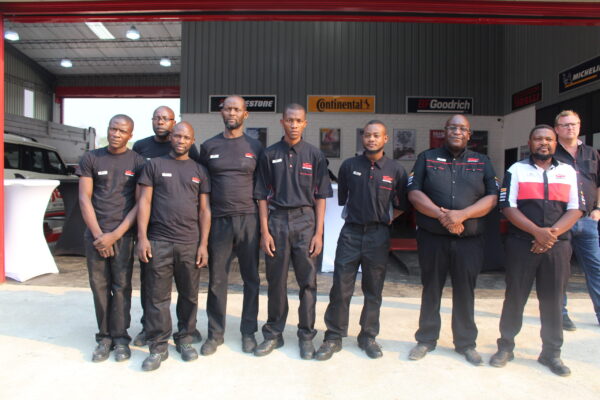
Hwange community welcomes Tiger Wheel and Tyre

0

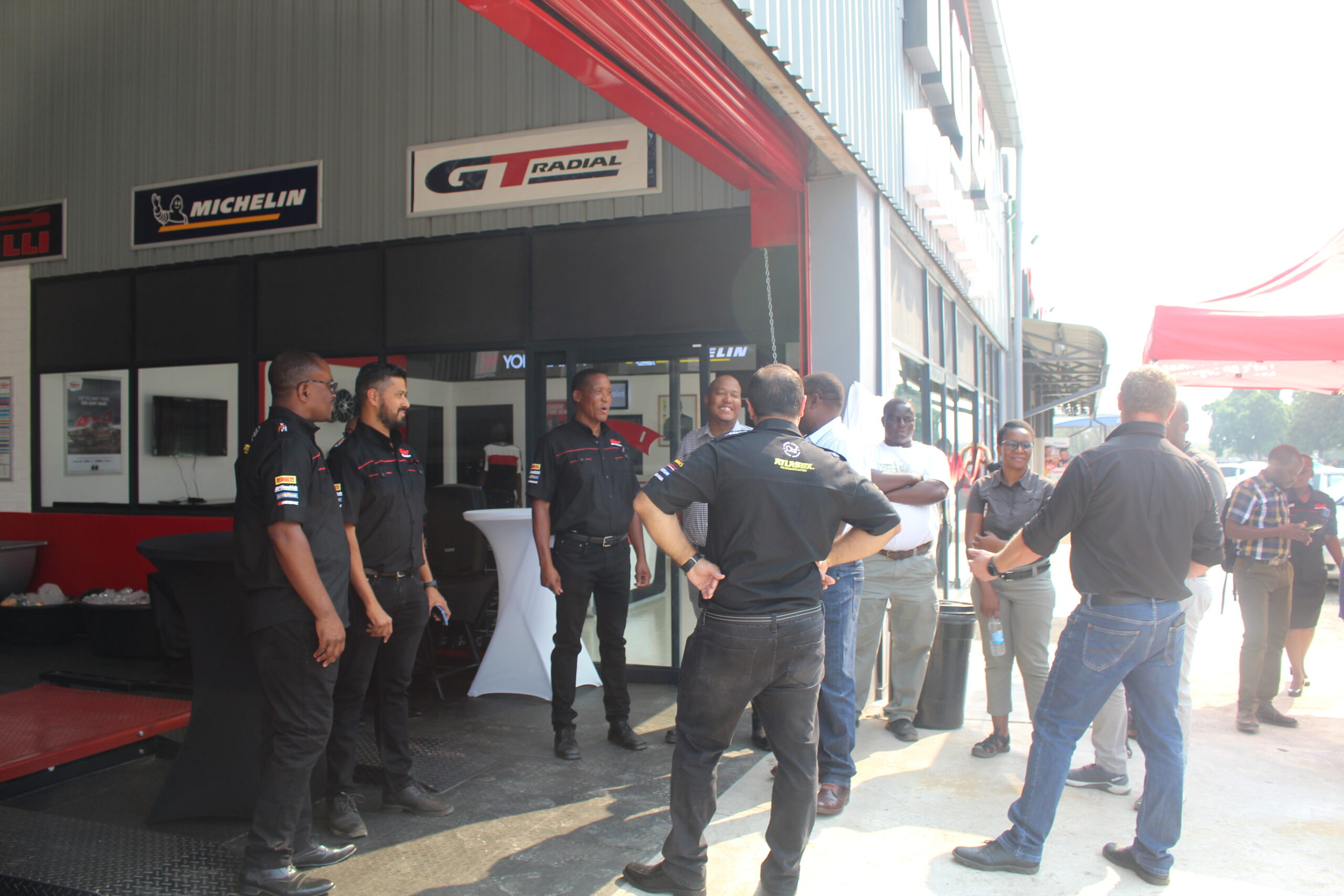
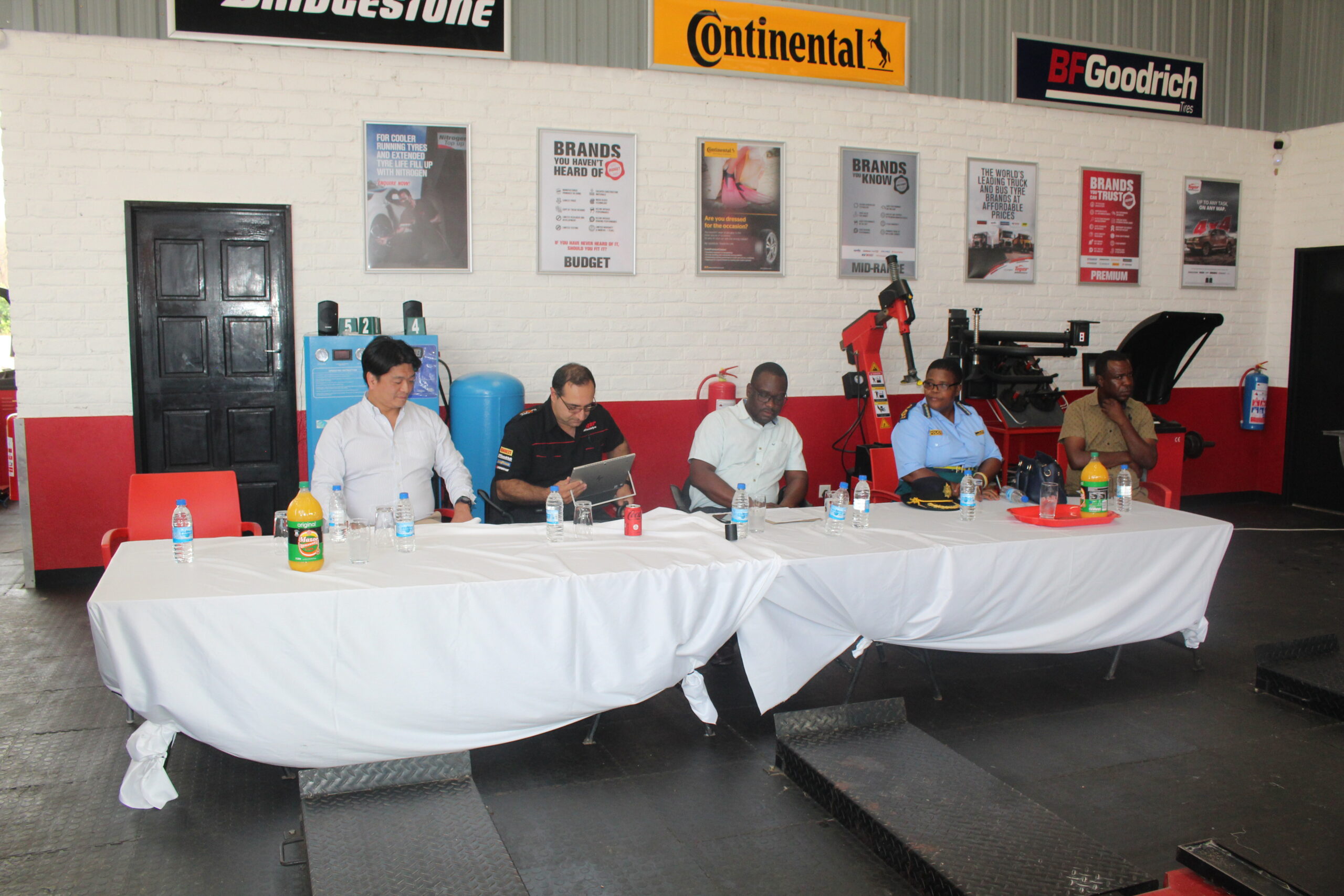
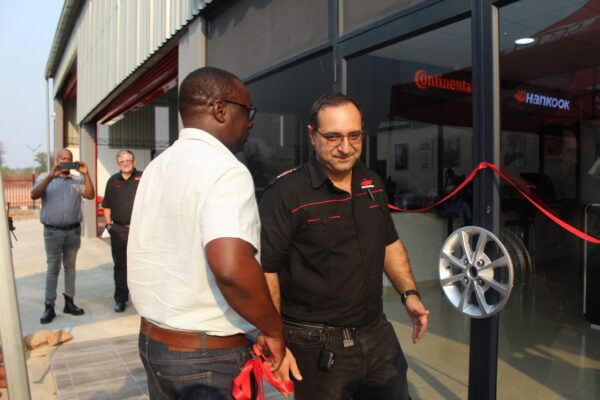
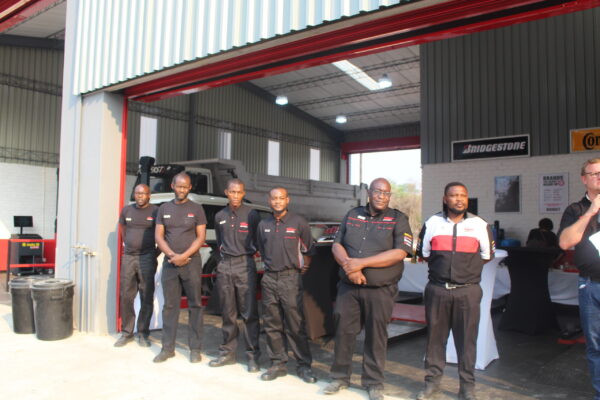
The Hwange Mining Community welcomed Tiger Wheel and Tyre in the coal mining town as it will proffer correct support services in the wheel and tyre area to assist Hwange Colliery and the mines around.

Rudairo Mapuranga

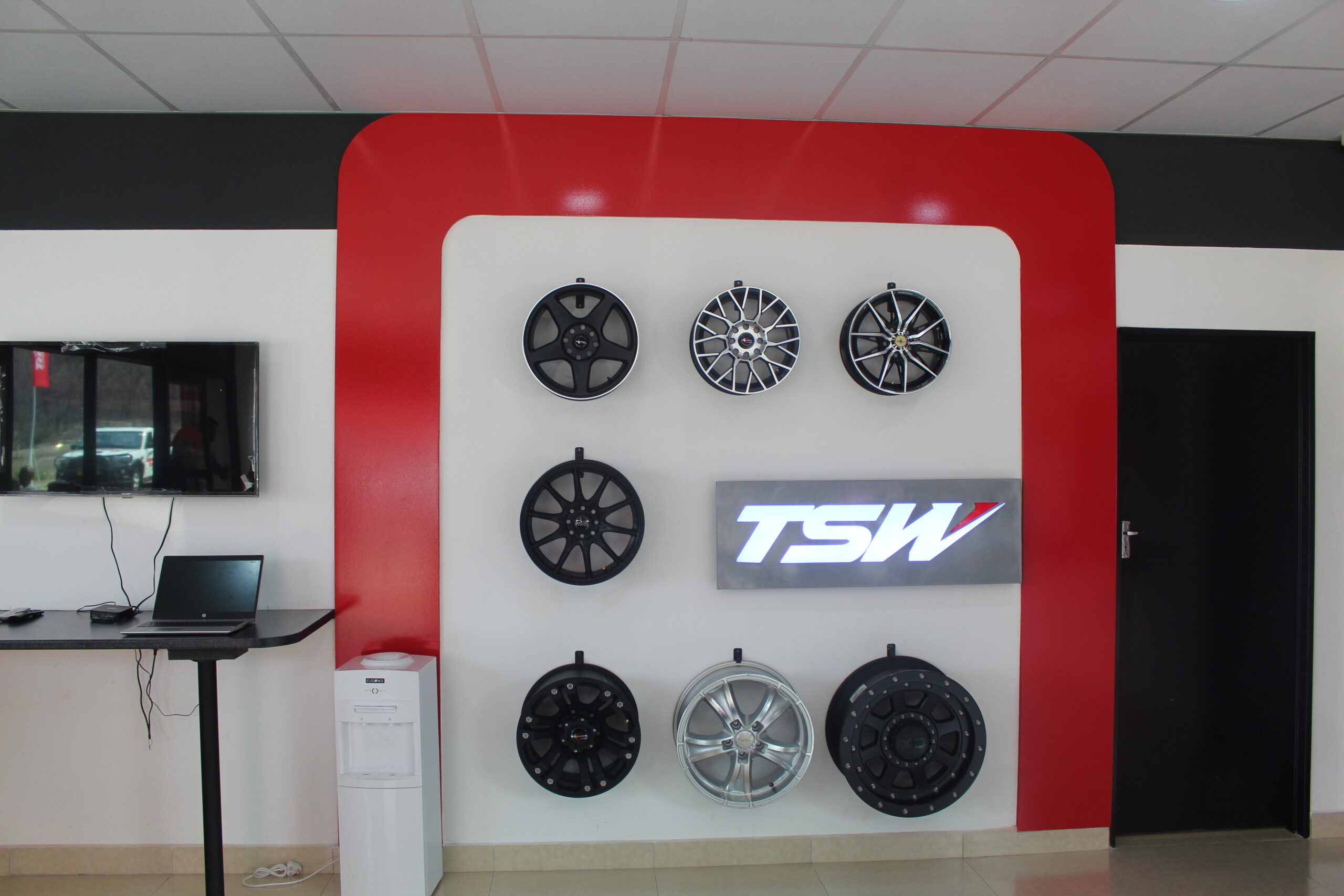
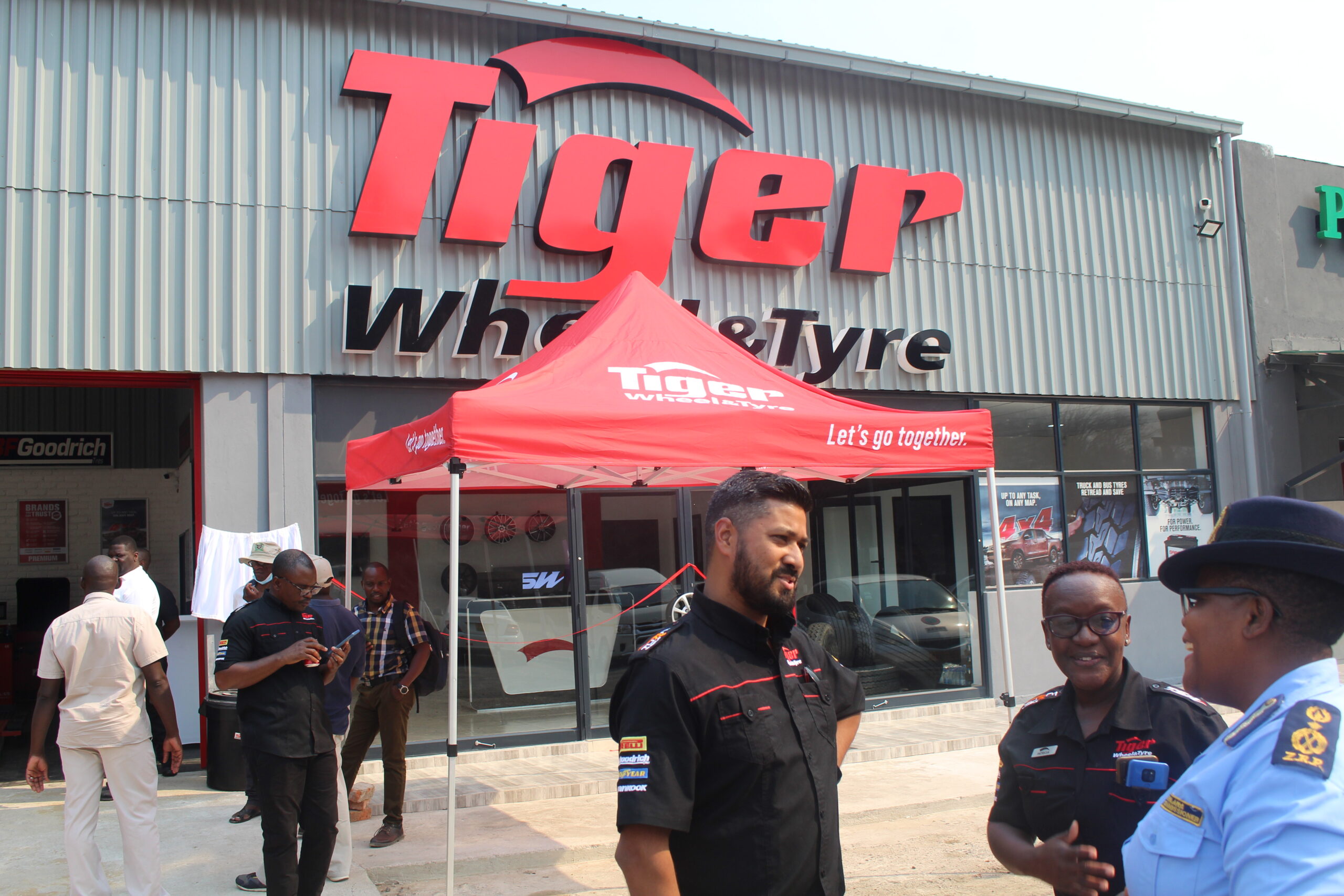
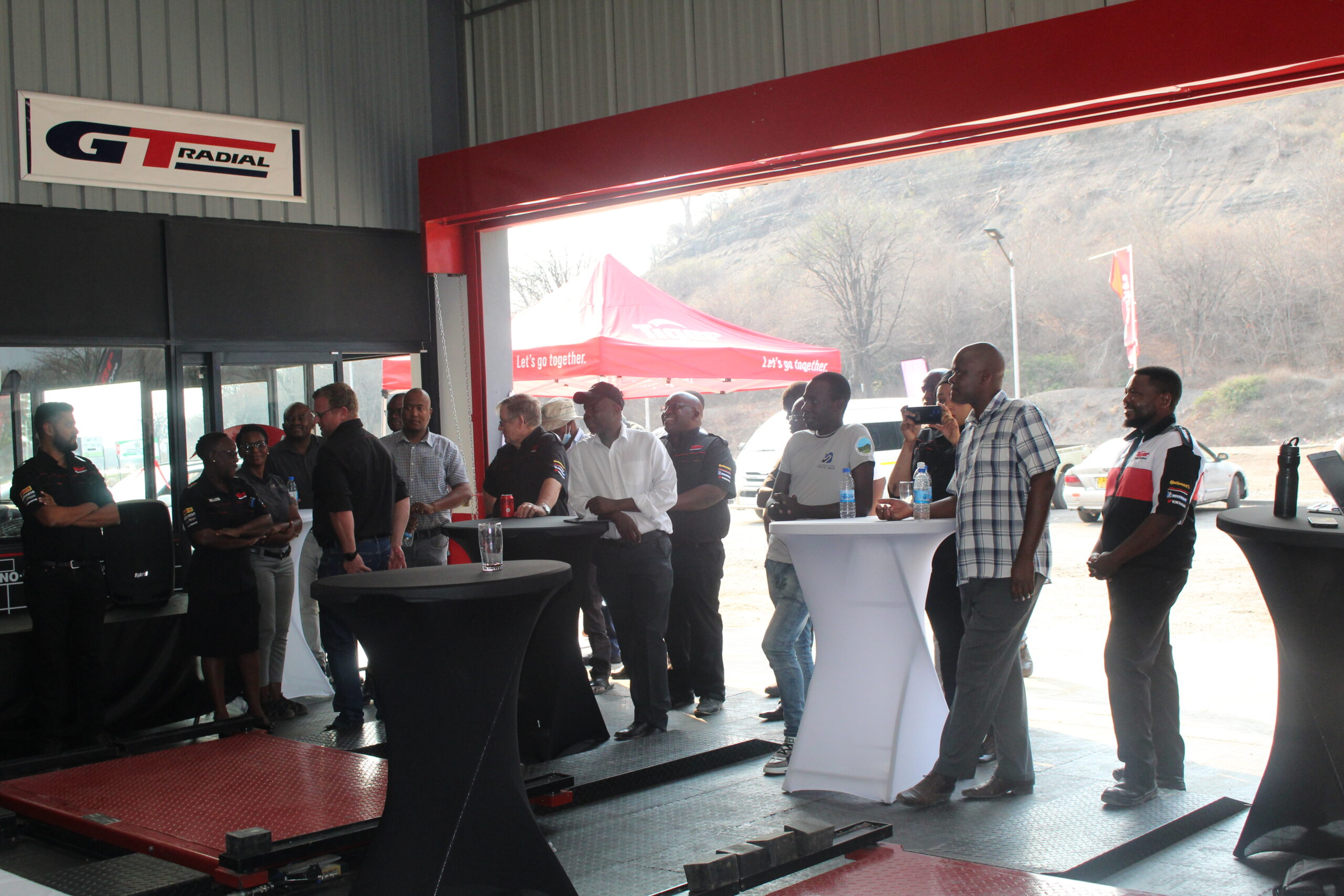
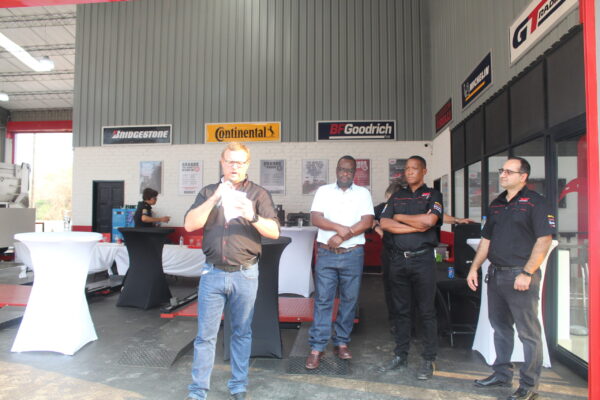
In it’s rebranding exercise Tiger Wheel and Tyre, a leader in the tyre automotive industry, has given its store a refreshing look which matches world-class standards and comes with a facelift for the entire Hwange town.

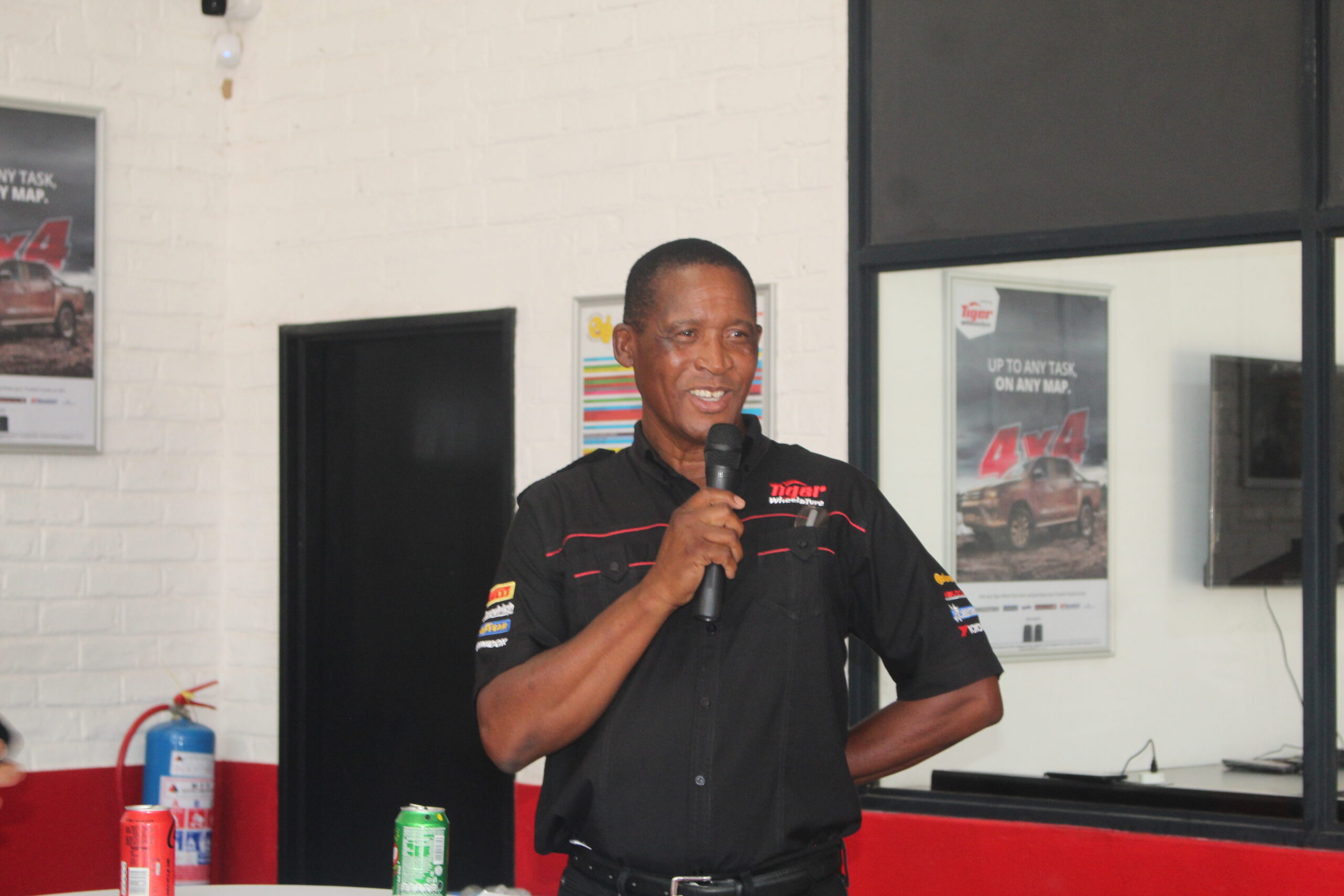
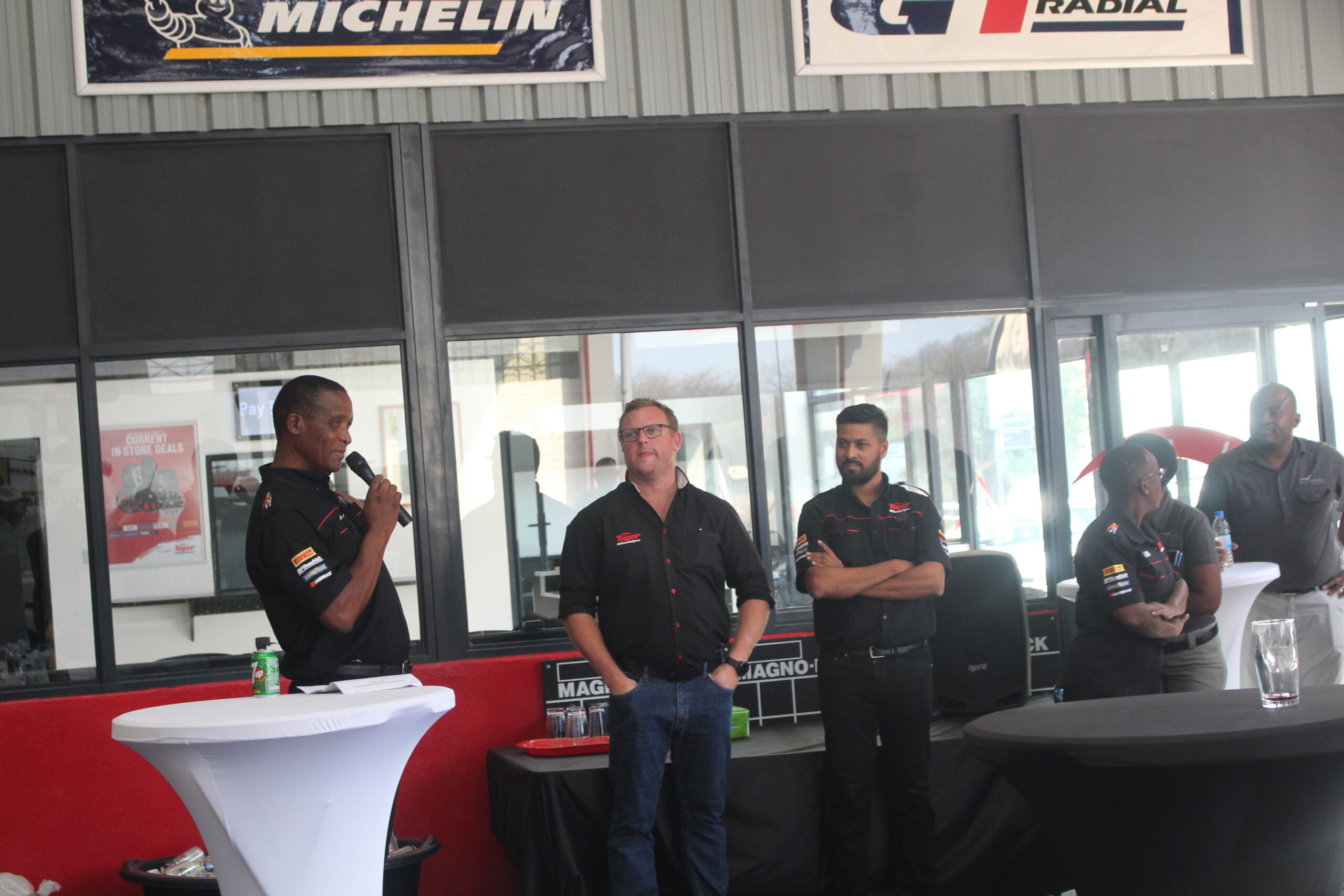
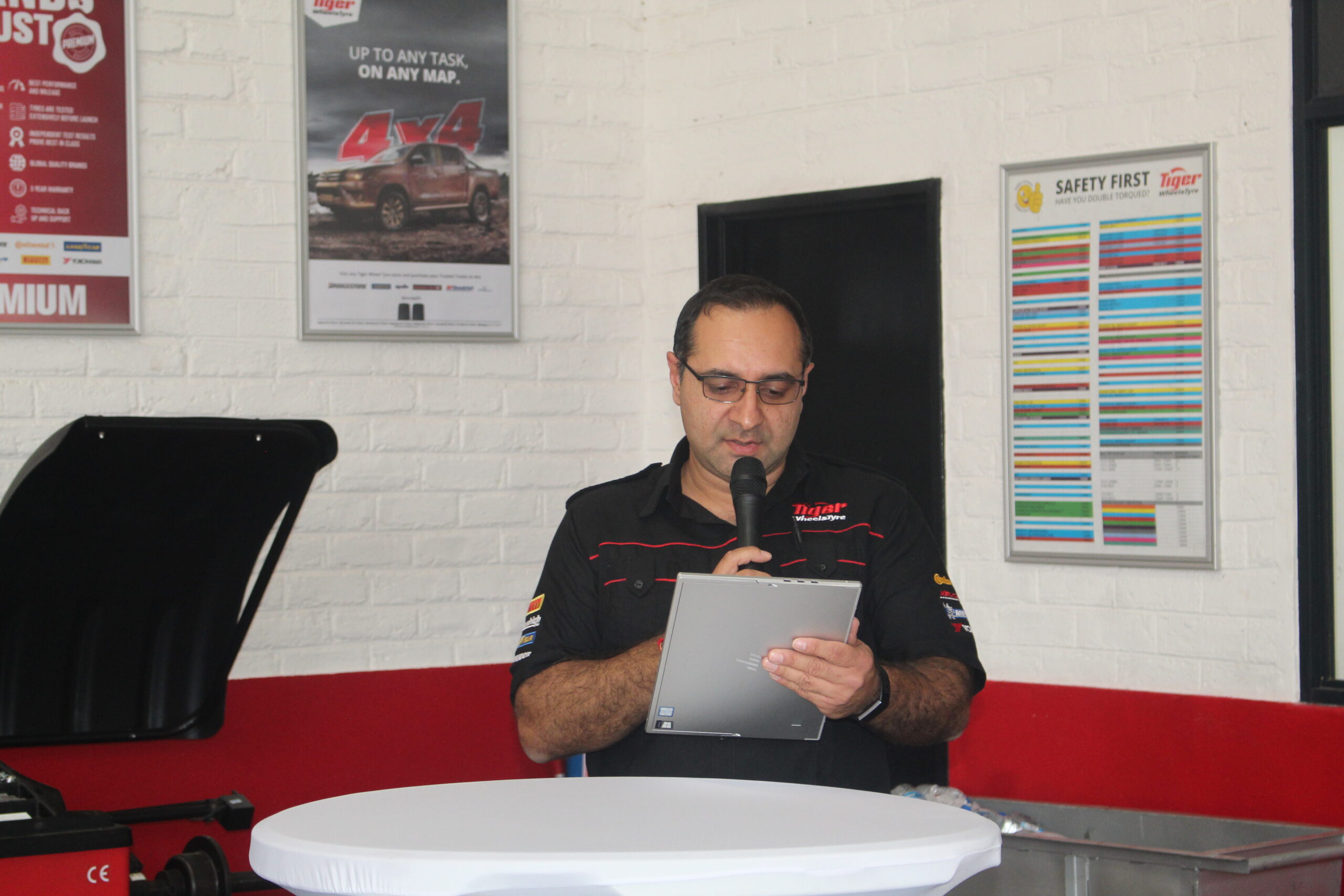
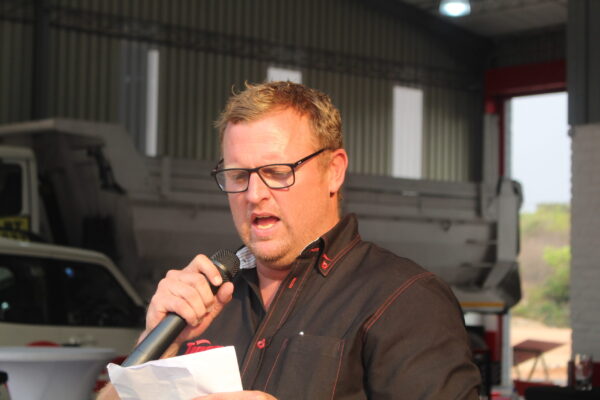
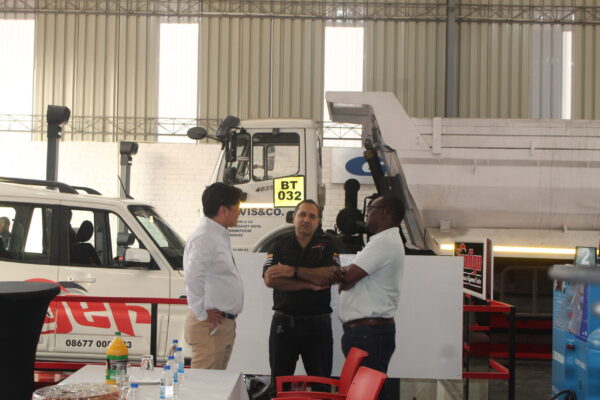
Speaking at the Official Opening of the store in Hwange last week, Hwange Colliery Company Limited Managing Director Mr Blake Mhatiwa said the coming in of Tiger Wheel and Tyre in Hwange is important to the growth of the mining industry as it will bring tyre and wheel solutions at the doorstep of mines.

“Being a mining community, I am sure you can imagine how important it is for every one of us to always be on the go and have the correct support service in the area to assist Hwange Colliery and the mines around with their production. This investment by Tiger Wheel and Tyre Zimbabwe is a very welcome investment to the business community of Hwange and the surrounding areas and the National Park. They will now be able to help keep our communities mobile, safe and ensure efficiency in our operations through the provision of high-quality tyres and related services at affordable prices at our doorstep.

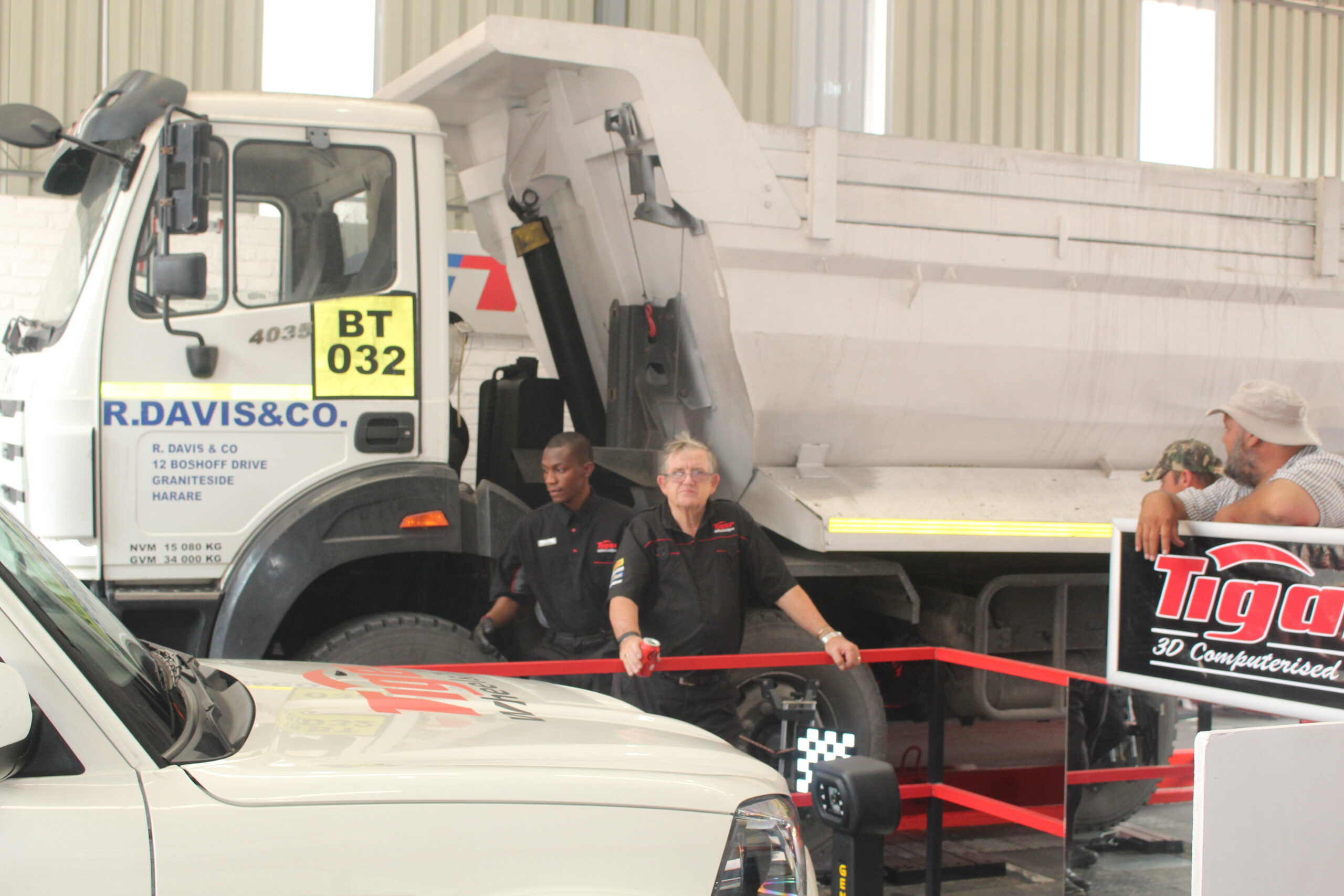
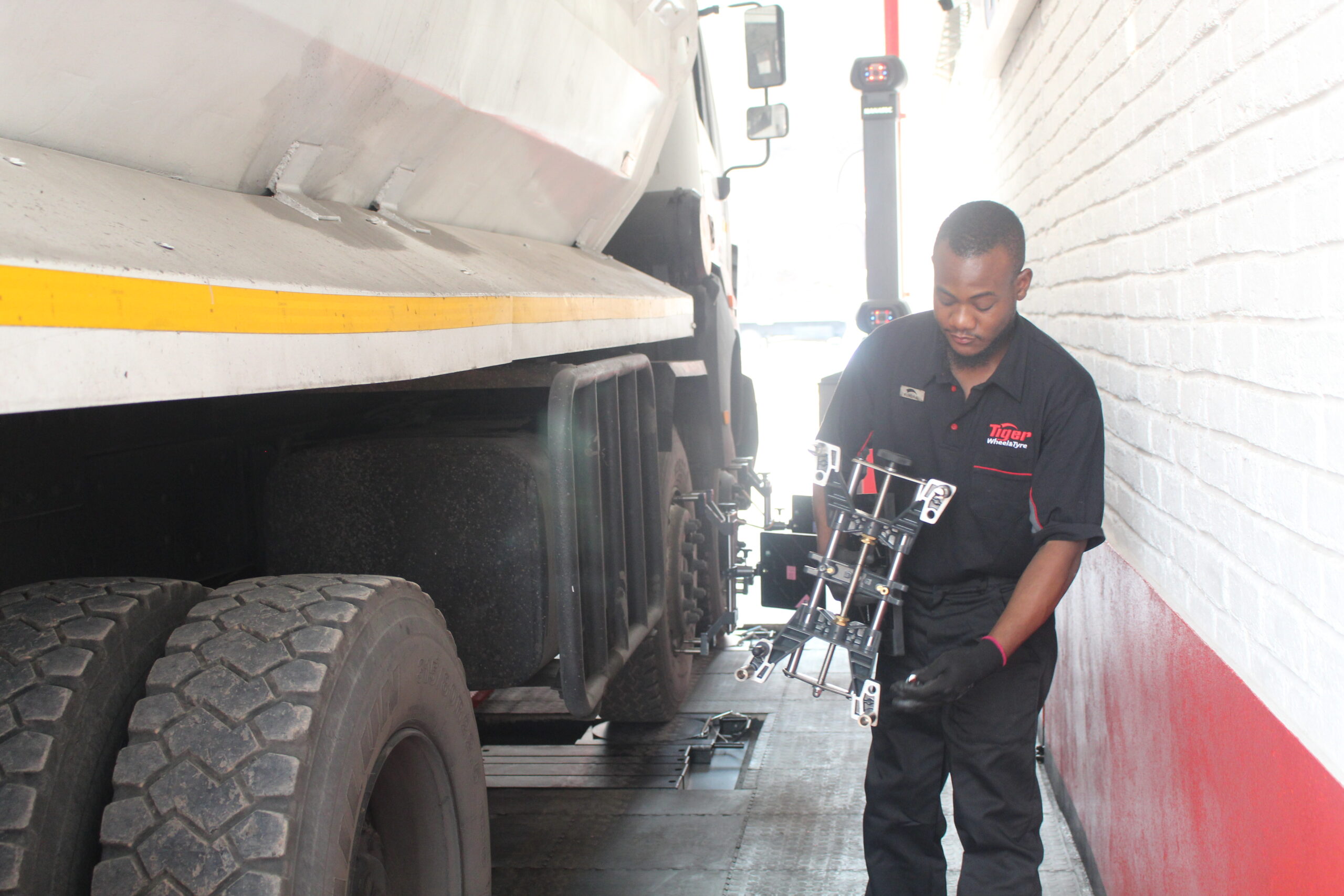
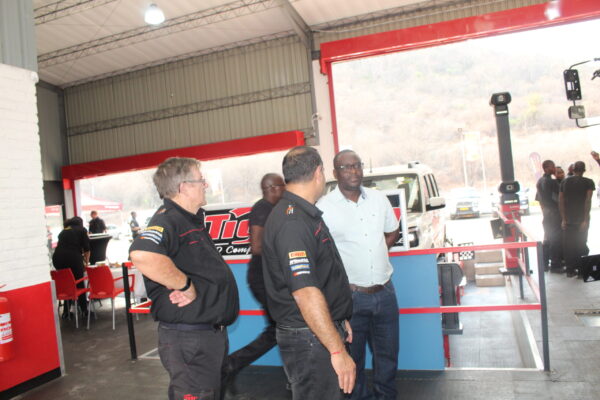
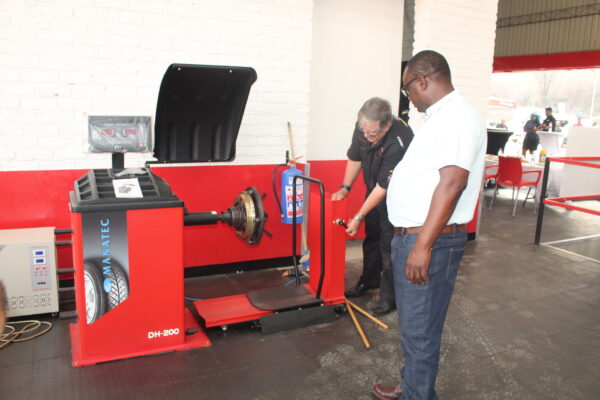
“I have been taken on a tour around the store and I noticed the latest modern equipment in tyre fitment, balancing, 3D computerized wheel alignment and the Nitrogen for Passenger vehicles, Trucks, Buses and I can undoubtedly conclude that all this comes together to define excellent and expert service plus safety for our drivers,” Mhatiwa said.

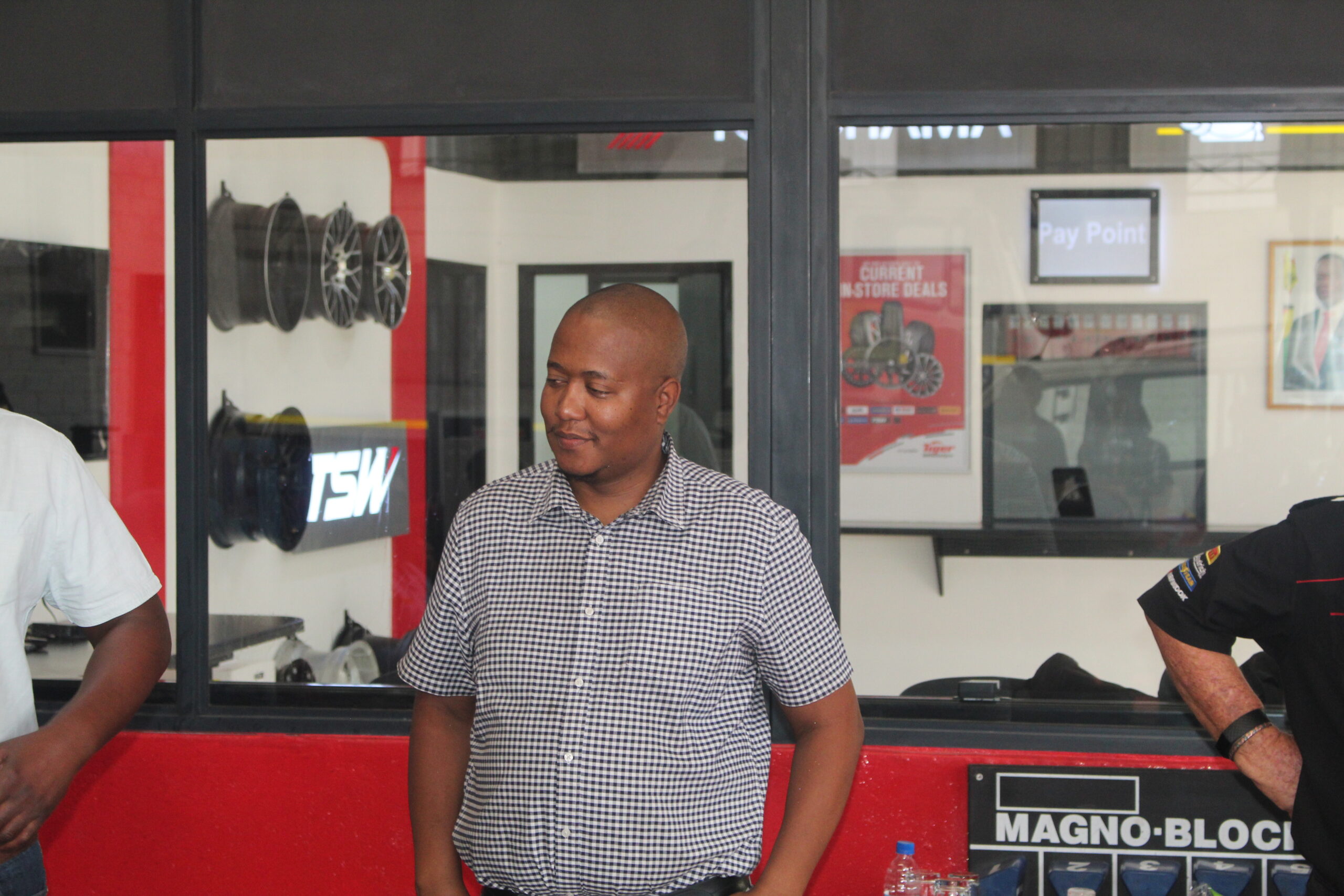
A local businessman in the town, Tinashe Mungofa of Justride Hardware commended Tiger Wheel and Tyre for recognizing the growth of Hwange by coming in to offer support services.

“The coming of Tiger wheels is something that the town wanted, it will actually open more opportunities for the town. It will also help small entrepreneurs grow,” Mungofa said.

Lennon Magaya from  Roadcraft driving school said he was excited to see Tiger Wheel and Tyre coming to Hwange as it has been his preferred choice for tyre and wheel solutions.

“Now that Tiger Wheels have come to our close proximity, we are happy as a town,” Magaya said

Of workers’ conditions at Arcadia lithium and recommendations

0

Recently they were reports of ill-treatment of workers and terrible working conditions at Prospect Lithium Zimbabwe (PLZ)‘s Arcadia lithium project in Goromonzi.

Rudairo Mapuranga

Allegations were that Crec9 a plant construction company contracted by Prospect Lithium Zimbabwe to install one of Africa’s biggest lithium processing plants at the mine that employs over 800 people was subjecting workers to deplorable living conditions.

It has been reported that workers at the lithium mining project were living in dusty metal houses, with no floor or ventilation. Reports also stated that there were no toilets and bathrooms at the workers’ houses with toilets only found 800m away.

It has also been reported that employees were working overtime working for up to 14hrs a day while getting only one meal around 11 am with the meal also being very unbalanced.

There were also allegations of unlawful dismissal of workers and lack of protective clothing with new workers getting PPE after a month. There also were allegations of abuse of women at the mine project by their Chinese employers.

What is on the ground?

On Thursday Mining Zimbabwe visited the Goromonzi-based lithium project to get facts on the matter. It has indeed been noted by this reporter that workers were living in metal houses however allegations that the houses were dusty and with no ventilation could not be established. The reporter however discovered that it was true that the employees were using bathing rooms and toilets that were a bit far from where they were staying. However, there was already a constructed block with bathrooms and toilets that was ready to be used.

When asked about the living conditions, plant construction Operations Manager Mr Gang Min Zhao said that the project was still under construction and that indeed the mine was going to build proper housing structures for its employees. He said Crec 9 as a construction company was there to build houses for Arcadia lithium mine employees, therefore, the houses in which workers are staying were make-shift for the period of construction like at most construction areas. He also said that the workers were not expected to be staying at the project premises since they made it clear Crec9 was not going to provide them with accommodation. He said living at the premises was optional as workers are supposed to return to their respective homes after working hours.

“The houses that the employees are living in are temporary, they are not permanent structures as our duty here as Crec9 is to construct a lithium processing plant and houses for employees of the mine. We are expecting to be done with the construction of the plant by year-end.

“For our employees to be living here is optional where maybe they feel that they want to stay, that’s why we built these temporary shelters after some workers approached us that they sometimes wanted to stay behind as they were coming from distant places with no good road networks. When we constructed the metal houses we overlooked the necessity of constructing bathrooms and toilets nearby. We have however rectified that as you can see from today the employees who will be staying behind have a nearby place to bath,” Mr Zhao said.

On employees working overtime and getting an unbalanced diet, the reporter employed both visual analysis and interviews. The reporter observed that the meal that the workers were having on the day of the investigation was balanced, eating sadza or rice with beef and veggies. Interviewing a randomly picked employee at the mine named Tonde, he said that working hours at the mine were flexible as no one was forced to work overtime, those who were opting to work overtime were doing so because it comes with better benefits than working normal hours (8hrs). He said the food they were getting was just a normal meal that they are used to eating. He said those who stay for overtime are also given a meal in the evening.

“My brother, this is one of the best workplaces I have ever worked in. The meals are good, actually the normal meal that you eat at your house. We have flexible working hours here, we decide with our supervisors what we want to do either working normal hours or overtime. There are a lot of benefits of working overtime so most of us are always asking our supervisors that we continue working because overtime money is a bit good than normal. When we decide to stay here for overtime we are also fed our supper here, a good one too.

“Yes I have heard allegations that we are not being treated fairly, fairly is objective my brother, but to say the conditions are bad I would be lying the conditions here might not be that good but not inhumane, this is a construction site have you ever seen a construction site with hotel-like accommodation,” he said.

This publication also found out that allegations of workers not having protective clothing could not be established as all the workers were in their protective gear.

On workers being fired baselessly, this publication established that most of the workers signed a one-month contract which the employer would choose not to renew due to different reasons. This has led some workers whose contracts could not be renewed to accuse the miner of unfair dismissals.

On sexual assault of women, the reporter established that while there is an isolated case of a woman who is alleging to have been sexually assaulted by a Chinese national, this is not the case with all other women working at the construction site.

Recommendations

The allegations of slavery-like treatment at the mine which is poised to become one of the biggest lithium mines in Africa could bring more problems to the country as it harms how lithium consumers would regard lithium produced in Zimbabwe in terms of responsible sourcing. While it is pertinent that workers’ unions and workers red flag companies that are not treating their workers well, it should be done responsibly without exaggerations as this may lead to our minerals being red-flagged by markets.

While it is true that some salaries are not enough for workers, the National Employment Council (NEC) should be taken to task for putting structures that can lead to the exploitation of labour. It is of importance that NEC consults all worker’s Unions before putting salary structures for workers as this has oftentimes seen workers being disadvantaged.

There has been a rise of allegations of sexual assaults in mining areas, with most of the cases more often than not being used for activism than taken through the courts of law. The reporter, recommends that cases of sexual assault should be reported to the Zimbabwe Republic Police (ZRP). Organisations that empower women should constantly educate women to report cases of sexual assault.

The reporter has discovered that there is a language barrier between Chinese Nationals and Zimbabweans, it is of extreme importance to bridge that gap. The reporter recommends that all foreign nationals coming into Zimbabwe be able to communicate in at least one local language. This will bring language barriers or loss in the translation of words as the situation is at most Chinese mines. In this digital age, Chinese supervisors can also make use of language-translating Mobile Applications like Google Translate which translates over 108 languages.

A supervisor will give an order to an employee in Chinese with one interpreter interpreting it into English while another will then translate it into Shona. This chain of translation will lead to the message ending to the user distorted and potentially inaccurate.

For construction companies, it is important not to overlook certain aspects when it comes to employees’ welfare as this will cost them their reputation. Construction companies can simply eradicate the challenge of accommodation by simply providing a bus that transports workers to and from work from a central point like Goromonzi (a distance of 13,6km) in this instance.

There is also a need to bridge the cultural gap between Chinese Nationals and local people, while the Chinese would not mind staying in quarters that have toilets at a distance local people would find that as abuse. Organisations that deal with cultural exchange to educate Chinese Nationals about the country’s work ethics.

The Portfolio Committee on Mines and Mining Development should also step in and visit these Chinese-owned mines for fact-finding.

Arcadia to commence production first quarter of 2023

0

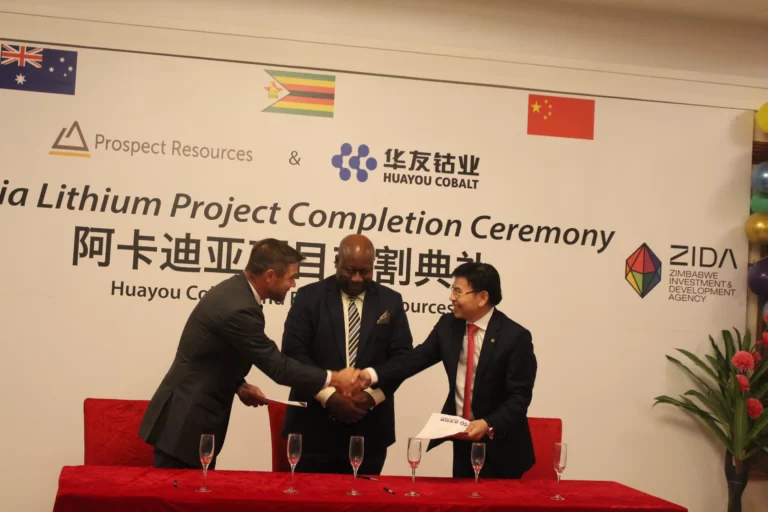
Hongkong Stock Exchange-listed battery metal producer, Zhejiang Huayou Cobalt through its newly acquired company, Prospect Lithium Zimbabwe (PLZ) plans to commence production at its Arcadia lithium Project in Goromonzi during the first quarter of 2023, PLZ General Manager Haijun Zhu said.

Rudairo Mapuranga

In May, PLZ announced that it was going to invest $300 million on the rapid development of the lithium mine and processing plant at its  Arcadia project with construction currently underway. The company that was contracted by PLZ to construct the processing plant Crec9 said it will finish construction of the processing plants and other buildings by the end of the year.

Speaking to Mining Zimbabwe Zhu said his company as it was prepared to contribute significantly towards the attainment of the US$0.5 billion lithium industry which was going to commence production during the first quarter of next year.

“The first season of next year we will start production,” Zhu said.

PLZ processing plant at the Arcadia Lithium project will have the capacity to treat around 4.5 million tonnes of ore and produce 400,000 tonnes of lithium concentrate per annum.

Huayou, one of the world’s biggest producers of cobalt, early this year completed a US$$422 million purchase of the hard-rock lithium mine just outside Harare (in Goromonzi) from Australia-listed Prospect Resources and other Zimbabwean minorities.

Zimbabwe is determined to benefit significantly from the popularity of lithium as it eyes becoming the world’s biggest “white gold” producer after 2023.

With the world superpowers committed to phasing out new gasoline and diesel engine vehicles by 2040, the recent growth in electric vehicle (EV) adoption has fueled a global boom in lithium production.

The adoption and rise in popularity of EVs and the world looking forward to clean energy has resulted in world lithium production increasing significantly between 2016 and 2020, up from 40,000 tonnes to 86,300 tonnes.

Currently, three countries, Australia, Chile, and China are accountable for 86 per cent of the world’s lithium production. Between 1995 and 2010 Lithium production grew steadily, up from 9,500 tonnes to 28,000 tonnes. But the advent of rechargeable batteries and electric vehicles brought in a new wave of demand, fueling an exponential production surge.

Australia currently is the world’s biggest lithium producer accounting for 46.3 per cent of the total lithium production, 40,000 tonnes.

According to the Deputy Minister of Mines and Mining Development Dr Polite Kambamura, the government’s thrust is to overtake Australia as the biggest lithium producer in the world.

He said that the value addition of lithium is important as the country seeks to maximize and get a true value for its lithium.

“We look forward to becoming a world leader in Lithium production. Government’s main thrust is on local Lithium value addition and beneficiation.” Dr Kambamura said.

In 2021 the country was the 6th biggest lithium producer in the world after Australia, Chile, China, Argentina and Brazil with only Bikita Minerals in production.

The production of lithium in Zimbabwe amounted to 1,200 metric tons in 2021. Figures have fluctuated in the period of consideration, with peak production of 1,600 metric tons recorded in 2018 and a low of just 417 metric tons in 2020.

Kamativi Lithium Project Update

0

CAT Strategic Metals Corporation (CSE:CAT, OTC:CATTF, FRA:8CH) (‘CAT’ or the ‘Company’) wishes to report that there have been numerous recent shareholder enquiries regarding the Company’s ownership interest in the Kamativi Lithium Tailings Project (the ‘Project’), located in Northwest Zimbabwe. In 2018, through an earn-in process, CAT acquired an 18.9% interest in Zimbabwe Lithium Company (Mauritius) Limited (‘ZIM’), which has the development rights for the Kamativi Lithium Tailings Deposit at the currently defunct Kamativi Tin Mine; the mine began production in 1936 and ceased operations in 1994 due to low tin prices and falling ore grades. ZIM, in turn, holds a 100% interest in Zimbabwe Lithium Company (PVT) Ltd (‘ZLC’) (formerly Jimbata (Pvt) Ltd). The Kamativi Tailings Project is a joint venture (‘JV’) between the Zimbabwe Mining Development Corporation (‘ZMDC’), owners of Kamativi Tin Mines – which holds 40% of the Project, and ZLC – which holds a 60% interest.

The Kamativi Tailings Project is a man-made deposit that was generated as a site for the containment of tailings produced during the processing of tin mineralization at the Kamativi Tin Mine. The tailings were deposited over a 58-year production period and are derived from the mining and processing of mineralized tin bearing lithium-caesium-tantalum pegmatites. Spodumene is the main lithium mineral present and historical estimates of the size and lithium content of the deposit – coupled with the most recent work undertaken by the Company in 2018 – indicate that there is lithium mineralization of economic interest.

In the fall of 2018, the Company published a Technical Report prepared by MSA Group (Pty) Ltd that was prepared in accordance with the disclosure and reporting requirements set forth in National Instrument 43-101 Standards of Disclosure for Mineral Projects (‘NI 43-101’), Companion Policy 43-101CP, Form 43-101F1, and the CIM Definition Standards for Mineral Resources and Mineral Reserves adopted by the CIM Council on May 10, 2014. Contained in the Technical Report was a Mineral Resource Estimate Statement as follows:

At the time the Company acquired its interest in the Kamativi Lithium Project in 2018, prices for battery grade lithium carbonate were ~ USD$14,000 per ton on the world market. In 2022, prices have increased significantly to a recent high of ~ USD$73,000 per ton; roughly a 500% increase (source: U.S. Geological Survey). The supply and demand issues effecting current lithium prices suggest that the Kamativi Lithium Tailings Deposit has dramatically increased in value and is one of the catalysts for renewed development interest in the project by all stakeholders.

Since the Office of the Permanent Secretary of Mines and Mining Development approved the entering into of the Joint Venture on the 4th of July 2017 between ZIM’s subsidiary and ZMDC, and the subsequent value add of the project through the publication of the NI 43-101, there have been attempts by outside parties to frustrate the development of the Project through posturing in the Zimbabwe court system, which has contributed to the delay in the development of the Project. This is despite the fact that the Project was included under the Zimbabwe Government’s 100 Days Rapid Results Initiative as a project of national interest. The Project is still proceeding through the judicial process, CAT and it’s Project Partners believe there is a strong legal standing and will continue pursuing the development of the Project.

ZMDC, ZIDA urged to support gemstone industry

0

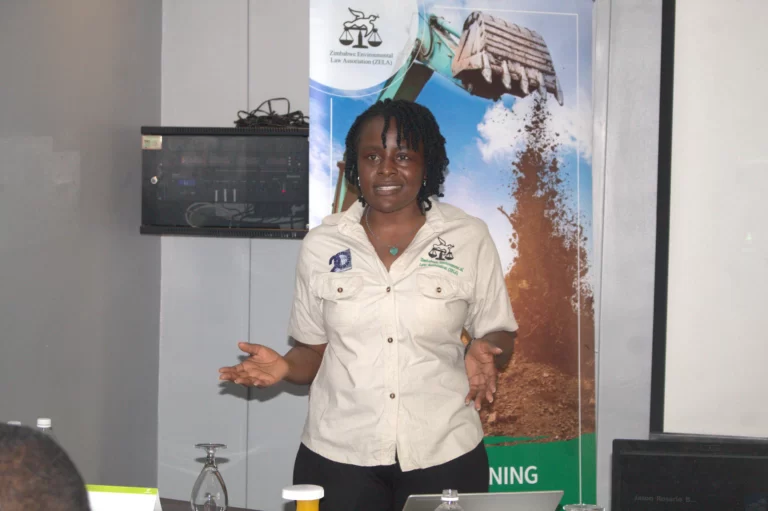
Zimbabwe Environmental Law Association (ZELA) programs assistant Fadzai Midzi has urged the Zimbabwe Mining Development Corporation (ZMDC) and the Zimbabwe Investments and Development Agency (ZIDA) to support the precious stone and semi-precious stone industry for the realization of the US$12 billion mining industry and the 2030 upper middle-income economy vision.

Rudairo Mapuranga

In 2018, Government adopted the Vision 2030 which reflects the aspirations and determination of the people of Zimbabwe towards a Prosperous Upper Middle-Income Nation by 2030. This national vision is expected to leverage on the diversified mineral resource base of over 55 exploitable minerals to help grow the economy. The thrust of Vision 2030 will be on exports of beneficiated minerals to enhancing benefits from the country’s minerals. It is anticipated that this will be realised through support for local processing of Zimbabwe’s diverse mineral resource endowment, with thresholds for beneficiation and value addition such as cutting and polishing.

In 2019, the Government launched an aspirational goal of achieving a US$12 billion-dollar mining industry by 2023. To achieve this ambitious goal, minerals such as gold, platinum, chrome, nickel, gemstones and diamond are expected to generate revenue through exports. In terms of this policy document, priority is given to investments in exploration, the opening of new mines, beneficiation, and value addition of minerals as well as expansion of projects subject to various commercial and economic models.

Speaking at the 21st Skills for Development for the Gemology Sector Conference held at Jameson Hotel in Harare yesterday, Midzi said ZIDA Act Chapter 14:37 and ZMDC act chapter 21:08 empower or give amend to the organizations to have a responsibility to support the growth and development of the gemstones industry.

Midzi said through section 13 of the act, ZIDA was responsible for supporting the gemstone industry by making investment regulations easy for investors.

“The ZIDA Act is relevant for investment in the gemstone sector and creates a mechanism to attract foreign investors through liberalizing the investment framework, affording investor treatment that is fair and equal, and most notably, that outlawing nationalization of investments.

“The three different investment routes in Zimbabwe, which may be utilised are direct and indirect private investments, investments that are in a Special Economic Zone, and investments for Public-Private Partnerships. Investment in the gemstone sector may be done through any of the three types of investment paths. The ZIDA is an important piece of legislation that can promote investment and export revenue in the gemstone sector as the country is endowed with gemstones whose value is estimated to be around US$2 billion,” Midzi said.

She said there was a need for ZMDC to be involved in the formalization revolution of the semi-precious stone industry. She said, In terms of Section 20, functions of ZMDC include investing in the mining industry on behalf of the State and engaging in prospecting, exploration, mining, and mineral beneficiation. Important to the gemstone sector, is that the ZMDC is also empowered to encourage and undertake the formation of mining co-operatives and to render assistance to persons engaged or intending to mine.

“Given that gemstone miners in the country are mostly marginalised communities in rural areas such as women who mine informally with limited knowledge on how to mine responsibly, value of the stones and capital, ZMDC should be rendering assistance to miners through creating co-operatives or syndicates for women gemstone miners.

“The ZMDC is also tasked with the mandate to review the prospects of the mining industry to recommend to the Minister on proper ordination of all investment programmes. Thus, the Corporation should also be reviewing and exploring the economic potential of the gemstone sector to attract investment,” Fadzai Midzi said.

Gvt urged to take a leaf from Tanzania, Zambia, and Brazil to support the gemstone industry

0

Zimbabwe Miners Federation (ZMF) President Ms Henrietta Rushwaya has urged the government (in its quest to realize a sizeable revenue from the gemstone industry) to take lessons from Zambia, Brazil and Tanzania on how they have managed to promote their gemstone industries.

Rudairo Mapuranga

Speaking at the 21st Skills for Development for the Gemology Sector Conference held at Jameson Hotel in Harare yesterday, Madam Rushwaya said the only way for the government to fully realize the significance and potential of the gemstone sector is to formalize them and put them into the mainstream economy.

“If managed appropriately, natural resources will benefit citizens and contribute to the fiscus including supporting employment.

“The government is therefore urged to design laws, policies and practices that support and enhance gemstone mining,” Rushwaya said.

She said for the formalisation, regulations and professionalisation drive it was pertinent for the government to consider taking lessons from Zambia and Tanzania as well as Brazil.

Rushwaya said in Tanzania, the government’s 2010 Mining Act commits the government to facilitate, support and promote increased participation of Tanzanians in gemstone mining including developing Tanzania as a gemstone Centre of Africa, ensuring that medium and small-scale gemstone mines are entirely owned and operated by Tanzanians and encouraging local investors in gemstone mining.

“Tanzania has taken concrete steps to formalise citizen mining since 1997, including through simplifying licensing procedures, improving access to land and expanding the resource available to citizen miners.

“The 2010 Mining Act establishes primary mining licence for citizen mining. Procedures for obtaining primary mining licenceless demanding and licences granted by zonal offices (flexible licencing regime).

“Tanzania’s evolution reflects an increasing recognition of and adaptation to the needs of citizen miners.

“Furthermore persistent and meaningful engagement between stakeholders supports progress towards the government’s citizen-centric vision for the gemstone industry,” Rushwaya said.

For Zambia, she said, “Following nearly 20 years of poor performance under state control, the government ceded its management responsibilities in 1996 and majority equity to Indian – the Israel consortium Hagurato to encourage greater investments in Kagem.

“The company capitalized the project to a scale rarely observed in the coloured gemstones industry making major upgrades to extraction and processing techniques to producing 30 million carats of emerald making it the single largest source of coloured gemstones by volume in the world,” Rushwaya continued.

As a case study for Brazil, Rushwaya said, “The government supports cooperatives to promote garimpeiro.

“These organizations have been instrumental in lowering the bureaucratic barriers and obtaining licences, bargaining for access of land,” she said.

In conclusion, Rushwaya said that the government of Zimbabwe must Identify areas of comparative advantage. She said the government should support skill development and technology transfer by supporting the establishment of gem labs and training centres that operate to international standards.

She said there was a need to come up with Beneficiation hubs giving the example of Thailand which cultivated a reputation for specialized knowledge and craftsmanship. Thai lapidaries are recognized for their quality, ingenuity and specialized cuts and expertise in colour treatment.

Rushwaya also urged the government to have Financial support-lending facilities for the gemstone industry.

Gold buying prices Tuesday 18 October 2022

Fidelity Gold Refinery (FGR) official gold buying prices Tuesday 18 October 2022.

SG 90% AND ABOVE US$50.37/g
SG ABOVE 85% BUT BELOW 90% US$49.57/g
SG ABOVE 80% BUT BELOW 85% US$49.04/g
SG ABOVE 75% BUT BELOW 80% US$48.51/g
SAMPLE BELOW 10g BUT ABOVE 5g US$47.72/g
FIRE ASSAY CASH US$50.37/g

NB: Fire Assay cash price is for gold above 100gs and no sample is deducted.
For Fire Assay Transfer price, a sample of not more than 10g is deducted
A 2% royalty is charged on all deposits (Small-scale Miners)
A 5% royalty is charged on Primary Producers

Cash available. Fidelity Gold Refinery prices will be changing daily in relation to world market prices.

Zambia moves to curb speculative mining license purchases

0

Zambia has announced that the number of mining licences that a company can hold at a time will be restricted to five to curb speculative purchases within the country’s licensing system.

The ministry of mines in February suspended the issuance of mining licences and commissioned an audit in response to public complaints about a lack of transparency.

“Every miner will be restricted to five licences and those that need more will have to justify it,” Zambia’s mines minister Paul Kabuswe said during a briefing on mining regulations.

“We have had a lot of licences being used for speculative purposes and we want to curtail that,” Kabuswe said.

He did not name the companies holding more than five licenses but said those should get in touch with the ministry.

The audit revealed that some companies owned as many as 50 licences. It also found that some were not registered with Zambia’s patents and companies registration agency and may not be paying tax.

The licensing department, which was expected to re-open on April 11, will resume work on October 19, Kabuswe added.

He also said illegal miners would be given 90 days of amnesty to register with the ministry of mines.

Mining Weekly

Karo platinum project taking off with solar power tailwind

0

A multi-phased development approach is being adopted at the Karo Platinum project in Zimbabwe, where a 17-year opencast mine is to be built with a timeline to deliver its first ore to mill in July 2024.

“In July 2024, we will put the first ore in mill,” Karo Mining Holdings MD Bernard Pryor told a project update presentation covered by Mining Weekly.

Land has been allocated for a 300 MW solar plant to serve the project, the 12-month design and construction period for which began on July 1.

The updated output is scheduled at 194 000 oz/y, which puts the project in line with  Anglo American Platinum’s Unki mine, also on Zimbabwe’s Great Dyke.

Total cost to first ore in mill is estimated at $391-million, with $20-million spent to date and with Tharisa able to provide an extra escalation reserve of $26-million should it be needed in today’s volatile world of escalation and inflation.

Under the Zimbabwean government, the project, with a total value of $686-million, has a five-year tax holiday.

Its internal rate of return is just over 26% and return on investment capital is 30%.

The earthworks contracter began clearing the site this week for earthworks terracing to begin in December.

“The accelerator is flat to the floor,” was how Pryor described the project’s pace.

Orders for ball mills and flotations cells, the two long-lead items, have been placed. The ball mills are on the critical path that defines the 24-month construction period and the advanced flotation cells are expected to lift metal recovery to 82%.

Civils contracts will be awarded this month and final negotiations are under way with the selected mining contractor, a mix between a South African mining contractor and a local Zimbabwean mining contractor, and “we should execute that in the next few weeks”.

In a country described by Pryor as having an exceptional level of education and challenged employment, there has been a nigh hundred-to-one response to the ten senior jobs advertised.

“My experience here in Zimbabwe is that the workforce is very capable, educated and has a great work ethic, which will certainly help us to bring this project in on time and on budget,” Pryor said.

A first-phase resource of just under 10-million ounces has a six-element grade of 2.04 g/t.

Typically, the reef horizons are between two and three metres thick and Karo will be targeting anywhere between three metres and five metres in terms of its mining proposition, Tharisa CEO Phoevos Pouroulis stated.

Currently Tharisa plc owns 70% and Leto Settlement the remaining 30% of Karo Mining Holdings plc, which in turn owns Karo Zimbabwe Holdings in joint venture with Generation Minerals, which is the Republic of Zimbabwe’s carried interest in the Karo Platinum project.

Pryor described environment, social and governance (ESG) as one of the project’s most important targets, along with International Finance Corporation-compliant performance standards being applied to the mining and concentrator processing plant.

“We still have the water supply and the power supply to be approved by the Zimbabwean government. Those are in process, and we see no real issues with them.

“In terms of the tailings dam, clearly a subject that is important to all miners, this is a structurally safe dam, rock built not earth or dam built, and it has been independently designed and checked by our consultants,” said Pryor.

The community is seen as key, with the two towns within 30 minutes’ drive of the project site earmarked for employee recruitment.

“We will prioritise local recruitment so that we can benefit the local communities as much as possible,” Pryor promised.

A dedicated social and environmental team of 12 people will ensure that all ESG obligations are met, he added.

Government has allocated new land for 12 households to be relocated and the new houses will be built according to laid-down standards in the next six to nine months, with previously absent power and water supply laid on.

GREEN ENERGY

Green energy and green efficiency are the other benefits of this project.

Discussions are under way with Total Eren for a 300 MW solar plant to be built on land allocated over the road from Karo’s proposed processing plant.

The power will be generated into the national grid and Karo will have a wheeling arrangement to buy back off the grid at the beneficial rates of solar power generation, which are significantly lower than the current power prices obtainable from the grid.

Needed for the processing plant will be 30 MVA, with the excess sold into the grid.

ECONOMIC CONTRIBUTION

Mining contributes 10% to 14% to the gross domestic product (GDP) of Zimbabwe and approximately 2% of the country’s GDP will come from Karo revenues.

The project will average 1 000 direct jobs during construction and a similar number during operations, leading to 7 000 indirect jobs creation in the community.

Regarding project execution, most of the detailed engineering has been completed and a pilot concentrator on site is treating about one ton of material an hour.

The pilot concentrator is being used to produce platinum group metals (PGMs) concentrates that it will look to for Phase 2 and it is also helping with the optimisation of flotation circuits and as a training ground for operators ahead of going on to the main plant.

CASH-FLUSH THARISA

It has been a standout year for Tharisa, which put in a record performance in the 12 months to September 30, with 64.1%-higher net cash of $78.6-million.

Starting with exploration and mine development takes time and requires strategic investment philosophies and capital needs to be patient when exploring new regions, Pouroulis emphasised.

If Karo meets its timelines to project completion, from first drill hole to first ore in mill would have taken six years.

Karo, 80 km southwest of Harare, has been awarded a special grant in the Great Dyke, which hosts the main PGMs- and base metals-rich sulphide zone in the Mashonaland West district, over an area of 23 902.9 ha.

To the south is Zimplats and to the north Zimplats’ Selous metallurgical complex. The land was originally explored by Zimplats, with the whole area having a resource of 96.4-million ounces.

In either cash or shares, Tharisa has invested $70.3-million. The first $4.5-million went in to acquire the first 26.8% shareholding in Karo Mining Holdings, $8-million was for first phase exploration, $3.4-million for technical studies, a non-fully-drawn $25-million kicked off the project in mid-year with early development funding, and the acquisition of the balance 39.5% shareholding had an equivalent share value of $29.4-million.

Exploration groundbreaking took place in 2018 and at the end of 2019, the area was demarcated as a special economic zone, which provides special privileges to new businesses entering Zimbabwe and investing into the country.

Phase 2 exploration recommenced post-Covid in the first quarter of 2020. The mining lease was received in 2021, which was basically for the life-of-mine and giving multi-phased access to all 92-million ounces.

Tharisa, which has paid dividends for six years, is committed to continuing to be a dividend payer in conjunction with the investment into Karo Platinum.

Mining Weekly
We will ‘maximise’ mineral reserves before debt clearing

0

Zimbabwe will not rush to use mineral reserves under a new policy that compels miners to pay half of their royalties in commodities to settle its foreign debt of US$13.2 billion.

“We want to focus first on maximizing value from our minerals and then later see how we can use them to clear our arrears,” Finance Minister Mthuli Ncube told Bloomberg.

Last week, President Emmerson Mnangagwa said minerals secured under the planned policy would be used as security for loans, but did not indicate when this would happen.

“Let me…say that the precious and high-value strategic minerals we accumulate can also be used to securitise any borrowings we may prudently envisage,” Mnangagwa wrote in The Sunday Mail. “This raises our country’s creditworthiness, and, thus, our ability to circumvent and fend off funding limitations designed against our economy by those who have imposed illegal and unjust sanctions against us.”

In his midterm budget, Ncube said mines were contributing too little in taxes, with just 1.2% of GDP in direct taxes in 2021.

Miners’ reaction

Miners have mostly said the new measure will have no material impact on their operations.

“We respect the government’s position. It’s their prerogative. All they are saying is they are changing payment modalities,” said Chamber of Mines Chief Executive Isaac Kwesu.

Caledonia Mining, one of the largest gold producers, and Impala Platinum, whose Zimplats is the largest miner in the country, have also said the regulation would not hurt them.

Bernard Pryor, MD of Karo Mining, which is developing Zimbabwe’s newest platinum mine at Selous, says this is not a new idea, but that he has not seen it work elsewhere.

“That is not a novel approach by governments. A lot of governments would like to take physical because they think they can do better with it than perhaps the mining companies can. I’ve not seen that ever play out successfully in any other country,” Pryor says.

Consultations were yet to begin with the industry and, says Pryor, “I think we’ll see probably quite a lot of change to that request over a period of time.”

Zimbabwe’s debt burden

He said Zimbabwe had begun issuing bonds with maturities of between two and 20 years in order to honour its debt to creditors and was looking at how they can be traded, while it was also looking to issue bonds to compensate white former farmers over time.

“We’ve begun to make token payments to the World Bank, the AfDB (African Development Bank), European Investment Bank,” Ncube said. “And all the Paris Club creditors, 17 of them, we will be making token payments to show that we want to be a good debtor.”

He said IMF staff would visit Zimbabwe in December and then discuss a staff-monitored programme in the first and second quarter of 2023.

That, he said, would enable access to “resources from a sponsor who will help us with bridge funding in order to clear the arrears” to international lenders and after that to restructure its debt to bilateral Paris Club creditors.

NeZWire