Home Blog Page 38

Price Slump and Challenges Force Artisanal Miners to Abandon Zimbabwe’s Lithium Fields

0

A significant exodus of Artisanal and Small-Scale Miners (ASM) from Zimbabwe’s lithium sector has been revealed in a new study, with many abandoning their mine sites entirely due to economic pressures and operational challenges, Mining Zimbabwe can report.

By Rudairo Mapuranga

This finding was presented by Joyce Machiri of the Zimbabwe Environmental Law Organisation (ZELO) during the launch of their “Mine to Market: Critical Minerals” situational report in Harare. The report assesses the entire lithium value chain, from extraction and processing to transportation and export.

According to Machiri, one of the study’s starkest discoveries was the state of ASM operations. “Most of the ASM sites were abandoned,” she stated. “They were not operational; they were affected by the price slump, which affected the big mines as well as the small-scale.”

The downturn in global lithium prices proved devastating for smaller operators, who lack the financial buffer of large corporations. Machiri described the visible aftermath of this exodus, noting that equipment and materials “were just seen lying around some mine sites; some were left along the road and the like.”

This retreat of ASMs from the lithium space coincides with other systemic issues plaguing the sector. The report identified challenges such as electricity and water shortages, which are hindering the processing of lithium into concentrate. These infrastructural deficits are also complicating the government’s efforts to enforce a ban on the export of raw lithium ore.

Machiri highlighted a critical lack of coordination among key government ministries and agencies, including the Minerals Marketing Corporation of Zimbabwe (MMCZ), which was notably absent at border posts. This absence, she said, creates significant oversight gaps, making it difficult to verify if the lithium being transported matches the accompanying documentation.

Furthermore, the study found a limited understanding of lithium minerals among officials from the Zimbabwe Revenue Authority (ZIMRA), coupled with a lack of weighbridges at borders to accurately determine the content of export trucks.

The ZELO report paints a picture of a lithium sector at a crossroads. While the government has approved numerous processing plants and attracted major mining companies, the departure of small-scale miners and persistent infrastructural and regulatory hurdles threaten the sustainability and equitable growth of this critical mineral industry. The findings call for a coordinated strategy to not only attract large investment but also to create a resilient and inclusive value chain that can withstand market fluctuations.

Strategic Pullback: Namib Minerals Lowers 2025 Guidance, as Expansion Projects take off

0

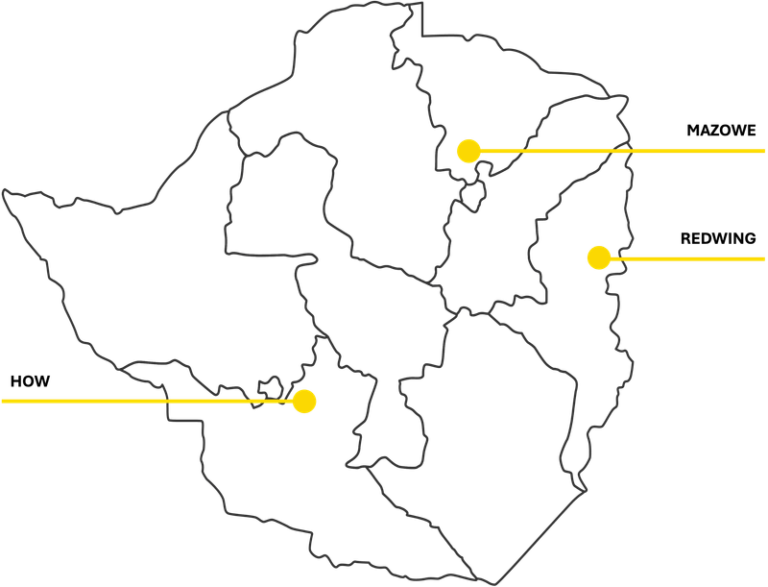
Nasdaq-listed multi-asset miner Namib Minerals, having taken a strategic approach to 2025, has lowered production guidance at its How Mine operation while simultaneously laying the groundwork for expansion at its Redwing and Mazowe mines. In its latest operational update, the company said the move is aimed at grade optimisation and operational stability, Mining Zimbabwe can report.

By Ryan Chigoche

For the 2025 financial year, output from How Mine is expected to fall to 24,000–25,000 ounces, down roughly 32–34% from the 36,600 ounces produced in 2024.

Adjusted EBITDA is projected at US$22–26 million, while all-in sustaining costs (AISC) are forecast to rise to US$2,700–2,800 per ounce.

Namib Minerals said the lower guidance is a deliberate, strategic pullback designed to stabilise ore quality and optimise processing efficiency, rather than a sign of operational weakness.

“Our focus this year remains on stabilising grades and improving processing capacity at How Mine,” the company said. “These improvements are expected to yield stronger and more consistent performance going forward.”

Analysts note that the reduced output underscores a trade-off between short-term volumes and long-term operational health. By concentrating on grade and throughput, Namib Minerals is positioning How Mine to deliver more consistent returns, while freeing management attention and cash flow for the next stage of growth.

WSP Steps In for Redwing and Mazowe

The company’s expansion ambitions are anchored by the appointment of WSP Global Inc., tasked with conducting feasibility studies at Redwing and Mazowe. The 12–18-month studies will verify exploration results, upgrade resources, and deliver SK-1300-compliant reports that form the technical and financial foundation for production restarts.

“The appointment of WSP marks a major step forward in our resource expansion plan and demonstrates our commitment to building a technically robust foundation for the next phase of growth,” the company said.

Namib Minerals said the studies are part of a phased growth strategy designed to align each mine’s production with its underlying resource potential.

By combining How Mine optimisation with development work at Redwing and Mazowe, the company is pursuing a calculated approach: securing short-term stability while preparing new assets to boost its overall production base.

Even as feasibility studies proceed, preparatory work at Redwing has begun. Dewatering is scheduled to start during the study period and is expected to take roughly eight months to reach the targeted mining levels. Surface infrastructure and power upgrades are also being planned to coincide with the restart timeline.

By overlapping feasibility and early-stage site works, Namib Minerals aims to shorten the gap between planning and production, ensuring that once financing is in place, the mines can move quickly into operation.

The company estimates total capital expenditure for Redwing and Mazowe at US$300–400 million, with the bulk of funding allocated to Redwing. Financing is expected to come from a combination of project debt, strategic partnerships, and internally generated cash flows, helping to limit shareholder dilution.

With How Mine entering a consolidation phase and feasibility work progressing at Redwing and Mazowe, the company appears poised to expand its production base over the next 18 months, moving closer to its goal of becoming a multi-mine gold producer in Zimbabwe.

Record Gold Prices, Higher Output Propel Caledonia to a 467% Surge in Q3 Profit

0

VFEX-listed miner Caledonia Mining Corporation posted a massive 467% surge in profit for the third quarter ending September 2025, driven by buoyant bullion prices and steady production at its Blanket Mine, Mining Zimbabwe can report.

By Ryan Chigoche

In the report, the miner posted a profit after tax of $18.7 million, a sharp increase from $3.3 million posted in the prior period, helping the company offset high operational costs.

The profit was in line with the topline, which jumped 52% year-on-year to $71.4 million, driven by both higher gold prices and increased sales volumes.

The miner sold 20,355 ounces of gold during the three months to the end of September, with a further 2,861 ounces held in inventory at the quarter-end and sold at the start of October.

Caledonia’s average realised gold price soared 40% to $3,434 per ounce, reflecting a broader rally in the precious metal during the period, driven by investor demand amid global economic uncertainty.

As a result, gross profit nearly doubled to $36.9 million, while earnings before interest, tax, depreciation and amortisation (EBITDA) rose 162% to $33.5 million.

Free cash flow improved to $5.9 million, swinging from a negative $2.4 million in the third quarter of 2024, while liquidity stood at $44.3 million, giving the company headroom for continued investment.

Commenting on the performance, Mark Learmonth, chief executive, said: “The strong gold price environment, which increased 40% to average $3,434 per ounce, combined with higher production, has resulted in a 52% increase in quarterly revenue and a significant uplift in free cash flow.”

“We continue to deliver solid operational and financial results at Blanket… maintaining our focus on stable production and disciplined capital investment as we seek to modernise operations and improve mining efficiency,” he added.

Production from Blanket totalled 19,106 ounces for the quarter, with a further 437 ounces produced and sold from Caledonia’s smaller Bilboes oxide mine, which is still in the early stages of development. A feasibility study on Bilboes is expected imminently.

The company’s consolidated on-mine cost was $1,228 per ounce, with all-in sustaining costs, a broader industry metric that includes sustaining capital expenditure, at $1,937 per ounce.

The quarter was marked by the death of a Blanket Mine employee in a secondary blasting accident in September.

Learmonth said: “The safety and well-being of our workforce remains our highest priority. We have initiated a comprehensive review of our safety procedures and training, and we are committed to ensuring that such a tragedy does not occur again.”

In governance news, Caledonia appointed July Ndlovu, a former chief executive of Anglo American’s coal division, as an independent non-executive director on 5 November.

The board declared a quarterly dividend of 14 cents per share, payable on 5 December.

What’s next? Caledonia is developing new mining areas to add to the reliable Blanket Mine. In this drive, the company is spending US$2.8 million on exploration at Motapa, with a feasibility study for Bilboes said to be imminent.

These projects, once running, could make Caledonia the biggest gold producer in the country.

Why the Mine Managers Conference and AGM Are Crucial for Mining Equipment Suppliers and Service Providers

0

In every mining nation, the success of the industry depends not only on mineral resources and technology but on the people who make operational decisions every day — the Mine Managers.

In Zimbabwe, the Association of Mine Managers Conference and Annual General Meeting (AGM) serves as one of the most important gatherings of these decision-makers. For equipment suppliers and service providers, this event represents a golden opportunity to engage directly with the heartbeat of the mining industry.

Here is why

1. The Nerve Centre of Mining Decision-Making

Mine managers are the ultimate link between the boardroom and the mine site. They are on the ground, oversee safety, production, and efficiency, and their recommendations often determine which equipment or services are adopted across entire operations.

While procurement officers handle paperwork, it is the Mine Manager who validates performance, approves trials, and influences which brands and service providers become trusted partners. Engaging them directly offers suppliers and service providers a chance to understand operational challenges firsthand and tailor their offerings to meet real mining needs.

2. A Meeting of the Industry’s Minds

The Mine Managers Conference and AGM bring together the men and women who lead Zimbabwe’s largest and most productive mines. Over several days, the event provides a rare platform for networking, discussion, and collaboration across the mining value chain.

For suppliers and service providers, this is not just another exhibition — it is a strategic forum where business relationships begin. From technology demonstrations and safety innovations to maintenance and logistics solutions, the event allows industry partners to showcase their products directly to those who use and influence purchasing decisions.

3. A Platform for Thought Leadership

The Conference goes beyond networking — it is a space for learning, sharing ideas, and aligning with the direction the industry is moving. When suppliers participate, they gain insight into current challenges such as cost pressures, productivity goals, ESG compliance, and digital transformation.

This knowledge helps companies position their products as solutions that support mine managers’ operational objectives rather than as generic offerings. Being seen as a thought leader rather than just a vendor builds trust and long-term engagement.

4. Relationship Building Beyond the Sale

Mining is a trust-based industry. Mines operate in remote, challenging environments where downtime is costly and safety is non-negotiable. Suppliers who consistently engage, support, and respond quickly to managers’ needs become more than vendors — they become partners.

The Mine Managers AGM provides the perfect setting to nurture these relationships in person, away from emails and formal meetings. It allows suppliers to strengthen their presence, understand customer feedback, and demonstrate an ongoing commitment to the industry.

5. Visibility Through Strategic Media Coverage

This year’s event will be covered extensively by Mining Zimbabwe, ensuring that participating suppliers and service providers gain media exposure long after the conference ends. Coverage will appear across print, digital, and social media platforms — amplifying the visibility of brands that support the mining sector’s leadership events.

The Mine Managers Conference and AGM are not merely annual gatherings — they are where Zimbabwe’s mining future is discussed, shaped, and strengthened. For equipment suppliers and service providers, participation is an investment in relationships, reputation, and relevance.

By engaging the people who manage the mines, suppliers position themselves not only as service providers but as trusted partners in the growth and sustainability of Zimbabwe’s mining industry.

Gold buying prices in Zimbabwe per gram/ ounce, 10 November 2025

0

Gold buying prices in Zimbabwe per gram/ ounce, 10 November 2025, from the official gold buyer and exporter Fidelity Gold Refinery (FGR).

1 oz = 31.1035 g

CategoryPrice ($/g)Price ($/oz)
SG 90% and ABOVE121.35$3,775.77
SG 85% and above but below 90%120.06$3,735.28
SG 80% and above but below 85%118.78$3,694.79
SG 75% and above but below 80%117.49$3,654.31
Sample 5g and above but below 10g115.57$3,594.49
Fire Assay CASH121.99$3,794.65


Note: The Fire Assay cash price applies to gold above 100g, with no sample deduction.

A sample of not more than 10g is deducted for the Fire Assay Transfer price.

Community Solidarity Emerges from Silobela Mining Tragedy

0

In the wake of the mining tragedy that claimed seven lives at Auriga 47 Mine, a powerful story of community solidarity has emerged, uniting government, miners, and local leaders in a shared mission of recovery and compassion, Mining Zimbabwe can report.

By Rudairo Mapuranga

The devastating incident, which saw artisanal miners trapped by floodwaters on November 5th before their bodies were recovered on November 7th, became a catalyst for an extraordinary cross-sector response.

Mr. Fortune Mupungu, the District Development Coordinator (DDC) for Kwekwe, explained how established disaster protocols were immediately activated.

“Whenever disaster happens, we activate the Civil Protection Unit,” Mupungu stated. “We managed to get assistance from Jena Mines and other small-scale miners in the area like Bravo. We also got assistance from the makorokoza in the area, those who were familiar with the underground tunnels.”

This collaboration between formal rescue teams and local artisanal miners proved invaluable.

“With the help of Jena Mines’ rescue team expertise, they were able to retrieve the bodies,” Mupungu confirmed, highlighting an operation that combined professional technical knowledge with intimate local understanding.

The response revealed profound leadership from Silobela’s Member of Parliament, Honourable Jonah Nyevera, whose involvement was both immediate and deeply personal.

“We received a lot of assistance from the MP, Honourable Jonah Nyevera,” said DDC Mupungu. “He provided tents as it was raining, food supplies for those working on site, and also provided USD$200 to each bereaved family.” The MP’s commitment extended to providing USD$1,000 for the artisanal miners assisting in the recovery and buses to transport mourners.

Most significantly, Mupungu noted, “The MP was there on the ground for two days while the rescue mission was happening,” demonstrating leadership through physical presence during the community’s most difficult hours.

The tragedy prompted a response from the highest levels of government. “We received greater assistance from the Government of Zimbabwe under the leadership of His Excellency Emmerson Mnangagwa,” Mupungu stated. “The government provided coffins, food, and transport.”

This national-level support was complemented by the mobilisation of the local mining community. The Chairman of the Small-Scale Miners in Silobela successfully rallied artisanal miners, whose specialised knowledge and manpower became crucial to the operation.

Beyond the immediate crisis, Hon. Nyevera is now advocating for changes to prevent future tragedies. He is conducting awareness campaigns, advising small-scale miners to avoid entering mines during dangerous weather.

The MP also identified structural issues within the mining sector that need addressing. “Big mines should also provide tributes,” Nyevera advocated, referencing the financial pressures on artisanal miners. He also called for bureaucratic reforms, stating, “If people apply for tributes, the Ministry of Mines should also be fast to process the papers… The Ministry of Mines should solve disputes and also give papers on time.”

He highlighted a fundamental problem that complicates regulation and safety oversight: “Now we don’t know whose mine this belonged to because there is no title there.”

The multilayered response to the Silobela tragedy, combining immediate humanitarian aid, hands-on leadership, and cross-sector collaboration, offers a model for community crisis response.

The actions of all involved, particularly MP Nyevera, demonstrate how compassion and concrete assistance can bring dignity to the darkest hours. As the community mourns, the solidarity shown in the aftermath of the tragedy provides a foundation for building a safer, more regulated future for the miners who are essential to the local economy.

Premier Adjourns General Meeting to Finalise Key Shareholder Discussions

0

London Stock Exchange-listed mining company Premier African Minerals Limited has announced the adjournment of its General Meeting (GM), originally scheduled for 7 November 2025, citing the need for additional time to conclude ongoing commercial discussions with its principal shareholder, Mining Zimbabwe can report.

By Rudairo Mapuranga

The meeting, which was convened to consider and vote on the disapplication of pre-emption rights set out in the company’s Articles of Association, will now reconvene on 19 November 2025 at 15:30 GMT at The Croft, Blue Hills, South Africa.

According to the company, the adjournment is meant to allow further engagement between management and key stakeholders before any resolutions are put to a vote. Premier emphasised that the resolutions under consideration are critical to the company’s strategic direction, cautioning that failure to pass them could have a “material impact” on shareholders and company assets.

Following the postponement, the company has set 17 November 2025 at 15:30 GMT as the new deadline for proxy submissions to its registrar. Shareholders who hold Depositary Interests through the CREST system have until 14 November 2025 to submit their instructions.

Proxy appointments already submitted will remain valid unless revoked or replaced by new forms. Premier urged shareholders to review the explanatory notes attached to the 15 October 2025 Notice of Meeting and to participate either in person or by appointing the meeting chairman as their proxy.

In a bid to improve accessibility and transparency, Premier will livestream the reconvened meeting through a webinar accessible via any internet-connected computer or smart device. A link will be made available on the company’s website two days before the meeting.

The adjourned meeting forms part of Premier’s ongoing efforts to stabilise operations and restructure its financial and shareholder frameworks amid continued work at the Zulu Lithium and Tantalum Project in Zimbabwe.

The company has been engaging with its principal shareholder—widely understood to be Canmax Technologies Co. Ltd., its offtake and prepayment partner—over several commercial matters, including a potential revised agreement linked to Zulu’s funding and production plans.

Premier’s Managing Director, Graham Hill, who authorised the release of the announcement, has been leading a series of operational and governance reforms since assuming leadership earlier this year. These include plant optimisation at Zulu, progress on the installation of a secondary flotation plant in Harare, and renewed efforts to align the company’s corporate structure with its strategic objectives.

Premier African Minerals Limited is a multi-commodity mining and natural resource development company focused on Southern Africa, with core assets including the RHA Tungsten and Zulu Lithium projects in Zimbabwe. The company also holds lithium and gold interests in Mozambique.

Its shares trade on London’s AIM market under the ticker PREM.

Zimbabwe’s Mining Academy Set to Transform Artisanal Gold Sector

0

A new initiative is set to professionalise Zimbabwe’s artisanal gold mining sector, equipping miners with the skills, tools, and knowledge to operate safely, responsibly, and profitably, Mining Zimbabwe can report.

By Ryan Chigoche

The Mining Academy, being developed by Planet Gold in partnership with the Zimbabwe School of Mines (ZSM), aims to tackle persistent challenges in a sector that employs between 500,000 and 1 million miners and supports over 2 to 3 million livelihoods nationwide.

Despite its size and economic importance, the sector faces long-standing issues, including limited financial inclusion, low productivity, weak safety standards, and minimal adherence to environmental regulations.

Only 4% of ASM operators maintain financial records, over 70% are excluded from the banking system, and 80% operate without geological surveys, making it difficult to identify high-value minerals. The sector is also responsible for around 40% of occupational health incidents, alongside daily environmental and social challenges.

To address these gaps, Planet Gold and ZSM are developing the Mining Academy — a platform designed to professionalise the sector, improve productivity, and empower miners to operate responsibly.

“The Mining Academy is primarily focused on Zimbabwe’s artisanal gold mining sector, which employs a significant number of people. It emphasises the importance of occupational health and safety, along with ESG practices, as essential for maintaining a responsible and effective industry. The ASM Academy is also addressing critical gaps in financial capacity, tackling issues such as financial inclusion, compliance with national laws, and improving overall productivity,” said Paul Matshona, Head of Research and Innovation at ZSM.

“Therefore, the Academy will be a platform to co-create solutions that formalise, finance, and digitalise the sector while promoting responsible and inclusive mining practices,” he added.

The Academy is structured around six core modules: feasibility studies and mine planning, financial management and negotiation, environmental compliance and ESG practices, legal and governance literacy, responsible mining and innovation, and community engagement, including conflict resolution.

Training will be practical, taking place at an experimental mine where miners can acquire essential skills in a real-world environment.

Gender inclusivity is a key priority, with women expected to make up 50% of participants. Graduates will receive certification from ZSM, preparing them for investment-ready ASM operations. International standards will be integrated into the curriculum, including OECD guidelines, London Bullion Market standards, and Fairmined certification, strengthening Zimbabwe’s capacity for formalisation and ESG reporting while aligning miners with global best practices.

The Academy’s success depends on collaboration across the mining ecosystem. It draws on insights from the Chamber of Mines, the Ministry of Mines, the Ministry of Environment, and industry associations. Plans include pilot projects, access to training equipment, and modules such as gold culture and controlled blasting techniques to enhance practical learning and attract more miners to the programme.

Once operational, the Mining Academy is expected to make Zimbabwe’s ASM sector safer, more productive, and financially inclusive. By fostering innovation, responsible resource management, and adherence to ESG standards, the initiative aims to transform artisanal mining from a largely informal livelihood into a professionally managed and sustainable industry.

ASM Urged to Implement Robust Safety Systems as Rain Season Commences

0

With the annual rainy season now underway, the Kwekwe District Civil Protection Unit (CPU) has launched a targeted awareness campaign urging artisanal and small-scale miners (ASM) to immediately implement enhanced safety and water management systems to mitigate rain-induced disasters, Mining Zimbabwe can report.

By Rudairo Mapuranga

The campaign strikes a pragmatic tone, focusing on risk reduction measures that allow for continued operations while prioritising worker safety.

The onset of the rains increases the risk of mining-related disasters, particularly due to the heightened soil fragility that can lead to underground collapses. Rather than calling for a complete cessation of activities—a measure often ignored in practice—the authorities are advocating for a proactive and managed approach to safety.

The Civil Protection Unit is strongly urging miners to focus on four key operational areas to safeguard their sites and workers. A critical immediate step is the implementation of effective water management systems. This includes constructing trenches and ensuring proper drainage around mining sites to divert surface water, which can rapidly destabilise underground workings and waste dumps.

Furthermore, miners are being called upon to institutionalise regular risk assessments and safety audits. These proactive checks are essential for identifying potential hazards such as unstable ground, faulty support structures, or water ingress before they lead to accidents. The directive also emphasises the importance of administrative controls, insisting that all mining operations maintain updated registers of all workers on site. This simple measure is vital for emergency response teams to quickly account for all individuals in the event of a collapse or other incident.

Finally, the campaign highlights the need for reliable communication systems. Every mining site must devise and test a method to quickly alert underground workers of any emerging danger, such as a sudden downpour that could flood shafts or trigger a collapse.

While the current campaign focuses on preventative measures, the Kwekwe District CPU has a history of responding to tragic mining incidents in the region, underscoring the critical importance of their current advisory.

This advisory from the Civil Protection Unit reflects a growing recognition of the ASM sector’s economic importance and the practical need to work with miners to improve safety standards. By focusing on implementable systems such as drainage, audits, and communication, the campaign aims to reduce the annual spike in mining accidents during the wet season, protecting both lives and livelihoods in the Kwekwe District.

Bodies of Silobela miners retrieved, recovery Operation Concludes

0

The Zimbabwe Republic Police (ZRP) has officially confirmed the devastating conclusion to the mining tragedy that unfolded at Auriga 47 Mine this week, with recovery teams successfully retrieving the bodies of all seven artisanal miners who were trapped when their shaft flooded following heavy rains, Mining Zimbabwe can report.

By Rudairo Mapuranga

The confirmation brings heartbreaking closure to a three-day ordeal that has gripped the Silobela community and drawn attention to the persistent dangers facing artisanal miners across the region.

In their official statement, the ZRP detailed that the incident occurred on November 5, 2025, at the Auriga 47 Mine located in the Base Mineral Block of Nzwananzwi Village, Silobela. The seven miners became trapped underground when torrential rainfall caused flooding in the shaft where they were working. After an extensive dewatering and recovery operation, the victims’ bodies were finally retrieved on November 7, 2025, bringing a tragic end to the rescue efforts that had mobilised local mining communities and emergency response teams.

The police statement transforms what was initially feared into a confirmed tragedy, moving the incident from a rescue operation to a recovery mission and now to a period of mourning and investigation. The formal confirmation by authorities provides some measure of closure to families who had maintained a vigil at the mine site since the flooding occurred, though it replaces their hope with grief.

The ZRP indicated that the names of the seven victims will be released once formal identification procedures have been completed by next of kin. This standard protocol ensures that families are properly notified before public announcements are made, respecting the dignity of the deceased and the grief of their loved ones during this devastating time.

The confirmation of all seven fatalities underscores the lethal power of mine flooding incidents and the vulnerability of artisanal miners who often work without adequate safety measures, proper ventilation systems, or emergency evacuation plans. The rapid inundation of the shaft by floodwaters left little opportunity for escape, highlighting how quickly routine mining operations can turn catastrophic during seasonal rainfall.


The Recovery Operation: Community Resilience in the Face of Tragedy

The successful retrieval of all seven bodies on November 7 represents the culmination of an intensive recovery effort that saw local mining communities, emergency services, and neighboring mines collaborate in a demonstration of collective solidarity. The dewatering process, which formed the central challenge of the operation, required specialized equipment and technical expertise to gradually remove water from the flooded shaft while ensuring the safety of recovery teams.

Mining Engineer Pias Ndala, who has been closely monitoring the situation, reflected on the technical challenges faced by recovery teams. “The successful retrieval of the victims, while tragically too late to save lives, represents a significant technical achievement under extremely difficult conditions. The collaboration between local mines, community members, and emergency services demonstrates the importance of prepared response protocols for mining emergencies, even if in this case they were activated after the tragedy had already occurred.”

Ndala emphasised that this devastating outcome should serve as a catalyst for meaningful change in artisanal mining safety practices. “We now have a profound responsibility to ensure these seven miners did not die in vain. Their tragedy must become the impetus for implementing comprehensive safety reforms that include mandatory emergency response planning, community-based rescue training, and early warning systems for weather-related risks. Furthermore, we need to establish formal safety certification programs tailored to artisanal mining contexts and develop affordable water monitoring technology that can alert miners to rising water levels before they become dangerous.”


Artisanal Mining in Zimbabwe: Economic Necessity and Persistent Danger

The tragedy at Auriga 47 Mine casts a spotlight on the broader context of artisanal mining in Zimbabwe, where an estimated 500,000 people depend on small-scale mining for their livelihoods. These operations, often referred to as “makorokoza,” contribute significantly to Zimbabwe’s gold production—accounting for approximately 60% of the country’s output—yet they operate with minimal regulatory oversight and safety protections.

Artisanal mining represents a vital economic lifeline for many rural communities like Silobela, where formal employment opportunities are scarce. However, this economic necessity comes with tremendous risk, as miners often work in precarious conditions without adequate safety equipment, proper shaft reinforcement, ventilation systems, or emergency evacuation plans. The seasonal rains that are essential for agriculture simultaneously transform mining operations into death traps when surface water infiltrates underground workings.

The persistence of such tragedies reflects the complex interplay between economic survival and safety considerations. Many artisanal miners are acutely aware of the dangers they face but continue their work due to limited alternatives, creating a cycle of risk that has proven difficult to break through regulation alone.

The Silobela region has experienced multiple mining tragedies in recent years, creating a painful pattern of loss and mourning for this tight-knit community. In February 2019, fifteen miners were successfully rescued at Peace Mine in Silobela through coordinated efforts by the Ministry of Mines and Mining Development, demonstrating that with proper coordination, successful rescue operations are possible.

In a separate tragedy at Jena Mines in Silobela, one miner lost his life after a tunnel collapse last year, highlighting the persistent dangers in the region’s mining operations. Then in June 2020, two artisanal miners were buried alive after a mine shaft collapsed at Crenjor 8 Mine in Silobela’s Kwekwe District, cutting short promising young lives.

This recurring pattern suggests systemic safety issues that require comprehensive solutions rather than temporary measures applied after each tragedy. The fact that similar incidents continue to occur despite previous warnings and tragedies points to the need for more fundamental approaches to mining safety that acknowledge both the economic drivers of artisanal mining and the imperative of protecting human life.


Seasonal Rains: Predictable Danger Requiring Proactive Response

The Meteorological Service Department had previously warned miners against engaging in mining activities during periods of heavy rainfall, noting that shafts could collapse as the ground becomes unstable due to saturation. Similar seasonal patterns have been observed across Africa, where governments have taken varied approaches to addressing rainfall-related mining dangers.

Mali’s government recently implemented a temporary suspension of all artisanal gold mining operations during the rainy season, specifically citing safety concerns. A Mines Ministry spokesperson explained the rationale behind this decisive action: “The reason for this suspension is quite simply safety. We cannot stand by while preventable tragedies claim the lives of our miners year after year during the same seasonal patterns.”

During rainy seasons, artisanal mining sites become extraordinarily dangerous due to several compounding factors. Landslides and mine collapses from saturated soil dramatically increase the risk of pit wall failures, while flooding of mining pits means even moderate rainfall can quickly fill unprotected shafts, trapping miners underground. Additionally, unstable ground conditions develop as water infiltration weakens supporting structures and compromises stability.

Malian mining authorities documented a 37% increase in mining accidents during previous rainy seasons, with most incidents being entirely preventable through proper timing and mining safety strategies. This statistical evidence underscores the predictable nature of these seasonal dangers and the urgent need for preemptive action rather than reactive measures after tragedies occur.

As the Silobela community begins the painful process of mourning and burial, attention must turn to preventing future repetitions of this tragedy. The Zimbabwe Miners Federation, together with the Environmental Management Agency, has previously issued statements warning miners to be cautious when carrying out their operations, but the recurrence of such incidents suggests that warnings alone are insufficient.

Engineering professional Pias Ndala emphasises that sustainable solutions must address both safety and economic realities. “We need to develop comprehensive safety strategies that acknowledge the economic imperative of artisanal mining while systematically reducing its dangers. This includes establishing community-based safety monitoring systems, developing affordable early warning technology for flood risks, creating emergency response protocols tailored to artisanal mining contexts, and implementing seasonal operating guidelines that protect miners during high-risk periods without imposing economic hardship.”

Ndala further suggests that “technical innovations like simple water-level monitoring devices, improved ventilation techniques using locally available materials, and community-managed emergency response equipment could significantly reduce risks without requiring substantial financial investment. What’s needed is the organisational framework and knowledge transfer to implement these solutions widely across artisanal mining communities.”


As families prepare to receive the bodies of their loved ones for traditional burial ceremonies, the full human cost of this tragedy becomes increasingly apparent. Each of the seven miners represented a family breadwinner, a community member, and a life cut short in its prime. The collective grief experienced in Silobela reflects not only the loss of individual lives but also the precarious existence of communities dependent on dangerous work for survival.

The broader challenge remains how to balance economic necessity with safety imperatives in a context where formal employment alternatives are limited. Until more comprehensive solutions are developed that address both the economic drivers of artisanal mining and its safety challenges, communities like Silobela will continue to face the painful dichotomy of celebrating mining as an economic lifeline while mourning it as a source of devastating loss.

The seven miners of Auriga 47 Mine now join the tragic statistics of artisanal mining fatalities, but for their families and community, they represent much more—irreplaceable lives lost in a preventable tragedy. As the official mourning period begins, the collective hope is that their deaths might catalyse the changes necessary to prevent others from suffering similar fates in seasons to come.