Home Blog Page 514

Fidelity gold buying prices Monday 14 September 2020

0

Fidelity Printers and Refiners official gold buying prices Monday 14 September 2020.

SG 90% AND ABOVE $56.03/g
SG ABOVE 85% BUT BELOW 90% $55.09/g
SG ABOVE 80% BUT BELOW 85% $53.84/g
SG ABOVE 75% BUT BELOW 80% $53.21/g
SAMPLE BELOW 10g BUT ABOVE 5g $54.47/g
FIRE ASSAY CASH $56.35/g

Cash available. Fidelity Printers and Refiners prices will be changing daily in relation to world market prices.


Contact FPR

No. 1 George Drive, Msasa, Harare, Email: [email protected], Telephone: +263 242-486670, +263 242-486694, +263 242-487131, +263 242-447810-5

What is an Environmental Impact Assessment (EIA)?

0

What is an Environmental Impact Assessment (EIA?)

An Environmental Impact Assessment (EIA) is an assessment of the possible impacts that a proposed project may have on the environment, consisting of the environmental, social and economic aspects.

The purpose of the assessment is to ensure that decision-makers consider the environmental impacts when deciding whether or not to proceed with a project. The International Association for Impact Assessment (IAIA) defines
an environmental impact assessment as “the process of identifying, predicting, evaluating and mitigating the biophysical, social, and other relevant effects of development proposals prior to major decisions being taken and commitments made. EIAs require decision-makers to account for environmental values in their decisions and to justify those decisions in light of detailed environmental studies and public comments on potential environmental impacts.

What is the EIA legislative policy?

The Government of Zimbabwe gazetted the Environmental Management Act in 2002 and S.I 7 of 2007 (Environmental Impact Assessment and Ecosystems Protection) which compels prescribed projects listed under the
first schedule of the EMA Act (Cap 20:27) to undergo an EIA process prior to implementation.

What projects require an EIA?

The projects that require an EIA are listed in the First Schedule of the Environmental Management Act. They are as follows:

• Dams and manmade lakes;
• Drainage of wetlands and irrigation schemes
• Conversion of forest land to other use;
• Conversion of natural woodland to other use within the catchment

1. area of reservoirs used for water supply, irrigation or hydropower generation or in areas adjacent to the Parks and • Wildlife estate;
• Housing Developments;
• Industry-chemical plants, iron and steel smelters and plants, smelters other than iron and steel, petrochemical plants, cement plants, lime plants, agro-industries, pulp and paper mills, tanneries, breweries and industries involving the use, manufacture, handling, storage, transport or disposal of hazardous- or toxic material.
• Infrastructure-highways, airports, new railway routes and branch lines, new towns or townships, industrial sites;
• Mining and quarrying-mineral prospecting; mineral mining; ore processing and concentrating; quarrying;
• Petroleum production, storage and distribution;
• Power generation and transmission- thermal power stations, hydropower schemes and high voltage transmission lines;
• Tourist resorts and recreational developments –resort facilities and hotels, marinas and safari operators;
• Waste treatment and disposal-toxic and hazardous waste: incineration plants, recovery plants, wastewater treatment plants, landfill facilities and storage facilities; municipal solid waste: incineration, composting, recovery and recycling plants and landfill facilities; municipal sewage: waste treatment plants, outfalls into aquatic systems, effluent water irrigation schemes and
• Water supply- groundwater development for industrial, agricultural or urban water supply; major canals, cross drainage water transfers, major pipelines and water withdrawals from rivers and reservoirs.

How long does it take to conduct an EIA study?

Before doing an environmental impact assessment for a project, a developer shall submit a prospectus to the Director-General containing information on the project such as the nature of project, location, size, area sensitivity and project implementation strategy among other issues. If the Director-General is satisfied that the proposed environmental impact assessment will be capable of evaluating the project’s impact on the environment, she approves it and asks the developer to prepare an environmental impact assessment. If she is not satisfied she rejects the prospectus and gives the developer directions that are necessary for the preparation of a new one. When approving a prospectus the Director-General may fix conditions relating to the scope of the assessment and the
developer concerned shall comply with any such conditions.

How long does it take to review an EIA study?

The Director-General responds to the submission of an environmental impact assessment report within sixty (60) working days and will notify the developer of her decision. If the Director-General does not respond within
this time the project shall be deemed to have been approved.

N.B For an EIA to work well, it should be considered at the time the project is conceptualised to avoid delays in project implementation on account of the EIA.

Who carries out the EIA study?

The developer shall engage a person independent of the development who is an expert in environmental planning and management services to prepare the environmental impact assessment.

How do I get hold of consultants?

To get hold of consultants visit an EMA office in your district or province. EMA has a list of approved consultants that developers should engage for their environmental impact assessments. Payment of a fee of $42 is needed
for viewing of the approved consultants list.

How much are the EIA review fees?

The consultant charges his or her fee for compiling the EIA document and the Environmental Management Agency charges 1, 5% of the total project cost.

Who should be consulted during the EIA process?

The Director-General may consult any authority, organisation, community, agency or person which or who in her opinion has an interest in the project.

How long is the licence valid for?

The certificate is valid for two years from the date of issue, the Director-General can extend the validity of the licence for not more than one year for projects implemented within the stipulated period but not yet complete.

Environmental audits

Project developers are expected to adhere to the contents of the EIA report as far as possible during project implementation.

EMA shall carry out bi-annual environmental audits to ensure that all projects being implemented are in compliance with the regulations. The developer shall submit a Quarterly Environmental Monitoring Report on
any issues raised in the Environmental Impact Assessment Report or any other issues that arise as a result of the implementation of the project.

Failure to submit a quarterly report will make a developer liable to a fine not exceeding level 14 or imprisonment for twelve months or both such fine and imprisonment.


Please talk to us we are always ready to listen. Email: [email protected] or 04 305543 / Toll-free 08080028, Like our Facebook Page- Environmental Management Agency or follow us on Twitter @EMAeep.

Zim Oil and gas deposits more than initially projected

0

Zimbabwe may have more oil and gas deposits than initially projected.  The country has five other basins capable of hosting hydrocarbons such as oil and gas, in addition to the Zambezi Valley basin, which is being prospected by Australia Stock Exchange-listed Invictus Energy.

The discovery of commercially viable oil and gas deposits in the Muzarabani area by Invictus could raise the potential of more oil and gas in the other basins, experts say.

Invictus plans to sink two test wells by September next year after further geophysics and exploratory work set to begin next month.

Mr. Paul Chimbodza of Geo Associates, Invictus’ partner in the Muzarabani project, told a local publication The Sunday Mail that the five basins warrant further exploratory work to ascertain the availability of oil and gas.

“Zimbabwe has six sedimentary basins that have the right geological address that warrants exploration for hydrocarbons, being Zambezi Basin, Kariba Basin, Tuli Basin, Mozambique Basin, Okavango basin and Nama Kalahari basin,” he said.

“Some of these have known oil seeps that warrant further detailed exploration. Geo Associates is focused on just a small part of the Zambezi Basin, and there is room for other oil and gas explorers in the rest of these aforesaid basins.”

Speaking at a technical briefing for journalists in Harare last week, Mr. Chimbodza said:

“The traditional ceremony will mark the commencement of work on the ground. By October we will have boots on the ground to do the work relating to the selection of the sites where the test well will be sunk. We will have two test wells in 2021.”

Invictus has begun mobilising a drilling rig, which is estimated to cost over US$20 million.

The energy firm is considering the option of hiring rigs that are already in the region

Currently, there is one rig in Namibia and two in Mozambique.

Drilling is expected to take up to 30 days.

The company has sunk US$3,5 million on geotechnical studies, seismic reprocessing, seismic interpretation and the recent acquisition of an investors licence from the Zimbabwe Development Agency.

Speaking at the same event, Mines and Mining Development Minister Winston Chitando said siting of the drilling sites was a meticulous and expensive exercise.

“The drilling for an oil test well is expensive.

“We are looking at around US$20 million just to check the existence of the oil and confirm beyond doubt. We are talking of an area which is around 100 000 hectares,” said Minister Chitando.

“So, what is critical is to ensure that the siting of that well is on point. There is very little room for error, hence the massive work taking place before the drilling. The siting of the well is what I would call a do or die.

“That is the reason why it is taking so much time. We are talking of two test sites, one which is four kilometres deep and the other two kilometres. The siting of those positions is extremely important, but the actual drilling doesn’t take time; I believe one month is enough to drill the well.”

Production sharing

The government and Invictus are negotiating a production sharing agreement (PSA) that will provide long-term tenure to the investor.

Minister Chitando said the PSA will be concluded in the next few weeks.

“There is now need to have a long-term tenure and I am sure at some stage you will remember some time back an announcement was made that there is a Government team that was set up — led by the Permanent Secretary in the Ministry of Finance and Economic Development (Mr George Guvamatanga) — to negotiate production sharing agreements with Geo Associates and Invictus.

“Again you find that minerals like gold and platinum, work on royalties, but oil and hydrocarbons work on production sharing, which means that Government gets a certain percent of the production.

“So we have been seized over the last few months negotiating a production sharing agreement with the investors and I am pleased to say the draft, is almost in place. It will go through the normal Government protocol.

“We expect that PSA will be concluded in the next few weeks.” SundayMail

Mines and minerals amendment bill to be presented next week

0

Mines and Mining Development Minister Winston Chitando assured legislators that the Mines and Minerals Amendment Bill would be ready for presentation to the Parliamentary Portfolio Committee on Mines by September 17.

Addressing MPs during a virtual conference organised by Transparency International Zimbabwe (TIZ) on issues of transparency and accountability in the mining sector, Chitando said: “The Ministry of Mines and the Attorney-General’s Office will now go through the Mines and Mineral Act amendments and if there are areas that are not captured correctly, they will be amended.”

“Thereafter, we will be in a position to present the draft amendments to the Mines Committee and as the ministry, we should be ready after September 17,” he said.

Turning to the Extractive Industry Transparency Initiative (EITI), he said staff in his ministry needed capacity-building on how to implement it.

TIZ recently questioned why Finance Minister Mthuli Ncube in his 2020 budget speech indicated that Zimbabwe would adopt EITI, but to date, the country has not done so.

“The starting point for EITI is for us to have a workshop for ministry officials to understand what EITI is and its implications, as well as what is needed to implement it, the rollout plan and what is involved in EITI. It is currently difficult to implement something which people do not know as my directors do not know EITI,” Chitando said.

Clerk of Parliament Kennedy Chokuda said the Mines and Minerals Amendment Bill was two years ago referred back to Parliament by President Emmerson Mnangagwa after some loopholes were noted.

“The Bill will be re-tabled before Parliament and passed. The US$12 billion mining industry is very ambitious but attainable. Let us hope that issues of transparency and accountability will be included in the Bill to put in place an enabling legal environment,” Chokuda said.

TIZ executive director Muchaneta Mundopa said there was need for collaboration between government, civil society and mining companies to contribute to the success of the mining industry and to manage conflicts over the management of mineral resources.

“One wonders why Zimbabwe is in debt distress and donor-dependent, yet we are endowed with mineral resources. That is as a result of unmet economic and social constraints as envisaged in EITI. We hope the Mines and Minerals Amendment Act will link mineral development to economic development,” Mundopa said.

Newsday

Mining sector shifts focus to long term goals

0

THE mining sector is shifting focus from short term goals to long term achievements in a bid to ramp up production towards the set target of US$12 billion earnings by 2023 in line with the national vision of creating a middle-income economy by 2030.

Mines and Mining Development Minister, Winston Chitando, said this during a recent tour of mining operations in Silobela under Midlands province.

Minister Chitando who later officiated at an education stakeholders meeting in the area, said the Covid-19 pandemic has forced the mining sector to shift focus.

While the Government had set a 40 tonne gold output target for the year 2020, Covid-19 disruptions have crippled smooth operations and adversely affected mineral deliveries.

The mining sector is considered as essential service and has been allowed to continue operations amid lockdown measures. However, the effects of a global economy standstill due to Covid-19, has frustrated gains achieved in the prior year.

Minister Chitando said Government was now focusing on achieving long term targets instead of yearly goals.

“The main focus is on medium to long term targets. We have put in a lot of effort in a bid to attain 100 tonnes gold output by 2023. There might be disruptions here and there but that is the main target,” he said.

“As you are aware in 2017 the mining sector was at US$2,7 billion and we are targeting US$12 billion by 2023, which is a milestone towards achievement of the 2030 vision

“Achieving a middle-income economy status is a process not a one-day event and achieving an industrialised economy takes long.”

Minister Chitando said despite the external shocks such as Covid-19 and adverse macroeconomic conditions, the Government was working hard to unlock the mining sector potential.

“As a sector we are assisting the President to march towards the 2023 goal as well as our own goal as a sector. We are setting up 14 gold centres across the country as we seek to increase gold production.

“We are also in the process of expanding our mining operations across the country,” he said.

Minister Chitando said mining plays a critical role in infrastructure development hence the need for Government to put more resources towards mining development.

He said the Midlands province has a lot of mining opportunities that need to be unlocked to create employment and contribute to the wider economy growth.

Invictus plans VFEX listing for Muzarabani project

0

The confirmation of commercially viable oil and gas deposits in Zimbabwe will be an energy sector and economic game changer for the country and its economic revival prospects, Australia Stock Exchange listed mining concern – Invictus Energy Limited, has said.

The firm also announced plans to list on the Victoria Falls Stock Exchange (VFEX) in a bid to increase participation by local investors.

The Australian behemoth, through its local entity, Geo Associates (Pvt) Ltd, is exploring for oil and gas in Muzarabani area under Special Grant 4571 and the prospect has so far passed all “stop and go” exploration stages.

Exploration started with desktop work up to the current stage where the miner is now set to drill two wells to further define and quantify the potential of the prospect.

To date, all pointers are that there is a compelling case for commercially viable deposits and it is against this background that the firm is on the verge of injecting up to US$40 million in two oil and gas test wells that are expected to give a definitive answer on the prospect’s potential.

Speaking at a technical briefing for journalists in Harare on Wednesday, Invictus Energy chairman Stuart Lake, said a positive drill will be a boon for Zimbabwe as has been the case in other parts of the world where success drills have been done.

“Oil and gas will be a game changer for the country going forward. We have seen how African countries elsewhere nearby have seen oil and gas found in recent years and that completely has been a game changer,” said Lake.

Speaking at the same event Geo Associates managing director Paul Chimbodza, said there is a need for patience as the miner meticulously goes through all the exploration processes that should precede the drilling of test wells.

Chimbodza said the average gestation period of oil and gas exploration is usually five to eight years, but also noted he was upbeat Geo Associates will be able to finish the process in a much shorter period of time.

“The gestation period for such a project is usually five to eight years but I must note that we are working a tight schedule from our stakeholders and Government and we hope to do it in an even shorter time,” said Chimbodza.

In a bid to increase local investor participation, Chimbodza said the company was in talks with the Zimbabwe Stock Exchange in a bid to get the much needed “hand-holding” towards listing on the Victoria Falls Stock Exchange.

Mines and Mining Development Minister Winston Chitando who attended the event together with his Energy and Power Development Counterpart Soda Zhemu, said Government was pleased with the progress that Geo Associates are registering and had since extended the miner’s Special Grant.

This comes as Government has adopted a new policy of issuing short term grants to investors in a bid to avoid speculative mineral rich land hoarding.

Investors are now compelled to show considerable work on the ground before they can get long term access to mineral rich concessions.

Geo Associates has thus accelerated its exploration work and is expecting to have, by 2021, people on the ground in Muzarabani to lay the ground for drilling work which should culminate in the establishment of fully developed two oil test wells.

“With re-interpretation of (exploration) data taking place, with the geophysics work taking place, I am happy that we have key milestones that are being achieved, so the project is going on very well,” said Minister Chitando.

“We have a milestone that the ZIDA license has been granted, we have the EIA, which has been approved, the special grant over the area has been extended by a further three years.

“The strategy we have now as a country is where we have mining concessions, we minimise the period or the duration of special grants so that they are performance related and make sure that work is going on the ground.

“So initially we gave with Geo Associates a limited timeframe on their special grant and they managed to convince us that they are doing sufficient work and as a result, the tenure has been extended by three years,” he said.

The VFEX

The establishment of the “VFEX” is now on an advanced stage as the bourse was granted a license to operate a securities exchange by the Securities and Exchange Commission of Zimbabwe recently.

Victoria Falls Stock Exchange Limited, which is a subsidiary of the Zimbabwe Stock Exchange (ZSE), is the one that will be running the securities exchange in the resort town of Victoria Falls.

The VFEX is the brainchild of the ZSE.

In a statement recently the Victoria Falls Stock Exchange Limited announced the granting of the license in accordance with the Securities and Exchange Act, Chapter 24:25.

The company said it was “now finalising the listing and membership requirements, setting up of the trading and depository systems as well as modalities on the clearing and settlement of transactions.”

“The completion of these processes, which is imminent, will enable VFEX to be launched. The market will be updated on the exact date when VFEX will go live,” reads part of the statement signed off by chief executive officer, Justin Bgoni, who is also CEO of the ZSE.

The granting of a license comes at a time when foreign currency liquidity challenges have raised risks for investors in the country.

Authorities believe that VFEX will help lure investors and have proposed that the settlement and clearing of transactions consummated on the VFEX should be settled according to international best practices including offshore.

Bgoni said the main objective of the new bourse, which will trade in foreign currency only, is to assist export-oriented companies to raise capital for growth.

In a statement accompanying the ZSE’s annual report, Bgoni said the VFEX will target main sectors in the economy such as mining, tourism, horticulture, tobacco, and finance.

“It is estimated that the sectors require more than US$20 billion to resuscitate the industries,” he said.

In preparation for the new bourse, the ZSE has covered some ground and has already called for an expression of interest to participate on VFEX.

To date, an aggregate of 80 firms in the financial and capital markets, have expressed interest to participate.

Victoria Falls is the country’s prime tourist destination that receives millions of global visitors, mainly affluent businesspeople holidaying_Business Weekly


Zesa seeks tariff review

0

Zesa Holdings wants to raise its tariffs, saying the present tariffs were now sub-economic.

Acting managing director for  Zimbabwe Electricity Transmission and Distribution Company (ZETDC) Mr Lovemore Chinaka said this before the Parliamentary Portfolio Committee on Energy and Power Development.

He said the existing rate was approximately 2.3 US cents per kilowatt hour instead of 10 US cents per kWh, which will allow the power utility to break-even. Movements in the exchange rate since the last increase had made electricity prices sub-economic and threatened Zesa viability.

“The long-term impact would be that we will be unable to fix the grid from a maintenance point if we have natural failures of transformers or lines that are down due to age. You find that our capacity to respond quickly has been eroded,” said Mr Chinaka.

Turning to vandalism, Mr. Chinaka said Zesa has been denied an opportunity to electrify 75 000 households in the past five due to rampant vandalism and thefts resulting in resources being re-directed to replace stolen equipment.

In 2017, Zesa registered 736 cases of thefts and vandalism, but this rose in 2018 to 766 and last year shot up to 1 178 cases. As of July this year, 498 cases had been recorded.

Mr Chinaka said the cases were high at the beginning of the year but dropped during the initial phases of lockdown that was introduced in March.

BREAKING: ZMF now an accredited gold buyer

0

Zimbabwe Miners Federation (ZMF) has been officially accredited as a gold buying agent.

ZMF President Ms. Henrietta Rushwaya confirmed the development.

“ This is a welcome move indeed as our members will now be able to come and sell their bullion to Fidelity through ZMF”, said Rushwaya

A gold buying agent is accredited by Fidelity Printers and Refiners (FPR), Zimbabwe’s only sole buyer and exporter of the yellow metal.

How to get a gold buying permit in Zimbabwe

For a prospective gold buyer, the criteria below must be satisfied before issuance of such gold buying agency permit:

A. Non-Custom Millers or Elution Plant Owners

1. Police clearance for individual buyers and for company directors/Agents
2. Propose under the current license / make commitment of gold quantities you can buy per month.
3. For companies, company profile and director’s names and physical addresses.
4. Passport size photo for the principal licence holder and company directors.
5. Current tax clearance certificate for companies.

B. Custom Millers and Elution Plant Owners:

a. Current licence for the custom milling plant and/or elution plant issued by the Ministry of Mines and Mining Development.
b. Current tax clearance certificate.

N.B: All custom millers are Fidelity Printers and Refiners’ gold buying agents in terms of SI 178 of 2005 section 3.

A survey whereby you meet people willing to sell gold to you and the following must be met:

1) Quantities one is willing to sell to you either per week/ month.
2) They must provide their ID and phone numbers.
3) They must as well countersign.

For more information and clarity please contact Fidelity Printers and Refiners on details below


No. 1 George Drive, Msasa, Harare
Phone: +263 242-486670, +263 242-486694, +263 242-487131, +263 242-447810-5
Email: [email protected]

Fidelity gold buying prices Thursday 10 September 2020

0

Fidelity Printers and Refiners official gold buying prices Thursday 10 September 2020.

SG 90% AND ABOVE $56.03/g
SG ABOVE 85% BUT BELOW 90% $55.09/g
SG ABOVE 80% BUT BELOW 85% $53.83/g
SG ABOVE 75% BUT BELOW 80% $53.21/g
SAMPLE BELOW 10g BUT ABOVE 5g $54.46g
FIRE ASSAY CASH $56.34/g

Cash available. Fidelity Printers and Refiners prices will be changing daily in relation to world market prices.


Contact FPR

No. 1 George Drive, Msasa, Harare, Email: [email protected], Telephone: +263 242-486670, +263 242-486694, +263 242-487131, +263 242-447810-5

Gemfields steps up efforts to tap Chinese Gemstone market

0

Precious gemstones miner Gemfields (LON: GEM) is stepping up efforts to market its emeralds and rubies in China after a report highlighted the “huge potential” for ethically sourced gems in the Chinese market.

Based on extensive qualitative and quantitative research among gemstone owners across China’s different regions, city tiers and levels of affluence, Gemstone concluded that now is the time to seize the opportunity of meeting Chinese consumers’ expectations of corporate responsibility and sustainability.

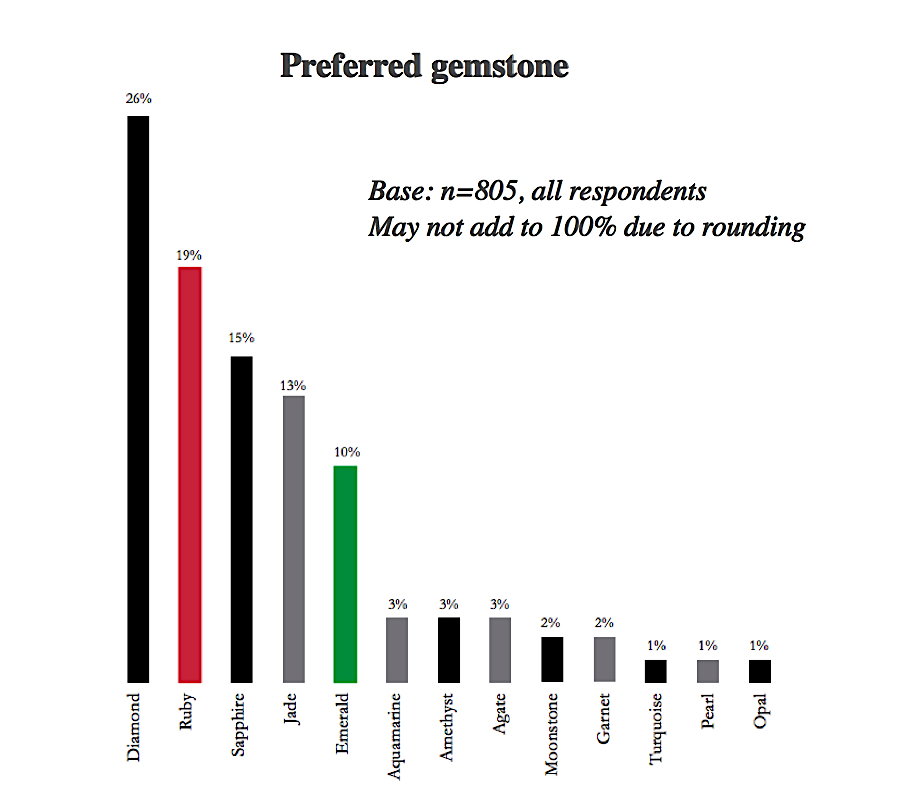
The document, titled “Sustainability: The Future of Coloured Gemstones in China” also shows that up to 35% of Chinese jewellery owners plan to acquire rubies, and 25% expect to buy emeralds in the near future. The findings point to an opportunity for the coloured gemstone industry, if pieces are marketed correctly.

Gemfields steps up efforts to tap Chinese market
Taken from: Sustainability: The Future of Coloured Gemstones in China.

The study also discovered that Chinese jewellery owners rank clarity, carat, colour and cut in this order when it comes to selecting a gemstone. Consumers reportedly care more about the gemstone itself than they do about its price.

“It is highly positive that 97% of jewellery owners are willing to pay a premium for responsibly mined gemstones,” chief executive Sean Gilbertson said. “We expect responsible sourcing will continue to receive ever-increasing attention, and become progressively more important to Chinese jewellery buyers.”

Gemfields owns and operates the Montepuez mine in Mozambique, which is the world’s richest known ruby deposit. It also has the Kagem emerald mine, in Zambia, which provides more than one-fifth of the world’s green gemstones.

The company, which owns Kagem in partnership with the Zambian government’s Industrial Development Corporation, currently repatriates all proceeds from the sale of Kagem’s emeralds back to Zambia. This strategy, says Gemfields, generates tax revenue for the government, as well as employment and associated economic growth.

First signs

Gemfields saw its first Chinese customer successfully win a schedule at an auction in Lusaka, Zambia, last year.

The buyer, Lok Chen of Cai Bao Cheng, bought 117,500 carats of large emeralds – greater than 31mm in size – which the company will cut and polish at their factory in Shenzhen.

The finished pieces are destined for the Chinese domestic market, either via a wholesaler or a jewellery company, Gemfields said at the time.

Cai Bao Cheng was the first company to signal an increasing interest in Zambian emeralds coming from Asian consumers, according to the company.

Gemfields’ growth strategies in China for the rest of 2020 includes undertaking marketing launches and ruby masterclasses, as well as participating in gem and jewellery fairs to maximize awareness on responsible sourcing.

Mining.com