Home Blog Page 554

Shurugwi ASM and their dead colleague Covid-19 free

0

Midlands Provincial Medical Director Dr Reginald Mhene allayed fears of Covid-19 cases in Mberengwa and Shurugwi following the death of an artisanal miner after suffering from acute respiratory challenges accompanied by fever and headache.

It is understood that the artisanal miner, who was working at a mine in Mberengwa, succumbed to Covid-19 like symptoms while five of the deceased’s colleagues are said to be suffering from similar ailments.

Dr Mhene said the patient tested negative to Covid-19 but the provincial rapid response team has also tested the deceased’s workmates.

“We received a report that there were people from Mberengwa who were having symptoms similar to Covid-19.

“One of the patients was in Zvishavane. We made a follow up to Mapazuli Clinic but unfortunately the person died. We took specimen from the body for testing and the results came out negative. We also established that the person was working in Shurugwi also and has not been feeling well for two months. We are yet to record a single case of Covid-19 in Midlands,” he said.

SN

COVID-19 Update: 23 April 2020

0

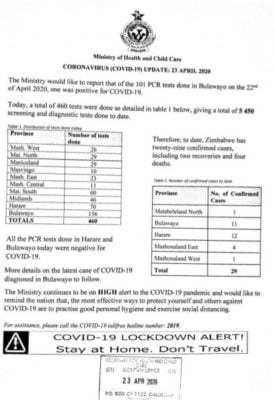
COVID-19 Update: As at 23 April Zimbabwe had 29 confirmed cases, including four (4) deaths. Two (2) people have recovered.

The Ministry would like to report that of the 101 PCR tests done in Bulawayo on the 22nd of April 2020, one was positive for COVID-19.

Today, a total of 460 tests were done as detailed in table 1 below, giving a total of 5 450 screening and diagnostic tests done to date.

Therefore, to date, Zimbabwe has twenty-nine confirmed cases, including two recoveries and four deaths.

Distribution of tests done today
Mash. West – 26
Mat. North – 29
Manicaland – 29
Masvingo – 10
Mash. East – 23
Mash. Central – 11
Mat. South – 60
Midlands – 46
Harare – 70
Bulawayo – 156
TOTALS – 460

Number of confirmed cases to date
Matabeleland North – 1
Bulawayo – 11
Harare – 12
Mashonaland East – 4
Mashonaland West – 1
Total – 29

All the PCR tests done in Harare and Bulawayo today were negative for COVID-19.

More details on the latest case of COVID-19 diagnosed in Bulawayo to follow.

The Ministry continues to be on HIGH alert to the COVID-19 pandemic and would like to remind the nation that, the most effective ways to protect yourself and others against COVID-19 are to practise good personal hygiene and exercise social distancing.

For assistance, please call the COVID-19 tollfree hotline number: 2019.

covid-19 23 april

Anglo American adjusts production forecasts

0

Miners have revised their output forecasts for the year in response to COVID-19 impact with Anglo American saying it would cut capital expenditure by almost as much as $1 billion.

“We are taking all necessary steps to ensure security and integrity of our assets for the long term, preserving our ability to swiftly return affected operations to normal levels of production when appropriate,” said CEO Mark Cutifani.

The miner is also looking to reduce its operating cost by $500 million.

Anglo American’s platinum operations have been put on care and maintenance since the start of the lockdown aimed at limiting the spread of the virus on March 26, with its mechanised mine Mogalakwena operating with half of its workforce.

Mining houses were instructed to put their operations on care and maintenance, with essential services, such as smelters allowed to operate with reduced staff.

Anglo’s diamond subsidiary, De Beers, had revised down its production forecast for 2020 by seven-million carats to 25- 27 million carats.

Golf Fields impact of COVID-19 on operations has so far been “relatively muted”. However, the gold producer stressed that the situation remained fluid and that there was a possibility of further restrictions in the countries in which it has a presence.

UK returnees test positive for Covid-19

0

Ministry of Health and Child Care has confirmed that two UK returnees tested positive for COVID-19.

The two are part of a group of 65 Zimbabwe citizens who recently returned from the United Kingdom and presently quarantined at Belvedere in Harare.

The two males who tested positive are 49 and 25 years old Harare residents.

The United Kingdom is an epicentre of the dreaded COVID-19 virus which to date has killed 9 Zimbabweans in that country. To date, there are 133,495 infected and 18,100 deaths.

covid 19 update

About Coronavirus disease (COVID-19)

Coronavirus disease (COVID-19) is an infectious disease caused by a newly discovered coronavirus.
Most people who fall sick with COVID-19 will experience mild to moderate symptoms and recover without special treatment.

HOW IT SPREADS

The virus that causes COVID-19 is mainly transmitted through droplets generated when an infected person coughs, sneezes, or exhales. These droplets are too heavy to hang in the air, and quickly fall on floors or surfaces.
You can be infected by breathing in the virus if you are within close proximity of someone who has COVID-19, or by touching a contaminated surface and then your eyes, nose or mouth.

Unki donates to Gweru hospital

0

Platinum miner Unki Mine today donated foodstuffs to Gweru Provincial Hospital.

This was revealed by the Ministry of Information and Publicity permanent secretary Mr Nick Mangwana.

“Unki Platinum Mine, today donated foodstuffs to Gweru Provincial Hospital. Unki says they have identified 13 institutions in the Midlands that will receive food assistance for the next three months”. said Mangwana on his twitter handle.

Union calls for inclusion in the fight against Covid-19

0

The Zimbabwe Diamond and Allied Minerals Workers Union is fully supportive of the Government’s decision to extend the lockdown by another two weeks ending on May 3, 2020, as a drastic measure to contain the spread of COVID-19 which has claimed thousands lives worldwide.

Insight of these developments and given the blanket reprieve to the Mining Industry to scale up operations, we have written to the Ministry of Public Service, Labour and Social Welfare appealing to be considered to monitor employers’ compliance in mitigating the spread of COVID 19 across all mines in Zimbabwe.

As the country went on national lockdown as announced by his Excellency the President of Zimbabwe Comrade E.D Munangagwa on 28 March 2020, Mines in zimbabwe big and small were issued temporary exemptions by the Minister of Mines pending consideration by the Government of Zimbabwe. For a mine to be exempted, they were required to apply through the Chamber of Mines or Zimbabwe Miners Federation making a commitment that they will observe the lockdown regulations that were set like decongesting the workplace, observance of respiratory hygiene, personal hygiene, social distancing at work as well as in transit to and from work. As most mines grabbed the opportunity to operate, we noted that the conditions set to operate were not fully observed.

The union wrote to the Minister of Labour on 4 April 2020 requesting to be granted essential service status because we were receiving complaints from members that nothing has changed even with the conditions set to operate, unfortunately, our request was declined. It is a fact that even before the COVID-19 pandemic, some mines were failing to provide basic PPE to its employees  and with the added responsibility we knew  that some employers were not going to put in place measures that protect workers against the pandemic as set by the Ministry of Health in line with the World Health Organisation guidelines

With the reprieve given to the Mining Industry to scale up their operations, we have decided to approach the Minister again for a reprieve allowing us to monitor how employers are complying with the set down conditions.

The union feels that in order to ensure and ascertain the safety of workers and their communities it has a natural duty and obligation to closely monitor and enforce the set conditions put in place by Government to combat COVID-19.

We are also disturbed by widespread reports that some employers are victimising workers by sending them home on unpaid leave in violation of the provisions of the Labour Act, a development which will antagonise industrial relations and subsequently led to disruptions in productivity on the mines.

Employers are forthwith warned and should stop all attempts to victimise workers and instead direct their energy to source materials in the form of PPE for use by their workers during this turbulent period faced by our nation.

The global situation we are in requires the engagement of parties not what we are seeing happening. A win-win situation has to be reached by parties.

In view of these circumstances, the union believes that it is duty-bound to enforce safety, health and welfare issues faced by workers during these trying times. While the union is fully behind and in support of the reprieve given to the mining sector by His Excellency, the President of the Republic of Zimbabwe, it is unfortunate that failure to allow unions to closely monitor compliance will lead to a health catastrophe and unfair dismissals which will result in unnecessary loss of lives and is also against the spirit and letter of the Labour Act.

Given a chance to exercise our mandatory duties, the union will through its officers spread across all provinces visit mining sites ensure uninterrupted

We are therefore calling on productivity and ensure that workers are provided with all the necessary PPE as well as ensuring that employers are in compliance with the guidelines to combating COVID-19.

The relevant authorities must ensure that more players are included in the fight against this pandemic in the form of embracing a multi-sectorial approach in order to save lives.

J Chinhema

General Secretary

BREAKING: Mines Ministry preparing exemption letters

0

Officials from the Mines and Mining Development Ministry have confirmed they are preparing exemption letters for ease of movement for miners.

President Emmerson Mnangagwa gave the green light for mining to resume after extending the country’s lock-down by an additional 14 days.

Miners are also advised to consult with their affiliate organisations like the ZMF, Chamber of Mines etc.

For more information or clarity please contact the Ministry of Mines and Mining Development

More to follow…


40 000 mine workers to undergo COVID-19 testing

0

PRESIDENT Emmerson Mnangagwa says mines are to resume operations during an extended lockdown, a plan that would need at least 40 000 mine workers to be immediately screened and tested for COVID-19.

On Sunday, Mnangagwa announced that Zimbabwe is to remain under lockdown for a further 14 days, although he will allow mines and manufacturers to resume some operations.

“Government is acutely aware of the need to keep the economy running, albeit at subdued levels. With this objective in mind, government has decided to allow the mining sector to resume or scale up operations, even then within parameters set by the WHO regarding social distancing and other public health safety measures,” Mnangagwa said in a live address.

“I have now directed the ministries of Health and Child Care and that of Mines and Mining Development to work closely to ensure the workforce in the mining sector is immediately screened and tested ahead of resumed operations.”

Workers will also be required to stay at their mine houses.

“Further, to the extent possible, I have directed that workers in the mining sector remain within the precincts of their accommodation at the workplaces for the duration of the lockdown.”

The Chamber of Mines, which represents formal miners, says its members employ more than 40 000 people. Mnangagwa’s directive means that mining, companies will have to procure and roll out a significant number of rapid diagnostic test kits to screen and test thousands of their workers and external contractors.

Government has been wary of completely shutting down mining, which earned the country US$2,91 billion in exports in 2019 and accounted for 55,2% of total exports. In the initial lockdown phase, miners were required to apply for exemption. Miners have also been required to observe social distancing, meaning less workers going in for shifts.

Zimbabwe earned US0 million from mineral exports in the first two months of 2020, according to Ministry of Mines data. This was up from US$300 million a year earlier, but short of government’s target of US$422 million for the period.

The Chamber of Mines has warned of a 60% dip in mineral output this quarter due to the coronavirus, estimating earnings losses of US$400 million.

Industries will also get a reprieve, although they must observe health safety rules, Mnangagwa said, adding he had held meetings with businesses over recent weeks.

“Over the past few weeks I have held several meetings with different professionals and business interests, in order to mobilise our nation towards this new campaign,” he said.

The Confederation of Zimbabwe Industries early this month appealed to government to end the lockdown so as to save businesses from further ruin. Mnangagwa said industries, including informal manufactures, will be allowed to operate.

“This reprieve covers our manufacturers in our informal sectors and SMEs as well, who have to use these two weeks to rebuild their capacities and stocks. The responsible ministry is also directed to work with health authorities to ensure there is order and safety in that sector, so critical to livelihoods,” he said.

Explaining his decision to extend the lockdown, Mnangagwa said current infection rates and local transmission point to what he called “a growing threat to our nation”. He said there was a “grim” projection that confirmed cases will rise.

“Once the cases begin to grow exponentially, the strain on our health facilities will be huge. We should thus do our best now to ensure the pandemic levels off at these low, manageable numbers we currently have recorded,” he said.

On contact tracing, Mnangagwa said: “Experts tell me that an ideal situation is devoting one contact tracer to every four infected cases. Tracing and isolation limits the multiplier effect of the pandemic. We have to ginger up our infection surveillance systems for speedy detection and contact tracing. Again, the government is addressing this critical area.”

Government, he said was always aware that the lockdown alone was never the solution, and that it had a huge impact on the economy.

Last week, the WHO said governments must only lift lockdowns when:
• Disease transmission is under control
• Health systems are able to “detect, test, isolate and treat every case and trace every contact”
• Hotspot risks have been minimised in vulnerable places, such as nursing homes
• Schools, workplaces and other essential places have established preventive measures
• The risk of importing new cases has been managed
• Communities are fully educated, engaged and empowered to live under a new normal

Mnangagwa conceded that Zimbabwe, like most other countries, is yet to meet these conditions, and hence had to extend the lockdown.

Tobacco auctions, due to start this week, will be decentralised while there will be limits on the numbers of farmers allowed at the auction floors.

Source – newZWire

Amplats workers paid in full

0

Newly appointed Anglo American Platinum (Amplats) CEO Natascha Viljoen said on Monday that “thankfully” the Conglomerate was able to pay all of its employees their full fixed basic salaries, pension and medical benefits, as well as housing allowances where applicable, for the full 35 days of the COVID-19 lockdown period.

She and FD Craig Miller would donate 30% of their salaries for three months to charities associated with the relief effort of Amplats in its host communities.

Nonexecutive directors had elected to contribute 30% of their fees for three months to charitable organisations that were aiding the pandemic relief effort.

The executive team had elected to contribute to the employee matching scheme supported by the Anglo American Foundation, and many employees had been forthcoming in making contributions to charities of their choice, Amplats stated in a release to SA based magazine Mining Weekly.

The Anglo American Foundation, the release stated, had set up a global programme to match employees’ personal donations to a number of local and global organisations, including the World Health Organisation’s Covid-19 Response Solidarity Fund, national Red Cross societies and South Africa’s Solidarity Fund, up to an initial aggregate value of $1-million, giving a total matched value of $2-million.

In addition, Amplats would continue to provide a wide range of essential services to its host communities in South Africa and Zimbabwe, offering additional assistance to alleviate Covid-19’s health and economic effects. In partnership with the University of Pretoria, Gift of the Givers and other stakeholders, Amplats reported that it was:

  • expanding water supply to communities that did not have access to water;
  • supporting local clinics and hospitals with training and providing essential personal protective equipment (PPE) and other equipment to assist them in responding to the pandemic;
  • delivering food parcels to vulnerable families; and
  • undertaking community awareness campaigns.

These initiatives would benefit more than 100 000 households in its host communities.

Viljoen said the JSE-listed Amplats would ensure that support was directed to those most in need and vulnerable at this time and provide both monetary and in-kind assistance as conditions in South Africa and Zimbabwe continued to evolve.

“We’ll also ensure our people at work are safe and equipped to stay healthy and our business is ready to support economic recovery,” Viljoen stated.

The contribution of 30% of top-level pay was in response to the call made by President Cyril Ramaphosa to contribute to the national fight against the spread of Covid-19. Amplats commended the personal financial commitments of the President, Deputy President, Ministers, Deputy Ministers and Premiers to donate a third of their salaries for the next three months to the national Solidarity Fund.

Mining Weekly

From physical to ebusiness, How Zimbabwean businesses can legally transact online

0

From physical to ebusiness, How Zimbabwean businesses can legally transact online

Contributors: R F Mushoriwa, (LLB & LLM) – Partner

Nathanael Manjoro, LLB – Associate

Date of publication: 19/04/2020

INTRODUCTION

Technology has changed the face of business in ways previously unimaginable. Buyers and sellers can now initiate and conclude a transaction without ever meeting, thanks to the power of the internet and related technologies. The present threat of the Covid-19 pandemic may yet force more businesses to go online rather than risk physical interactions in the course of doing business, and this progression may be good for businesses in Zimbabwe that were in truth, lagging behind international business norms. However, online business is risky. From the possibility of con artists setting up false websites and promoting non-existent goods and services, to identity theft, card fraud and other forms of online crime, the risks are endless. It is for this reason that the legislature enacted the Consumer Protection Act [Chapter 14:14], (hereinafter, The Act) which contains rules of how businesses should play the e-commerce game. While there are various enactments that have an impact on the conduct of e-business, this article shall focus on the basic legal requirements imposed by the Act for doing business online.

SCOPE OF TRANSACTIONS COVERED UNDER THE ACT

The Act applies to what are called ‘consumer contracts’ and these are widely defined in the Act as contracts for the sale or supply of goods or services or both, in which the seller or supplier is dealing in the course of business and the purchaser or user is not, but does not include— (a) a contract for the sale, letting or hire of immovable property; or (b) a contract of employment. A “consumer” is defined as any natural person who enters or intends entering into an electronic transaction with a supplier as the end user of the goods or services offered by that supplier[1]. Therefore, any person who sells goods or services to the public in the ordinary course is subject to this Act.

This article seeks to provide guidelines to business on how to comply with the law while migrating to, or maintaining e-business structures.

EXECUTIVE SUMMARY

In brief, this Article will look at various forms of electronic business. It will also look at the obligations imposed by the Consumer Protection Act which include the obligation of disclosure which sets out 18 requirements that must appear either on the website or other electronic medium through which business is conducted. Non observance of this constitutes a criminal offence. We also cover formalities required before a contract is consummated, and also look at the cooling off period which is a statutorily provided time in which a buyer can cancel a contract after receiving goods purchased online. Finally, we deal with the right to privacy which accrues to all customers who deal with vendors on electronic platforms. It is easy to comply with this law, and potentially ruinous not to do so.

HOW COMPANIES CAN DO BUSINESSES ONLINE

Companies can take advantage of various online platforms to either take advantage of wider markets, or just to sustain activity in times of unexpected physical restrictions such as those imposed in response to the Covid-19 pandemic. The internet has become an essential tool in the modern world hence its availability makes it easy for business not only grow, but survive. Companies can make use of;

  • Online platforms to sell products and merchandise via websites (online shopping)- This platform only requires a website to be setup where online payments and electronic transactions can be made. Once a client has identified a particular product they desire they can purchase it anytime and it can be delivered without any physical contact. This platform is available for all companies that sell goods or services to the public. Online platforms do not require the exchange of physical cash for transactions. In order to make payments various means can be used such as online banking, mobile money banking and other transactions which are safe and secure.
  • Concluding and negotiating different types of electronic Contracts-

There are four different ways of e-contracting:

  • The first and most important method of contracting on the Internet, is similar to a negotiation of one or more infrequent transactions by exchange of letters and documents or email contracting. In this method the parties can exchange e-mails and even attachments setting out the terms and conditions of their contract in detail. This is quite similar to offer and acceptance between the parties.
  • The second method is contracting on the World Wide Web (www), which is similar to a mail order. In this method, one party maintains the website at which he advertises his goods and services. The prospective buyer accesses the website and then completes an electronic form, whereby he orders goods or services from the seller.
  • The third manner is where the parties trade under the framework of an Electronic Data Interchange Agreement (EDI). EDI can be defined as computer-to-computer transmission of data in a standardized format‟. EDI enables businesses to exchange documents over either the internet or their private networks.[3]. Private networks EDI is used by large businesses when buying goods but smaller businesses and individuals prefer to use EDI as it reduces costs[4]. This is the primary electronic commerce medium; it is only applicable and valid between the contracting businesses that have assented to it.
  • Natural persons whilst chatting online in a virtual chat-room can make legally relevant agreements that are valid and binding. This is the final and the fourth method of contracting electronically[5].


  • Online meeting with various applications – Meetings are widely conducted through various online platforms such as Zoom, Skype and others. They are affordable and make it easier for anyone to have that face to face interaction whilst doing business. It is convenient for doing business on the go.


  • Social media platforms to market products- several business brands now have a social media handle, account or platform. Social Media continues to dominate in the world because everyone has inexpensive access to it. It is therefore an easy, fast and accessible platform to market any product.


All the above innovations and options must however be used in line with the laws of the land, and the basic requirements imposed on a business can be found in the Act. These are set out briefly hereunder.


THE LAW ON CONSUMER PROTECTION IN ELECTRONIC TRANSACTION IN ZIMBABWE


The Consumer Protection Act [Chapter 14:14] provides the regulations and requirements for any company or business conducting electronic transactions in Zimbabwe, in particular section 52 – 54. Any business intending to mitigate losses that may arise from loss of physical traffic by venturing online must become conversant with the requirements of this law.


The legal requirements for electronic transactions


Duty of Disclosure on the Seller

In terms of Section 52 of the Consumer Protection Act a supplier offering goods or services for sale, for hire or for exchange by way of an electronic transaction must make certain information available to consumers on the website where such goods or services are offered. Section 52 (1) (a)-(r) of the Act provides a list of 18 pieces of information that must be disclosed on the website or platform where the supplier offers its goods or services. This information includes the following;

  • the full name and legal status of the supplier,
  • the physical address and telephone number of the company.
  • Website and email address.
  • Membership of any self-regulatory organisation or accreditation body of which the vendor is a member plus their contacts;
  • Any code of conduct to which supplier subscribes and details of how it can be obtained;
  • In the case of a juristic person like a company, its registration details, registered address and office bearers;
  • Address where seller will receive service of documents;
  • Sufficient description of goods and services sold by the seller to allow buyer to decide on the proposed e-transaction.
  • Full price of the goods including transport, taxes and other fees and costs.
  • Payment methods;
  • any terms of agreement, including any guarantees, that will apply to the transaction and how those terms may be accessed, stored and reproduced electronically by consumers; and
  • the time within which the goods will be dispatched or delivered or within which the services will be rendered; and
  • The usage of the term “on the website” is indicative thereof that this section will only affect suppliers that are conducting sales on a website.
  • the manner and period within which consumers can access and maintain a full record of the transaction; and
  • return, exchange and refund policy;
  • any dispute resolution code and how it may be accessed by buyer;
  • the security procedures and privacy policy of that supplier in respect of payment, payment information and personal information; and
  • where appropriate, the minimum duration of the agreement in the case of agreements for the supply of products or services to be performed on an ongoing basis or recurrently; and
  • the rights of consumers in terms of section 53, where applicable.

What is evident is that the lawmaker has placed a heavy burden of disclosure on the suppliers of goods and services who decide to use online methods of doing business and it is easy to see why this is so. There are many cases of online fraud that have occurred worldwide and the problem is not getting any smaller. As long as the buyer has some information about the person or entity from who he is buying, then there is a chance of not only authenticating the transaction before entering into it, but also a chance of tracing any fraud or malfeasance by the seller. The law is there to create a balance between the power of the seller and the vulnerability of the buyer and give an aggrieved buyer a chance at obtaining justice. It is also important to note that the 18 requirements are not alternative but cumulative in that all 18 requirements must be present on the website itself. Compliance with only 17 would be insufficient as all are mandatory requirements. Non-compliance carries with it the criminal sanction of a fine or prison or both and it is for this reason 6that every business executive must take their online presence seriously to avoid potential criminal sanction.

What is Acceptable Level of Disclosure?

The question that arises is what is the level of disclosure is sufficient for purposes of this Act? How does a seller know that he has supplied enough to avoid falling foul of this law? The test that the court applies in order to determine whether the information that is provided is sufficient is the test of reasonableness. The document itself should be sufficient to gain the attention of a reasonable customer, and the terms and conditions provided should be visible and readily available to the consumer. These principles were applied in the matter of Durban’s Water Wonderland (Pty) Ltd v Botha & another[6].

Formalities Required Before Conclusion of E-Contract

Before the contract is finally concluded, Section 52(2) obliges the supplier to provide the consumer with an opportunity to review the entire electronic transaction, to correct any mistakes or to withdraw from the transaction, before finally placing any order. Should the supplier fail to comply with the 18 requirements, the buyer may cancel the agreement within 7 days of receiving the goods or services under the transaction, and must return the goods to the supplier or, where applicable, cease using the services performed by the supplier. In this case, the seller is obliged to refund the buyer less the direct costs of returning the goods. The final and critical requirement under s52(5) is that the seller must provide a secure payment system, failing which the seller is liable for all damages that accrue to the buyer arising from losses related to insecure payment structures.

Cooling-off period

Section 53 provides a cooling-off period which simply allows a consumer the chance to cancel the purchase within a prescribed period of receipt of goods purchased from electronic platforms. Cooling-off periods have two objectives. Firstly, they can force people to delay action against one another until the cooling-off period has lapsed, and secondly, they offer the consumer the chance to consider the advantages and disadvantages of the agreement having received the goods and juxtaposing these with the information about the goods supplied on the website. If unhappy, the consumer will then be entitled to cancel the contract within this given time period for no reason and with no penalty to such customer.

Rights Accruing to Consumers

Right to Privacy viz Unsolicited Marketing

The business world is tough and sellers invariably must use tactics which some may view as unwarranted. Unsolicited marketing tactics where emails or other communications are sent to the potential buyers are common. The Customer is protected against these types of tactics by being accorded certain privacy rights under this Act.

Section 54 deals with unsolicited direct marketing. It obliges any person sending an unsolicited marketing document or communication to ensure that same has the option to unsubscribe from the mailing list, and a right to inform such customer of where their personal details were obtained from. In the event that a recipient does not respond to whatever offer or content is in the communication, the contractual rules that could lead to a contract being consummated as a result of such inaction are interfered with by law and no contract arises in such cases. A contravention of these provisions exposes the marketer to a level 5 fine or 6 months’ imprisonment or both.

CONCLUSION

Electronic business is the future and this has been proven world over. The safety and security of those participating in it is promoted by laws which impose varying degrees of obligations on the parties. In this case, we have focussed on the Consumer Protection Act [Chapter 14:14] whose requirements should when met, allow a seller to avoid penalties of non-compliance while chasing business via electronic means.

[1] Section 2 Consumer Protection Act {Chapter 14:44}

[2] Pistorius, 1999, p 286

[3] Shim, et al., 2000, p 141

[4] Nagalingam, 2000, p 6

[5] Loetz & Plesses, 2004, p 4

[6] Supreme Court of Appeal 1999 (1) SA 982 (SCA).


Mushoriwa Pasi Corporate Attorneys is a top commercial law firm in Zimbabwe which provides quality legal services within the jurisdiction and beyond and has offices at 37 Lawson Avenue, Corner Bates Street, Milton Park, Harare, Zimbabwe. Contact us on +263 242 793322(3) or visit www.mushoriwapasi.co.zw