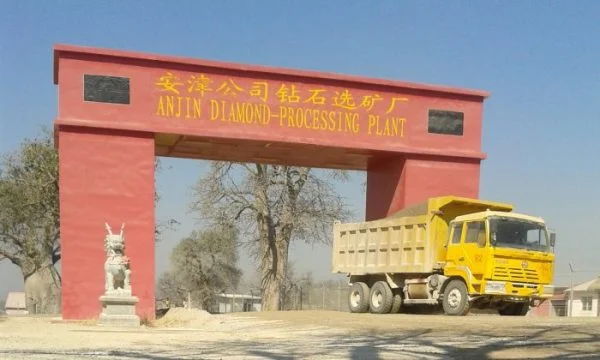
Troubled Chinese miner Anjin Diamond Mining is undergoing an exploration of diamonds in the vast Marange diamonds fields.
The development was revealed during a tour of the Zimbabwe Consolidated Diamond Company (ZCDC) by members of the media.
“I understand that Anjin is back in Marange and they are currently doing exploratory work,” said ZCDC acting chief executive officer Roberto De Pretto.
De Pretto hastened to point out that they are not in a joint venture with the Chinese miner.
“We used to operate in Portal A and B but we have since withdrawn from Portal B. Anjin is now operating there but we are not in a joint venture. They are on their own. They don’t report to us,” said De Pretto.
Concerns had been raised by natural resource watchdogs alleging that the Chinese miner had not conducted an Environmental Impact Assessment and was operating under a claim separate from which they were awarded an Environmental Impact Assessment (EIA) certificate for.
The Environmental Management Agency (EMA) indicated that Anjin was awarded an EIA for its old claim under Portal Q.
“Anjin Diamond Mining renewed their EIA certificate for their old claims that they were mining before the government order. Portal Q claims is under ZCDC and they did the EIA for Portal Q and the license is still valid,” said EMA spokesperson Amkela Sidange.
However, it has emerged that Anjin is operating in Portal B which was formerly under ZCDC.
“The EIA certificates are site-specific meaning it’s confined to areas where the EIA certificate has been issued unless the Company issued with an EIA certificates subcontracts to the other, but the overall responsibility lies with the Company issued with an EIA certificate. Basically, the EIA certificate cannot be transferred to another site,” explained Sidange.
Anjin was a 50/50 percent partnership between the military and Chinese investors Anhui Foreign Economic Construction (AFECC) which also owned Jinan Mining.
It was part of the eight miners that were kicked out of Chiadzwa in 2015 after the then Mines Minister Walter Chidhakwa refused to renew their mining licenses to make way for ZCDC.
Through its shareholding company, AFECC, Anjin, and Jinan filed a High Court application seeking to regain their mining rights in Marange citing a breach of bilateral and contractual agreements.
AFECC lost the High Court case and took the matter to the Constitutional Court as they resisted calls by the former government to withdraw the case.
They were later readmitted back into Marange by President Emmerson Mnangagwa’s new dispensation. Source: The Industry and Trade Expert
Global gold mining company AngloGold Ashanti is to sell its Mponeng mine and Mine Waste Solutions (MWS) to Harmony Gold for $300m (R4.44bn), the company said in an announcement yesterday.
According to Mining MX, the R118bn gold producer said that in choosing Harmony Gold it had opted for a long-standing operator of ultra deeps mines.
“From the beginning of the process an objective has been to sell our South African assets to a strong, capable and responsible operator that will ensure their long-term sustainability,” said Kelvin Dushnisky, CEO of AngloGold Ashanti. He said the company’s management focus and capital allocation would be sharper as a result of the sale.
The transaction consists of $200m on deal closure – expected in June – with the balance payable by means of a royalty of $260 per ounce on underground gold mined in excess of 250,000 ounces a year for six years starting January 1, 2021.
In addition, $20 per oz is payable on underground production located at deeper levels of Mponeng but which requires billions of rands in additional development capital. If some 8.53 million oz in reserves located in the deeper areas were mined, it would yield $170m to AngloGold at the stated royalty.
Harmony Gold said absorbing Mponeng and Mine Waste Solutions into its portfolio would add 350,000 oz annually to production which has been guided to about 1.4 million oz in the current financial year.
The deal also increases Harmony’s South African reserves by 8.27 million oz excluding Mponeng’s reserves below existing infrastructure. “Harmony believes that the acquisition is a natural next step following the acquisition of Moab Khotsong in 2018,” it said.
Harmony bought Moab Khotsong for $300m incorporating some 250,000 oz into Harmony’s production for which CEO, Peter Steenkamp, had an aspirational target of 1.5 million oz/year. The group achieved that target last year but given the ageing nature of other mines in its portfolio, production has started slipping again.
Buying Mponeng and MWS, which also incorporates the reserves of other AngloGold ‘mines’ Savuka and Tau Tona, begs the question as to how it will allow Harmony Gold to adjust its portfolio as it has a collective life of mine of five years.
CAPITAL CONSIDERATIONS
For AngloGold, the sale means it won’t have any more operations in South Africa, although Dushnisky has been at pains to say the company’s head office and a listing would be kept in Johannesburg, the former owing to the low cost of operation.
For Harmony Gold, buying Mponeng and MWS makes it easily the standard-bearer for the South African gold industry with production of about 1.7 million oz assuming the company decides not to take the opportunity to close marginal operations. In any event, production from Unisel and Masimong will disappear in six to 18 months as they run out of gold.
Peter Steenkamp, CEO of Harmony Gold, said he considered the price paid for the asset was “fair”, but he declined to comment on whether the company would take up the option of developing the eight million plus oz of reserves below infrastructure.
This is gold that requires billions of rands in capital expenditure to exploit but which would extend the life of Mponeng by 20 years, according to previous AngloGold estimates. “We would extend declines to access that gold but we’ve made no decision on that,” Steenkamp said today in response to questions.
He thought, however, Harmony could make a better fist of the capital cost of extending Masimong. “Declines are something we’ve done alot of; we are quite good at it,” he said.
DEBT
Frank Abbott, financial director for Harmony Gold, expected a four-year payback term on Mponeng assuming the current (elevated) gold price. “It won’t really stretch out balance sheet and it will help us generate cash to develop Wafi-Golpu,” he said of the Papua New Guinea mine Harmony is hoping to develop in the medium- to long-term.
Harmony’s earnings before interest, tax, depreciation and amortisation (EBITDA) to net debt ratio would increase to about 1.5 times compared to its current ratio of 0.7x.
“The mine will give us the best bite of Wafi-Golpu,” said Steenkamp. “We have paid back about half of Moab Khotsong (bought from AngloGold for $300m in 2018) and so we can afford Mponeng,” he said, adding however the company was keen to lay its hands on an agreement with the PNG government for the development of Wafi-Golpu so it would know what funding it was required to raise.
REACTION
Analysts said the transaction, flagged in the early part of 2019, made sense for AngloGold, especially because it frees up management attention and lowers average costs, as well as releasing the company from regulatory, labour and power supply risks in South Africa.
James Bell, an analyst for RBC Capital Markets, said in a note that in AngloGold’s hands, Mponeng would probably not qualify for new capital allocation. The asset was also sensitive to gold price and currency assumptions owing to its marginality.
“We think the argument could be made that there is a window of opportunity in the current gold price environment to get a sale done and AngloGold is right to take advantage of this especially against a backdrop of continued structural issues in South Africa around power availability, inflation and labour,” he said.
“We view the announced South African asset sale as a strategic positive as it sets out a path for the company’s exit from South Africa,” said Goldman Sachs.
ASX listed lithium and battery minerals company, Prospect Resources has discovered possible large deposits at its Arcadia Mine of caesium, a much sought after chemical element or metal used mainly in high temperature or high-pressure oil and gas drilling.
Prospect is an Australia listed firm involved in the exploration and mining of lithium, used to make electric vehicle batteries and in the ceramics industry. The company is currently developing the Arcadia Lithium project near Harare.
Demand for lithium is anticipated to grow exponentially as electric vehicles become more common and affordable, driving growth in global demand, as is the case at the moment with internal combustion engines (ICE).
While lithium is one of the major minerals expected to drive the Government’s vision of building a US$12 billion industry by 2023, caesium could be another significant export earner for Prospect and Zimbabwe.
The identified chemical element occurs within pollucite, a high value and rare caesium bearing mineral that forms in extremely differentiated Lithium-Caesium-Tantalum (“LCT”) molten rock systems.
Zimbabwe’s lithium deposits are second to none in Africa, and proven deposits are located in Bikita, Goromonzi, and Kamativi.
ZIMBABWE’s export list continues to be dominated by raw materials despite the existence of vibrant policies aimed at boosting industrial productivity.
The latest Reserve Bank of Zimbabwe’s (RBZ) monthly economic review shows that there was no transformation in the quality of goods leaving the country.
“The country’s export basket continued to be biased towards primary commodities, with gold, nickel and flue-cured tobacco contributing about 72.0% of the country’s export earnings, during the period under review,” the document said.
During the period under review, monthly merchandise exports increased by 9.5% to US$378.4 million in September 2019.
This followed increases in export earnings from flue-cured tobacco 41 %; nickel ores and concentrates 32%; and gold 8%.
The details indicate the ineffectiveness of the numerous policies employed by the government in a bid to improve productivity.
To date, blueprints like the Transitional Stabilisation Program, budget allocations, and tax incentives have been incepted to motivate the manufacturing sector.
Last year, the government launched a three year long Zimbabwe National Industrial Policy (ZNIDP), with an objective to help transform the economy through value addition, increasing employment levels and promoting a culture of savings.
But nevertheless, value addition remains a pipe dream for the embattled Southern Africa nation.
In the report, the central bank further reveals the country’s total merchandise trade increased by 7.2%, from US$729.9 million in August 2019 to US$782.2 million in September 2019 driven by increases in both merchandise exports and imports.
The country’s exports were destined for South Africa, 41.1%; United Arab Emirates, 27.1%; Mozambique, 8.1%; Swaziland, 1.6%; and Zambia, 1.4%; Hong Kong, 0.7%; China, and Kenya, 0.6%, during the month under review.
During the same period, merchandise imports rose by 5 % to US$404 million in September 2019, from US$384 million in August 2019.
The increase was largely on account of higher imports of diesel, fertilizers, medicines, and electricity.
The merchandise trade developments resulted in the narrowing of the trade balance by 34.9%, from -US$38.9 million in August 2019 to -US$25.3 million in September 2019_NewZimbabwe.com
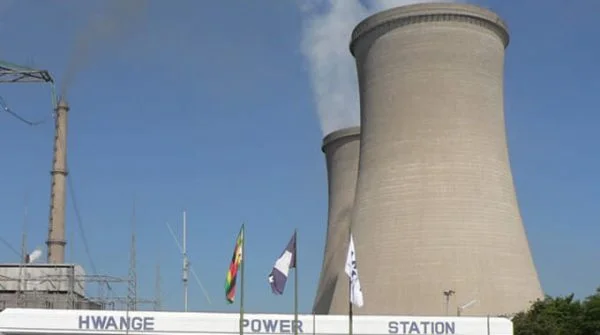
THE US$1,5 billion Hwange Thermal Power Station Expansion project is now 40 percent complete with the contractor, Sino Hydro, optimistic that the project will meet the January 2022 deadline.
The project is expected to add 600MW to the national grid and is one of the key infrastructure development initiatives meant to stimulate economic growth in the country.
According to ZBC News, a delegation from the Matabeleland North Provincial Affairs Minister’s office visited the site last Friday to assess progress. Site manager, Engineer Forbes Chanakira, told the delegation that despite foreign currency challenges, notable progress has been made in construction with the entire project now 40 percent complete.
“We are now in the 19th month and as I have already indicated that Unit 7 start-up is expected on the 25th of April that’s the initial commissioning, which will run for six months and then after the pre-commissioning will then have the commercial operation date around October 2021,” said Eng Chanakira.
Sino Hydro project site manager, Engineer Tang Zhaolai, said while the Coronavirus outbreak might result in delayed shipment of some essential materials, measures have been put in place to reduce the risk, adding that the project remains on schedule.
“For this project, we tried to reduce the risks to the project, for instance, we have cancelled all flight tickets for our staff from China coming to this side.
“We have also stopped staff going to China for vacation,” he explained.
A deputy director in Matabeleland North Provincial Affairs Minister Richard Moyo’s office, Mr Tapera Mugoriya, stressed the significance of the project in stimulating economic activities and growth of the domestic economy.
“This project will be commissioned during the same time with another megaproject, the Gwayi-Shangani Dam. For MatabelelandNorth province, though it’s a national project we are proud to be hosting this and are confident it will benefit the province,” he said Mr. Mugoriya.
It is hoped that for the next 10 months, the contractor will focus on construction of the main building and the boiler as well as commence mechanical works.
To date, a total of 2 506 people have been employed with the manpower level expected to go beyond 3 000 during the peak phase.
In June 2018, President Mnangagwa officiated at the groundbreaking ceremony for the Hwange Thermal Power Station Expansion project, which had failed to take off for over 10 years due to funding constraints.
This was after Zimbabwe was frozen out of the global economy over land reform at the turn of the millennium.
Progress on the project started moving after President Mnangagwa’s State visit in April 2018, during which Chinese President Xi Jinping authorised financing of the power project. — ZBC News/Business Chronicle
FOUR machete-wielding robbers attacked workers at a mine in Collen Bawn and stole two cellphones after they failed to get cash.
Matabeleland South provincial police spokesperson, Chief Inspector Philisani Ndebele, confirmed the incident which occurred at Busi Park Mine on Sunday at around 9 PM.
He said the gang, which was armed with machetes and knobkerries, attacked the two mine workers in their tents.
Chief Insp Ndebele said the gang then fled after the mine workers teamed up in a bid to retaliate.
“In can confirm that we recorded a case of robbery which occurred at Busi Park Mine in Collen Bawn. Mr. Brian Mpinga who is a worker at the mine was sleeping in his tent when he was woken up by noise from the accused persons. He lit a torch and went out to check and met one of the accused persons holding a machete.
“The accused person ordered Mr. Mpinga to switch off his cellphone and force-marched him out of the tent to his three accomplices who were armed with machetes and knobkerries.
They took Mr. Mpinga’s cellphone and demanded money from him but he indicated that he didn’t have any,” he said.
Chief Insp Ndebele said Mr. Mpinga managed to flee and hid in the bushes.
He said the gang moved to another tent belonging to Mr. Khulekani Zhou where they demanded cash and threatened to kill him.
Chief Insp Ndebele said the gang took Mr. Zhou’s cellphone and went on to search the tent for cash but could not find any.
He said Mr. Mpinga informed other mineworkers who mobilised a gang and went after the robbers.
He said as the robbers left Mr. Zhou’s tent to proceed to another tent they saw the mineworkers approaching and they fled the scene.
Chief Insp Ndebele appealed to members of the public with information that could lead to the arrest of the suspects to contact any nearest police station.
“Investigations are underway and we have not made any arrests yet. We appeal to members of the public with information that could lead to the arrest of the suspects to contact the police. We also urge members of the public to desist from storing large sums of money in their homes to avoid losses. People should also report when they observe suspicious activities,” he said.
Inside Mining Zimbabwe (IMZ) met a youthful most likely Africa’s youngest Group Chief Geologist Mr. Patrick Takaedza (PT) who gave us an insight on his line of work and his opinion on Mining in Zimbabwe.
IMZ: Good day Mr. Patrick Takaedza welcome to Inside Mining Zimbabwe. We understand that you are the Group Chief Geologist at RioZim. Can you please explain your role as the Group Chief Geologist at RioZim and your background information up to how you become the Group Chief Geologist at one of Zimbabwe’s biggest miner?
PT Thank you. I will start with my background as a career geologist. Firstly l am highly indebted to Mark Tsomondo, probably my first proper mentor as a professional geologist. Other notable individuals that have helped shape me as a career geologist are Felischismi Mwijage and Julian Ford.
I have had the opportunity to be exposed to several mineral commodities throughout my working experience in projects across Southern, Central, Eastern and Western Africa, Australia and Asia in exploration, mineral resource and mining roles. This effectively makes me an all-rounder in the essential roles of geologists.
I am a member of both the AusIMM and SAIMM and through all this, I have achieved competency, by JORC 2012 definition, in various mineral commodities some that are not the usual or common mineral commodities we deal with every day. This has allowed me to do work and reports for various companies listed on the ASX for example.
My role with ZSE listed RioZim LTD, in summary, is to increase ounces, grams, kilos, tonnes, you name it, within the corporate portfolio. Simply put, I assist in ensuring that the company’s Mineral Resources keep growing. This, in turn, increases the Life of Mine (LOM) of projects within the Group.
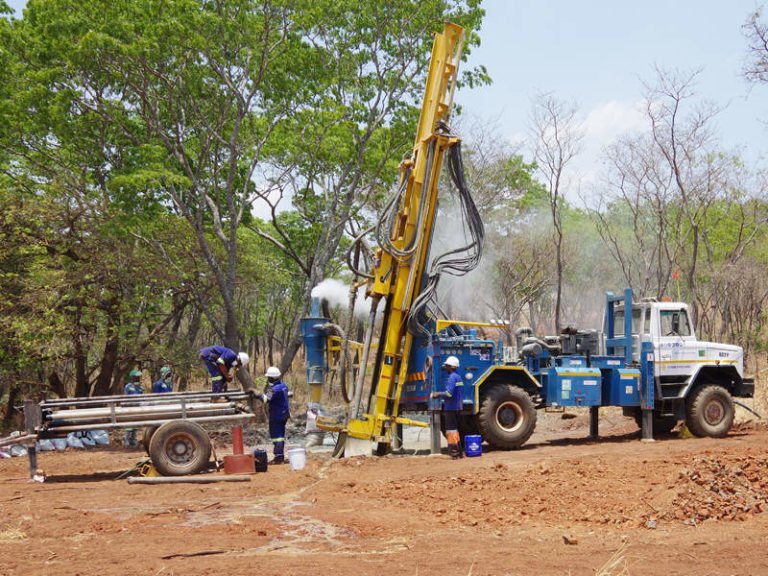
I guess the next question would be how do I achieve this. Firstly it is organic growth through robust exploration. One of my strategic objectives is to generate resources at twice the rate at which mining production depletes them, at minimal costs. So far the RioZim Group has invested in 8 Diamond Coring Rigs.
Secondly, I help grow the company’s Mineral Resources through mergers and acquisitions by scouting for, assessing and evaluating potential external projects RioZim LTD is a diversified mineral commodities group and so l guess my competency and multi-mineral commodity experience and exposure have found me the role as the Group Chief Geo.
Patrick Takaedza in Namibia
IMZ: How is it working for a leading a critical area of a huge organization like Rio Zim
PT: Its very hectic but exciting to be managing more than 13 projects within the group. My colleagues offer full support within their capacity and as a result, am not really overwhelmed.
IMZ: What do you emphasize when evaluating geological data.
PT: Data quality and Standards as guided by the JORC 2012 or NI43 – 101 are a pre-requisite. To achieve this only a professional with sufficient experience should undertake the work.
IMZ: If you were to lead the Zimbabwe geological survey what would you introduce or get rid of?
PT: Firstly l would expedite the Cadastre finalisation for obvious reasons. Some countries like Uganda have completed this timeously because they outsourced some German company to do it for them.
Secondly, we need field-based extension geologists to probably assist the artisanal and small scale miners at government-subsidized cost. This will ensure compliance with the act and sustainable exploration and exploitation of mineral resources.
Lastly, not really sure if that should be applicable through the ZGS or the parent Ministry rather but I have serious reservations on CRAPs. (or peggers), their role and their necessity in the mineral or mining industry. I would scrap them altogether or set minimum professionally relevant qualifications for which one can be considered for a CRAP.
IMZ: Geologists are of the opinion that Zimbabwe is hamstrung by a lack of mineral exploration. What is the way forward for the country to be able to fully explore its mineral wealth other than issuing EPOs?
PT: Unfortunately, l do not see any other way unless we are going to find ways to incentivize, promote and support brownfields exploration on and around already existing and producing mines. Probably the government should consider incentives for these brownfields projects as any exploration is very risky and capital intensive and not ideal to be funded from production revenue. In other countries listed companies actually raise exploration funding on the Stock Exchange and so don’t have to use their own revenue.
IMZ: It is without a doubt that you are a very experienced and tested geologist, there is an issue of Exclusive Prospecting Orders (EPOs) in Zimbabwe, there are people who are pushing for the ban of these EPOs. From a geologist’s point of view, do you think it is wise to ban EPOs and why?
PT: I will give my own brief perspective on this sensitive matter. Firstly there are specific organizations claiming to represent some groups of people who have been lobbying for this blanket ban on EPOs, take note of “BLANKET” ban. I happen to attend some of the MAB meetings where these groups are asked to give reasons to object to the issuing of EPOs. It has therefore occurred to me that most of these organization are now more like activists who just oppose for the sake of opposing without giving any concrete reasons.
The merits of granting or not granting an EPO should be dealt with EPO by EPO. All stakeholders should be involved, eg farmers, lands, forestry, fisheries, tourism, heritage, district councils, and even village representatives not only small-scale miners should be part of this process. Having said that, I believe small-scale miners and large-scale miners should be complementary in their contribution towards the mineral production of a nation rather than being pitted against each other as competitors. It has also been apparent that some of these organisations are being led by individuals who lobby for this ban for personal or individual reasons. We have gold mining barons in as much as we have land barons. To explain this, for example, l have been asked by leaders of one such organization to commit in writing that l will reserve the right their members to peg within RioZim pending EPOs, a provision set in section 103 of the Mines and Minerals Act. They argue that EPOs monopolize and sterilize ground available to third parties wanting to peg as well. My response has always been it doesn’t make sense that we reserve that right to any particular organization and that we will rather consider everyone and anyone depending on circumstances.
Why then do small-scale miners oppose EPOs as if they are reserved only for large-scale organizations unless there are some other reasons except “gold claim grab”. Why are EPOs being opposed as if they are a legal provision only available for gold exploration? Some organizations are lobbying for the ban to preserve business for CRAP holders.
Are EPOs are necessary? In my opinion… yes. Therefore, anyone interested in the sustainable growth of mineral resources and production at a national level will never oppose EPOs. EPOs attract exploration investment and anyone can apply for an EPO, even the small scale miner if they have a plan and the resources to undertake and fulfill the work required. However, exploration is very risky and capital intensive and under the circumstances, not anyone can execute it. Exploration undoubtedly has led to the discovery of all significant mineral deposits across the world in general and Zimbabwe in particular. Not all of these deposits have surface expressions that would be easily discoverable. As we slowly deplete the near-surface resources that we are exploiting currently we need to do advanced exploration to discover more resources to replace what we are depleting.
EPOs then provide the mainframe to which mineral deposit discoveries and resources can be generated through exploration. Some of these deposits constitute the biggest gold, platinum, and coal mines in Zimbabwe. One would then question whether that is detrimental to the countries growth and how. The answer is crystal clear.
IMZ: We have seen small-scale and artisanal miners accounting for over 60 percent gold deliveries to the country’s sole gold buyer and exporter Fidelity Printers and Refinery (FPR). Can we, therefore, trust small-scale and artisanal mining to sustain the economy of Zimbabwe?
PT: Well, if the 60% is true, then its short term and I do not see this trend lasting for a couple of years. It is actually a misnorm that the Zimbabwe Govt should have addressed the moment it manifested. The government should have investigated the reasons why this happened. The answer is simple though. The bigger-scale miners have been constrained and throttled by wrong policies for years. There have been double standards when dealing with small and bigger scale miners clearly favoring the former. This has included different forex payments and payment times, the “look aside” attitude of government when it comes to miners compliance obligations all of which come with costs that the bigger mines have to bear while not being enforced to the smaller miners. Having said that, small-scale miners will never sustain a growing economy for reasons l stated before. They can only mine high grades that are closer to the surface and they cant mine the wider open pittable resources that are usually low grade. Most of these near-surface high-grade resources will soon get depleted but production will still need to go on. It brings me back to the EPO issue and why they need to be allowed.
IMZ: You mention Policies name one?
PT: Allocation of Forex payments. Small scales used to get far more and in cash while larger mines got about 30% that never used to be paid. This incapacitated the big miners while the small guys prospered.
IMZ: What would you say the small-scale and artisanal gold miners are doing wrong in their operations and how can they correct this?
PT: Generally small-scale mining in Zimbabwe is not sustainable. Mining is very technical requiring proper planning and scheduling for sustainability. This is also a huge gap in Safety, Health and Environmental footprints associated with mining and mineral processing speaking of artisanals, recall the Battlefields/ Cricket disaster. My advice is that they follow the law to the book rather than seek waivers and engage consultancy services where they require professional help.
IMZ: We speak to lots of ASMs funding is a major challenge for them in initial stages to seek professional services and most venture into ASM as a way to eke a living due to high unemployment. Is there anything professionals like yourself can do to help because ASM seems to be here to stay Zim just has to make it work?
PT: It all starts with the mind set. First it needs to be appreciated that exploration is a must in mining. Secondly is the issue of sustainable mining that obviously includes SHE that needs acknowledgment. Having said that i recall the lands/agric ministry used to have AREX or AGRITEX officers who would technically assist the farmer no matter how small scale. Its a consideration worth the while with the Ministry of Mines who employ many geologists and mining professionals.
Yet again Fidelity has been at the forefront of promoting mining through loans. Why don’t they extend the helping hand to prior processing fo ensure sustainable growth of the product they require. They need to sponsor exploration/ prospecting as well as pre-requisite obligations and requirements that need compliance like EIAs and EMPs.
Other organizations like the UZ, School of Mines, Banks, and Institute of Mining Research can also extend their services to assist the small scale as part of their projects.
IMZ: ASM use gold Peggers who only know a few methods like using copper wires, gold detectors, etc what’s your advice when they are prospecting for gold?
PT: Well l don’t know if this copper wire divining really works and where it has actually worked. The secret in successful mining is knowing how much Mineral Resource you have and where exactly it spatially sits in the ground. The biggest gold miners like Barrick, Newmont, Kinross, Randgold, Gold Fields, etc would not have been spending millions to billions doing exploration and drilling if it was that easy and straightforward. Copper wires surely cant give you a grade, a tonnage or a reef thickness. Only one machine is capable of doing that, and that would be the drill rig, the reason why it is nicknamed “The Truth Machine”. My free advice is that anyone prospecting for gold does it the scientific way, using properly trained professionals like geologists. Initially, it may sound expensive for the small-scale miner but ultimately it will save them lots of money, time and headaches.
IMZ: What needs to be done for small-scale mines to develop into medium mines in Zimbabwe?
PT: It is all about the discovery of mineral resources in sufficient quantities. The size of the resource determines the size and extent of a Mine. Discovery means exploration and so the small scales need to acknowledge and accept that exploration is the most important aspect in mining and mineral resources should they require sustainable growth. As such, they need to invest in exploration no matter how rudimentary.
IMZ: Which mineral would you say is the most underrated or underutilized in Zimbabwe and how can its true value be appreciated?
PT: I cannot think of any but generally interest in mineral commodity follows the global trends and markets to which it is destined. So you will find out that a lucrative mineral commodity today might not be so lucrative in a couple of years. So true value is only realised if it is only profitable to exploit such a mineral. Mining is a business and any business should be profitable to make sense.
IMZ: There has been noise on the delay by big mines like Great Dyke Investment and Vast Resources to start their operation. From a geologist’s point of view, what do you think could be the reason for these delays?
PT: Delays are always associated with funding or rather lack of it. The processing from exploration, feasibility, mine establishment, and mining can take many years while requiring funds at each stage.
Unfortunately, as Zimbabwe, where we stand right now, such pre-requisite funding is not easy to come by for obvious reasons l will not dwell on.
IMZ: Jobs are not easy to come by for geologists who just graduated, what your advice on a recently graduated John.
PT: Unfortunately for John, it’s never an easy walk. John naturally doesn’t have the experience and exposure to even do small consultancy jobs so he will have to just keep applying and hopefully wait. While he waits l recommend he does some extra professionally related courses, voluntary jobs, internship etc. It is also worth joining professional organizations even at student level. Networking in the industry usually helps too.
IMZ: Besides your busy work schedule what do you do in your spare time do you socialise or have family time?
PT: Rather put it as besides family and work what else do you do (laughs). Family comes first, my job and career second, then when l get extra time I am a keen reader and researcher. I watch cartoons with the kids when at home but generally am an outdoors person and when I am not busy l take time for social networking and drinks with my fellow industry seniors like Luckstone Saungweme and Kennedy Mtethwa among others. Am usually very busy with very little time to spare.
IMZ: Thank you so much for your time insightful information. We hope to have more interactions like this in the future.
A company SIMALU Mining (Pvt) Limited has been barred from invading and conducting business at 10 claims belonging to nine Gwanda small-scale miners operating as Lushonkwe Nqama Small-Scale.
Patrick Dube, Zibion Sibanda, Sifiso Ndlovu, Angelina Dube, Ntokozo Ngwenya, Misheck Nyathi, Zodwa Moyo, Tshinyiwe Ncube and Nozipho Sibanda, through their lawyer Dumisani Dube, filed summons at the Bulawayo High Court challenging the fraudulent acquisition of their claims.
They cited Simalu Mining (Pvt) Ltd, Ntokozo Hlongwane, Casper Ndlovu, Major Maseko, Naphtal Ncube, Rachael Nthala, the provincial mining director Matabeleland South, Scrap Crushers (Pvt) Limited, the Matabeleland South Province Affairs minister Abednicho Ncube, the officer commanding Matabeleland South police and the Sheriff of the High Court as respondents.
In their particulars of the claim, they submitted that Scrap Crushers (Pvt) Ltd, which holds several claims within Lushonkwe Community agreed to cede to them Orient 1, Orient 2, Lady Annah 4, Lady Annah 5, Lady Annah 6, Lady Annah 7, Lady Annah 8, Lady Annah 9, Lady Annah 10 and Lady Annah 11, held under registration numbers 37537-46.
“The community subsequently delegated some committee members to oversee the process of legal transfer, logistics, and payment of arrears and transfers. The said members registered a company Simalu Mining (Private) Limited, (first defendant), without the knowledge, blessing, and authority of the plaintiffs and other community members,” the claim read.
On December 3, 2018 community members reported the fraudulent transfer of the claims to Simalu Mining to the (Mines) Minister who advised the defendants to transfer the claims back to Lushonkwe Nqama Trust.
“On February 27, 2019, plaintiffs submitted all the requisite papers to the provincial mining director for Matabeleland South. Despite numerous demands for the defendants to transfer the claims to the plaintiffs, there has been no transfer of the stolen claims.”
“Wherefore, plaintiffs pray for an order for the cancellation of the transfer of ten (10) gold mining blocks … as it was done fraudulently, unlawfully and through misrepresentation and, therefore, void ab initio.”
Bulawayo High Court judge Justice Evangelista Kabasa last week ordered the applicants to be allowed access to the mine claims and carry out their normal activities.
“The applicants’ agents, assigners and or employees shall accompany the Sheriff, Messenger of Court, Gwanda and members of the Zimbabwe Republic Police and Mines ministry to identify the mining claims and shafts referred to,” Kabasa ruled. “The first and second defendants (Simalu and Hlongwane) and any other person acting through them are hereby interdicted …from conducting any mining activities, works, surveys, prospecting and pegging on the (claims) and any other shafts being worked by applicants.”
Justice Kabasa ordered Simalu Mining and Hlongwane to pay the cost of suit. Zimdaily
ASMs in Mutasa district said Mutasa Rural District Council’s failure to rehabilitate roads that link gold claims and milling plants had adversely affected gold production.
The miners made the remarks at a Green Governance Zimbabwe Trust-organised workshop in the district recently.
Samuel Mandara, a miner, said they were paying road levy every month despite the council’s reluctance to rehabilitate roads.
He said they had been greatly affected particularly this rainy season.
“As small-scale miners, we are struggling to transport gold ore to gold millers because of poor roads. We are paying $60 road levy to Mutasa Rural District Council, but nothing is being done and this is affecting our production,” he said.
“The roads are in a bad state especially in this rainy season, something needs to be done. We end up repairing the roads on our own and this is not good at all,” he said
Zimbabwe Miners Federation treasurer-general Lufeyi Shato, who also attended the meeting said: “Roads has been a cause of concern for us miners and we are really affected. Something needs to be done. Mining is a combination of things, we also need water and electricity among others,” he said. Newsday
TWO suspected Zimbabwe Republic Police officers were severely assaulted by a mob during a foiled robbery attempt.
The duo, Question Karachi (36) and Kaziva Mayimbo (24) were not asked to plead on a robbery charge when they appeared before Concession resident magistrate Ruth Moyo, who remanded them in custody to February 19.
The State alleges that on February 4, the suspects together with two accomplices, who are still at large, connived to rob gold buyer Zachariah Machacha of Dutch mining syndicate in Mazowe.
The suspects, who were dressed in police uniform, threatened to arrest Machacha after misrepresenting that they were conducting operation Chikorokoza Ngachipere.
They handcuffed him and ordered him to surrender all the money in his possession.
The suspects searched him and stole US$30 and ZWL$500.
Angry residents who were watching allegedly pounced on the suspects and meted instant justice before effecting citizens’ arrest.
Two of the suspects fled while two were successfully apprehended and surrendered to Mazowe police. Newsday
To provide the best experiences, we use technologies like cookies to store and/or access device information. Consenting to these technologies will allow us to process data such as browsing behavior or unique IDs on this site. Not consenting or withdrawing consent, may adversely affect certain features and functions.
Functional
Always active
The technical storage or access is strictly necessary for the legitimate purpose of enabling the use of a specific service explicitly requested by the subscriber or user, or for the sole purpose of carrying out the transmission of a communication over an electronic communications network.
Preferences
The technical storage or access is necessary for the legitimate purpose of storing preferences that are not requested by the subscriber or user.
Statistics
The technical storage or access that is used exclusively for statistical purposes.The technical storage or access that is used exclusively for anonymous statistical purposes. Without a subpoena, voluntary compliance on the part of your Internet Service Provider, or additional records from a third party, information stored or retrieved for this purpose alone cannot usually be used to identify you.
Marketing
The technical storage or access is required to create user profiles to send advertising, or to track the user on a website or across several websites for similar marketing purposes.