Home Blog Page 582

Zimbabwe upscales efforts to join the London Bullion Market Association

0

Zimbabwe is upscaling its efforts to be readmitted to the London Bullion Market Association (LBMA) so that it optimises earnings from gold through participation on the global arena, a government official has said.

Zimbabwe was booted out from the LBMA in 2008 following depleted gold production levels which slumped to 3 072kg tons, far below the stipulated 10 tonnes per annum required by the London Bullion guarantee membership.

However, the requirement was fulfilled in 2015 when production hit 21 tonnes.

Ever since then, the country’s gold output has been on an upward trajectory, with production hitting 33.29 tonnes in 2018 before dropping to 27.66 tonnes last year.

LBMA is the largest over-the-counter gold and silver wholesale market in the world where investment banks, brokers, dealers, exchange-traded funds, jewellery companies, mining companies, refiners, and central banks, interact and trade with each other.

It attracts participants from all around the world and sets twice the daily global reference benchmark for gold.

LBMA is the biggest centre for gold trading, which can potentially increase Zimbabwe’s ability to sell its gold to international buyers, including its former trading partners.

In a telephone interview with the Mining Zimbabwe Magazine, Mines and Mining Development deputy minister Polite Kambamura said the government was making frantic efforts to be readmitted to the global market.

“We want as much to be readmitted to the London Bullion Market Association. The challenge that we are having now, of this pandemic, we cannot fully stretch our muscles in terms of production,” he said.

“As much as we are trying our best because as of now, there are a lot of things that are affecting the industry, things like consumables and funding. The current production that we are having allows us to join the LBMA.”

“So we are making efforts to reengagement with the LBMA. As soon as things normalise in terms of this pandemic, definitely, there are no two ways about it, we will be admitted,” Kambamura said.

Discussions to rejoin the LBMA have been on the agenda for the last five years or so, but with little success.

Currently, the southern African nation is selling its bullion to Rand Refiners of South Africa where a levy of 0,3% is effected on the total earnings.

Kambamura admitted that the country was losing a lot by not trading in the LBMA.

“As you are aware, currently we are selling our bullion to Rand Refinery. There are costs involved in terms of fees to Rand Refinery and even on the prices we don’t have that leverage,” he said.

“In the LBMA we will be exposed in the international community where prices are a bit higher and also we can have investors who may be interested in coming to invest in the country especially in the gold industry, not forgetting that in our US$12 billion milestone, we will be contributing US$4 billion by 2023.”


“So, to achieve that, we need to be readmitted on the LBMA to be on the international arena,” he said.

Last year, President Emmerson Mnangagwa launched a strategic roadmap to propel the country’s mining sector to a US$12 billion mining industry by 2023

Under the mining roadmap, gold is expected to contribute US$4 billion, platinum US$3 billion, while chrome, iron, steel, diamonds, and coal contribute US$1 billion.

Lithium is expected to contribute US$500 million and US$1,5 billion will come from other minerals.


This article first appeared in the 15 June issue of Mining Newsweek Magazine

BREAKING: Mining tycoon, John Bredenkamp dies

0

Zimbabwean mining tycoon John Bredenkamp has died. He was 79. Online reports say the wealthy tycoon passed away from kidney failure.

More to follow

UK company completes reverse takeover of Zimbabwe coal project

0

UK Investment holding company Contango Holdings completed acquisition by way of reverse takeover of Consolidation Growth Holdings’ interest in the Lubu coalfield project, in Zimbabwe.

The Company on June 18 started trading on the LSE. The company’s share capital consists of 203-million shares of 1p each.

The admission follows the completion of an acquisition by way of reverse takeover of Consolidation Growth Holdings’ interest in the Lubu coalfield project, in Zimbabwe.

Contango now has a 70% interest in the Lubu project, which has had more than 12 000 m of drilling completed and which has a total resource of more than one-billion tonnes of coal.

The company acquired the interest in the asset for an implied value of £6.4-million and in June last year started an exploration work programme, which included nine drill holes designed to enable full washability test work and the determination of product range and grade.

Contango has spent more than $750 000 on development work at the project to date.

The company is targeting the production and sale of semi-soft coking coal for export to Southern African countries and additional potential for sales of thermal coal to domestic power companies.

Contango is in discussions with a number of offtake groups to sell an initial one-million tonnes a year of coal.

The company says site preparation is under way and boxcut for mining will start soon, with first production and sales expected before the end of the year.

“I am delighted to have successfully brought this asset to market and I am confident that the work conducted on Lubu in recent years will translate to material value for shareholders in the near future.

“The remaining months of 2020 are set to be punctuated with high impact news flow as we look to deliver first production and revenues from Lubu by the end of the fourth quarter,” says executive director Carl Esprey.

He adds that the company’s strategy is centred on providing early cash flows from this first asset, and then expanding its production schedules to realise the full value of this one-billion-tonne coal project.

“I believe this is a message which will resonate with investors as we look to underpin the company’s financial performance with the objective of supporting a dividend policy,” Esprey states.

The company will provide further details on its activities as they progress. The site is being prepared for production, specifically the refurbishment and development of supporting facilities, ground clearance and removal of an overburden of the 20-acre area that comprises the initial mining zone within Block B2 of Lubu.


BREAKING: Civil servants awarded salary increment effective immediately

0

Civil servants awarded salary increment effective immediately. This was announced by the Ministry of Information and Publicity permanent secretary Nick Mangwana.

Said mangwana

  • -With immediate, ALL Civil servants salaries will be adjusted upwards by 50%
  • -Additionally; all Civil Servants to be paid a flat non-taxable Covid19 Allowance US$75 per month
  • -All Government Pensioners to to be paid a Covid19 Allowance US$30

African Gold unveils DFS for 100 000 oz/y Mali mine

0

TSX-V-listed African Gold Group has published a definitive feasibility study (DFS), as well as an updated mineral resource and reserve estimate, for the Kobada gold project, in Mali.

The DFS envisions a production rate of 100 000 oz/y for the first five years of operation.

Based on current reserves, the project can deliver a total gold output of 728 654 oz over 9.4-year mine life.

The DFS further finds the average total operating cash cost for Kobada to be $704/oz for the life-of-mine, with an all-in-sustaining cost of $782/oz.

The project has an after-tax net present value of $226-million, with an internal rate of return of 41.1% at a $1 530/oz gold price.

The study determines that Kobada requires a capital expenditure of $125-million, as well as a contingency of $11-million, which has a payback time of 3.82 years from the start of production, assuming the sustained gold price of about $1 530/oz.

African Gold intends to purchase power from a standalone 11 MW hybrid solar/thermal power plant, which will be funded by an independent power producer, with power purchased at a competitive kWh rate.

Meanwhile, the company’s mineral reserve estimate has increased to 754 800 oz of proven and probable reserves, which is a 48% increase in ounces compared with the mineral reserve estimate stated in the company’s 2016 feasibility study on the Kobada project.

The company says that further potential remains to significantly increase the resource and reserve along strike and depth at the project.

African Gold will undertake drilling during the second half of the year to further increase the reserve and extend the mine life.

Eventually, construction of the process plant and associated infrastructure is expected to take 19 months.

African Gold has expansive holdings in West Africa’s Birimian Greenstone Belt, including more than 460 km2 across Mali and Burkina Faso, with a focus on the development of the Kobada project.

The company earlier this week promoted COO Danny Callow to president and CEO, appointed Scott Eldridge non-executive chairperson, Jan-Erick Back as vice-chairperson and John Begeman as lead independent director.

African Gold has also announced a planned name change to Avion2Gold.

Shell, IBM team up to accelerate digitalisation in the mining industry

0

Oil and gas major Shell and NYSE-listed IBM have joined forces to introduce a new business-to-business digital mining services marketplace platform to offer field-tested technology and digital solutions that can help mining companies improve safety, mine planning, operational efficiency and sustainability.

Oren, which was codeveloped by the duo, aims to become a one-stop digital platform for the mining sector to access the best digital solutions and technologies from Shell and IBM, as well as a host of leading and emerging companies.

The online marketplace is expected to accelerate the digitisation of the mining industry, speed up the transformation of mining workflows and build in more operational resiliency in a rapidly changing world, the companies said in a joint briefing on June 17.

It will facilitate technology transfer, innovation and integration from solution providers across the ecosystem, as well as assist miners to efficiently locate solutions at all levels of the organisation and make their existing workflows more intelligent to enable their digital journeys, said IBM iX global managing partner Matt Candy.

“The next push in mining requires a new approach towards industry-wide technology platforms which requires new levels of openness, innovation and collaboration,” said Shell global marketing lubricants VP Carol Chen, noting that miners can benefit from many of the digital solutions used in the energy industry, including, for example, those that help manage operations safely and efficiently in remote locations.

This emerges as current world events disrupt regular business operations, with mining companies seeking solutions to become more agile and resilient and embedding more automated mine solutions such as self-driving haul trucks and remote operations centres in their operations.

A Shell survey found that 80% of the more than 350 mining businesses engaged are wrestling with similar challenges in their operations.

These include difficulty aggregating data to make actionable insights; lack of intelligent workflows owing to siloed organisational working; improving sustainability; and ensuring employees are safe while deploying autonomous technology.

The Oren marketplace platform allows solution developers – both established enterprise companies as well as startups – to get their market innovations to mining clients quickly.

This is key, as many mining companies have limited time and resources to develop in-house tools to mitigate these challenges.

“[The mining companies] are looking to deploy ready-made, proven solutions to improve operations by aggregating data from different sources to create a single view of their operations in order to abstract insights and really drive action and make more informed data-driven decisions,” the duo said.

The platform enables mining operations to develop a roadmap designed to deliver the interconnected mine of the future by creating connected solutions that integrate and leverage data, artificial intelligence, the Internet of Things, automation and analytics.

The Oren team will bring expert support to mining companies to help build their specific digital journey roadmap.

The marketplace allows access to field-proven mining solutions such as cloud-based digital service MachineMax for off-highway vehicles and industrials fleet optimisation; smart lubricant condition monitoring service Shell Remote Sense; and IBM’s Maintenance, Repair and Operations Inventory Optimisation Services which helps manage spare parts inventory optimally for both critical and non-critical spares.

The platform also hosts dedicated environmental management and compliance software that can provide detailed analysis and reporting on pollutant inventories, greenhouse gas emissions, energy consumption, environmental impact assessment, mine rehabilitation and mine lifecycle assessment.

Further, there will be early adopter access for pioneering technologies that help transform mining operations and a searchable repository of best practice mining use cases to show solutions in action at other mine sites.

Chamber Of Mines Of Zimbabwe Prioritising Use Of ICTs

0

The Chamber of Mines of Zimbabwe (CoMZ) president Ms Elizabeth Nerwande is prioritizing the upgrade of the Chamber’s resource centre so that information becomes available to its membership in real-time.

Contacted for comment following her re-election on May 28, 2020, Ms Nerwande said as part of her agenda during her second and final term as president, her team is working towards the transformation of the Chamber into an institution that offers real, tangible benefits to its members and to broaden its revenue base.

She said in due course the Chamber must operate an up-to-date resource centre that eliminates the “black box” mentality where information becomes available after a crash, adding that members must be able to access information at the click of a button.

“While we continue to pursue our issues of lobbying and engaging on the ease of doing business, bearing in mind the industry’s state-objective of attaining a US$12 billion sector by 2023, top on my agenda in this second era is to place the Chamber as a leader of Information.

“Given this new normal occasioned by the COVID-19 pandemic where we all must observe social distancing measures, 80 percent of our work is now running through use of Information Communication Technologies (ICTs). Our role in relaying information as well as being a point of reference on mining matters has also become more urgent. We are therefore in the process of enhancing our capacity to have updated information. We are working on upgrading our resource centre,” said Ms Nerwande.

Indeed, there is increasing realisation across the globe that in a fast-paced, dynamic operating environment, the availability of information in real-time makes decision-making much easier.

Focus in most advanced economies has thus been on ensuring the availability of quality information that is relevant to the needs of its users.

In that regard, the Chamber is taking a defining step in upgrading its resource centre to serve as the central information and data domain not only for its membership but also for other stakeholders who can access the facility within specified limitations.

Traditionally, a library has been seen as a central point for the storage of information in hard copy, where students, researchers, among other users, go to find relevant information in their respective subjects.  But since the dawning of the digital age, the importance of a library has been transformed in its utility and role due to the Internet and Internet products accessible to staff.

In the case of the Chamber of Mines of Zimbabwe, its leadership is desirous of ensuring that speed and efficiency come together as they get down to providing information on mining to their membership.

Asked to comment on the government’s vision to attain a US$12 billion mining sector by 2023, Ms Nerwande said they remain coordinated and organised to ensure its attainment.

“Such a goal can only be realised when all stakeholders address the perennial constraints on the ease of doing business with a unity of purpose,” she remarked.

“There is need to speedily conclude the development of a consolidated fiscal regime for the ease of doing business,” she added. Zimeye

How Mines Ministry corrupt syndicates operate

0

Mines and Mining Development Ministry leadership’s inaction to fix Certificate issuance problems has created loopholes for corrupt Mines Officials to manipulate leading to gold leakage onto the parallel market, unending claim disputes, and illegal mining amongst others.

Corruption is rife at the Ministry’s provincial offices dotted across the country with double allocations being a common feature which is usually a deliberate attempt to wrestle high yielding claims by corrupt Mines Ministry Officials to the highest bidder or persons with much deeper pockets.

This is how the corrupt syndicates operate;

  1. An ordinary person or prospector is allowed to part ways with his hard-earned cash to acquire a prospectors license zwl1000.
  2. The Ministry hands him over to a pegger who charges from US$300 to 500 (some are known to advertise for US$2000 and all work is done quickly and certificates issued immediately).
  3. Pegger does his or her part and submits the documents to the ministry such that they may come and verify what has been done by the pegger. The customer pays registration fees of zw$1,000 (also customer incurs a cost, fuel or hiring a car, time wasted, loss of business attending to this, etc)
  4. Once the documents are in the Ministry’s hands the customer awaits a call from the ministry such that the customer may show the mines officers the temporary beacons marked by the pegger. (This is where the whole process dies).
  5. As the customer waits for no 4 to take place time will be ticking and the prospector’s licenses life span expires and Mines Ministry is not compelled to action expired applications.
  6. While waiting for no.4 the Ministry has no staff and no vehicle and no fuel to attend to applications. They do not accept to be ferried to and from the site by miners for security reasons.
  7. While waiting for no.4 the Ministry will be taking in new applications and collecting 1 and 3 non-stop.
  8. For years this system has been happening at mines offices to the point that their maps are so heavily marked and you can’t tell who is who on their maps. In Mines Gweru Office’s case, they direct you to peggers that charge for one to browse their maps.
  9. With all the money collected year in and year out Mines Ministry cannot afford, either new maps or Fuel to service their mining areas, etc.
  10. On the other hand, special grants applications will be also flowing in and getting trapped just like the above.
  11. When anyone with under the table money, or a well-connected person comes through, their application is processed fast and a site visit is done and certificate/s issued.

Certificates are being issued but the question is to who and why are procedures of first come first serve not followed especially to those who paid through the nose. Recently as many as 600 claims were forfeited and experts questioned ministry’s motive for taking such a retrogressive action which likely resulted in killing off struggling small scale mining projects. Mining Zimbabwe recently sent the Mines and Mining Development Minister a list dating back to 2017 of miners still awaiting certificates and up to now, there has been no action taken.

Mines Ministry Perm sec implicated in gold mining claims scandal

0

Mines and Mining Development Permanent Secretary Onesimo Mazai Moyo and three other senior employees have been sucked in a scandal in Midlands province regarding double allocation of gold mine claims, Zim Morning Post has learnt.

The syndicate involved Moyo along with Provincial Mining Director (PMD) Midlands Province Nelson Munyanduri and Alfred Tavengana who is employed as a surveyor by the ministry.

The trio allegedly received bribes from a company called AGKK Mining Syndicate to unlawfully grab a mine belonging to one Fungai Bangidza in Kwekwe.

According to papers seen by this publication, Munyanduri and Tavengana are said to have abused their office by giving AGKK a prospecting license to the mine with full knowledge that the mine belonged to Bangidza.

The owner has approached the ministry officials but the perm sec has been a stumbling block because he is siding with the PMD,” the source told this publcation.

The problem is that money exchanged hands from the provincial offices up to the national level,” the source said adding “The dispute has now been brought before mines minister Winston Chitando.”

Investigations by the Zim Morning Post also revealed that the Zimbabwe Anti Corruption Commission has been alerted over the matter.

The two are said to have allocated the claim identified as Glen Arroch to AGKK, regardless of an existing dispute which barred its allocation to any other party.

Armed with full knowledge of the situation on the ground, Munyanduri proceeded to allocate the mine and defied the letter that was written to him by Bangidza advising him that the allocation was illegal.

Bangidza advised in the letter that he was the rightful occupant of the mining claim pending a High Court ruling.

In July 2019, using his powers,  Munyanduri further wrote a letter to the Zimbabwe Republic Police (ZRP) Midlands province instructing them to stop Bangidza from operating on his mine to pave way for AGKK to operate.

A court order was eventually given in August 2019 to bar activity at the mine but Munyanduri went ahead and processed a mining license certificate for AGKK.

Sources within the Ministry of Mines and Mining Development claim that the permanent secretary was aware of the problem in Midlands Province since it was not the first time a claim had been allocated to more than one person.

The secretary is believed to be working with the directors to make sure that their syndicate loot minerals during a court process, as it took longer.

The matter is still before the courts.

Access to finance key for small-scale miners

0

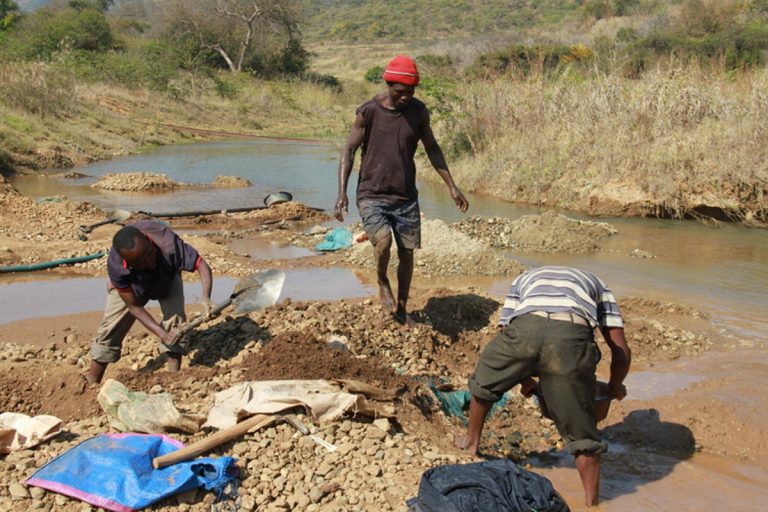
Stakeholders in the small-scale mining sector see access to finance and technology as key in taking advantage of growth opportunities at a time Zimbabwe is angling for a US$12 billion in the sector by 2023.

This is in addition to the vast mineral resources Zimbabwe possess that if exploited, can boost the country’s foreign currency earnings.

A survey by the Zimbabwe Coalition on Debt and Development (ZIMCODD) titled “The Economy We Want” highlights that opportunities for economic and social transformation from a citizen’s perspective vary with each sector.

Small-scale miners bemoan lack of access to loans, which if made available for procurement of machinery and expansion projects, could be a game-changer for the sector that contributes over half of the gold delivered to Fidelity Printers.

The survey notes that: “6.81 per cent of the respondents from the mining sector saw an opportunity for growth through leveraging of the abundant minerals to stimulate socio-economic growth as a result of Government support to small-scale miners with loan facilities and access to technology.”

Interestingly, as part of the $18 billion economic recovery and stimulus package in the wake of Covid-19, the Government has allocated $1 billion to the mining sector through a credit facility for the gold sector targeting both small and large-scale miners.

Small-scale miners said the facility would bring a huge relief to their operations as they have been hard hit by the outbreak of the Covid-19 pandemic.

Zimbabwe Miners Federation (ZMF) secretary-general, Mr Philemon Mokuele, however, told The Chronicle that there was a need for the Government to ensure the fund was properly administered and benefited the right people.

Access to finance has always been a stumbling block for small to medium enterprises (SMEs) across all the economic sectors despite their enormous contribution to the economy.

In agriculture, small-scale producers have a critical role in the production of both food and non-food crops.

According to the ZIMCODD survey, 8.6 per cent that represented the farming community believe growth opportunities lie in equal allocation and distribution of inputs with emphasis on Government-led programmes such as the Command Agriculture.

“Agricultural inputs must be distributed and allocated proportionally according to the land one productively uses in a non-partisan manner. Additionally, market linkages were another opportunity noted by farmers since most small-scale farmers bemoaned the fact that they struggle to access markets to sell their produce at a fair and competitive price,” reads part of the survey.

Access to fair markets was also cited as critical to ensure farmers sell their produce at an open market which results in competitive prices and therefore improved quality of produce brought to the market by farmers in an effort to fetch higher prices.

Women and youth who represented 14.53 percent and 22.7 percent of the respondents respectively also saw an opportunity of leveraging on their numbers through effective participation and advocacy to influence economic policy formulation and implementation. The role of the media cannot be overlooked in all these processes to disseminate information and shape policy formulation.

Said ZIMCODD: “The media plays a critical role of ensuring that information reaches people as such involving them at all levels across all sectors warrants that they have access to first-hand information which means citizens access credible information from reliable sources at all times.”