Home Blog Page 59

China-Led Platinum Surge Sets Stage for Strong 2025 Outlook – WPIC

0

Platinum’s bullish run in 2025 is showing no signs of slowing, driven by soaring investment demand and a resurgence in jewellery buying, particularly in China.

By Ryan Chigoche

The World Platinum Investment Council (WPIC) says this strong momentum has placed platinum ahead of gold and silver as the best-performing commodity so far this year.

From the beginning of the year, the platinum market has been in a structural deficit, with robust investment demand and accelerating interest from China as key factors that will shape the rest of the year.

These trends, the WPIC notes, position platinum as both an attractive investment asset and a strategically important metal for the global energy transition.

“Platinum has broken out of its post-pandemic trading range to be the top-performing commodity in the first six months of 2025.

“Looking to the remainder of 2025, platinum’s investment case remains compelling, with the platinum market in structural deficit. Platinum’s sustained, significant discount relative to gold continues to add to its appeal. This is especially true in China, where both jewellery demand and bar and coin demand are forecast to show exceptionally strong growth this year. The success of Shanghai Platinum Week, which achieved record-breaking attendance and is increasingly drawing an international audience, demonstrates heightened interest in platinum, both as an investment asset and as a critical mineral across multiple value chains,” said WPIC CEO Trevor Raymond in a recent media interview.

According to WPIC data, global investment in platinum bar and coin surged by 660% year-on-year in the second quarter of 2025. China has become the key growth engine, now accounting for 64% of global platinum bar and coin demand, up from just 11% in 2019.

This surge has been fuelled by market development initiatives, investors seeking refuge from record-high gold prices, and a revival of China’s platinum jewellery sector. Platinum jewellery demand in the country jumped 32% in Q2 to 668,000 oz, pushing global jewellery demand to its highest first-half level since 2015. For the full year, jewellery demand is forecast to climb 11% to 2.23 million oz, with China contributing a 42% increase.

On the investment side, the dramatic second-quarter rise in Chinese bar and coin purchases lifted total bar and coin demand 55% higher to 109,000 oz. For the whole of 2025, bar and coin demand is expected to increase 45% to 282,000 oz, with demand for bars of 500 g and above in China climbing 15% to 186,000 oz. Exchange-traded funds (ETFs) are also forecast to return to net inflows in the second half of the year, reaching 100,000 oz on stronger investor sentiment and platinum’s persistent discount to gold.

Platinum’s critical role in the global decarbonisation effort is also gaining attention. Demand from hydrogen-based applications is projected to rise 19% to 49,000 oz this year, supported by a growing pipeline of orders for proton-exchange membrane (PEM) electrolysers and ongoing regulatory support.

Raymond emphasised that platinum’s investment function is a crucial part of its strategic value.

“Platinum investment is a natural mechanism for attracting metal into any geography, providing a pool of liquidity to supply future demand. For a strategically important metal like platinum, which is an essential ingredient for the hydrogen economy and global decarbonisation, this is likely to prove particularly important for major end users such as China that do not have meaningful domestic sources of supply.”

Although industrial platinum demand grew 41% quarter-on-quarter to 513,000 oz in Q2, it is forecast to fall 22% to 1.9 million oz for the full year. This drop is largely due to a 74% decline in glass demand, partly offset by gains in petroleum (+14%), hydrogen (+19%), medical (+4%), and electrical (+2%) applications.

With prices reaching a ten-year high of US$1,450/oz in July and China’s demand showing no signs of slowing, WPIC maintains that platinum’s structural deficit will continue to underpin investor interest through the remainder of 2025.

Gold prices today per gram/ ounce

0

Gold buying prices in Zimbabwe today, 11 September 2025, from the official gold buyer and exporter Fidelity Gold Refinery (FGR).

CategoryPrice (US$/g)Price (US$/oz t)
SG 90% and ABOVE110.913,448.60
SG >89% <90%109.743,412.26
SG >80% <85%108.573,375.89
SG >75% <80%107.393,338.51
Sample 5–10g105.633,283.18


Fire Assay CASH $111.50/g and US$3,468.03/oz

NB: Fire Assay cash price is for gold above 100g; no sample is deducted.

A sample of not more than 10g is deducted for the Fire Assay Transfer price

Four Artisanal miners die in Shurugwi mine collapse

0

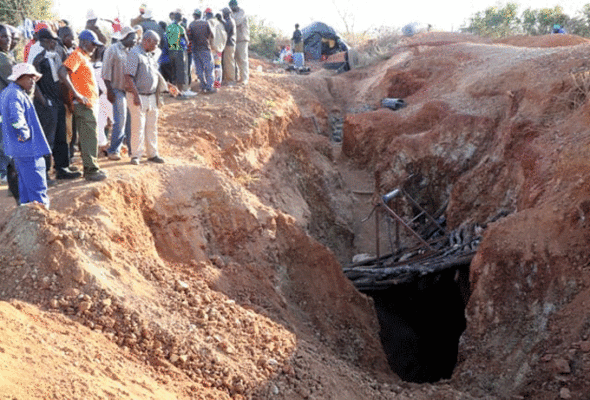
SHURUGWI – The Zimbabwe Republic Police (ZRP) has confirmed a tragic mining accident at Chengxi Gold Mine in Shurugwi that claimed the lives of four artisanal miners.

According to a statement released on the ZRP’s official Twitter account, the incident occurred on 4 September 2025. The miners were prospecting for gold in a disused mineshaft when the shaft collapsed, trapping them inside.

“The ZRP confirms a mine accident which occurred at Chengxi Gold Mine, Shurugwi, on 04/09/25, where four artisanal miners died. The victims, who were prospecting for gold in a disused mineshaft, got trapped after the mineshaft collapsed. The bodies of the victims were retrieved and taken to Gweru Provincial Hospital for a post-mortem,” the police statement read.

Authorities are investigating the circumstances surrounding the collapse and have urged artisanal miners to exercise caution when working in abandoned or unsafe mining areas.

This incident highlights ongoing safety challenges in Zimbabwe’s artisanal and small-scale mining sector, which continues to attract many miners despite the risks associated with abandoned or poorly maintained shafts.

Chinhoyi Miner Fined for Expired Firearm License as National Crackdown Intensifies

0

A miner in Chinhoyi has been fined for failing to renew his firearm license, a case that comes amid a sweeping national police operation targeting illegal weapons and expired certificates, Mining Zimbabwe can report.

By Rudairo Mapuranga

The National Prosecuting Authority (NPA) confirmed the conviction of Andrew Nyamadzawo, who was arrested on July 19, 2025, at around 8 PM in the Chijaka area after he was found in possession of a 7.65mm pistol with an expired licence.

The firearm was intended for the protection of cash, bullion, and other valuables in transit. When asked to produce a valid certificate, Nyamadzawo could only submit an expired document registered in his name.

The Chinhoyi Magistrates’ Court handed down a suspended sentence on condition that he pays a fine of US$200. The firearm was recovered by authorities.

This case aligns with a broader crackdown by the Zimbabwe Republic Police (ZRP). In a press statement dated September 10, 2025, the ZRP revealed that since August 27, 2025, a total of 2,132 suspects have been arrested nationwide for offences related to unlicensed firearms, expired certificates, misuse of toy guns, and possession of dangerous weapons.

Among these arrests, 305 involved firearms with expired certificates – the same offence committed by Nyamadzawo.

The police also recovered 60 unlicensed firearms, 96 firearms linked to other offences, 258 misused toy guns, and 2,967 dangerous weapons. In a related operation, 604 individuals were arrested for selling or possessing prohibited skin-lightening products.

The ZRP used the statement to remind the public of their obligations under the Firearms Act (Chapter 10:09), urging proper firearm security and adherence to safety regulations. The release also highlighted that in the event of a firearm owner’s death, family members or estate administrators are required to surrender the weapons to the police.

Additionally, the police announced a forthcoming Presidential Firearms Amnesty, which will allow individuals and institutions to voluntarily surrender unregistered firearms and ammunition without prosecution. Full details of the amnesty program are expected to be released soon.

Cabinet Directs Polluters to Pay for River Rehabilitation as Alluvial Mining Ban Holds

0

The government has ordered that perpetrators of illegal riverbed mining bear the full cost of rehabilitating degraded environments, invoking the “Polluter Pays Principle” as the next phase of its nationwide ban on alluvial mining, Mining Zimbabwe can report.

By Rudairo Mapuranga

The directive was briefed to the media by the Minister of Information, Dr. Jenfan Muswere, during a Cabinet briefing that received an update on the implementation of Statutory Instrument 188 of 2024, which outlawed alluvial mining along riverbanks. With the ban largely successful in halting active mining, authorities are now shifting focus to the extensive environmental cleanup required.

Dr. Jenfan Muswere delivered the briefing, stating that “since alluvial mining has largely ceased, attention has now shifted to the rehabilitation of degraded sites, with liability for the rehabilitation being borne by the perpetrators.”

The government reported significant progress in operations to eliminate the practice across most provinces. To enforce the new rehabilitation drive, the legislative framework is being strengthened through the development of new regulations, and legislative reform will be expedited to “ensure environmental justice and accountability.”

The Cabinet update provided a provincial breakdown, noting that no identified alluvial mining sites in need of rehabilitation were found in the metropolitan provinces of Harare and Bulawayo. This indicates that the most severe damage is concentrated in rural and mineral-rich regions.

The government’s monitoring and enforcement efforts will now be concentrated on provinces where degradation is most acute, including Matabeleland North and Masvingo. These regions have seen some of the country’s most severe river siltation, which has contributed to a critical national water crisis.

Minister Muswere emphasised that the enforcement of the ban is “ongoing,” and the government continues to heighten its “monitoring and evaluation as well as enforcement mechanisms.”

The move to hold mining operators—both legal and illegal—financially accountable for environmental damage marks a significant escalation in the government’s policy. The “Polluter Pays Principle” is a standard environmental policy tool designed to internalise the cost of pollution, ensuring that the responsible parties, rather than the public, fund the restoration.

This policy shift follows recent public scrutiny over sentencing disparities for mining-related offences, where foreign nationals received fines while Zimbabwean citizens were jailed for similar activities. The new rehabilitation directive applies a uniform standard of accountability, focusing on the environmental impact rather than just the act of illegal mining.

PlanetGOLD Calls for Collective Responsibility to Safeguard Zimbabwe’s Mining Environment

0

Zimbabwe’s mining industry continues to play a critical role in the economy, providing jobs and generating revenue across multiple commodities. However, Mining Zimbabwe can report that the rapid expansion of mining has left a significant environmental footprint.

By Ryan Chigoche

Open pits, deforestation, silted rivers, and contamination from heavy metals and chemicals have been reported across the sector, raising concerns about ecosystem degradation and community health.

The Environmental Management Agency (EMA), mandated to regulate and monitor environmental compliance in mining, has faced challenges keeping up with the scale and diversity of mining operations. Limited technical capacity and resources have resulted in gaps in monitoring and enforcement, leaving parts of the sector vulnerable to unsustainable practices.

Rather than leaving environmental stewardship solely to EMA, Upenyu Makoni, Communications Officer for planetGOLD, told Mining Zimbabwe that a collective approach is needed.

“Effective environmental stewardship requires a concerted effort from all stakeholders, including miners, civil society, and communities, as well as government agencies. The mandate of EMA is critical, and its role as the regulator must be strengthened and supported. Key to this is fostering even deeper collaborative frameworks between institutions, ensuring that monitoring and enforcement are consistent across the entire mining sector,” she said.

Following this, planetGOLD highlighted that its collaboration with EMA in recent times has been constructive.

EMA officers accompanied planetGOLD teams during site profiling exercises across the country, providing local knowledge and facilitating engagement with mining communities.

The agency has also conducted awareness campaigns to educate miners and simplify compliance processes, helping improve environmental practices across the sector.

The planetGOLD initiative brings together EMA, the Ministries of Mines, Environment, and Health; Fidelity Gold Refinery; the Zimbabwe Miners Federation; miners; and other sector advocates to promote safer, cleaner, and more sustainable mining practices. The initiative benefits communities and workers across the sector while reducing environmental risks.

The project added that continued investment in EMA’s technical and logistical capacity is essential to enable consistent monitoring and enforcement, and that accountability for environmental damage requires participation from all stakeholders.

Gold buying prices per gram in Zimbabwe, 10 September 2025

0

Gold buying prices per gram in Zimbabwe today, 10 September 2025, from the official gold buyer and exporter Fidelity Gold Refinery (FGR).

SG 90% and ABOVE US$110.88/g.
SG ABOVE 89% BUT BELOW 90% US$109.70/g.
SG ABOVE 80% BUT BELOW 85% US$108.53/g.
SG ABOVE 75% BUT BELOW 80% US$107.36/g.
SAMPLE BELOW 10g BUT ABOVE 5g US$105.60/g.

Fire Assay CASH $111.46/g.

NB: Fire Assay cash price is for gold above 100g; no sample is deducted.

A sample of not more than 10g is deducted for the Fire Assay Transfer price

Kavango Completes VFEX Listing

0

Kavango Resources PLC, a London-based exploration company, has officially completed its listing on the Victoria Falls Stock Exchange (VFEX), making history as the first pure-play exploration firm to take this route. The move signals growing investor confidence in Zimbabwe’s mineral wealth and dovetails with government efforts to modernize and formalize the gold sector.

By Rudairo Mapuranga

Kavango CEO, Ben Turney, described the VFEX listing as more than just a fundraising exercise.

“We are extremely pleased to have completed our listing on the Victoria Falls Stock Exchange and to welcome Zimbabwean investors onto our shareholder register,” Turney said.

“Kavango has a bold mission to introduce modern exploration and mining technologies to Zimbabwe’s goldfields. Our listing means Zimbabwean investors can share in the rewards as our business grows in this exciting gold frontier.”

Launched in 2020, VFEX is a U.S. dollar-denominated stock exchange designed to attract global capital while giving local investors access to world-class mining plays. Its incentives—including tax exemptions on dividends and capital gains—make it attractive for investors seeking dollar-based returns.

The success of Caledonia Mining, which operates Blanket Mine, has already shown that VFEX can provide real depth of capital. In fact, Caledonia has raised more on VFEX than on its New York Stock Exchange listing—an endorsement that gave Kavango confidence to take the same path.

Kavango’s listing comes as the company develops its Hillside Gold Project and the Nara Project. But the bigger bet is on Zimbabwe’s under-explored gold belts, where artisanal miners dominate and modern exploration techniques remain limited. Kavango believes that systematic exploration, using geophysics, data analytics, and new geological approaches, could reveal major deposits that past generations of miners left undiscovered.

The VFEX listing not only provides Kavango with capital but also creates strong alignment with Zimbabwean investors—an important step in a country where resource nationalism often shapes mining policy. By bringing locals onto its shareholder register, Kavango strengthens goodwill and builds a stronger case for long-term regulatory support.

While producers like Caledonia have proven VFEX works for established miners, Kavango’s listing will test the market’s ability to support early-stage explorers with no immediate revenues but significant long-term potential. If successful, it could open the door for more junior companies seeking exposure to Zimbabwe’s mineral wealth.

Zimbabwe has set ambitious targets to grow the economy to an upper middle income by 2030, with gold expected to anchor the growth. Attracting foreign companies that bring expertise, technology, and risk capital is central to this vision. Firms like Kavango, which are willing to take bold exploration risks, could be the key to unlocking the next generation of large-scale gold mines.

Zimbabwe’s persistent economic instability, policy uncertainty, and political risk perceptions remain concerns. However, the VFEX—by providing a USD-based, investor-friendly platform—aims to neutralize some of these issues and give both local and foreign investors confidence.

All eyes will now be on how Kavango performs post-listing. If it can replicate even part of Caledonia’s success, it will send a strong message: Zimbabwe’s gold sector is open for business, and the Victoria Falls Stock Exchange is ready to be the financial lifeline driving its next phase of growth.

I Don’t Know If It’s Mining or Agriculture, But We Must Act Now to Save Our Rivers

0

A journey from Harare to Bulawayo was once a lesson in Zimbabwe’s rich hydrology, a traverse across veins of life that sustained the nation. In 2006, the rivers I crossed were vibrant, flowing entities, their waters a lifeline for communities, livestock, and vast swathes of agricultural land.

By Rudairo Mapuranga

Today, that same journey paints a starkly different picture: a desolate panorama of sandbanks, invasive weeds, raw sewage, and a silence that speaks volumes about an impending ecological catastrophe. The story of our dying rivers is the story of a nation jeopardizing its own future.

The crisis announces itself immediately upon leaving the capital. The Mukuvisi River, which threads through Harare, is a tragic opening act. Once a flowing waterway, it is now a choked drain, suffocating under the weight of effluent and water hyacinth. This is not a river; it is a warning. Further west, the situation at Lake Chivero and the Manyame River is even more alarming. These should be crown jewels in our water infrastructure. Instead, they are repositories of pollution and silt, their capacities shrinking visibly from year to year due to unchecked catchment degradation.

As the highway unfolds past Selous, the scale of the disaster becomes terrifyingly clear. The Mupfure River, a crucial tributary feeding into the Manyame system, is heavily silted, its banks eroded by artisanal mining and streambank cultivation. Farmers, desperate for fertile soil, till right to the water’s edge, destabilizing the banks. Miners, desperate for gold, dig directly into the riverbed, altering its course and chemistry.

The narrative intensifies around Kadoma. Here, the Muzvezve River, a name synonymous with gold deposits, has paid the ultimate price for the mineral wealth beneath it. It is now a labyrinth of mining trenches and settling ponds, its flow disrupted and its water contaminated by chemicals. Beyond Kadoma, the great Munyati River, one of Zimbabwe’s major waterways, is a shadow of its former self. Its flow, once powerful and reliable, has been bled dry by extensive agricultural abstractions and mining activities along its tributaries. The same fate has befallen the Sebakwe River in Kwekwe. This river is the sole feeder of the Sebakwe Dam, which supplies water to the cities of Kwekwe and Redcliff. Its accelerated siltation is a direct threat to urban water security, turning stretches that were once perennial into seasonal streams.

Between these major systems lie smaller but equally vital rivers: the Sessami, the Umsweswe, and the Rwizi, which are seldom mentioned but are critical for rural communities and the health of the broader ecosystem. These, too, are drying up, their courses fragmented and polluted.

By the time you reach Gweru, the pattern is inescapable. The Gweru River itself, which gives the city its name, is struggling. Its flow is thin and anaemic, often carrying a cocktail of agricultural and industrial runoff. The vibrant ecosystems it once supported are fading memories.

The journey into Matabeleland reveals the final, most brutal chapter of this story. Rivers that were the very lifeblood of the region — the Shangani, Insiza, Umguza, and Mpopoma — are now mere geographical features on a map, not functioning waterways. For most of the year, they are vast, empty expanses of sand. The Insiza River, which feeds the Insiza Dam, is so heavily silted that the dam’s capacity and lifespan are being drastically reduced. This has dire consequences for Bulawayo’s already precarious water supply. The Umguza River, north of Bulawayo, is similarly degraded, its catchment eroded by overgrazing and deforestation, ensuring that even when rains come, the water runs off the land too quickly, causing erosion instead of recharging the aquifer.

So, what happened? Is this the fault of mining, with its unchecked riverbed operations and chemical pollutants? Or is it agriculture, with its relentless streambank cultivation, abstraction, and deforestation of catchments? The frustrating — and perhaps most important — answer is that it is both.

Experts confirm that this is a crisis of cumulative pressure. An official from the Environmental Management Agency (EMA) recently stated, “We are witnessing the collective impact of decades of abuse. From illegal mining operations that churn up riverbeds to widespread streambank cultivation that destroys riparian buffers, our rivers have been assaulted from all sides. They are treated as dumping grounds and sandpits, not the critical natural infrastructure they are.”

The Zimbabwe National Water Authority (ZINWA) has issued equally grave warnings. “The hydrological profiles of major rivers like Manyame, Sebakwe, and Munyati have been fundamentally altered,” a ZINWA official noted. “Inflows into our major dams are declining at an alarming rate because the catchments are no longer able to hold and release water sustainably. Siltation is our biggest enemy. If a concerted, national effort is not mobilized immediately, we will bequeath to the next generation a landscape of sand where rivers once flowed.”

The truth, though harsh, is simple. The arteries that carry life from Harare to Bulawayo are collapsing. This is no longer a theoretical environmental concern; it is a direct threat to national security, economic stability, and human survival. The debate over whether mining or agriculture is the primary culprit is a dangerous distraction. While we argue, the rivers die.

The call to action must be equally collective and decisive. We need enforced and respected buffer zones along all rivers. We need a moratorium on all riverbed mining, backed by consistent and impartial law enforcement. We need to support farmers with sustainable land-use practices that protect waterways instead of destroying them. Most importantly, we need a national consciousness that views a healthy river not as an obstacle to development, but as its very foundation.

The rivers will not wait for our debates to conclude. They are disappearing now. The question is whether we will act in time to save them, or simply be the generation that watched them die.

Gold Miners rejoice as Prices Hit US$110 per Gram, Over US$3,400 an Ounce

0

Zimbabwe’s gold miners are celebrating as gold prices breached the US$110 per gram mark today, 9 September 2025, translating to more than US$3,400 an ounce.

According to the official buyer, Fidelity Gold Refinery (FGR), today’s top price for gold of 90% purity and above stands at US$110.36/g (US$3,431.66/oz), up from yesterday’s US$109.21/g (US$3,395.49/oz). The Fire Assay cash price, which applies to gold above 100g, also climbed from US$109.78/g (US$3,413.45/oz) to US$110.95/g (US$3,449.08/oz).

Other categories showed similar gains:

  • SG above 89% but below 90%: from US$108.05/g (US$3,361.59/oz) to US$109.20/g (US$3,397.57/oz).

  • SG above 80% but below 85%: from US$106.89/g (US$3,325.06/oz) to US$108.03/g (US$3,361.28/oz).

  • SG above 75% but below 80%: from US$105.74/g (US$3,289.34/oz) to US$106.86/g (US$3,324.15/oz).

  • Samples below 10g but above 5g: from US$104.01/g (US$3,235.37/oz) to US$105.11/g (US$3,269.48/oz).

The upward swing means more cash for small-scale producers, who supply most of Zimbabwe’s gold deliveries to FGR.

“This is good news for us. Every dollar makes a big difference because costs keep going up. At least now we feel the effort is paying off, zvirikuendeka,” said one small-scale miner from Kwekwe.

With prices now holding above the US$110/g (US$3,400/oz) threshold, miners are “smiling all the way to the bank.” Analysts say the official market could see higher deliveries, strengthening Zimbabwe’s gold output and foreign currency inflows.