Home Blog Page 593

Vast, Katanga new agreement for Marange project

0

Aim listed Vast Resources plc and Katanga Mining (pvt) Ltd formed a new agreement for the development of Vast’s Heritage concessions in the Marange Diamond Fields of Zimbabwe.

To manage and hold the interests of Vast Resources and Katanga Mining (pvt) Ltd, a joint venture company for the Chiadzwa Community, a new company, ‘Newco’, has been formed.

Consultancy partner, Botswana Diamonds will now receive new shares representing 2.5% of Newco, and Vast a total 97.5%, in the special purpose vehicle created by Vast.

Under the agreement, Botswana Diamonds will provide its consultancy efforts to Vast pro bono immediately for a five-year period whilst Vast will cover all capital requirements for up to $10 million.

Both companies explained how a review of an agreement between the two parties was required in light of Vast nearing its finalisation of an agreement with the Central Authorities on a package of ground in the Chiadzwa / Marange area.

Shares in Botswana Diamonds were trading 8.82% higher at 0.925p on Thursday morning.

Andrew Prelea, Chief Executive of VAST explained how the group concluded that BOD’s contribution as a consultant would ultimately “add significant value to the project.”

“We look forward to the diamond agreement being concluded and to work starting on what is highly prospective ground,” added Chairman of Botswana Diamonds, John Teeling.

Teeling further acknowledged Zimbabwe as a country “rich in resources” with “significant diamond potential” that is opening up to investment.

According to Reuters, President Emmerson Mnangagwa has recently tightened efforts to benefit from the region’s mineral resources to combat inflation and unemployment affecting Zimbabwe’s economy.

Vast is developing the project through Katanga Mining, a joint venture formed together with the local community at Chiadzwa, whom the company emphasised in its September update will directly benefit from natural resources acquired from the area.

About Vast Resources

Vast Resources is focused on the rapid transformation from exploration company to mining company and delivering multiple revenue streams. This will be driven by the advancement of its two primary value drivers, the Baita Plai Polymetallic Mine in Romania, and the Chiadzwa Community Concession in Zimbabwe, into near term production. Vast resources was once a shareholder in the Chegutu based Pickstone Peerless Mine.

Vox Markets

Should Zim gold miners have their cake and eat it?

0

Zimbabwe’s gold deliveries have dipped 23% to 23.03 tonnes during the first 10 months of 2019, from 30.13 tonnes during the comparative period last year, due to the government’s adverse mining policies.

The development comes at a time when the country is experiencing rampant inflation, subdued production across most sectors of the economy, crippling power outages and serious shortages in many areas, leaving Zimbabwe on the edge of total economic explosion. Given that gold is the single highest foreign currency earner, ahead of tobacco, the government should pay more attention to the sector.

Gold contributes 38% of the country’s total earnings and more than 60% to the mining sector’s revenue. Surprisingly, the crafters of mining laws and regulations have turned a blind eye to the critical issues affecting the gold sector. In various forums, the RBZ Governor, John Mangudya, has insisted that gold miners cannot get a 100% forex retention level because the country needs money to import grain, fertilisers, drugs, and fuel.

This year, the RBZ reduced the gold forex retention level from 70% to 55%, and this has greatly displeased gold miners who have resorted to selling a large chunk of their production to South African dealers. The level of side marketing in the gold sector is a cause for concern. Some reports have claimed that senior government officials and ruling party stalwarts are involved in side marketing.

That puts the central bank in an invidious position as this has created arbitrage opportunities for those close to the corridors of power. Worse, Finance Minister Mthuli Ncube believes that close to 34 tonnes of gold have been smuggled out of the country in the first 10 months of 2019 and nothing concrete has been done to stop it.

A fortnight ago, during the US$12bn mining roadmap conference in the capital, Henrietta Rushwaya, the Zimbabwe Mining Federation president, told the gathering that gold production had gone up significantly but formal gold deliveries were going down.

“We can’t say gold production is going down, actually it’s going up, but gold is sold through other channels which are offering high forex retention levels, which show that the government should do something to ensure that the precious mineral is sold through formal means here,” Rushwaya said in the presence of Mangudya and Ncube.

Irvine Chinyenze, the Gold Miners Association of Zimbabwe (GMAZ) chief executive, says the fact that the authorities maintain the forex retention levels means there is someone benefitting somewhere.

“The monetary authorities should rethink their 55% forex retention threshold if they want miners to sell their yellow metal via Fidelity Printers and Refiners, otherwise we will continue to lose gold to South Africa which offers good incentives for gold miners and dealers,” says Chinyeze.

The government is planning to increase forex retention to 60% but the miners want above 70%. Analysts believe Zimbabwe is extracting over 75 tonnes of gold but most of it is smuggled out of the country by influential figures.

Some miners, especially large scale, are believed to be selling their gold to suspected smugglers to get more forex for their operations_Business Times

About Bindura Nickel Corporation (BNC)

0

Zimbabwe Stock Exchange (ZSE) listed major nickel mining concern, Bindura Nickel Corporation (BNC), has a long history almost linked with the very history of nickel mining in Zimbabwe.

The company operates nickel mines and a smelter complex in Bindura in Zimbabwe’s Mashonaland Central Province.  Scope of operations entail the extraction of nickel and the production of nickel by-products like copper and cobalt.

These are the main activities in the company’s two main divisions, namely, the Mining Division and Bindura Smelter & Refinery (BSR) Division.

The mining division is constituted by Trojan Nickel Mine Limited (TNM) and Hunters Road Nickel Mine (Private) Limited. Assets and liabilities for all the operations, however, is the prerogative of Trojan Nickel Mine.

Trojan Nickel deposits were the first to be discovered in Bindura in 1956 with the first concentrate having been produced in 1964. BNC was then established in 1966 by the Anglo American Corporation Group in Zimbabwe. Madziwa Nickle Mine near Shamva was first mined during the year.

The smelter and refinery was commissioned in 1968, with the first nickel cathode having been produced the very year using two blast furnaces that treated concentrates from the two main suppliers of nickel ore then, Trojan and Madziwa Mines.

The two blast furnaces were decommissioned in 1976 and replaced with an ultra-modern electric furnace.

Epoch Nickel Mine was established in Filabusi in 1969. Epoch and Shangani mine’s introduction had, in fact, necessitated the replacement of old blast furnaces.

In 1971 Bindura Nickel Corporation got listed on the ZSE.

Shangani Mine was closed for two months in 1995 pursuant to a mine accident.

Two years later in 1997 proposals were made to close Madziwa and Epoch mines and develop Hunters Road nickel property.

Epoch Nickel Mine and Madziwa Nickel Mine were closed in 1998 and 2001 respectively due to a decline in nickel prices and poor ground conditions.

As another scourge, toll treatment of matte from Botswana and Australia Bindura’s smelter exceeded nickel production from locally sourced concentrates.

In 2003 the Anglo American Corporation sold its 52,9 percent stake in BNC to Mwana Africa Holdings for US$8 million.  BNC was the first of Mwana Africa’s acquisitions before the Anmercosa base metal and gold prospects in the Katanga copper belt in 2004, and the Freda Rebecca gold mine in Bindura in 2005. Freda Rebecca was closed in 2007.

The Shangani and Trojan mines and the Bindura smelter and refinery complex were placed on care and maintenance in 2008 citing depressed performances.

In 2009 RBZ relinquished its role as gold sales agent to allow firms to sell the metal and keep all the proceeds. Mwana Africa, the new holding company, then announced an intention to restart gold production at the Freda Rebecca mine the same year.

In 2012 US$23million was raised through a renounceable rights offer to necessitate the reopening of Trojan Mine.

The mine subsequently restarted operations in October 2012 after nearly four years of care and maintenance.

By March 2014, Mwana Africa PLC’s shareholding in BNC was 74,82 percent. Exactly a year later, the group raised US$20 million for the Smelter Restart Project which by 2017 was 83 percent complete.

In 2015, a Chinese mining and exploration group, ASA Resources, acquired control of BNC by taking over Mwana Africa’s 74,73 percent shareholding.

In tandem with the acquisition, Mwana Africa shareholders approved a name change to ASA Resources.

In 2017 BNC concluded feasibility studies of converting the Smelter into a plant that processes Platinum Group Metals (PGMs). However, results indicated this was impossible, due to a limited supply of platinum concentrates.

ASA Resources disposed of its 74,73 percent stake in BNC in 2019.

Its assets in Zimbabwe include the disposed Bindura Nickel Corporation, Freda Rebecca Gold Mine and an agribusiness venture.

The Smelter enhancing project had reportedly been temporarily shelved as the group pivots towards shaft deepening to boost production on the back of an anticipated improvement in the global nickel price. Prices are projected at US$18 000 per tonne of nickel.

Market Capitalisation as updated November 27, 2019, stood at $185 948 492 with a share price of 15,00 cents.

Business Weekly

It’s palladium, rhodium vs platinum

0

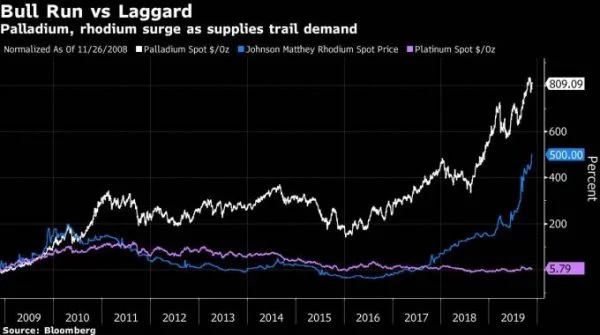
South African miners face a conundrum: increasing palladium and rhodium output to take advantage of soaring prices risks depressing the already fragile market for sister metal platinum.

That’s because palladium and rhodium are mined as by-products, with every extra ounce of the former typically coming with two to three additional ounces of platinum.

Stricter emissions standards have boosted palladium and rhodium consumption in autocatalysts for gasoline cars. By contrast, the backlash against diesel vehicles, where most platinum gets used, has seen the metal languish.

Consequently, some of the world’s biggest platinum miners, including Sibanye Gold and Impala Platinum are loathe to boost production, even as palladium’s eight-year supply deficit could widen in 2020.

“They can’t increase production because the main metal is platinum and they don’t want to make the price come down,” said Rene Hochreiter, an analyst at Noah Capital Markets in Johannesburg.

Platinum has rallied 15 percent this year from a decade low, but demand is forecast to drop in 2020, pushing the market back into a surplus. Palladium has jumped 40 percent in 2019, while rhodium has surged 144 percent.

“Expanding production to try and benefit from higher rhodium and palladium prices can be quite risky,” said James Wellsted, a Johannesburg-based spokesman for Sibanye.

“Most companies seem reluctant to raise production in South Africa due to the possible impact it will have on the platinum price.”

The rally in palladium and rhodium is extending the life of older shafts along Rustenburg’s platinum belt, but producers aren’t rushing to invest in new mines, according to Johan Theron, a spokesman for Implats.

Boosting production would make the platinum market “even more supplied,” he said.

Given the geological and market restraints, Implats expects output from South Africa’s mines to start declining over the next five years.

New projects in South Africa would take years to develop, while those in neighbouring Zimbabwe may be stymied by political and economic uncertainty, he said.

Anglo American Platinum Ltd., the most profitable of South Africa’s producers, will make a final decision on whether to expand its Mogalakwena mine at the end of 2020, according to spokeswoman Jana Marais.

Unusually, the company’s flagship mine produces more palladium than platinum, but Amplats must weigh the prospects for power supply from South Africa’s troubled state-owned utility before moving forward, she said.- Bloomberg.

Despite talk of coal’s demise, it still powers the world

0

Environment, Tourism, and Hospitality Industry Minister Mangaliso Ndlovu this week told BBC HardTalk host Stephen Sackur that Africa should be allowed to benefit from its natural resources as it is also playing its part to mitigate the adverse effects of climate change.

He said despite the drive toward renewable energy such as solar, coal will remain a source of energy in the foreseeable future.

“For coal we will not move at a faster pace because we still believe our emissions are very insignificant compared to developed nations.

“You will agree with me that the major emitters have moved slowly out of that because they know that it’s benefiting their economies. I think we need to also give Africa a chance. I think Africa can still benefit from its resources,” said Minister Ndlovu.

Minister Ndlovu and Zimbabwe, it seems, are not the only ones who think coal still has a future.

For all the talk of ditching fossil fuels to fight climate change, coal remains king in much of the world.

The amount of electricity generated from coal jumped 7 percent in the developing world last year, according to BloombergNEF’s annual Climatescope report that evaluated more than 100 nations. It’s the biggest increase in five years.

While coal consumption is sliding in the US and Europe, it’s still cheaper than wind or solar in many emerging markets. That makes it an appealing choice in China, India and other nations seeking cheap electricity to lift residents from poverty.

Since the start of the decade, coal use has jumped 54 percent in the developing world, presenting huge challenges to the push to stave off the most dire impacts of climate change.

“If we really want to limit global warming, we need to start replacing coal plants,” said Luiza Demoro, lead author of the report.

“If we need to rely on economics, it’s going to take a really long time.”

The study also found investments in clean energy fell 21 percent, to $133 billion, across emerging markets last year, as China, India, and Brazil all cut back.

The report comes as the impacts of climate change become increasingly stark. In the last month alone, wildfires have devastated swaths of Australia, floods have paralysed Venice and California utilities have plunged millions of people into darkness to prevent live power lines from sparking blazes after years of drought.

The continued use of coal in the developing world highlights the uneasy relationship the world has with the fuel. While many developing nations including China and India have pledged to limit emissions as part of the Paris climate accord, they’re faced with the dilemma of also bringing affordable electricity to rural regions.

Renewable power won’t be cost-competitive with coal in some developing countries until about 2025, Demoro said.

That’s why BNEF expects carbon emissions from power plants in emerging markets to increase through the middle of the next decade.

Coal accounted for about 47 percent of all generation last year in the nations BNEF studied, which include most of South and Central America, Africa and Asia, and parts of Eastern Europe. Globally, it accounts for about 40 percent of power.

This year, the amount of electricity overall coming from coal-fired generation plants is forecast to fall 3 percent this year, according to Carbon Brief. But it still dominates in emerging markets. While clean energy accounted for just over half the capacity added in developing nations last year, wind and solar farms can’t run around the clock. So new coal and gas plants will actually supply more electricity.

“There’s more bad news than good news,” Demoro said. — Bloomberg

Zisco US$1bn deal collapses

0

R and F, the Chinese investor that was looking at acquiring a stake in the Zimbabwe Iron and Steel Company, has advised Government that it is pulling out of the deal.

Several sources within Government told Business Weekly that efforts to renegotiate the deal, agreed on under the previous administration, were unsuccessful.

The deal entailed the acquisition of ZISCO’s majority shareholding by R and F to pave way for the resuscitation of its Redcliff-based steel and iron plant at a cost of US$1 billion.

Following the review of the deal under the new dispensation, it came out the transaction had not been negotiated in good faith as it gave the investor “excessive offers”.

According to the sources, the deal was literally as good as mortgaging the country. Other concerns, which were raised by the Government were that R and F was not in steel making business, thus compromising its capacity to revive Zisco, once the largest regional integrated steelworks, from the operational point of view.

Apart from the mineral claims held by Zisco’s subsidiary, some of the assets that had not been factored when the deal was negotiated, include the company’s large real estate and a huge stockpile of scrap metal with an estimated value of US$40 million.

“R and F wrote to the Government advising that it was no longer interested. The parties could not agree after the new dispensation ordered the deal to be re-looked into.

“There are several issues the Government was not happy with.

“It is not like the Government wanted to sideline the investor, but wanted a win-win situation,” said one source.

Industry and Commerce Minister Dr. Sekai Nzenza, who recently took over the ministry following a recent Cabinet reshuffle, said she was yet to be briefed on the situation.

“Zisco . . . will certainly be a priority but I am yet to be fully briefed,” said Minister Nzenza.

Efforts to get a comment from Zisco acting chairperson Dr. Gift Mugano proved fruitless.

ZISCO stopped operations in 2008, plagued by a lack of capital to recapitalise and mismanagement. With its furnaces having the capacity to produce up to one million tonnes of steel per year, the company was among major foreign currency earners.

Foreign investor interest

ZISCO has been a subject of foreign investor interest in the past. Essar Africa Holdings, a unit of India’s Essar Group, had agreed to invest in ZISCO in 2011 during the era of the inclusive Government, but the deal collapsed in 2015. This was after a similar deal with another Indian firm, Global Steel Holdings failed to materialise in 2007.

Essar planned to build a new steelworks complex, replacing the antiquated plant and exported it via a terminal it wanted to build in the port of Beira, Mozambique.

The company was also looking into the feasibility of building iron ore and coal terminals at the port of Beira. There other international companies that once showed interest in Zisco include ArcelorMittal South Africa, a unit of the world’s biggest steel maker.

Former ministers to superintend over failed Zisco deals include Dr. Obert Mpofu in 2006 when the company was negotiating with Global Steel; Professor Welshman Ncube (Essar) during the inclusive Government between 2009 and 2013 during talks with Essar.

The deal collapsed when Dr. Mike Bimha was the Industry minister, leading to signing the deal between Zisco and R and F, which was renegotiated under Nqobizitha Ndlovu, recently reassigned as the Minister of Tourism and Hospitality Industry.

In 2018, Ndlovu told a business conference in Bulawayo that the Government was not satisfied with the progress, saying “we could open up for more interested investors.”

Last year, the Government took over both the external and domestic debt of Zisco of nearly $500 million as it sought to clear its balance sheet and attract investment.

Ziscosteel owed US$212 million in external loans, US$6 millio9 to external suppliers, $57 696 085 in domestic loans and $219 113 219 to domestic suppliers_Business Weekly

JOC to deal with maShurugwi

0

THE Midlands Provincial Joint Operations Command (JOC) has been tasked with effectively dealing with the “maShurugwi” menace in order to bring sanity to artisanal mining in the province.

In an interview yesterday, the Minister of State for Provincial Affairs, Larry Mavima, said machete wars between artisanal miners need to be contained and JOC has been mandated to work towards that goal.

The machete-wielding illegal gold miners, Minister Mavima said, have done much damage in the Midlands province and seem unstoppable.

“The Government is not taking lightly the maShurugwi menace and the provincial JOC has been tasked with dealing with these machete-wielding gold miners ruthlessly so that we bring to an end unnecessary loss of lives and damage to property these people bring wherever they go. So JOC has met and is working on ways and means of dealing with them and it will be ruthless,” he said.

The Minister said Government has also been working with churches and traditional leaders in a bid to bring sanity between artisanal miners. “We are confident of putting a stop to this menace because we are also working with the church and traditional leaders to address this menace. It is like a cancer which needs to be nipped in the bud once and for all,” said Min Mavima.

He said machetes have been used to kill many people as they unleash a reign of terror in the Midlands province in the fight for control of gold claims and ore.

“It has always been Government position that violence has no place in this country and that is why we are working with JOC, churches and traditional leaders to restore sanity, peace, unity, and tranquility in the province and if we start here, it will cascade to all other provinces,” the Minister said.

He said maShurugwi have no role to play in the development of the country under the New Dispensation.

“Basically, these people are renegades and have no role to play in the New Dispensation. The new Government is pre-occupied with peace, unity, and development. This New Dispensation preaches peace, unity, and tranquility and doesn’t tolerate any form of violence in this lucrative industry. As the Provincial Minister as I alluded to earlier, we have tasked JOC to deal with them ruthlessly,” Min Mavima said.

Officially opening the Zimbabwe Miners’ Federation Annual General Meeting in Gweru recently, President Mnangagwa spoke strongly against violence in the artisanal mining sector_The Chronicle

BNC pleads for raise in forex retention

0

BINDURA Nickel Corporation (BNC) says it is lobbying for the increase of foreign currency retention up to 80 percent citing inadequacy of the foreign currency as substantial amount of money is being directed towards dedicated power imports from South Africa.

The revelation was made during the Bindura Nickel Mine tour where the company indicated that it was spending substantial amount of foreign currency on direct power imports from Eskom in order to alleviate power outages currently obtaining in the country and improve the mine’s uptime.

Consequently, the nickel producing concern cited that the 50 percent they are currently retaining is minute to meet the overall foreign currency requirements for the mine given what is consumed by power imports thereby pleading with government to consider upward revision of foreign currency retention by the nickel miner.

The company also highlighted that it had reached an arrangement to remunerate its skilled workforce in foreign currency so as to retain expertise and avoid skills flight. Bindura Nickel Corporation managing director Batirai Manhando told Business Weekly in an interview that his firm was anticipating an upward review of above 80 percent in order to meet their foreign currency demands.

“We actually prepaid power from South Africa for us to guarantee constant supply and this has constrained US dollars that are available for other operations and the 50 percent retention is clearly inadequate we have lobbied the Government to say, can you increase what we retain, I think Government is still looking at that, we are looking at retention northwards of 80 percent for us to remain viable.

“And since we started this there has been a steady supply of power. Fine we get loading shedding here and there but by and large we are getting a better supply of power,” said Manhando.

BNC is one of the selected companies that have resorted to power imports to deal with obtaining power outages.

Solar Power

The firm, whose 75 percent shareholding was acquired by Sotic International, hinted on moving towards powering the mining operation with solar power in the near future saying it had already consulted companies on the feasibility.

Without smelter operations the firm uses an average of 15 megawatts per day, power consumption BNC expects to triple when the smelter operations kick in.

“We have plans to go solar, we are consulting a lot of companies at the moment to tender supply of solar power and also the funding modalities.

“We intend to have a solar plant that can power the entire mine especially during the day and create enough battery capacity to support evening operations.

“The guys we are talking to right now are talking of 45 MW facility and with current operations, we are using 15 megawatts but when smelter begins operations we will reach 45 megawatts,” he said.

BNC is currently producing an average of 500 tonnes per month and is hopeful the commodity price will be on an upward trajectory in years to come especially if the traction about electric vehicles continues to gain momentum_Business Weekly

Zesa lacks critical skills: Gata

0

The newly constituted Zesa Holdings (Pvt) Ltd board will have its work cut out as it faces a daunting task to light up its generation capacities amid a crippling skills flight.

Energy and Power Development Minister Fortune Chasi last week announced the return of Dr. Sydney Gata to the power utility as executive chairman.

He will be deputised by Tsitsi Makovah in a board that also includes economist Professor Ashok Chakravati, investment banker Jonathan Wood, engineer Wadzanai Chigwa, business executive Stella Nkomo, Rosemary Siyachitema, accountant Caroline Mathonsi, and seasoned lawyer James Muzangaza.

Addressing a media briefing after their inaugural meeting with Minister Chasi on Wednesday, Dr. Gata said his first three days back in office had him seeing a dedicated and enthusiastic workforce at the power utility but its efforts could be curtailed by a skills flight.

Dr Gata said records at the power utility show that close to 600 former Zesa technical staff had left for greener pastures in the United Kingdom, Australia and neighbouring South Africa.

“The task ahead of us is a very tough one,” said Gata.

“I have been in my office now for three days since my appointment. I do find that while (workers’) spirit (to do the job) is very high, the capacities have depleted very much.  If we just factor the fact that for instance the national grid of the United Kingdom they are 72 ex-Zesa employees.

“One utility in Australia has got 65, Eskom about three months ago, the count was 430 ex-Zesa technical staff . . . so the organisation has been severely depleted of the capacities it used to command. That will be a major challenge,” he said.

In response to the deficit, Zesa has turned to South Africa and Mozambique for imports to cover the gap but this again has not been sufficient as the neighbours are also grappling with depressed generation.

Lack of foreign currency to pay for the imports has also hampered Zesa.

“(Minister) you said you wanted to see a hands-on board, this is a critical condition for success, the board has to be present.

“Intellectually present in the deliberations of this industry otherwise we won’t succeed,” said Dr. Gata.

The Zesa board gets into office to find a damning forensic audit report which details several cases of corruption on the desk_BunessWeekly

‘Kariba won’t shut down’

0

Power output at Kariba South will remain curtailed, Zesa Holdings says, but the plant will not be shut down due to critically low water levels, as onset of the rainy season has seen inflows into the dam gradually increasing.

This comes as Zimbabwe faces a crippling power shortage, which has forced the country to rely on rolling power cuts (which mostly last 18 hours) and imported power, at a time it faces critical shortage of foreign currency.

There were concerns, even from the State power utility’s officials earlier in the year, that with Zimbabwe and Zambia heavily dependent on Kariba for their main source of power, the Kariba Dam level would continue to fall at a fast rate than its inflow, leading to possible depletion of the reservoir.

Zimbabwe has become ever more dependent on Kariba, given the reliability issues that frequently dog the country’s second and only other major power plant, Hwange.

The fact that the power plant is now old, and has suffered from limited or negligent maintenance, has made it prone to frequent break downs.

Ordinarily, Kariba Dam requires a minimum of three good rainy seasons to fill up if the water drops to a critical level.

Kariba South Power Station had its generation capacity increased from 750 megawatts to 1050MW, which was completed in March last year resulting in it becoming the country’s single largest power (hydro) plant.

Kariba Dam is designed to operate at maximum level of 488 metres at the dam wall, but the drought that ravaged north of the Zambezi River, the main feeder river of the dam, has caused the water level to fall to 477,19m.

Low water level in the Kariba Dam prompted the Zambezi River Authority, which administers the affairs of the lake, to ration water to both Zimbabwe and Zambia for power generation; allow them to do a maximum 357 to avoid depleting the dam.

While the water level appears high enough to sustain high power output, the reality is that only a percentage of the water, known as live water – between 488m and 475m (with 0,70m) freeboard – is usable for purposes of generating electricity.

At current level, the dam is 12 percent (of live water) full while at the same time last year, with the lake water level sitting at 483,49m the dam was roughly 59 percent full, in terms of the water used to generate electricity.

At the current 477,19m it means only 2 meters of remaining water can be used to generate power and below that threshold, the dam can only holds what is technically called “dead water”, which only usable for recreation and fishing.

But Zesa spokesman Fullard Gwasira allayed fears this week that the Kariba South power plant could be forced to shut down to save the reservoir the danger of depleting it too dangerous levels.

“Kariba will not shut down. Production will remain curtailed due to the low water levels.

“With the onset of the rainy season, we expect inflows to improve and incrementally production to increase,” Gwasira said.

But power utility Zesa, together with their counterpart in Zambia, can make a decision to maintain power generation at constant levels that enable them to let water out of the dam via the power stations and down the river at the same rate the water flows in.

The hydro-metric network used for the control and day to day operations of the Kariba reservoir comprise of 13 stations where water levels are monitored daily. Flow measurements are carried out at eight of these stations which include the Victoria Falls, one of the key stations on the Zambezi River.

The maximum flow recorded at Victoria Falls was during the early construction phase of Kariba Dam in March 1958 at 10 000 cubic metres per second.

The lowest flows recorded to date at Victoria Falls were during the 1995/96 season which had an annual mean flow of 390 cubic metres per second.

The Long Term Mean Annual flow at Victoria Falls is 1 100 cubic metres per second. Flows at Victoria Falls increased during the week under review before closing at 204m3/s on November 25, 2019, from 189 m3 /s just under a week ago.

Last year on the same date, the flow on the Zambezi was 244m3/


Business Weekly