Home Blog Page 603

Zim owes Eskom R322 million

0

Minister of Public Enterprises Pravin Gordhan has said that debt-laden power utility Eskom is owed a combined R632 million by three neighbouring countries for providing electricity.

Gordhan, in written reply to a question from Democratic Alliance MP Denis Joseph, said the debtors were Zimbabwe Electricity Supply Authority (Zesa) of Zimbabwe — which owes R322 million; Zesco of Zambia — which owes R221 million; and  Electricidade de Mocambique (EDM) — which owes R89 million.

Eskom, which has a total debt burden of R450 billion, has for years experienced difficulties in collecting money owed to it electricity it has already provided. It is owed about R25 billion by South African municipalities, many of which are financial trouble.

Gordhan said none of the funds owed to Eskom by the power utilities of neighbouring countries were in dispute. “Eskom’s clients acknowledge their debt and attribute economic challenges as well as financial constraints as the cause of their delays in settling the outstanding debt,” Gordhan said.

The minister included a submission from Eskom in his written reply, which said Zimbabwe’s economic challenges meant it was  unable to honour its debt obligations.

“Eskom and Zesa currently have a payment plan agreement for the settlement of the debt and Zesa is paying off the debt as per the agreement,” the submission said. Eskom said it supplies EDM with standby power. — Fin24.

Confidence among mining executives shrink

0

Confidence among mining executives in Zimbabwe has dipped further this year, hit by worries over power cuts, the foreign currency crisis and an uncertain policy outlook, a new industry survey shows.

The Mining Business Confidence Index (MBCI), which gauges confidence among members of the Chamber of Mines, has dropped to 2.2% from 8% at the end of last year.

The index scale ranges from -100 to +100, with the lowest score representing least level of confidence and the biggest score representing the highest.

Mining executives expect a drop in production in 2019, but anticipate some recovery in 2020. However, overall sentiment remains largely weak, the survey shows.

Sharp dip

The latest index shows how much confidence has collapsed from the 2017 index, which rose sharply to 21.9% in the immediate aftermath of the ouster of Robert Mugabe. Before that, the index had last been measured at -6.6%. Under Mugabe, the index had been stuck mostly in negative territory, reflecting sub-zero investor confidence under his rule.

The initial bounce in confidence that followed President Emmerson Mnangagwa’s rise to power late in 2017 has now almost been reversed, replaced by growing pessimism over his failure to solve the power and forex crises, as well as bring policy stability to the economy.

To measure sentiment, the survey polled mine executives on their outlook on the economy, profitability, commodity prices, access to capital, the policy environment, title security, political risk and investment plans.

When asked to rank their most pressing concerns, executives placed power cuts at the top of the list. This was followed by “inadequate foreign exchange retention”; miners want to be allowed to keep 100% of their export earnings. Currently, they keep 55%, while the remainder is sold on the interbank market.

Other key concerns are rising production costs, discounted mineral prices and the shortage of capital.

Key mining survey findings:

  • 60% of respondents said they faced power outages of up to three days per week. Some 90% of mine executives said they continued to suffer power outages despite signing contracts with ZESA for dedicated power. “Almost all respondents indicated that the power outages have resulted in production stoppages and output losses of between 1% and 40%,” the survey says.
  • Producers demand lower tariffs and want to be allowed to import their own power
  • 60% of mine executives are pessimistic about political and country risk, while just 20% indicated that they are positive about the political environment
  • 80% of respondents see 2019 output falling by between 10% and 40%
  • 70% of miners do not anticipate a stable mining policy environment for 2020, while 20% were optimistic
  • 60% are less confident about their prospects to raise capital in 2020. Just 20% are anticipating access to capital to improve in 2020. A further 20% expect the situation to remain the same next year
  • 60% expect the economy to contract in 2020. In contrast, Finance Minister Mthuli Ncube has forecast the economy to recover 4.6% next year, after falling into recession this year.

Bright spots

However, there are some bright spots in the mining survey.

The report says 60% of executives till expect their operations to be profitable in 2020, which is more executives than was the case in the last survey. Some 60% of the respondents expect marginal growth of the mining sector in 2020. Of the respondents, 80% expect to inject fresh capital into their business in 2020, while 70% expect commodity prices to firm next year.

However, the good news does not offset the pessimism, which dominates the report. Gold miners expect a fall in output of up to 35%, platinum producers see output falling by up to 7%, diamond output will drop this year by between 30% and 40%), chrome (-10% to -20%), nickel (-2% to -10%) and coal (-10% to -40%).

Vast Resources@vast_resources

The finance facility signed with Atlas Capital Markets will offer full funding to bring Baita Plai and the Chiadzwa Diamond Concession into production. Please click on the link to read the full details. http://ow.ly/Vkd350wSJEa 

Documentation signed for US$15,000,000 (US$13,500,000 net) facility - Vox Markets

Documentation signed for US$15,000,000 (US$13,500,000 net) facility – Vox Markets

Vast Resources plc, the AIM-listed mining company, is pleased to announce that the Company has signed a binding conditional Bond Issue Deed for a facility of up to US $15,000,000 through an issuance…

voxmarkets.co.uk

25 people are talking about this
Amid the gloom, anticipated future production from the likes of Vast offer some optimism for miners

However, miners anticipate a rebound in 2020, with gold likely to recover by as much as 40%, chrome by 20%, diamond by between 10% and 20% and coal by up to 15%. The forecasts on recovery are based on plans by mines to ramp up production.

Gold accounts for 43% of the country’s total mineral exports, according to the survey.

Mining skills and capacity

Skills flight also hit mines this year, with 60% of miners saying they lost critical skills during the year due to inflation and regulations barring miners from paying locals in foreign currency.

Average capacity utilisation for the mining industry fell to around 70% in 2019, compared to 75% in 2018. Only platinum producers were able to sustain high capacity utilisation, which was close to 100%.

“Executives of mining companies operating below full capacity mentioned acute power outages, inadequate foreign exchange allocations, capital shortages, high cost structure and obsolete equipment as the major constrains weighing down capacity utilisation in the mining industry,” the survey says_Newzwire

US$70m smelter: Mimosa chickens out

0

Zimbabwe’s second largest Platinum Group of Metals (PGM) producer, Mimosa Mining Company, has shelved plans to establish a US$70 million refinery plant at the Zvishavane complex for local beneficiation of the minerals after feasibility studies revealed the investment would be uneconomic, according to company managing director Fungai Makoni.

Despite being the second largest PGM producer after Zimplats, Mimosa has the smallest ore body among the three major producers that also include Anglo American’s Shurugwi based Unki Platinum Mine, which has since commissioned a US$62 million processing plant.

Mimosa, however, say they remain committed to local beneficiation in line with Government policy and will consider beneficiating their concentrate at any of the other local PGM producers provided the terms make business sense.

In the meantime, the company will continue shipping out its raw concentrate to South Africa for onward beneficiation until a local deal is hammered.

Makoni revealed this to Business Weekly in Zvishavane on the sidelines of the firm’s long service and superior performance awards last Friday.

The awards celebrate the miner’s employees on achieving five, 10, 15 and 20 years of service milestone. It also honours excelling employees from the preceding year.

Local beneficiation is at the centre of Government’s plan to grow the mining sector’s export earnings to US$12 billion annually from 2023 going forward, up from US$2,7 billion attained in 2017.

Said Makoni: “I am sure you have heard talk about the need to put up smelters, the need to put up refineries. As Mimosa we are very supportive of that initiative, we really want to see a situation where in this country we have beneficiation facilities.”

“Unfortunately, like I mentioned earlier, we are the smallest in terms of resource size. So when you put our resource size up against the cost of putting up a smelter or a refinery, you then find that we cannot do that alone. When we did our feasibility study we were looking in the region of between US$65 million and US$70 million.

“So what we are looking at doing is . . . if there are others in our business who have got the capacity to take our feed, we are quite happy to consider that and feed our concentrate into the capacity of others.

“If in any event, a situation arises where there is a centralised processing facility that comes up and if the terms of processing at that facility makes commercial sense, then we as Mimosa, are prepared to feed into that centralised processing facility.

“So beneficiation, we think is the best way to go and certainly, we are supporting it in as far as we can get the commercial terms,” he said.

PGMs are expected to play a major role towards the attainment of the US$12 billion per year exports by 2023 with an expected contribution of US$3 billion.

This will be achieved through expansion of existing PGM projects, beneficiation as well as new production from Karo Resources.

On beneficiation, Unki — in May this year, became the first platinum miner to heed Government’s call to value add locally when it switched on its custom-designed smelting plant which has a furnace rating of 8MW.

The smelter has an annual smelting capacity of 61 000 tonnes.

During the smelting process many minerals are also extracted and there has been challenges with accountability issues when the process is done in South Africa_Business Weekly

Call to capacitate semi-precious stone sector

0

GOVERNMENT should invest more incapacitating semi-precious stone industry operators to ensure they contribute to achieving the $12 billion earnings from mining by 2023, Zimbabwe Miners’ Federation (ZMF) chairman, Mr. Makumba Nyenje, has said.

He made the call while giving a keynote address at the two-day ZMF annual general meeting and conference, which ended in Gweru on Thursday. President Emmerson Mnangagwa officially opened the conference.

Mr. Nyenje said the semi-precious stones industry has been relegated to the periphery and it was high time the Government provided equal support to the sector.

“The semi-precious stone industry was until recently virtually ignored and is in dire need of a structured market place as well as investment. There is a need for a proper laid down pricing structure to avoid having miners in the sector being fleeced by fly-by-night investors,” he said.

Mr. Nyenje said there was a need for the Government to intervene by setting up a pricing structure and marketing of the stones. He also bemoaned a downward review of forex retention allowance saying it had impacted negatively on the whole mining sector.

“A review of the forex retention allowances on gold, chrome, and semi-precious stones has had a negative impact on the mining sector. 

“As a result of the current policies, fold packages have dramatically increased, chrome miners have limited access to international markets and are experiencing predatory pricing regime in the domestic market, which has created huge problems for the sector,” he said.

Mr. Nyenje challenged the Ministry of Mines and Mining Development to speed up the implementation of the Mines and Minerals Bill, which he said was key to the growth of the mining industry. 

“As we implement strategies to drive the formalisation process, we noted that our Mines and Minerals Act is inadequate in addressing the challenges faced by our mining sector both in regards to the path to formalisation as well as the facilitator of growth in indigenous small scale operations. Via our enhanced Government and mining industry engagement, we seek to eliminate the gaps, which previously occurred with regards to industry policies,” said Mr. Nyenje.

He said ZMF had stepped up efforts to access operational funding from Government.

“In our efforts to source operations funding from our Government, we noted that it will require an Act of Parliament in order to be added directly to the national budget. In the interim, we are working directly with our parent ministry and we have made a formal request to be added to their budgets to support our joint formalisation initiatives,” he said_The Chronicle

Kariba power plant shut down imminent

0

State Power utility, Zesa Holdings, may be forced to stop generation at the Kariba Hydroelectric Plant as water levels have plummeted to critical levels, Business Weekly can reveal. This publication also recently carried a story of low coal stock reserves at Hwange Thermal Station, the country’s second largest power station, as coal miners are failing to meet demand, a development compromising national power supply.

Kariba, Zimbabwe’s largest power plant with a capacity of 1 050MW, is churning out less than 10 percent of its capacity as water levels at the lake, where neighbouring Zambia also draws water for its power plant on the northern bank, are fast dwindling.

At peak periods of demand, the country requires about 1 800MW, but is currently able to produce an average of 500MW, at best, due to the effect of drought on Kariba water levels and the antiquated equipment at Hwange Power Station.

Zimbabwe has been enduring the worst power cuts in three years due to declining water levels at the giant water reservoir and dilapidated power infrastructure at Hwange thermal plant.

Importing power is also a challenge as some of the regional suppliers, particularly Eskom of South Africa, are struggling to keep generating units in service. A scarcity of foreign currency has also resulted in Zimbabwe struggling to pay for power imports.

“What we see is the continued decline in output due to low water levels and there is no guarantee that Zesa will be able to keep the plant in operation in near future,” said a source who requested not to be named because he is not authorised to talk to the media.

Given that water levels in the Kariba dam only reach peak inflows around middle of each calendar year when plains up north where the river originates will have saturated, the dam may not supply power for more than half the year in 2020.

Hwange thermal station has become so unreliable due to recurring breakdowns and the situation at Kariba is likely to worsen the already dire electricity supply situation in the country.

Zesa spokesperson Fullard Gwasira told Business Weekly in an interview that the allowable threshold of water that can be used for power generation continues to decline by the day.

“As long as we continue generating, water keeps going out with no corresponding inflows,” said Gwasisa.

“We will try and stretch the (use of) available water to maintain generation. Zesa will try and maximise what is available. But we do not anticipate to shut down.”

ZESA commissioned two units at Kariba last year with capacity to generate 300 MW built under a US$533 million deal with Chinese company, Sino Hydro.

The same company is building two more generating units at Hwange with capacity of producing 600MW.

Hwange is operating with critically low stocks of coal due to reduced feedstock supplies from the miners amid concerns that the situation could also trigger stoppages of power production.

Recently, Zesa claimed that it was not getting enough supplies from the coal miners — Hwange Colliery, Makomo Resources and Zambezi Gas.

Its target stock is 300 000 tonnes, which is equivalent to 45 days of power generation at 600MW. But ZESA is only receiving an average of 85 000 tonnes, enough for only 11 days.

Prolonged cuts

The prolonged power cuts have led to production stoppages while households are enduring power cuts lasting for 19 hours. The Government assumes the economy will shrink 6 percent this year due to a combination of factors including, power cuts.

Zimbabwe Power Company said it missed its third quarter target by 36 percent, after sending 1,505.44 GWh of energy against a target of 2,355.61 GWh.

This output is 67,48 percent below the output for the same period in 2018.

Year-to-date, ZPC has send out 6219, 28 GWh, representing a negative variance of 9,08 percent_Business Weekly

Mine workers gang up to defraud employer

0

THREE employees at a mine in Lalapanzi in the Midlands province ganged up and allegedly defrauded their employer, a Chinese investor, of more than US$163 000 after forging invoices showing purported payments to company suppliers and pocketing the money.

The two allegedly falsified invoices to steal US$54 168,43 from Bunday Technical Mining.

They also sold 1 212 tonnes of chrome concentrate worth US$$109 080, which was meant for export to China and converted the money to personal use.

The company lost US$163 248 in total.


The Chronicle

Power cuts weigh down RioZim’s operations

0

Incessant power cuts being experienced in the country weighed down on diversified resources group RioZim’s operations during the half year to June 30, despite arrangements to be exempt from power cuts. This, together with other economic challenges resulted in an 8 percent decline in gold output.

Industry wide, erratic power supplies have been blamed for low production as production time is severely lost to load shedding, a phenomenon also affecting the domestic consumers.

According to RioZim, its mining operations were severely affected by power cuts although the group is paying for electricity in foreign currency to guarantee uninterrupted supplies.

As a result, total gold output went down 8 percent to 962kg from 1 050kg achieved in the same period last year.

“Incessant power cuts, which commenced in the second quarter of the year significantly affected production. As a direct result of these power cuts, the Group, recorded a decrease in production,” said group chairman Saleem Rashid Beebeejaun in a statement accompanying financial results for the half year period under review.

At Dalny Mine acute power cuts were the order of the day in the second quarter of the year, which worsened during the month of June with the mine only afforded an average of four to six hours of plant running time per day.

As a result, production went down 7 percent to 215kg from 232kg recorded in the same period in 2018.

Renco Mine recorded a 28 percent decrease in gold production to 259kg on the back of severe power cuts in the second quarter of the year as well as plant breakdowns which reduced production processing time.

Its flagship, Cam & Motor Mine, however, recorded a 7 percent growth in gold production to 489kg, from 458kg achieved in the same period in 2018 on the back of processing of pure oxide ores with good grades and higher recoveries.

Apart from the power challenges, RioZim has indicated the company has now reverted to paying for almost everything in US dollars which is unsustainable in an economy already experiencing severe foreign currency shortages.

“This is impacting working capital, maintenance and expansion capital expenditure. In the absence of either being allowed to retain and use 100 percent of its export proceeds or raise and use US Dollars from shareholders, the company’s position will continue to be extremely challenging,” said Mr Beebeejaun.

Meanwhile, RioZim is in the process of constructing its Biological Oxidation (BIOX) plant to treat refractory ore at Cam & Motor Mine. Civil works for the project are in full swing and structural steel fabrications are in progress.

According to the group, key suppliers and contractors have also been appointed for the project whose commissioning is expected in the fourth quarter of 2020, depending on availability of foreign currency_Business Weekly

Women break glass ceiling in mining

0

Many women are increasingly determined to rub shoulders with their male counterparts in the business circles. It appears that economic sectors previously dominated by men no longer respect any gender codes on occupations anymore. Kundai Chikonzo (35), is one of the many female businesswomen defying the odds. Just last week her company Hawkline Gold Mine in Insiza, commissioned a $1,1 million processing plant.

Chikonzo, who is based in Bulawayo, ventured into mining in January 2019 after a considerable stint in mine administration for different organisations since 2012. Mining had never been her passion, but she later developed interest after working for various mining houses.

“While doing mine administration, I ran a consultancy firm called CheeTee Consults,” Chikonzo said in an interview.

“I started introducing mine development to my clients, but then discovered that most clients were taking time to develop their mines while the takings were good. In 2017, I thought of registering my own mine and implement what I thought was the best and further establish a proper set up, taking note of employees safety.

“I started acquiring equipment, but financial constraints limited progress of the project. That is when Fidelity Printers and Refiners, came to my rescue, to partner with me, through sponsoring my education at Zimbabwe School of Mines. Dulys Motors also chipped in by supplying the tractor to make my project a success,” she said.

This marked the birth of Hawkline Gold Mine in Insiza District, Matabeleland South province. This is considered a major milestone in a predominantly male industry, which has had a poor record of attracting and retaining women. This is quite understandable as historically, the mining sector was male dominated. The winds of change have come with more roles and opportunities for women to participate.

Chikonzo said today’s mining is being reset and recalibrated to be more diverse and inclusive and as is evident today when women’s contributions are exceptional.

Mining is crucial to the economic development of Zimbabwe. Yet it is fraught with challenges of safety, risk that may exclude other players such as the vulnerable, which include widows and people living with disabilities.

“I would like to bring special attention on the need to address aspects of inclusion and participation of persons with disabilities. I believe the development and diversity in the sector creates an enabling environment to reaching new plateaus of inclusiveness.

“As Hawkline Mine, we have made great strides in ensuring that women get the opportunity to participate and work within the sector. Those who are physically challenged, have also been given an opportunity to demonstrate that disability is not inability. We have one at Hawkline Mine, who has one hand, but he proved to the nation during our commissioning of the plant that disability is not inability.”

While mining communities have the precious resources critical for economic development, such communities are plagued by poverty, income insecurity and lack of access to education, which consequently negatively impact on the welfare of children.

“Further, Hawkline is not only extracting the resource but giving back to the community through employment and helping on the construction of a community hall,” she said.

“In this regard, in the community where Hawkline Mine is situated, we want to contribute to the development of a protective ecosystem for the children of the community we work with, for them to be valued, heard, educated and nurtured,” she added.

“We want to achieve this through sports as we work hard to change the attitudes and norms around the development of children in mining communities. Through corporate social responsibility programmes we are ensuring that the mining sector is moving beyond just producing ounces but is also focusing on sustainable development.”

So far there are a number of women who have distinguished themselves in mining and these include Chamber of Mines of Zimbabwe president Elizabeth Nerwande and president of the Zimbabwe Miners’ Federation, representing small-scale miners Henrietta Rushwaya.


Business Weekly

Rushwaya survives horror crash

0

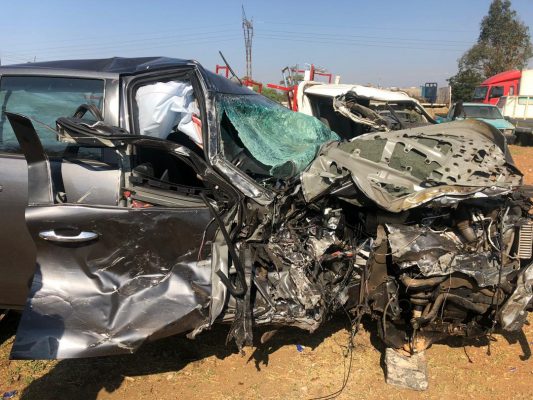
Zimbabwe Miners Federation (ZMF) President Ms Henrietta Rushwaya survived a fatal car accident yesterday on her way back from the ZMF 2019 Annual General Meeting and Exhibition.

The accident which claimed the life of one person saw the small scale miners boss coming out unscathed.

Speaking to Mining Zimbabwe Rushwaya could not hide her joy from survival from the fatal accident that left her car beyond repair.

The ZMF boss would not say much but only thanked God for coming out alive from the fatal crash and expressed her condolences over the death of one person they had a head-on collision with. It is believed the crash occurred after the deceased vehicle encroached by more than 2m into the lane Rushwaya and colleagues were travelling in leading to the deadly crash.

“I’m fine and we thank God for the gift of life,” said Rushwaya.

Here are the pictures of her wrecked vehicle….

Henrietta Rushwaya accidentHenrietta Rushwaya accident

Henrietta Rushwaya accident

Miners ambush, rob gold dealer

0

TWO mine workers have been arrested for allegedly robbing a Gwanda businessman of R27 400, $900, 35 grammes of gold and mercury after ambushing a taxi he had hired to take him home.

Lawrence Sibanda (30) from Nkayi and Pritchard Maphosa (27) from Silobela who both work at Danslok Blanket Mine attacked Mr Emmanuel Zvawanda while he was on his way to Gwanda from

Longvalle Farm on the outskirts of the mining town.

The pair is expected to appear in court on November 11 for robbery. They will proceed by way of summons pending further investigations.

According to State papers, Sibanda and Maphosa, who were armed with axes, ambushed a taxi which Mr Zvawanda and his wife Ms Thembelihle Ndlovu had hired to take them to Gwanda Town in the middle of the night.

Mr Zvawanda buys gold from artisanal miners in Longvalle Farm.

“On 27 September in the afternoon, Sibanda and Maphosa went to Mr Zvawanda’s tent at Longvalle Farm along Lumene River in Gwanda to collect a cellphone.

“They later went back at around 7PM under the pretext of inquiring about the price of gold from Mr Zvawanda and they later left.

“On the same day at around 9PM, Mr Zvawanda, who was in the company of his wife, Thembelihle Ndlovu, hired a taxi from Longvalle Farm to Gwanda Town.

“Sibanda and Maphosa connived to rob Mr Zvawanda and they ambushed the taxi after it had travelled for a distance of about one kilometre from the farm,” read the State papers.

Sibanda and Maphosa, who were allegedly both armed with axes, approached the car and smashed the windows of the vehicle demanding cash from the complainant.

Mr Zvawanda tried to resist but the pair severely assaulted him with stones and the axes they were holding.

“Mr Zvawanda’s wife managed to flee from the scene and when he also tried to escape he fell to the ground due to injuries he had sustained during the attack.

“Mr Zvawanda then surrendered a sling bag which he was carrying containing R27 400, RTGS$900, 35 grammes of gold, a digital scale, a cellphone, three teaspoons of mercury and a driver’s licence to Sibanda and Maphosa. The pair took the bag and disappeared into the bush.

“Mr Zvawanda was rushed to Gwanda Provincial Hospital where he was further referred to United Bulawayo Hospitals.
“He lost his left eye as a result of the attack. The matter was reported to the police resulting in the arrest of the pair on October 24,” read the State papers_The Chronicle