Home Blog Page 646

Panner dies in mine shaft fall

0

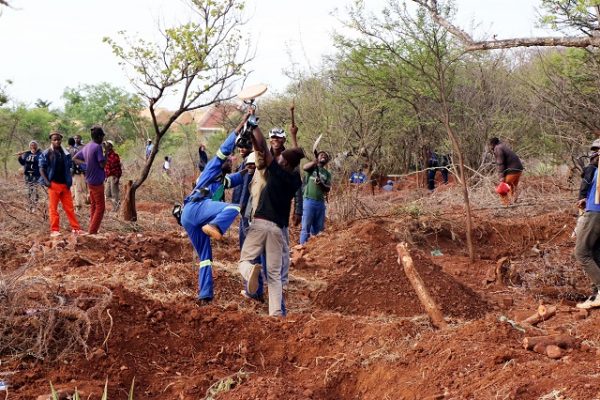
A GOLD panner died after he fell into a 20-metre-deep mine shaft in Umzingwane while illegally prospecting for the mineral.

Matabeleland South provincial police spokesperson, Inspector Loveness Mangena confirmed the incident which occurred on Sunday at around 6AM at Stancorn Farm.

She said Goodness Sibanda (25) of Dingile Village in Matobo slipped and fell into the shaft.

“I can confirm that we recorded a sudden death case which occurred in Umzingwane. Goodness Sibanda who was in the company of two others was illegally prospecting for gold at Stancorn Farm.

“While he was entering the shaft Sibanda slipped and fell into the shaft and sustained broken legs and head injuries. He was assisted by his mates who pulled him out of the shaft and he was ferried to Umzingwane District Hospital where he was confirmed dead upon arrival,” she said.

Insp Mangena urged people to desist from illegal mining.

“As police we continue to urge people to desist from engaging in illegal mining activities as by so doing they will be putting their lives at risk. Such people conduct their mining activities without protective clothing and necessary equipment which may result in injuries or death, like in this case. People have to regularise their mining operations and acquire the necessary equipment and clothing,”_The Chronicle

Gold holds firm

0

Gold prices yesterday held on to the previous session’s gains, as fading hopes for progress in US — China trade talks hit risk appetite, while markets also awaited clues on monetary easing by the US Federal Reserve.

Spot gold rose 0,4 percent to $1 510,50 per ounce as of 0723 GMT, and stood its ground above $1 500 after jumping as much as 1 percent in the previous session. US gold futures gained 0.8 percent to $1 516,20 per ounce.

“The market is holding back, and looking at what’s going to happen in the US – China trade talks today . . . If the trade dispute turns worse, we are going to expect some strong risk-off trade,” said Phillip Futures analyst Benjamin Lu. — Reuters.

Eureka tipped to be major gold producer

0

Delta Gold’s Eureka Mine near Guruve in Mashonaland Central Province, is set to become the country’s largest gold producer within the next two years if it manages to perform as envisaged by authorities.

Mines and Mining Development Minister Winston Chitando, gave targets that are set to see the mine which is currently under reconstruction following the injection of new capital by crocodile breeder and skin exporter — Padenga Holdings Limited — blossoming.

The mine is currently under reconstruction and workmen are busy refurbishing the plant and equipment as well as dewatering the open pit in order to access mining areas ahead of resumption of production that has been slated for the first quarter of 2020.   

In an interview after touring the mine with a delegation that included the Information, Publicity and Broadcasting Services Minister Monica Mutsvangwa, the Ministry’s Permanent Secretary Nick Mangwana as well as Energy and Power Development Minister Fortune Chasi, Minister Chitando said the mine has potential to contribute even more than the set target of two tonnes annually.

The delegation visited the mine on Tuesday. He said Government is also excited by the reconstruction progress being made at the mine since President Mnangagwa officiated at the ground breaking ceremony for the reconstruction of the mine last year.

The reconstruction of the project shows investors are falling in love with Zimbabwe on the back of business friendly policies by the new dispensation anchored on President Mnangagwa’s “Zimbabwe is open for business” mantra.

“We have the 2023 US$12 billion (annual export) milestone, specific for gold, we have the 100-tonne (per year) milestone in 2023.

“Part of that milestone, included in there is two tonnes (per year) from Eureka. Last year His Excellency (President Mnangagwa) came here for a ground-breaking ceremony for the construction of this mine, which obviously is a brownfield.

“We have come here to see the progress, which has been made (in construction) since His Excellency did the ground breaking ceremony and I am pleased to say the mine is well on track to achieve production by the first quota of 2021 and ramping up production to contribute more than two tonnes by 2023,” said Minister Chitando.

Production at Eureka Gold Mine was suspended more than 17 years ago at the height of investor fatigue and capital flight as businesses protested the regime’s policies.

However, the new dispensation has set itself to correct the anomaly and build an upper middle-income earning economy by 2030, which will be anchored on the strength of key sectors like mining, agriculture, tourism and the manufacturing sector among others.

Speaking at the opening of the reconstruction programme last year, the President said the reopening of the mine presents a huge opportunity.

“(The reopening of the mine) offers an opportunity for it to make its contribution to the nation’s gold output which is expected to reach 100 tonnes per annum in the next five years,” said the President then_Business weekly

ZCDC plans huge diamond output leap

0

The Zimbabwe Consolidated Diamond  Company (ZCDC) said on Friday it is aiming to ramp up output to 10  million carats per annum in the next two years as it seeks to enhance benefits accruing to the nation through the exploitation of diamonds.

Despite discovering huge diamond deposits in the eastern parts of the country over a decade ago, Zimbabwe is yet to realise meaningful benefits from their exploitation.

Companies that were operating in the area previously have been accused of fuelling leakages at the expense of the country, especially following the revelations by the late former President Robert Mugabe that the country could have been prejudiced of revenues amounting to $15 billion over the years.

While the figure remains contentious, no one has doubted the occurrence of leakages in the sector.

ZCDC acting chief executive officer Rob De Pretto told journalists that production was steadily increasing since they commenced operations in  2016.

He said production reached 1.8 million carats in 2017, 2.8 million carats in 2018 while the target for this year and next year is 3.1  million and 6.12 million carats respectively.

With the increasing production trend, De Pretto said the diamond miner was motivated to replicate successes that other countries such as  Botswana and South Africa had recorded through diamond exploitation.

“Look at what diamonds have done to those countries, those communities,  they have benefited tremendously from the wealth that diamonds have brought to those countries. We have not seen that same benefit coming to our communities and country so that is what we want to do. We want to realise the full potential of our diamond endowment,” he said.

He said the ZCDC had huge plans for the local diamond sector including tying up new joint venture partners, opening up new mines and building beneficiation centres in the country.

“We have been inundated with interest from foreign and local companies eager to do joint ventures.

We have signed a joint venture with Alrosa, there is another one we are  about to sign next week after Cabinet approval and then there are  another 11 in the pipeline.”

“Some of our Joint Venture partners are bringing in advanced technology and this is Satellite Remote Imaging; what happens is there are six satellites orbiting the earth and these satellites have the ability to penetrate up to 60-100 metres below the surface of the earth.

“So we are going to be scanning the whole of Zimbabwe using satellite technology and it will tell us where the hot-spots are, once we know where the hot-spots are we send in our teams we do geophysics,  geochemistry, we do sampling, we do drilling.  We do not want to leave any diamonds behind,” De Pretto said.

He added: “Each of you will benefit from the diamond sales because you  will get better infrastructure etc.”

De Pretto said the ZCDC was also looking to play its part in the attainment of a US$12 billion mining industry by 2023. – New Ziana

Hwange Power Station increases output

0

THE Zimbabwe Power Company (ZPC) says Hwange Power Station is now generating an average 500 megawatts per day after the refurbishment of unit 5, easing electricity shortages in the country following months of acute outages.

Before the refurbishment, Hwange was generating an average of 300 megawatts as the plant frequently broke down due to old age.

Hwange Thermal Power Station has an installed generation capacity of 920MW from six units. The station was built in two stages, with the first four units commissioned between 1983 and 1986, and the final two commissioned in 1986 and 1987.

“Following the refurbishment of unit five at Hwange Power Station, the station is consistently running 5 units at an average of 500 megawatts. Unit six is expected to return to service in December,” the ZPC said in a statement on Thursday.

Once complete, refurbishment of unit six is expected to add a further 170 megawatts to the national grid.

“ZPC remains committed to maintain plant efficiency by adhering to scheduled maintenance programmes,” said ZPC.

According to daily power generation statistics by the ZPC, Hwange Power Station was generating 464 megawatts on Thursday. Zesa is currently importing power from neighboring countries to bridge shortfalls in supply, which is far outstripped by demand. But still the nation faces supply shortages, and has had to contend with power rationing of up to 10 hours a day. —New Ziana

Coal piling up in Europe

0

Stockpiles of coal are surging at some of Europe’s largest ports as utilities from Germany to Spain are increasingly favouring cleaner gas in power generation.

Reserves at ports in Rotterdam, Amsterdam and Vlissingen last week rose to their highest levels since July.

The uptake after the summer has slowed because of mild weather so far this autumn. Crashing natural gas prices have also made it more attractive for utilities to burn the fuel, just as solar and wind continues to eat into the overall share of fossil fuels.

The latest statistics is yet another sign of how energy economics is supporting nations weaning themselves off the dirtiest fossil fuel to curb emissions to slow climate change. For most of this decade it was more profitable to burn coal in Germany, but that relationship was turned on its head early this year because of a glut of gas.

“With the flood of gas in the global markets, it has made it harder for coal generators to compete economically against gas,” said Joe Aldina, head of coal analytics at S&P Global Platts in New York.

Coal inventories at the three ports on September 16 stood at 6.5 million tons. At the same time, water levels at Kaub on the Rhine fell to their lowest since December. The river is a vital transport route for barges to coal-fired plants in Germany.

In the UK, coal-fired power generation fell below 1 percent of the total in the second quarter, the government said on Thursday. That’s the lowest share since the 19th century. Stocks are well-above average levels for the past five years, even if they have declined from multi year highs this spring, said Aldina.

The pace of thermal coal imports should continue to slow and keep stockpiles in check, he said.

In the gas market, a record number of liquefied natural cargoes to Europe this year, coupled with stable flows from both Russia and Norway helped fill up storage levels much earlier-than-usual this autumn. Benchmark prices have plunged almost 60 percent in the past year.

“European coal burn is at a very low level because of ultra-low gas prices,” said Hans Gunnar Navik, a senior analyst at StormGeo AS in Oslo.

Although coal for 2020 has been buoyed by recent macro events ranging from French nuclear supply risks to surging oil prices after the recent attack in Saudi Arabia, the benchmark contract has declined 22 percent this year.

“With these issues abating, the market is losing its once supportive drivers and reverting back to its supply and demand fundamentals,” Hui Heng Tan, a coal analyst at Marex Spectron Group, said by email.  — Bloomberg.

RioZim closer to 2 400MW power deal

0

RIOZIM will sign an engineering procurement and construction contract (EPC) with Power China for the first phase of its 2 400 Megawatts (MW) Sengwa Thermal Power Plant next month, a highly placed company director has revealed.

The coal fired plant, to be constructed in Sengwa, Gokwe North, will be built in phases starting with a 700MW power station and coal mine with an annual production capacity to supply around 300 million tonnes for power generation.

Business Weekly has it on good authority that RioZim intends to start canvassing for project finance among the banks by the beginning of the new year.

No comment could, however, be obtained from RioZim chief executive officer Bheki Nkomo.

RioZim’s Sengwa coal fired power plant project comes at a time Zimbabwe is facing acute power shortage, which has spawned rolling power cuts, disrupted economic activity and forced consumers to use expensive alternative options including power generators.

Several milestones have already been achieved since the Zimbabwe Stock Exchange (ZSE) listed multi-commodity miner signed an exclusivity agreement with Sino hydro’s electrical sister-company in September last
year.

The parties have concluded technical designs for the power station, 110 kilometre water pipeline from Kariba Dam, a coal mine and residential town for mine employees, with US$5 million having already been expended on the project.

Further, RioZim has also received the technical report on the project, which was prepared by Power China and will be evaluated by the company’s own technical people.

A power grid impact assessment has also been concluded, with recommendations made for a US$22 million substation to be built in Chakari  area near Kadoma.

Next key steps entail RioZim energy unit, Rio Energy, concluding a power connection agreement with Zimbabwe Electricity Transmission Distribution Company (ZETDC), setting up a joint project implementation team with ZETDC and concluding financing arrangements with Power China.

Concurrent with the construction of the power station will be the installation of 400Kva transmission line from Sengwa Power Station to Chakari, which will have a new substation build to avoid overloading the one at Selous.

“But also important is the fact that Power China wants a power demand analysis at a national and regional level to see if there really is effective demand and they have allocated US$1 million for that,” the source revealed.

South African firms with expertise in this field are already being considered for the job.

“The power demand analysis should start by October and be concluded by December to allow RioZim to be in front of bankers for finance by January,” the source said.

They want to see who the buyers of the power will be and whether they can pay in foreign currency needed to recoup the investment into the project.

“They will put US$1,4 billion and want to know who want the power,” the source said.

RioZim is also pushing for Special Economic Zone (SEZ) status for the Sengwa project, which will allow investors to consider setting up operations in the cotton producing area and to pay for the power in hard currency.

The company is targeting investors interested in the cotton value chain such as textiles given the area’s cotton producing potential, abundance of land and water.

“Our attraction is the SEZ, we want companies to come and manufacture, create jobs and export into the region in order to pay for the power in foreign currency.”

Power situation in Zimbabwe 

Zimbabwe is currently facing an acute shortage of power on the back of significantly low Kariba Dam water levels following the drought experienced in the dam’s catchment area.

At peak of demand, Zimbabwe requires 1 800MW, but can only manage just under 1 000MW due to constrained capacity at the major power plants; due to either climate or resource limitations.

The Zambezi River Authority, which administers the affairs of Kariba Dam, has restricted generation at 1 050MW rated Kariba, Zimbabwe’s largest power plant, to 358MW. The country’s other major power plant, Hwange Power Station, which has rated capacity of 920MW but manages about 550MW at best, faces reliability issues due to old age.

Zimbabwe and Zambia, which both face acute power shortages due to reduced output at the shared Kariba Dam, are working together to develop the 2 400MW Batoka George hydro scheme whose power will be shared equally.

Three other small thermal power plants; Bulawayo, Munyati and Harare, which average 100MW, have been de-commissioned pending re-powering programmes to reboot their productivity_Business Weekly

Zimplats records slump in production

0

Zimbabwe’s largest platinum producer Zimplats recorded a 36,1% slump in production volumes to 415,72kg in August as rising inflation, coupled with power cuts and foreign currency shortages, took a toll on the extractive sector, it has been revealed.

Zimplats’ production in the first eight months was pegged at 5 230,584kg.

The Impala Platinum Holdings (Implats) subsidiary retained US$150,9 million and US$98 million respectively from platinum sales.

Figures, however, indicated that Zimplats was getting a lot of value from other metals that form part of the platinum group of metals (PGMs), particularly palladium and rhodium sales.

Zimplats recently put its US$23 million refinery project on hold citing lack of a clear government road map on the mineral beneficiation policy.

“The SMC Base Metal Refinery refurbishment project remains on hold pending finalisation of the national beneficiation road map.

“The project total expenditure as at 30 June 2019 was US$23,6 million,” the company said in statement accompanying its year-ended June 30 results.

The Australian Stock Exchange (ASX)-listed miner was upbeat about the future despite the economic challenges facing Zimbabwe. Its shareholders continue to inject more capital into the company.

“The group spent a total of US$115 million in the full year-ended 30 June up from US$135,3 million spent on capital projects (stay in business, replacement mines and expansion projects) during the year compared to US$135,3 million spent in 2018,” the company added.

Zimplats said it had successfully navigated Zimbabwe’s turbulent currency market because most of its revenues were in foreign currency.

“Revenue is generated from sales of platinum group metals. We traced, on a sample basis, payments received in US$ to the relevant bank statements, noting no material exceptions,” the company said.

“We considered factors impacting the operating subsidiary’s access to foreign currency by inspecting relevant exchange control regulations and underlying agreements and obtained an understanding of the underlying terms and conditions.

“We found management’s conclusions to be reasonable.

“We inspected the expenditure disclosed for the operating subsidiary and noted that the operating subsidiary transacted using a combination of United States dollars, bond notes and real time gross settlement (RTGS).

“(We looked at) underlying agreements and noted that all long-term debt and borrowings were denominated in US$.”

Zimplats said the scrapping of the Indigenisation and Empowerment Regulations was expected to attract more players into the mining sector.

Source: The Standard

Govt to address miners

0

Government has made a commitment to address the multiple challenges affecting mining companies, which have led to a significant drop in revenues from mineral sales in the first half of the year.

This emerged after an inter-ministerial breakfast meeting held in the capital last week.

The meeting was attended by the Chamber of Mines of Zimbabwe; the Minister of Mines and Mining Development Winston Chitando; Finance and Economic Development Minister Professor Mthuli Ncube; Minister of Power and Energy Development Fortune Chasi; Industry and Commerce Minister Mangaliso Ndlovu; Information and Broadcasting Services Minister Monica Mutsvangwa and senior Government officials.

Power shortages, fuel supply bottlenecks and foreign currency retention thresholds are making it difficult for miners to increase production.

Speaking after the meeting, Chamber of Mines of Zimbabwe president Ms Elizabeth Nerwande commended Government for its undertaking.

“It is gratifying that Government has pledged to address the issues we raised, which are impacting negatively on mineral production. The challenges require concerted efforts by all stakeholders, a meeting of minds in the interest of the nation, as the mining sector contributes the bulk of the foreign currency earned and is the largest sectoral contributor to the gross domestic product,” said Ms Nerwande.

Miners are unhappy with foreign currency retention ratios of minerals such as gold, which are currently pegged at 55 percent.

There are fears the current policy is driving mining houses to the parallel market.

Gold deliveries to Fidelity Printers and Refiners fell to 13,2 tonnes in the first six months of the year from 17,3 tonnes a year ago.

Source: Sunday mail

US Issues Withhold Release Orders on Zim rough diamonds

0

THE United States Customs and Border Protection (CBP) issued five Withhold Release Orders (WROs) one of which are our own Zimbabwe Diamonds.

The CBP press release reads as follows:

U.S. Customs and Border Protection (CBP) issued five Withhold Release Orders (WROs) covering five different products, imported from five different countries yesterday, September 30. This action was based on information obtained and reviewed by CBP that indicates that the products are produced, in whole or in part, using forced labour.

“A major part of CBP’s mission is facilitating legitimate trade and travel,” said Acting CBP Commissioner Mark Morgan. “CBP’s issuing of these five withhold release orders shows that if we suspect a product is made using forced labor, we’ll take that product off U.S. shelves.”

Under U.S. law, it is illegal to import goods into the U.S that are made wholly or in part by forced labor, which includes convict labor, indentured labor, and forced or indentured child labor. When sufficient information is available, CBP may detain goods believed to have been produced with forced labor by issuing a WRO. Importers have the opportunity to either re-export the detained shipments at any time or to submit information to CBP demonstrating that the goods are not in violation

The Forced Labor Division within CBP’s Office of Trade leads agency enforcement efforts prohibiting the importation of goods made using forced labor. CBP receives allegations of forced labor from a variety of sources, including from the general public.

“CBP is firmly committed to identifying and preventing products made with the use of forced labor from entering the stream of U.S. Commerce,” said Brenda Smith, Executive Assistant Commissioner, CBP Office of Trade. “The effort put into investigating these producers highlights CBP’s priority attention on this issue. Our agency works tirelessly behind the scenes to investigate and gather information on forced labor in global supply chains,” she said.

The following WROs are effective immediately:

  • Garments produced by Hetian Taida Apparel Co., Ltd. in Xinjiang, China; produced with prison or forced labor.
  • Disposable rubber gloves produced in Malaysia by WRP Asia Pacific Sdn. Bhd.; produced with forced labor.
  • Gold mined in artisanal small mines (ASM) in eastern Democratic Republic of the Congo (DRC); mined from forced labor.
  • Rough diamonds from the Marange Diamond Fields in Zimbabwe; mined from forced labor.
  • Bone black manufactured in Brazil by Bonechar Carvão Ativado Do Brasil Ltda; produced with forced labor.


Investigations may be initiated a number of ways, including news reports and tips from either the public or trade community. CBP may also self-initiate an investigation into the use of forced labor in any given supply chain.

“CBP works extensively with our stakeholders, the media, and private sector businesses to gather information on forced labor in global supply chains and educate importers on U.S. compliance standards.” said Todd Owen, Executive Assistant Commissioner, CBP Office of Field Operations, “And we encourage the trade community to know their supply chains to ensure goods imported into our country are not produced with forced labor.”