Home Blog Page 662

Should EPOs be scrapped?

0

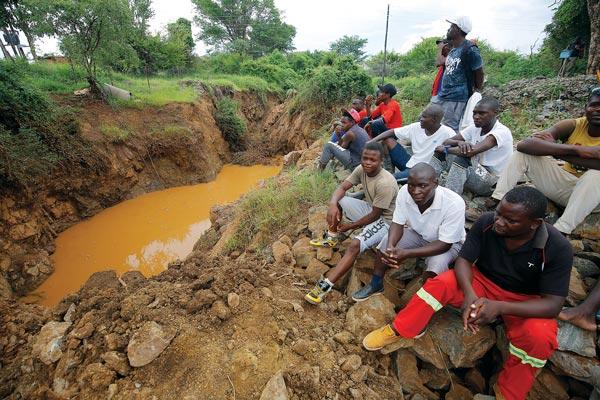
Last month Zimbabwe Miners Federation (ZMF) sent a letter to the Mines Minister, Winston Chitando. ZMF stated that they were against the application of Exclusive Prospecting Orders (EPOs) due to the fact that EPOs are against national interest.

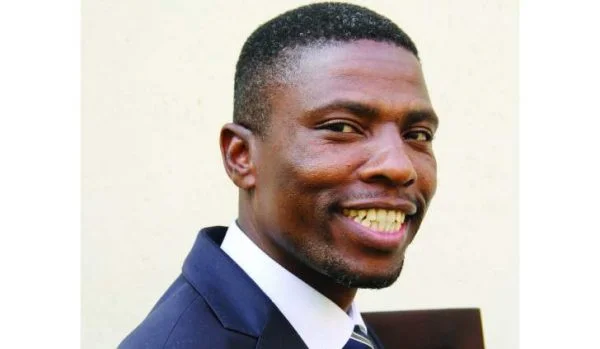
Rudairo Dickson Mapuranga

ZMF argued that, while it is true that there is a need to explore and quantify minerals in Zimbabwe using modern technologies, EPOs will eventually affect the uplifting of women and economic empowerment, gains achieved since independence due to the fact that some people will grab large pieces of land for themselves living others with nothing specifically women who are mainly amateurs in the industry.

Commenting on ZMF stance, one expert in the mining industry and economics said that EPOs were necessary for the country to discover new metals and also to protect other metals from being extracted without the knowledge of the government which might lead individuals or organizations benefiting instead of the government.

“Surely the government must have guidelines to curb speculation. The rest of the world grants EPOs and new large deposits are found that way. The government can simply copy regulations that stop speculative purposes. Rather than ban exploration that generates new large scale deposits which Zimbabwe is so desperate to increase forex generation for the country” he said.

However, some miners believe that EPOs should be strapped because they are becoming a platform of corruption and prestige, where one would just acquire large pieces of land without even mining.

“The challenge is people hold on to these EPOs for years without any work on the ground. The rules are there but with little enforcement as has been the case, the industry is going to suffer” said one miner.

Those who support the idea that EPOS are a danger to gains of economic freedom believe that EPOs should target mainly heavy metals like lithium and gases, coal.  As gold and chrome have been prospected and discovered long back. They believe that the Government must prioritize small scale mining for quick gains in gold and chrome production.

However, experts believe that, under any circumstances, EPOs have to be enforced. Corrupt elements that might be disturbing the correct purpose of EPOs should be looked in to. They believe that for the mining industry to grow the current position on EPOs is the right thing to do.

“Any country that requires new deposits must give companies ground for large scale exploration. The reason people think gold was discovered long back only is that there hasn’t been exploration ground available for new discoveries to be made. This is exactly why Zimbabwe came from being the third-largest gold producer in Africa to I don’t even know number what now. That’s why we get happy producing 30 tonnes of gold when we should be close to 100 tonnes of gold per year” said one expert.

This article first appeared in Mining Zimbabwe Feb 2019 issue

ZMF pushing the government to solve fuel crisis

0


Last month the president Emmerson Mnangagwa announced fuel price hike which was deemed by some economic experts “painful but necessary”. The price hike were aimed at reducing the high demand of fuel which had smashed Zimbabwe to the hardcore, was also implemented to reduce the allegedly hoarding of fuel from Zimbabwe by foreign companies due to the fact that in reality fuel in Zimbabwe was too cheap, costing less than USD O,7O.

Rudairo Dickson Mapuranga

However, according to some experts, the fuel situation in Zimbabwe is affecting miners all the more than creating a favorable environment for them. The fuel price hike which caused diesel and petrol to cost more than $3, fueled the escalation of some mining equipment and even basic commodities without prices of precious metals and stones increasing, as a result the miner is affected all the more.

Miners are crying over fuel prices in Zimbabwe, some who met Mining Zimbabwe said that their work relations have been decreased due to price hikes which were speared mainly by the increase in fuel prices.

“Currently the fuel remains the hardest hitting coupled with the fact that the retention is not workable,    Chamber of Mines is engaging government to increase forex payment to 80%, and submissions were made to Reserve Bank for immediate review. The portion of 50% and 50% bond is a huge loss for chrome Miners especially with the increased fuel price and the fact that service providers are charging USD for parts” said one miner.

Zimbabwe Miners Federation (ZMF) said that they are engaging the government on the issue of fuel which have affected mining activities to a greater degree. They said that the government need to look into the matter, pay their dues in USD or provide them with a certain funding that will enable them to grow. The fact remains that the mining industry have proven be a major catalyst in the turnaround of the economy of Zimbabwe.

“We continue with the call for formalization by government amending the mining act and ZMF requires an act to be included in government budgets to access funding for its miner programmes” they said.

An inside source in ZMF said that the organization is in the process of pushing to acquire fuel import license so that cost of fuel will be reduced specifically to the miner in order to increase production. Miners activities especially small scale miners require the use of diesel and petrol because most of these miners use diesel or petrol electricity generators for extraction and power.

“We want a license so we can import it in specifically for miners, but the president will announce it let me put you in touch with her directly, so she gives you the scoop first. We are still in talks right now so it can only be divulged after there’s a concrete plan” she said.

This article first appeared in Mining Zimbabwe Feb 2019 issue
Africa should stop expecting supercharged profits from mining: Akufo-Addo

0

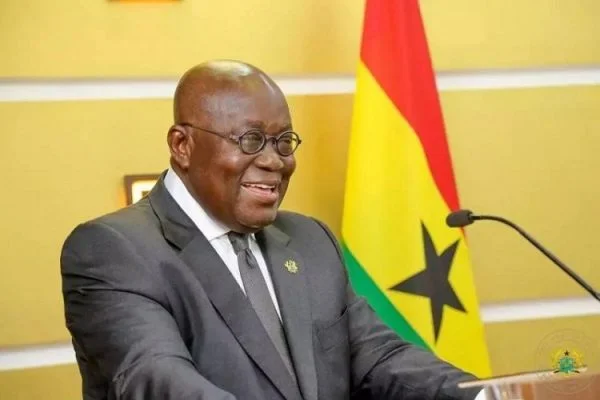
Standing before hundreds of mining investors and executives last week, Ghanaian President Nana Akufo-Addo issued a firm warning: stop expecting supercharged profits from Africa’s mineral riches.

It’s a theme that has simmered for years, as governments across the continent seek a bigger share of benefits from their natural resources. The debate ratcheted up in 2018, with countries including the Democratic Republic of Congo and Zambia—the continent’s No. 1 and 2 copper producers—becoming increasingly insistent that producers must pay up.

There’s also been a backlash against the terms under which foreign companies agreed to invest in the first place—many mining codes, investment pacts and joint ventures were drawn up based on lower commodity prices and by previous regimes. In his Cape Town speech, Akufo-Addo said African nations shouldn’t be expected to give special financial incentives to secure investment that producers wouldn’t get in other parts of the world.

For Congo and Zambia at least, geology is on the government’s side

For Congo and Zambia at least, geology is on the government’s side. The countries are home to some of the richest copper deposits at a time when the biggest miners are universally bullish on the metal and almost all are looking to expand their exposure. Congo’s resources of cobalt—a key ingredient in rechargeable batteries that’s found in the country alongside copper—are even rarer.

In Congo, arguably the most important of Africa’s mineral-rich countries, the government introduced a new mining code last year that raised royalties, added taxes and canceled a clause that would have protected producers against fiscal changes for 10 years.

“Never forget that money is a coward.”

There has been strong opposition from the mining industry, but no concessions. While producers may have hoped for a reprieve when the country elected a new president in December, there have been initial indications that the code won’t be revisited. Still, President Felix Tshisekedi has yet to appoint a team or clearly outline policy, so the situation may change.

Zambia, which is situated on the same giant copper belt as Congo, has also increased its mining royalties. While companies threatened to cut jobs and close mines, the government says it’s standing firm.

“The mismatch that exists between the huge resources that the country sits on and the poverty levels in the rest of the country cannot continue,” said Zambia Mines Minister Richard Musukwa. “There is no one who goes to pay taxes while smiling. It’s only natural for them to defend their positions.”

So far, the mining industry has been vocal in its opposition to the changes, but its options are limited. Having poured billions of dollars into building mines that take years to start making money, many have little choice but to grumble and get on with it.

Still, producers warn that the increased uncertainty will put future investment at risk.

“Never forget that money is a coward,” said Robert Friedland, founder of Ivanhoe Mines Ltd., which is developing huge copper and zinc mines in Congo. “When a politician says something dumb, when a government does something dumb, money runs away at the speed of light.”

Bloomberg News

Celebrations as trapped Miners resurface from underground

0

WATCH: As crowds celebrate when the first miners appeared from below the ground in Battlefields.

AUDIO: What really happened at the Battlefields mine disaster

0

“Survivors were neck deep in water for days”

The member of Parliament for Chegutu West Dexter Nduna explains in detail what happened at the Battlefields Mine and updates the current situation of the survivors.

The accident has highlighted the safety issues confronting illegal gold miners, who last year contributed significantly to Zimbabwe’s record 33 tonne bullion output.

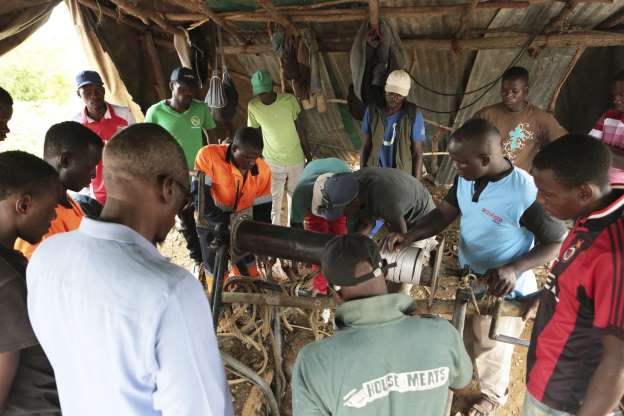
Battlefields and surrounding areas are rich in gold deposits and popular with artisanal miners who use picks and shovels and generator-powered water pumps. The makeshift shafts and tunnels can easily collapse in the rainy season when the ground is soft.

The pits are dotted around a clearing some 8 km from the main dirt road. On the edges are shacks made of plastic which serve as accommodation for those digging for gold.

At abandoned mines, the miners, known locally as “Makorokoza” or hustlers, usually sneak in at night and can disappear into shafts and tunnels for more than two days.

Listen to the audio below detailing what really happened 

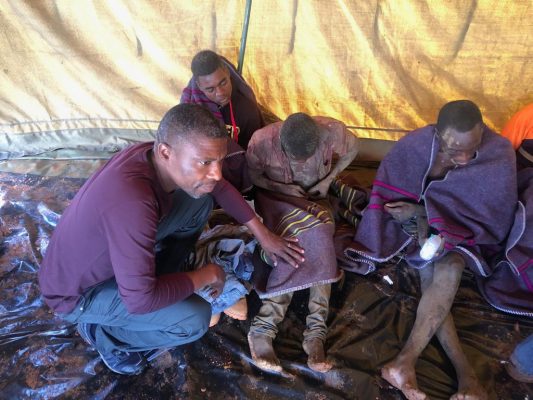
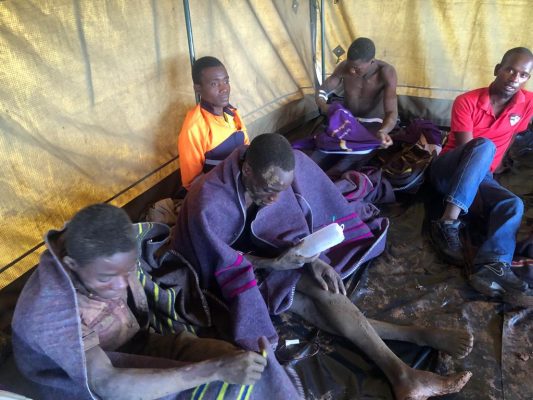
IMAGES: Dexter Nduna with rescued miners

0

SURVIVORS of the Battlefield mine accident are starting to surface after a spirited effort to rescue them from the pits they were illegally mining.

President Emmerson Mnangagwa declared the accident a state of disaster. The accident occurred at the Silver Moon and Cricket Mines in battlefields near Kadoma.

More survivors are expected to be pulled to the surface as rescue teams are working nonstop since the news broke.

8 miners are rescued from Battlefields mines

0

REPORTS coming in say at least 8 miners have been rescued at the battlefields mine.

More to follow…


Gold fields slumped 73%

0

South Africa’s Gold Fields Ltd said on Friday its full-year profit slumped 73 percent, dented by a decline in bullion production led by its South Deep operations.

Headline earnings per share (HEPS) fell to $0.07 per share, for the full year ended Dec. 31, 2018, from $0.26 in the previous year.

HEPS is the main profit measure used in South Africa that strips out certain one-off items.

Revenue dropped 7 percent to $2.58 billion in 2018 from $2.76 billion in 2017 due to the lower ounces sold, the firm said.

Bullion production slipped 6 percent to 2.036 million ounces in 2018 from 2.160 million ounces in 2017 due to a decline in production at South Deep, Gold Fields said.

While South Deep had a difficult year, the large-scale restructuring completed at the end of 2018, places the mine on an improved footing from which to gradually build up production

South Deep, the company’s last South African asset, has lost money over the past five years and Goldfields has been working to mechanise operations in the face of challenging geology 3 kms (2 miles) below the surface.

Production at the South Deep in 2018 was affected by a slow build-up after the seasonal holidays in the first quarter, labour restructuring, safety stoppages and a six-week strike, the gold miner said.

“While South Deep had a difficult year, the large-scale restructuring completed at the end of 2018, places the mine on an improved footing from which to gradually build up production,” said Chief Executive Officer Nick Holland in a statement.

Gold Fields, which employs about 3,600 people in South Africa, said last year it would restructure its South Deep operations and cut about 1,100 jobs, nearly a third of the workforce, to save money. In response, the National Union of Mineworkers (NUM) went on strike at the mine on Nov. 2.

The firm has declared a dividend of 20 cents per share, making the total dividend for the year at 40 cents ($0.0283) per share, compared with 90 cents a year ago.

Reuters