Home Blog Page 671

Gold production under threat from forex shortages

0
THE country’s gold sector is in a precarious situation after it emerged that the Reserve Bank of Zimbabwe (RBZ) has not been paying primary gold producers for the last three months, NewsDay has established.

The current state of affairs has resulted in gold suppliers threatening to cut off their supplies to large-scale gold producers as they were now also owed large sums of money.

Primary gold producers get 55% of their delivery in foreign currency, with the rest paid in bond notes (a local fiat currency).

Industry sources told this paper that primary gold producers have been involved in marathon meetings with the central bank to find a lasting solution to the biting problem.

Chamber of Mines chief executive Isaac Kwesu confirmed the delays and indicated that the miners were engaging the RBZ to resolve the problem.

“Yes, there have been these delays and we are engaging with the RBZ so that they expedite the process,” he said.

“The problem we have is that our suppliers now demand payment in US dollars and yet we get 50% in forex and the other 50% in RTGS. We expect our authorities to avert the situation because once payment is delayed or stopped, the production cycle is affected”.

Suppliers of critical raw materials who spoke to NewsDay said they had not received payment for their supply from gold producers for almost two months, as such they were reeling under serious operational challenges.

“We are not getting any payments for supplying consumables.We supply drilling consumables, which are used to blast the stones underground. We also supply drill steel, drill bits and jack hammers, but it’s now almost three months without getting paid. We are grounded,” said one supplier on condition of anonymity.

Efforts to get a comment from Fidelity Printers and Refineries (FPR), the central bank’s subsidiary, which is licensed to buy gold from large-scale producers, small-scale producers and holders of gold buying permits did not yield any results.

In 2018, gold deliveries to FPR hit a record 33,2 tonnes, up from 24,8 tonnes recorded in the previous year, which was mainly driven by small-scale miners.

Small-scale miners contributed 21,7 tonnes, while primary producers accounted for the remaining 11,5 tonnes last year.

Last year, Rio Zim closed three of its gold mines citing inadequate allocation of foreign currency, which then stood at 30%. It then resulted in the central bank increasing allocation to 55%.

NewsDay

Implats Mines unaffected by protests

0

MINES in Zimbabwe were unaffected by the #Shutdown protest action that rocked Zimbabwe and disrupted economic activity last week, said Business Report which cited the Amplats’ spokesman, Johan Theron.

“Demonstrations were mostly centred around the urban areas, which impacted some of our head office workers in Harare,” said Theron. “Our mining operations were not directly impacted by the demonstrations.”

Implats controls Zimplats, while it jointly owns Mimosa together with Sibanye Stillwater, making it the biggest platinum investor in the troubled southern African country. Anglo Platinum is the other platinum group metals producer as it controls the Unki mine, which is set to commission a smelter plant in the next few weeks, said Business Report.

South African investors have largely maintained their investments in Zimbabwe, despite currency woes and rising operating costs as local inflation spirals out of hand.

Implats said its mining operations had not been affected by the strike action, although its head office in Harare was affected by the #Shutdown demonstrations over a massive hike in fuel prices. MX

Mining industry focuses on automated systems

0

It is not a secret that the mining industry has historically been extremely conservative, and it has always been difficult to bring miners to experiment in the production, which has been developing for centuries. But the 21st century dictates its terms and to stay afloat, traditional businesses need radical changes. A few years ago, world mining leaders launched a large-scale process of updating their own fleet of equipment. Acumen Research and Consulting (ARC) estimates that the global mining equipment market will reach $ 285.5 billion worldwide by 2026. At the same time, the main drivers of the growth will be automated technologies and so-called “smart” solutions for the production.

Already now the most advanced “miners” perform a number of technological processes, such as drilling and transportation of raw materials, with the use of robotics, while in 2019 the majority of industry players may start using new technologies on an industrial scale. Analysts of Technavio predict the growth of the robotics market in the mining industry by an average of 27.01% by 2022.The most advanced “miners” perform a number of technological processes, such as drilling and transportation of raw materials, with the use of robotics.

On the very eve of the New Year, transnational mining and metallurgical company Rio Tinto, which was one of the first to build its own “mine of the future”, officially announced the launch of the world’s first AutoHaul autonomous long-distance railway network for the transportation of iron ore to the ports of the company in the Pilbara Region in Western Australia. The company’s ten-year work on the creation of the largest railway robot should lead to an increase in the ore production in Pilbara from 340 million to 360 million tons. At the same time, in the other hemisphere, Swedish technology companies, including Ericsson, Scania, Eprioc and SKF, are joining together in the Swedish Mining Automation Group (SMAG) and are beginning to promote their own products and technologies for mining companies. Sweden is currently not among the top mining countries, and therefore SMAG started its cooperation with Canadian companies that hope in the short term to upgrade their own production and to start using the innovative technology with the help of the concern. In 2019, manufacturers of industrial robotics will increasingly resort to international cooperation to expand the market and introduce new technological solutions in mining.

At the same time, the leading players in the robotics market should be ready for the increased competition and emergence of new companies that have not previously worked in the mining sector. A few years ago, there was practically no alternative in the market of unmanned trucks, such companies as Caterpillar and Komatsu fully met the needs of miners in autonomous transport. In 2018, the Swedish automaker Volvo signed an agreement with the Norwegian mining company Brønnøy Kalk, according to which Volvo unmanned trucks will carry limestone on a three-mile route between the mine and the port. It is planned that in 2019 the system will operate to the full extent.

In Morocco, a TEREX-based mining truck with robotic control developed by the Russian company VIST Robotics (part of Zyfra Group) has passed successful trials at a special test site. In Russia, autonomous trucks BelAZ are already used in the quarry of the Siberian coal and energy company in Khakassia. At the moment, the first robot dump truck has been assembled and successfully passed along the route of the quarry in an offline mode, while the process of assembling and equipping the second dump truck, as well as building the infrastructure necessary for the operation of autonomous machines is being carried out. In Kazakhstan, VIST Robotics together with the Nazarbayev University started to work on the truck tractor based on the KAMAZ NEO truck.

In addition to unmanned trucks, the company is testing a robotic drilling system. It is planned that the developed product will replace a person in particularly dangerous production conditions, while the cost of drilling wells will remain at the same level or even decrease. The company expects to see the first test results in the second quarter of 2019.

Companies engaged in the development of unmanned aerial vehicles can also start to increase production, as mining companies are finding new and new applications for drones. Drones are most actively used for the exploration and testing of equipment in hard-to-reach places. Drones make 3D maps of the fields, which are then analyzed using Big Data technologies to assess the potential of the mine. Unmanned aerial vehicles help to avoid emergency situations in the quarries, tracking the process of explosive operations and traffic.

Australian mining giant BHP Billiton, known for its active introduction of drones into production, announced the beginning of using drones in sea freight in the experimental mode. The company intends to use drones to check the status of the holds of vessels before flights. Unmanned vehicles will replace the person and will independently record meter readings, look for the damage that cannot be seen with the naked eye and transmit the image in the 4K format to the operator.The expansion of the use of robotic and automated technologies in the mining industry is made possible by reducing the cost of innovative products.

The expansion of the use of robotic and automated technologies in the mining industry is made possible by reducing the cost of innovative products. According to the McKinsey report, over the past 30 years, the average price of a robot has fallen by half in real terms, and even more in relation to labor costs. Analysts believe that demand from emerging economies encourages robot manufacturers to switch to cheaper regions, and robotics will continue to fall in price. Mines, which will use only robots, which will be controlled by robots, are no longer a fantasy. In 2019, one of the first of such projects may be implemented. Resolute Mining announced that its gold mine Syama in Mali will be the first in the world to become fully autonomous. A fiber-optic network will be created throughout the mine, ensuring constant contact of autonomous tractors, robot drillers and ground-based control centers.

The report of the consulting company BDO Australia says that by 2020, more than 50% of miners around the world will be replaced by robots. Such forecasts sound very encouraging for manufacturers of industrial robotics and at the same time impose a great responsibility on the companies that will need to develop more advanced technical solutions to fully replace people. Manufacturers of robotic equipment also have to pay special attention to the protection of devices after massive virus attacks on industrial facilities in 2018. BDO Australia analysts believe that by 2020, activist hackers will launch at least five global cyberattacks with permanent denial of service (PDO) at mines through connected devices.

Not less and perhaps more significant obstacle to the final transition to the use of robotics in mining is still the problem of employment of workers whose work is being performed by the machine. Governments cannot allow unemployment to rise, even though the costs of production automation have been reduced. There is a difficult situation, as the contradictions between effective business and social responsibility in the coming year will only grow. Only a joint effort of states, mining companies and manufacturers of robotics will help to find a way that will suit all players in the industry.

mining.com

Negotiations for return to London Bullion Market commence

0

THE country is targeting to upscale its engagement for re-accreditation into the London Bullion Market this year as Government seeks to optimise earnings from gold through participation on a global market.

Last year, Zimbabwe had a strong performance in gold output at a record 33,2 tonnes that raked in over $1 billion dollars in export receipts.

According to ZBCtv, Mines and Mining Development Deputy Minister Polite Kambamura said rejoining the London Bullion Market Association (LBMA) opens the country’s yellow metal to secure a market that offers competitive prices and protection against price movements.

Discussions to rejoin the LBMA have been on the agenda for the last five years, with experts contending that this would enhance the country’s ability to sell its mineral to global buyers.

Zimbabwe dropped out of the association in 2008 after production of the yellow metal plummeted to 3,5 tonnes, which is far less than the stipulated 10 tonnes.

Now with a projected output of 40 tonnes this year, the Ministry of Mines and Mining Development believes it has a strong case to seal its readmission into the bullion association this year.

One of the prerequisites for re-admission on the world gold market was for Zimbabwe to refine 10 tonnes of gold for three consecutive years, a requirement fulfilled in 2015 when production hit 21 tonnes.

At present, Zimbabwe is selling its stock to Rand Refiners of South Africa where a levy of 0,3 percent is effected on the total earnings.

It is widely believed that the LBMA, which was established in 1987, sets the benchmark for gold and silver metal bars across the world.

In particular, the LBMA Good Delivery List is used by many precious metals exchanges around the world to identify refiners whose gold and silver bars are accepted in their own markets. — ZBCtv/Business Chronicle

ZCDC expects to produce 4.1 million carats in 2019

0

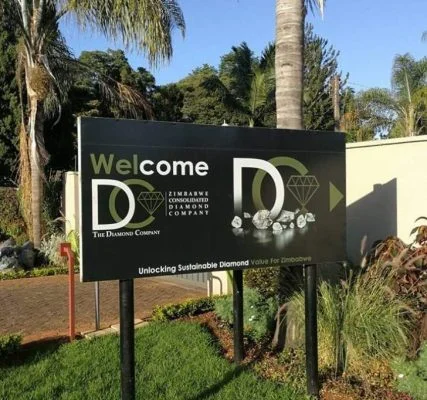
The Chief Executive Officer of state-owned Zimbabwe Consolidated Diamond Company, Moris Mpofu, revealed that the company plans to invest $32 million in exploration projects this year.

Such projects involve reopening mines in Chiadzwa, home to the Marange diamond fields, and other parts of the country, as well as launching new operations in the Save River floor and the Odzi river.

According to Mpofu, the final goal is to grow annual output to 4.1 million carats in 2019 and to 10 million carats by 2025. Last year, ZCDC produced 2.8 million carats, with sales adding up to $47 million.

The diamond miner’s CEO also said that he expects investment and strategic partnerships to increase in the next 12 months, given that the recent changes to Zimbabwe’s rules around diamond mining give ZCDC, Murowa Diamonds – a unit of RioZim- and two other companies to be approved by Government exclusive rights to undertake exploration and mining of the precious gems across the country.

Giant Russian diamond miner Alrosa to launch in Zimbabwe

0

GIANT Russian diamond producer, ALROSA, has announced plans to launch mining operations in Zimbabwe.

The news was announced during Zimbabwe’s President, Emmerson Mnangagwa’s trip to Moscow.

“Today we see opportunities for a new stage of our partnership. We are ready to develop new joint projects for diamond exploration and extraction,” said Sergey Ivanov, CEO of ALROSA.

“We also seek to support Zimbabwe in the development of its diamond-mining industry in line with industry’s best practices.

“We are happy to share with our partners a wealth of experience in the field of mineral exploration and diamond mining, including the industry self-regulation and responsible business.”

Namibia’s Mines and Energy Deputy Minister highlights women’s role in mining. The decision follows negotiations between the Russian company and Zimbabwean officials, which took place in 2018.

“We have opened a small window for foreign countries to participate in our industry,” said President Mnangagwa at a press conference, reported Africa News.

“We believe we can participate meaningfully in the diamond industry. We are ready to share all our technologies and know-how with our colleagues, so that Zimbabwe can establish itself in the global diamond mining market,” commented Sergei Ivanov, President of ALROSA, at the press conference.

Kazakhstan companies keen on Zim investment

0

REPORTS say over 50 Kazakhstan companies have expressed keen interest in partnering Zimbabwean counterparts in various business and economic development spheres.

The companies’ representatives met President Mnangagwa at his delegation at a Zimbabwe Kazakhstan Business Forum in Astana today (Sunday).

The Kazakhstan business people were drawn from mining industry, machine building, power generation, agriculture, pharmaceuticals, aerospace, finance and export services, transport and logistics, road construction, exploration and refining of minerals and chemicals.

Kazakhstan’s Industry and Infrastructure Development Minister, Mr Zhennis Kassymbek outlined the role of his country as a get-way for trade to Europe via Russia and how his country is ready to receive partners from Zimbabwe in the mining, machinery, agriculture and energy sectors.

He said in Zimbabwe, Kazakhstan has an important partner for trade not only for that country but the SADC region as a whole.

Several companies urged Zimbabwean business people to come forward and forge linkages with Kazakhstan without further waste of time.

The Zimbabwean government announced its intention to open an embassy in Astana to facilitate the business movements and transactions between the two countries as Zimbabwe opens a new frontier of economic diplomacy in Eurasia.

Zimbabwe’s Acting Minister of Foreign Affairs, Professor Mthuli Ncube said there is need for a Zimbabwe Kazakhstan Joint Commission to coordinate cooperation between Harare and Astana.

On the mining side, Minister Winston Chitando explained Zimbabwe’s intention to start stainless steel manufacturing and new opportunities emerging in the lithium and nickel sectors.

Miners request at least 80% forex

0

MINE workers and the Chamber of Mines have agreed to approach the government and table a request for the sector to get at least 80% of their foreign currency earnings, businessdigest has learnt.

This comes at a time mine workers are demanding to be paid in foreign currency pointing out that their salaries in Real-Time Gross Settlement and bond notes have been seriously eroded amid price hikes of basic commodities.

Associated Mine Workers’ Union of Zimbabwe president Tinago Ruzive told businessdigest on Wednesday that they had agreed with the Chamber of Mines to set up a meeting with Mines minister Winston Chitando to discuss the issue of forex retention.

“When we met the Chamber we agreed that we should team up and meet the minister and demand that the sector retains 80% of their forex earnings,” Ruzive said. “If the government agrees to this, it means us as mine workers can be paid in forex.”

The Chamber of Mines has told mine workers that employers will only pay them in forex if they can get forex retention of at least 80%.

The issue of forex retention has been a thorny issue, particularly in the gold mining sector. Last year, Riozim closed three of its gold mines citing the inadequate allocation of foreign currency, which then stood at 30%. It resulted in the Reserve Bank of Zimbabwe increasing the allocation to 55%.

Many mining companies have been struggling to remain operational due to the low foreign currency retention threshold set by the central bank.

The Dimension Stone Producers’ Association has also called on the Reserve Bank of Zimbabwe to increase the foreign currency retention threshold to ensure viability. The association has been calling on the central bank to increase its forex retention from the current 50% to at least 85%.

Some mining companies have decided to pay a certain percentage of their employees’ salary in forex in a bid to placate restive workers.

Zim Independent

Vast Resources plc notice of General Meeting

0

Vast Resources plc, the AIM listed mining company with operating mines in Romania and Zimbabwe, announces that a Chairman’s Letter including a Notice of General Meeting of the Company will be posted to shareholders today, 15 January 2019.  The General Meeting will be held at 2.00p.m on Thursday 31 January 2019 at the Company’s registered office, 6th Floor, 60 Gracechurch Street, London EC3V 0HR.  A copy of the Chairman’s Letter and Notice of General Meeting will be available on the Company’s website at www.vastresourcesplc.com.

Purpose of the Chairman’s Letter

The purpose of the Chairman’s Letter is to seek through the passing of Resolutions at the General Meeting approval to grant the Directors authority to issue new equity share capital up to specified limits, and to disapply statutory pre-emption rights.

The Chairman’s Letter to shareholders explains the reason for the proposals, which are divided into specific areas to permit Shareholders to support certain aspects of the proposals should they so wish.

The areas where the Directors are seeking authority to issue new equity shares for cash are set out below and comprise:

  • Development of diamond mining in the Marange diamond fields in Zimbabwe (Resolutions 1 and 2);
  • Creation of head room in connection with the loan from Bergen Global Opportunities Fund LP (“Bergen”) (Resolutions 3 and 4); and
  • Commencement of mining at the Baita Plai polymetallic mine in Romania and general working capital (Resolutions 5 and 6)

The agreement with Bergen requires a resolution to increase headroom to be put to Shareholders by 31 January 2019. The Directors consider that the interests of Shareholders are best served by bringing forward all the proposals for increased headroom in a single document, rather than over a period.  It should be stressed that there is no firm commitment at this time to issue any of the new equity share capital for which authority is sought, and it remains the policy of the Directors to minimise such issues.

Zimbabwe Diamonds
In August 2018 the Company announced that it had concluded an agreement (the ‘Agreement’) with Red Mercury (Pvt) Ltd (‘Red Mercury’) for exclusive access to a 15km² diamond concession area (the ‘Heritage Concession’) in the Marange Diamond Fields in the Chiadzwa region of Zimbabwe, popularly considered to be one of the richest sources of alluvial diamonds globally.

Red Mercury is a company owned by the Marange-Zimunya Community Share Ownership Trust under the laws of Zimbabwe, and which has received an undertaking from the Government of Zimbabwe for a licence to mine on the Heritage Concession

Under the Agreement, Red Mercury is responsible for providing a full mining licence and Vast is responsible, subject to the results of exploration and subject to Zimbabwe’s future indigenisation laws when changed as anticipated not being an effective bar to investment, to procure funding such as is necessary to develop an efficiently operating diamond mine on the Heritage Concession.  Since the Agreement was reached the Zimbabwe Mines Minister has made a statement that indigenous ownership requirements may be waived subject to certain conditions including reserving 10% of the gems mined for ‘local value addition’.

Following the completion of initial due diligence, the Company prepared base case commercial scenarios and made the decision, subject to legal due diligence, to proceed to the full Joint Venture Agreement with Red Mercury.

Despite reports in the press that the Minister of Mines has stated that the Company will be invited to explore for diamonds in Zimbabwe, as yet the Company has received no official notification of this position.

Notwithstanding this, the Company wishes to be in a position to proceed with mining the Heritage Concession within six months of finalising documentation, with a view to commencing production in H2 of 2019.  Under Resolution 1 the Board is requesting authority to issue shares to a nominal value of £2,000,000 (allowing for the allotment of up to 2 billion new ordinary shares of 0.1p each) to support funding for this and under Resolution 2 the Board is requesting the disapplication of pre-emption rights in respect of any such allotment.  The Board plans as far as reasonably possible to finance the mining operation by means of loan finance, but using the authority to issue shares as collateral security for the loan. The unissued shares used in this way would not fall to be issued except in the event of default.  Shares would only be actually issued pursuant to the authority to extent that this is not achievable.

Agreement with Bergen
On 19 December the Company entered into a convertible securities issuance deed (the Deed) with Bergen, in connection with an issuance by the Company of zero coupon convertible securities having a nominal amount of up to US$3,150,000 (the “Convertible Securities”).

The Convertible Securities are (subject to satisfaction of certain conditions) issuable in two tranches and the initial Convertible Security, with the nominal value of US$1,575,000, was duly issued shortly following signature of the Deed.  The second Convertible Security, also with the nominal value of US$1,575,000, is expected to be issued within approximately a week of the passing of the relevant resolutions to be proposed on 31 January 2019, and is conditional on the passing of that resolution.  Each of the Convertible Securities has a term of 12 months.

No conversion rights attach to the initial Convertible Security until 18 January 2018 or to the second Convertible Security for the first 30 days after the date of its issue.  Thereafter, the Convertible Securities will (subject to the satisfaction of certain conditions) be convertible into shares of the Company, in whole or in part, at the option of Bergen.  The Company will make an announcement if at any time any Convertible Securities are converted in whole or in part and will specify in such announcement the relevant conversion price, which will be, at Bergen’s election: (a) (as to no more than US$1,500,000 of the Convertible Securities) £0.0059 per share, calculated as 140% of average daily VWAPs during the 20 trading days prior to the execution date of the Agreement and (b) 92% of the average of five daily volume-weighted average prices of the shares on AIM during a specified period preceding the relevant conversion (the “Second Issue Price”); in each case subject to rounding).

In addition to the non-conversion period, Bergen has agreed to certain, substantial, limitations on its ability to dispose of the shares following a conversion of the Convertible Securities, by reference to the trading volume of the shares on AIM (provided that no default has occurred). Additionally, Bergen may postpone the funding of the second tranche of the Convertible Securities in the event that the market price of the shares is below a specified level being 0.2p for any two consecutive trading days during the term of the Agreement and, should the price of the shares remain below that level, elect not to fund the second tranche.

Bergen is also contractually precluded from shorting the Company’s shares.

The Company will have the right to repurchase the Convertible Securities for cash at 100% of their nominal value (and without a fee or penalty) within 90 days of the execution date of the Agreement.

Under Resolution 3 the Board is requesting authority to issue new shares up to a nominal value of £1,000,000 (allowing for the allotment of up to 1 billion new ordinary shares of 0.1p each) being the amount specified in the Deed to permit draw down of the second Convertible Security and under Resolution 4 the Board is requesting the disapplication of pre-emption rights in respect of any such allotment.  This is in addition to the authorities already granted to issue and allot new shares up to a nominal value of £592,000 in connection with the initial Convertible Security under the Deed.

Baita Plai and general working capital
On 16 October 2018 the Company announced that, following the completion of all legal documentation, the Company’s 80% subsidiary African Consolidated Resources srl now had the right to mine at the Baita Plai Polymetallic Mine in Romania, and was targeting initial production from Baita Plai in H1 2019.

The delay in obtaining the right to mine has been very costly for the Company.  The Company has been required to bear the ongoing dewatering costs during the wait period, and at the same time the Mercuria Tranche B finance has been deferred which has impacted on needed capex expenditure on Manaila.  But the most important impact has been the delay in generation of cash flow from Baita Plai when in production – a matter which is critical to the Company’s budget.

A comprehensive start up and mining plan for Baita Plai is now near completion by the Company’s technical director.  This plan allows for first production after six months and for an accelerated move to full production (13,000 tonnes per month) after 12 months.  Further details of this plan will be released shortly.  The successful implementation of the plan will transform the Company’s finances.

As at the date that this letter is printed Tranche B of funding from Mercuria, amounting to $5.5m, is expected very shortly.  However, on account of the factors mentioned above caused by the delay in the right to mine and also because of increased development capital required by the accelerated move to full production, additional capital and hence additional authority will be required.

The proposed authority in addition would also cover the cost of exploration at the Group’s other properties in Romania, such as at the Magura Neagra and Piciorul Zimbrului prospecting licences (collectively Zagra) in northern Romania, where a 4,000m surface diamond drilling campaign commenced in November 2018.  All core samples will be submitted to the ALS laboratories located in Rosia Montana for copper, lead, zinc, molybdenum, gold and silver assays.

Under Resolution 5 the Board is seeking authority to issue new shares up to a nominal value of £800,000  (allowing for the allotment of up to 800 million new ordinary shares of 0.1p each) and under Resolution 6 the Board is requesting the disapplication of pre-emption rights in respect of any such allotment which authorities also cover general working capital requirements.

Action to be taken
Shareholders have been sent a Form of Proxy for use at the General Meeting.  Whether or not shareholders intend to be present at the General Meeting they are requested to complete and return the form of Proxy in accordance with the instructions printed thereon.  To be valid, completed Forms of Proxy must be received by the Registrar as soon as possible, and in any event not later than 2.00pm on 29 January 2019.  Completion of a form of proxy will not preclude shareholders from attending the meeting and voting in person if they so choose.

Recommendation
The Directors believe that the ability to obtain the necessary finance and therefore the passing of the Resolutions is important to the Company and Shareholders taken as a whole.  The Directors unanimously recommend the shareholders to vote in favour of the Resolutions as they intend to do in respect of their own shareholdings amounting to 77,362,431 ordinary shares of 0.1p each (approximately 1.32% of the total issued ordinary shares).


Diamond Giant Alrosa is coming back to Zimbabwe

0

Alrosa PJSC, one of the world’s top diamond miners, is returning to Zimbabwe after a more than two-year break as it expands outside Russia.

The company will develop new mining operations in the country with the support of the government, Alrosa said Monday as Zimbabwe’s President Emmerson Mnangagwa visited Moscow. The Russian producer opened an office in Zimbabwe last month, Chief Executive Officer Sergey Ivanov said at a press conference.

Mnangagwa, who became president in 2017, sees diamonds as a key way to help revive Zimbabwe’s mining industry, which suffered years of decline under his predecessor Robert Mugabe. The government is considering waiving a rule that prevents foreign investors holding controlling stakes in its diamond mines.

“We also seek to support Zimbabwe in the development of its diamond-mining industry in line with industry’s best practices,” Ivanov said in a statement. Geologists and mining engineers from Alrosa will arrive in Zimbabwe in the next month to start operations, it said.

Despite the country’s diamond riches, no major producers operate there. Rio Tinto Group sold its stake in a project in 2015 and gem giant De Beers quit the country more than a decade ago. Alrosa stopped working in the nation in 2016, a few years after first studying assets there.

Zimbabwe’s diamond production has tumbled in recent years as easy pickings at the once vast Marange diamond fields have been exhausted. Output is down almost 75 percent in the past five years, with the southern African nation now producing just a fraction of what Russia mines. Bloomberg
error: Content is protected !!