Home Blog Page 673

Two dump trucks of diamond looted

0

DETECTIVES in Mutare have launched an investigation into an armed robbery case in which 10 criminals allegedly bulldozed their way into the Chiadzwa diamond fields and looted two dump trucks of diamond ore before vanishing into the darkness.

The diamond ore theft occurred last Sunday, around 1am.

The criminals, suspected to be highly trained and co-ordinated, allegedly rounded up and disarmed unsuspecting Zimbabwe Consolidated Diamond Company (ZCDC) security guards on duty.

They allegedly assaulted them before force marching one of them to what is known as “the RBZ plant” where the diamond ore was stored.

Manicaland police spokesperson Inspector Tavhiringwa Kakohwa confirmed the incident, but refused to discuss the details with the press.

“Investigations are in progress and the suspects are still on the run. I cannot comment now because I do not have full details of the alleged incident,” he said.

However, police sources privy to the investigations said the value of the stolen diamond ore was still being quantified.

They said on December 16, at around 1am, a group of suspected illegal diamond panners proceeded to the ZCDC Portal A, RBZ area 1, and approached the security guard on duty.

“They apprehended, assaulted and force marched him to the RBZ plant where diamond ore was stored.

“On their way to the plant, the group came across two other dog handlers and ordered them to lie on the ground facing upwards. They asked for directions to the diamond ore. The dog handlers informed them that the whole area had diamond ore. That is when another group of diamond panners approached them,” said the source.

“Another security guard who was on duty patrolling the area armed with a short gun riffle, spotted the accused persons and approached them. He was, however, apprehended, disarmed and ordered to lie down alongside the other two dog handlers”.

“Four criminals were left guarding the captive security guards while the other criminals proceeded to RBZ plant,” added the source.

The source said the robbers found two dump truck operators who were resting, and ordered them to reveal where the diamond ore was stored.

“The operators showed them a heap of diamond ore and the panners started loading it into some sacks. The group then left towards the eastern direction.

They returned the fire arm that they had confiscated from one of the guards,” said the source. The ZCDC guards later informed Dingiswayo Jeremiah Gumbo, who was the security officer on duty about the robbery.

A report was made at ZRP Marange. Detectives from Mutare Central attended the scene.

source: The ManicaPost

Mnangagwa to commission platinum processing plant

0

SHURUGWI-based Anglo-American Platinum Miners, Unki Mine’s $62 million platinum processing plant is now complete and is expected to be commissioned by President Mnangagwa in January next year.

Construction of the plant commenced in 2016 as the company heeded Government’s call on value addition and beneficiation.

Unki Mine general manager Mr Walter Nemasasi said President Mnangagwa was expected to commission the plant next year.

He, however, said more information regarding the plant would be availed to the public once the plant had been commissioned.

“We are expecting President Mnangagwa to open the plant sometime in January and unfortunately there will be no Press briefings until then,” he said.

Unki Mine Smelting Plant project manager Mr Clifford Mutevhe once told Sunday News Business that all the structural and engineering work for the smelting plant was complete.

The plant was expected to be commissioned in July this year.

Mr Mutevhe said the plant would start operating at full throttle in 2019.

“This is a huge project that the mine is undertaking. All the structural work has been done,” he said.

Mr Mutevhe said the smelting plant, which will consume over 11 meggawatts, would see the company smelting about 623 000 tonnes of platinum concentrate per annum.

Platinum mining companies agreed to set up platinum refineries at their respective mining sites while they have also agreed to construct a single platinum processing plant.

Platinum processing, although requiring a lot of resources and capital, would enable the country to realise more from its minerals as well as curbing repatriation of profits.

In May last year, the Government signed an agreement that would see the construction of a $300 million platinum refinery which will significantly increase platinum export earnings.

The refinery would give Zimbabwe an opportunity to refine its platinum as opposed to the current process of exporting it as predominantly raw mineral.

The total output is thus expected to rise to 0,49 million ounces (moz) in 2026 from 0,42 moz produced thus year.
source: The Sunday News

ZERA advocates establishment of crude oil refinery

0

Zimbabwe should seriously consider establishing a local crude oil refinery as a way of cutting the ballooning fuel bill, according to the Zimbabwe Energy Regulatory Authority (Zera).

Zimbabwe’s fuel consumption has risen from an average 2 million litres daily in January to 4 million per day in October, putting a strain on the country’s limited foreign currency, as well as fuelling the emergence of fuel queues.

The Reserve Bank of Zimbabwe (RBZ) has doubled foreign currency allocations to fuel dealers from $10 million to $20 million per month in the same period.

Presenting oral evidence before the Parliamentary Portfolio Committee on Power and Energy on Thursday, Zera acting chief executive officer Mr Edington Mazambani said Zimbabwe is better off with its own refinery.

Mr Mazambani also said Government can also consider rationing the scarce commodity, but he cautioned that this would not be a popular route.

It is believed that establishing local fuel processing capacity will cut the import bill substantially, develop regional export potential and create employment.

He, however, could not reveal the amount of savings to be realised assuming the nation decides to establish a refinery.

“There is definitely an increase in consumption of fuel, probably occasioned by the number of vehicular traffic on the roads and it’s more pronounced in the capital,” said Mr Mazambani.

“For petrol, we started in January at 1,6 million litres per day, it has since moved to about 3 million litres per day.

“We should, maybe, explore the setting up of a refinery to support downstream industry and also generate foreign currency when we export within the region.

“As a nation, we do have business proposal to look at the possibility of us setting up a refinery. Zambia is no longer operating their refineries, they are actually importing more of the finished product than crude oil, Botswana consumes the finished product, DRC. . . so it’s a possible market which if we explore can actually support a business case to have a refinery in this country,” he said.

Zimbabwe used to operate the Feruka Oil Refinery in Mutare which, however, mothballed in 1966. Government made efforts to revive the project in 2004 by Capref with a takeover proposal.

However, Mr Mazambani told Parliament that reviving the Mutare Refinery was ill-advised as it has since been overtaken by technology and, thus, resuscitating it could prove uneconomic.

“I am not really a technical person but that refinery was a Rhodesian project, technology has since moved. I don’t think we can operate that refinery (or) resuscitate it to be economically viable,” he said.

Before going the refinery route, the acting Zera boss said there is a need to revive a reliable public transport system so as to discourage people from driving personal vehicles.

He noted that the increase in vehicles is a result of the death of the public transport system, which is no longer reliable.

“(The other solution) is maybe to have a more reliable public transport system that will release the pressure because at the moment driving a car is no longer a luxury, it’s really a necessity because of the absence of reliable public transport system,” he said.

“So we think that if we were to introduce public transport system which is on time every-time, we will see more people opting to use public transport,” said Mr Mazambani.

Speaking before the same committee, RBZ Governor Dr John Mangudya assured parliamentarians that the country will not run out of fuel this festive season as sufficient allocations for fuel purchases will continue to be availed.

Reports say there are about 1,5 million registered vehicles on the country’s roads, some of which remain unaccounted for.

source:The Sunday mail

Chinese mining group exit Zimbabwe

0

Chinese mining and exploration group ASA Resources Group says it is tying up a deal to sell-off its shareholding in Bindura Nickel Corporation (BNC), which will see it exit the Zimbabwean market.

ASA operates Freda Rebecca, the largest single gold mine in Zimbabwe and Trojan Nickel Mine through BNC, which is listed on the Zimbabwe Stock Exchange (ZSE),
ASA gained control of BNC and its assets in 2015 after taking over the miner’s holding company Mwana Africa and booting out its founder, Kalaa Mpinga.

In a cautionary statement to shareholders, BNC announced that it had reached a deal with a potential buyer.

“Asa Resource Group has entered into a sale and purchase agreement (SPA) with a third party in relation to the 74,73% shareholding in BNC. The conditions of the SPA include various regulatory approvals and other conditions as expected with a transaction of this nature. The third party is a United Kingdom-based nickel company with complementary interests in Southern Africa,” the notice reads.

“Shareholders are advised to exercise caution when dealing in the company’s securities until a full announcement is made”.

In January this year, South African Gold producer Pan African Resources (Panaf) announced that it was in exclusive negotiations with ASA Resource Group to acquire assets and liabilities in Zimbabwe.

Panaf, a mainly gold miner which is listed on the Johannesburg and London stock exchanges, has operations in South Africa.

The group also has operations in Botswana, Democratic Republic of Congo (DRC), South Africa and Angola.

ASA has been operating under judicial management since July last year after struggling to service its obligations.

Last year, the board reported that $4,3 million was missing from Freda Rebecca Mine, with an audit showing that the then executive chairman Yat Hoi Ning and finance director Yim Kwan had irregularly transferred money to two Hong Kong-registered companies.

In the six months to September, BNC registered a 26% increase in profit after tax to $2,8 million, buoyed by firm mineral prices on the international market.

However, sales during the half year period were down 14% to 2 980 tonnes from 3 485 tonnes last year on the back of low production and logistical challenges in moving the product out of the country.

Cost of sales increased by 11% from $16,2 million last year, to $18 million in the period under review, mainly due to an increase in local costs. Production declined to 3 076 tonnes from 3 460 tonnes in 2017.

BNC has had to put its ambitious Smelter Restart Programme on hold because of the prevailing economic challenges.

source: NewsDay Zimbabwe

Miners affected by Zim drop from S&P?

0

…a major blow to the mining sector

S&P Dow Jones announced that they will be removing Zimbabwean domiciled companies from its indices from 24 December due to serious cash shortages in the country, high inflation of the bond money and foreign currency shortages.

What does this mean for the miner?

Dickson Rudairo Mapuranga

Miners are of the view that the move to remove Zimbabwean companies from Standard and Poor African indices will negatively impact on Zimbabwe’s development and investment opportunities in the mining sector, according to S&P Dow Jones Indices statement, Zimbabwean companies will be rated at zero price in 14 different indices thereby reducing the chances of Zimbabwe attracting foreign investors, the move according to experts will lead to Zimbabwe only attracting bogus investors mainly who have nothing to lose but more to gain due mining exploits.

According to one mining expert, this will to some extent affect Large Scale Mines particularly those partnered with publicly traded companies and small scale miners to a greater degree are safe, although the effect will be felt by every Zimbabwean, this will have a slim effect on Zimbabwe’s economy which already is in shambles.

“The truth is our risk rating was already unfavorable. Small Scale Mines will not be affected as much, private investment has always been measured differently regarding investment decisions into small scale operations, potential for return on investment being the major driving factor. Investment prospects for the Small Scale Miner in Zimbabwe will remain unaffected because of the great growth potential in our sector and opportunity to obtain significant returns, besides our type of investment has a higher risk tolerance and does not necessarily rely on S&P when making decisions.”

Some miners are of the view that, Standard and Poor is an American firm, under the authority of Americans, therefore, with United States’ current stance on Zimbabwe, it is bound to negatively portray Zimbabwe to the international community. However, miners are positive that this move will not affect the mining industry in anyway, since miners have been operating without the influence of S&P, and the fact that not all investors abide with S&P.

‘’… it’s an American company. America currently doesn’t view us in a good light, so I’m not surprised. Do you think all investors abide with this S&P thing? Definitely not. That’s why the Chinese and Russians are making so much headway into Africa.” Said one miner.

One mining expert said that, miners do not care about these ratings which mainly focuses on other firms that are not in the mining sector, the mining industry will sustain itself and can even go to become bigger and attract attention from these rating organisations.

“Personally I don’t care about S&P ratings, they never rated China until China was already too big for them to ignore.  Anyway, what I do agree on is the fact that we are going nowhere slowly” he said.

Falgold fails to publish financial results

0

LISTED miner Falcon Gold Zimbabwe has failed to publish its financial results for the financial year to September 30 this year, citing operational challenges which have been worsened by inadequate foreign currency allocations by the Reserve Bank of Zimbabwe (RBZ).

The company said the publication of results will now be expected after the end of 2018.

In a recent cautionary statement, the struggling firm said it was failing to pay creditors and was being cut off supply of critical operating inputs, thereby impacting normal operations.

“The directors of Falcon Gold Zimbabwe Limited (the “Company”) wish to advise all shareholders of the following pertinent matters, The Number 2 mill at the Golden Quarry processing plant (Shurugwi) had a catastrophic engineering failure late last week,” reads the statement.

“In the intervening period, management has been undertaking a full impact assessment and is now evaluating various options to deal with the matter at hand.
Notwithstanding this mill failure, to date the funding required to execute the 2019 financial budget has not been received by the company and discussions with regards this funding are ongoing”.

The Bulawayo-based mine owns Venice Mine in Kadoma; and Golden Quarry Mine located in Shurugwi.

Falgold is 84,7% owned by Canadian-listed New Dawn Mining Corporation.

For the six months ended March 31 2018, Falcon Gold Zimbabwe Limited reported revenue of $ 2,5 million down from $3,6 million recorded over the same period last year.
Loss from continuing operations before taxation was $ 1,6 million compared to $2,5 million in the prior year.

In 2016, Falgold disposed its Dalny Mine to one of the country’s top producers RioZim for $8million.

RioZim has also been facing similar challenges of inadequate foreign currency to meet its operational requirements.

The central bank has since reviewed the forex retention threshold of gold miners to 55% of export earnings from the previous 30% after the Chamber of Mines Zimbabwe, which represents large-scale miners warned of imminent closures and job losses in the extractive sector.

But as the dollar note shortage persists, some miners have only received part of their allocation from the central bank, while others have not received anything at all.
Outstanding foreign payments for gold producers are in excess of $15 million.

This year, the country is targeting output of 35 tonnes of gold, but hopes of achieving that target have been dented, because of the slump in production.

Mining contributes more than 60% of the country’s foreign earnings and the sector is expected to anchor revival of the southern African economy.

source: NewsDay Zimbabwe

Oil prices decline

0

Oil prices fell yesterday after reports of swelling inventories and forecasts of record US and Russian output combined with a sharp sell-off in stock markets as the outlook for global growth deteriorated. US crude oil dropped $2,04, or 4,1 percent, to a low of $47,84, its weakest since September 2017. It recovered to around $49,28, down 60 cents, by 1420 GMT. North Sea Brent lost $2,41, or 4 percent, to $57,20, a 14-month low. Brent last traded around $59,01, also 60 cents lower.

Both oil benchmarks have shed more than 30 percent since early October due to swelling global inventories. World stock markets tumbled yesterday as fears about a slowing global economy gripped investors, just as the US Federal Reserve looked set this week to deliver its fourth interest-rate hike of the year.

Investor confidence is deteriorating with more fund managers expecting global growth to weaken over the next 12 months, the worst outlook in a decade, Bank of America Merrill Lynch’s December investor survey showed. Japan’s Nikkei lost 1,8 percent after US stocks dropped to their lowest in more than a year.

“A large part of the move is due to a broader market sell-off, with both US and Asian equity markets coming under pressure,” said commodities strategist Warren Patterson at Dutch bank ING in Amsterdam.   Reuters.

Gold rises

0

Gold rose to a one-week high yesterday, helped by a weaker US dollar and a fall in global stock markets, but moves were limited as investors sought clarity on the path of U.S. interest rates as concerns about a slowing global economy deepened.

Spot gold was up 0,1 percent at $1,247.06 per ounce at 1310 GMT, having earlier touched its highest since December 10 at $1,250.27, just short of a five-month peak of $1,250.55 hit last week. US gold futures were steady at $1,251.30 per ounce.

“There has been a slight increase in the minority view that the Fed might not raise rates, given the recent weakness in the equity markets. It would be quite a shock if they didn’t increase rates in this week’s meeting,” said Capital Economics analyst Ross Strachan.

“Most of the attention will be on how many more interest rates rises there may be next year.”

The Fed is widely expected to raise interest rates for the fourth time this year at its two-day policy meeting ending on Wednesday. But weak stock markets and slowing global growth may prompt the central bank to signal a slowdown in rate increases.

“We have seen quite a broad-based sell-off across many other markets, from equities to other commodity markets, and an increase in risk aversion. In that climate, gold is edging gradually higher towards a multi-months peak,” Strachan said.

World stock markets tumbled as fears about a slowing global economy gripped investors, while the dollar index slipped 0,3 percent against a basket of major currencies. Gold tends to gain when interest rate hike expectations ease because lower rates reduce the opportunity cost of holding non-yielding bullion and weigh on the dollar, in which it is priced.

In euro terms, gold reached its highest since June at 1 100,57 euro an ounce. Reuters.

Hwange Communities raise concern over Deka river pollution

0

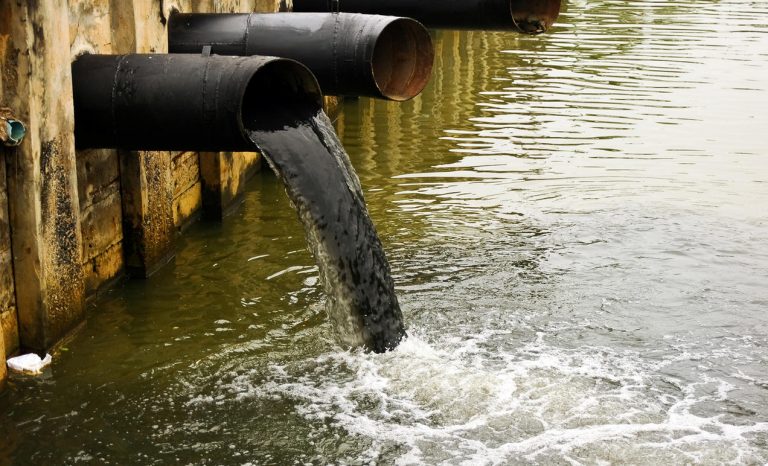
COMMUNITIES in Hwange who, for years, have been affected by Deka River pollution, have raised concern over coal mining companies’ failure to address the problem and reneging on their promise to provide safe water.

This was revealed recently by a taskforce comprising of Hwange district administrator, Hwange Rural District Council, communities from affected areas and other interested stakeholders at a feedback meeting organised by Basilwizi Trust.

The taskforce, which is looking into the pollution problem, was set up in March this year.

Villagers said the mining firms had reneged on honouring their pledge to drill boreholes leading to loss of livestock due to the acidity of the water.

The mining firms have been blamed for the death of hundreds of fish in December last year.

Hwange Colliery Company, Zimbabwe Power Company, Chilota and Sandledge Mining (formerly Coalbrick Mine), who are discharging effluent into the river, were summoned by the taskforce and pledged to, among other things, investigate the source of pollution and drill three boreholes each in the affected communities.

Preliminary studies conducted by the Environmental Management Agency (EMA) revealed that acid mine drainage (AMD) from the mining activities in the area was affecting aquatic life. Other pollutants from mining activities such as coal dust or fines were cited as contributors.

AMD refers to the outflow of acidic water from a mining site. In most cases, this acid comes primarily from oxidation of iron sulfide, which is often found in conjunction with valuable metals.

“We are disappointed at the pace these companies are taking in addressing access to water issues, which they pledged to do sometime in March after effluent was discharged into the Deka River, which is an important water source for us and our livestock. Fish continue to die and our livestock is also being affected by this pollution. The water is not safe to drink, bath or wash as it leaves skin itching, which has forced us to travel distances of between 3km and 5km to access drinking water,” Mashala village head Patrick Nyoni said.

Nyoni said they need to find lasting solutions to stop pollution. He said environment authorities took samples of the water, which was sometimes yellow or dark green in colour, but have not released the results.

Rosemary Shoko from Chachachunda said women were the most affected, as they were in constant contact with the water.

“This a crisis that needs urgent attention, and the delay that is taking place has become a great worry to us. We as women are the most affected as we have to walk for several kilometres to access clean water, and since our primary food source has been polluted, it is us who have to look for alternative relish. We are very worried about our health, considering the tenderness of women skin which when exposed to the contaminated water from the river becomes itchy. We have continued to say these companies have been gambling with our lives, polluting the water without restraint. What are we going to eat when our animals are also dying from this calamity?” she said.

Communities in Chachachunda, Zvabo, Mukuyu, Mashala and Mwemba, home to a population of about 1 200, blamed the mining companies’ poor rehabilitation systems for the catastrophe.

Acting Hwange district administrator, Simbarashe Kayela said the companies had committed to start drilling boreholes in December.

“Your concerns are noted, and I want to assure you that the DA’s office is doing everything in its power to ensure that boreholes are drilled as per pledge. So far, I can confirm that Hwange Colliery has been rehabilitating some of the boreholes that had broken down long back as part of its short-term plan to resolving the problem. I’m happy that they have put tentative timelines to start drilling, which is a positive development, though the process has been slow. It’s not going to be a one day activity, but it’s an ongoing process of engagement,” he said.

Kayela said ZPC would take advantage of a second pipeline which is going to be constructed under the Stage 7 and 8 expansion schemes of the power station to connect taps to the communities.

He said Sandledge had asked for drilling quotations and would commence work before monthend, while Chilota has not been mining for sometime and are yet to advise.

Meanwhile, HRDC said it was engaging mining companies with a view to finding a permanent solution that would eliminate pollution.

EMA revealed that similar patterns were experienced in 1996 and 2007. The agency said there was need for long term commitment such as the installation of a treatment plant to stop pollution.

“We have engaged companies that are dumping effluent into the river to do so after treating it. There has been compliance in that regard. However, it has also been noted that AMD, which finds its way into the river, is the main culprit causing the deaths of fish. There is need for concerted efforts in establishing effective treatment mechanisms such as installing a treatment plant downstream,” EMA Matabeleland North provincial manager Chipo Mpofu-Zuze said.

Though the Environment Management Act has a provision for the setting up of an Environment Fund, which is meant to assist in cleaning up, rehabilitating degraded and polluted environments, nothing has been done to utilise it in addressing the Hwange issue. Setting up of the treatment plant reportedly costs around $30 million, a figure most companies cannot afford.

Source: Newsday

Pelgin introduces a new model truck in Zimbabwe

0

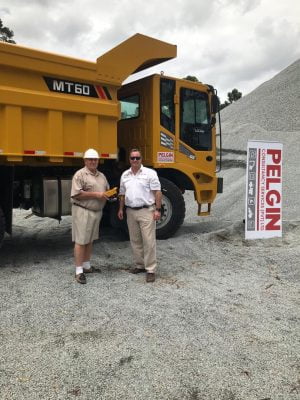
Last week Gary Moorcroft, the Managing Director of Pelgin Consultancy Services, handed over a LGMG Rigid Dump truck to Collin Campbell of Pomona stone quarries at a ceremony held at Pomona Stone Quarry in Harare.


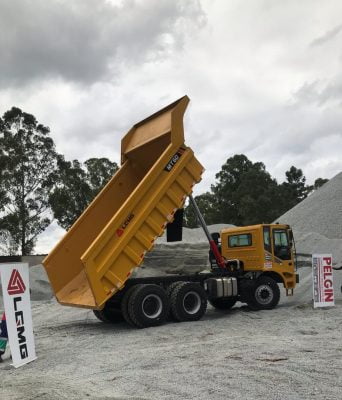
The truck which is a LGMG MT60 Rigid Dump Truck, the first MT60 model to operate in Zimbabwe, offers a payload of 45 tons, and is ideally suited for medium size mines and stone quarries. However, there are a number of smaller LGMG MT50 and larger MT86 Models already operating on chrome mines in the Country.

Pelgin, are confident that this product range is set to become a major solution for mining operations looking for a productive, but price competitive solution for their haul requirements. There are a number of medium to large projects that Pelgin are currently working on for the supply of the LGMG Range of equipment, and Zimbabwe will soon become a major destination for these products.

According to Pelgin, the truck handed to Pomona Quarries LGMG MT60 Truck, has a payload of 45 tons, and is being loaded with a Volvo EC700 Excavator, fitted with a 4.1m3 rock bucket.


Pelgin is proud to handover the first LGMG MT60 Rigid Mining Truck to Pomona Quarries in Harare.

“This is an ideal match, and the excavator is needing 7 passes to load the truck, which hauls the blasted grey granite in the pit to the primary crusher. The truck is standard, but does include the more robust tyres fitted with 15.00R25 E4 Tyres. This unit has a 20m3 bin purpose built to take the higher SG rated material. Standard bin size for the 45 ton payload is 25m3. The Body is made of NM400 steel and is designed to take the harsh conditions found in mining and quarrying operations. Pelgin also provided Pomona with a LGMG Technician to offer operator training as well as maintenance training.” Said one Pelgin consultant member.

Pelgin are the official Volvo CE Dealer in Zimbabwe and have become a major source of equipment for the mining and construction industries in Zimbabwe. In addition SDLG is also offers by Pelgin, a Company that is jointly owned by both Volvo CE and LGMG. This gives Pelgin the unique advantage of offering the full spread of mining and construction equipment that offers complete solutions to their customer base. There is no doubt that LGMG will become a popular Brand for Pelgin in Zimbabwe as the mining industry embraces them in the years to come.

Pelgin also offer LGMG MT86H model, which is a 55 ton payload. It is extremely popular in larger mining operations around the world, reports have it that, over 3 000 of these units are sold each year. LGMG can offer up to a 70 ton payload model, for example their LGMG CMT106. The truck is a dedicated rigid off road mining dump truck, built from the ground up. LGMG trucks are tougher, more productive and dedicated to harsh mining conditions. This, coupled with being extremely price competitive, make it a viable alternative not only to generic tipper trucks but also the more conventional, yet pricey, articulated and rigid mining trucks available.

  • Contact Pelgin Consultancy Services (Pvt) Ltd
  • 7 Loreley Close Msasa, Harare
  • Telephone: (0242) 486773 / 74 Mobile: 0772573683