Home Blog Page 693

Tanzania threatens Acacia Mining of a possible shutdown over water pollution

0

Tanzania has given Barrick Gold-subsidiary Acacia Mining (LON:ACA) until March 30 to stop waste water pollution at its North Mara mine or face a shutdown, but the country’s No.1 gold producer said Friday a brief spill affecting the operation has already been halted.

The miner says the spill happened because sections of a pipeline used to carry water to a tailings storage facility were either vandalized or stolen.

The African miner, fined over the incident in January, said the spillage happened after sections of a pipeline used to carry waste water from the North Mara mine to a tailings storage facility (TSF) had been either vandalized or stolen. As a result, it said, the pump used to move tailings was switched off, causing water levels in the pond to rise and subsequently overflow.

“The mine has welcomed the support of the government on resolving this issue, and is working closely with the authorities to implement improvements to security measures around the polishing pond in order to help prevent any recurrence,” Acacia said in the statement.

Barrick Gold, which owns 63.9% of Acacia Mining, recently proposed  a plan to settle disputes between the Tanzania miner and the country’s government, which includes a $300 million payment to resolve tax claims in the East African nation.

In 2017, Acacia was handed a $190 billion tax bill — almost four times Tanzania’s gross domestic product and about two centuries worth of revenue for the company — for underreporting output, an allegation the company denies.

North Mara is Acacia’s largest mine. It produced 336,055 ounces of gold last year, or about 65% of the company’s total output._Mining.com

Gold gains while Palladium, platinum eye biggest weekly fall

0

Gold rose a percent to a one-week high yesterday, briefly breaching the pivotal $1,300-per-ounce ceiling, as weak U.S. payroll data dented the dollar and risk sentiment, while also exacerbating a gloomy global economic picture.

U.S. job growth almost stalled in February with the economy creating only 20,000 jobs amid a contraction in payrolls in construction and several other sectors.

Spot gold was up 1 percent at $1,298.66 per ounce as of 1:56 p.m. EST (1856 GMT), en route to a weekly gain of 0.4 percent. Prices on Thursday fell to $1,280.91, within striking distance of a more than five-week low touched earlier this week.

U.S. gold futures settled up 1 percent at $1,299.30.

“We saw a surprisingly weak non-farm jobs number that pressured the dollar and the U.S. stock markets, which in turn supported the rally in gold,” said Jim Wyckoff, senior analyst at Kitco Metals. “Gold is going to be influenced by the dollar index.”

The dollar held its earlier losses versus a basket of currencies, making bullion cheaper for holders of other currencies, while Wall Street was set to fall after the jobs data.

“Growth in the U.S. is going to slow as the country has reached full employment and productivity is very high so there isn’t much space for growth … And we’re coming to an end of the Federal Reserve’s rate cycle, which should weaken the dollar further,” said Natixis analyst Bernard Dahdah.

While Friday’s report from the Labor Department did have a few bright spots, such as dip in the unemployment rate and an upward revision to December and January data, it did indicate the U.S. economy is slowing, supporting the Fed’s “patient” approach toward interest rate hikes this year.

The jobs number could be revised up and the “internals” were not so bad, Kitco’s Wyckoff said.

“I don’t think this particular report alone will alter the Fed’s monetary policy,” he said. “If we get a string of weak numbers next couple of months, then that’s a different story, but right now that 20,000 rise in non-farm is an anomaly.”

Investors also kept a close eye on trade talks between the United States and China, with mixed signals from Washington on the likelihood of a breakthrough.

Meanwhile, palladium slipped 1.5 percent to $1,505 per ounce, on track for its biggest weekly decline since the week ended Nov. 23.

Silver gained 1.9 percent to $15.30, after slipping to its lowest since late December on Thursday. Silver was up 0.8 percent for the week.

Platinum rose 0.2 percent to $814.88 per ounce. It was down 5.3 percent so far this week, its biggest weekly percentage decline since mid-August. _Reuters

Lancashire Steel to resume operations

0

Lancashire Steel, a subsidiary of Ziscosteel, is set to resume operations after a new investor
Whinstone Enterprises agreed to inject fresh capital.

Lancashire Steel, which used to produce wire among other steel products, closed in 2010 as a result
of shortage of supply after its mother company Ziscosteel suspended operations. However, there
could be light at the end of the tunnel after Lancashire Steel and Whinstone Enterprises — under the
Lancashire Joint Venture (LJV) vehicle — on Wednesday called for former staffers to apply for jobs at the
Kwekwe-based steel maker.

LJV said it was looking forward to assembling a new team and beginning operations. “… All long
service employees of Lancashire Steel who served in various divisions in the plant section (must)
submit their CVs and job profiles as a matter of urgency to the plant offices in Kwekwe,” the company
said.

This comes as the Indian partner raised a stink last year after it emerged that the company was being
investigated in Botswana for corruption. According to local media reports, the deal will give Whinstone
Enterprises 50 percent ownership of the Kwekwe-based steelmaker after five years, and 90 percent of
profits, but fails to specify how much the company is supposed to invest in the deal, which analysts
say was a case of corporate raiding of a national resource.

Lancashire Steel — which stopped operations in 2010 — entered into a five-year partnership with
Whinstone Enterprises, owned by the Verma family, which was implicated in the closure of Pula Steel
in Botswana under a cloud.

The Verma family, which owned 17 percent of Pula Steel, while 52,3 percent was held by the
Botswana government through Bamangwato Concessions, was under investigation in the
neighbouring country after the company closed in 2016.

Ranvir Kumar Verma, who owns Whinstone Enterprises, was Pula Steel chief executive at the time it
was hit by allegations of corruption and forced to close. Reports by Botswana’s Mmegi newspaper
indicate that Ranvir has no experience in steel manufacturing and was allegedly behind the
employment of illegal Indian immigrants.

Since the deal between Lancashire Steel and Whinstone Enterprises was signed on July 27, 2018
insiders said there has been no movement amid reluctance by the Indians to pour money into
operations. “Lancashire Steel looked for an investor because they didn’t have money, but then the
investor came and says you have been down for long, don’t expect to be up and running soon.

He can’t even pay electricity bills and, instead, wants us to pay through sales of scrap metal,” a source
said.

Ezekiel Machingambi who was acting managing director at the firm last year confirmed that production
had not started and could not say when it would._Daily News

Botswana sees lower mineral revenues in 2019

0

Diamond rich Botswana expects mineral revenues in the 2019/20 fiscal year to drop by 4 percent to 13.6 billion pula ($1.26 billion) due to a decline in royalties and dividends, a minerals ministry budget document showed on Thursday.

Mineral Resources Minister Eric Molale said in the document that global diamond demand was showing signs of slowing down. Retail jewellery sales fell during the last quarter of 2018, he said, while polished prices continued to decline into the beginning of 2019, albeit at a slower rate.

“Trading and prices of diamonds are expected to remain subdued during the first quarter of 2019 due to significant overstocking of small polished diamonds,” Molale said in the document presented to parliament late on Wednesday.

Debswana, a joint venture between Anglo American’s De Beers and Botswana, produced 24.1 million carats of diamonds in 2018, a 6 percent jump from the previous year.

The company is the largest contributor to Botswana’s government revenues._Reuters

Eskom needs more bailouts

0

South Africa’s struggling state power firm Eskom may need more bailouts from government to survive, after the country’s energy regulator on Thursday granted it smaller tariff hikes than the utility had wanted.

Eskom supplies more than 90 percent of the power in Africa’s most industrialised economy. But it is grappling with cashflow problems, breakdowns at its creaking coal-fired power station fleet and a 420 billion rand ($29 billion) debt burden.

There will have to be painful reform for Eskom, and that will have to come from either higher tariffs or the government increasing its expenditure

The government last month promised Eskom a bailout of 69 billion rand over the next three years, but that is insufficient to cover the revenue shortfalls which will result from the tariff hikes granted by regulator Nersa on Thursday.

Nersa tried to partly shield South African consumers from Eskom’s financial woes, shifting the burden onto government.

“There will have to be painful reform for Eskom, and that will have to come from either higher tariffs or the government increasing its expenditure,” William Jackson at Capital Economics said.

“The government will probably have to raise its funding.”

Nersa granted Eskom average tariff increases of 9.4 percent, 8.1 percent and 5.2 percent over the next three years, far below the 17.1 percent, 15.4 percent and 15.5 percent Eskom said it needed last month.

The regulator also allowed Eskom to recover 3.9 billion rand from customers for electricity supplied in the 2017/18 financial year, but it has not yet decided when that recovery will happen.

Nersa had already granted Eskom a roughly 4 percent tariff increase in 2019/20 as part of an earlier cost recovery application, so the effective tariff increase felt by South Africans in 2019/20 will be over 13 percent.

The exact size of the tariff increases in 2020/21 and 2021/22 has not yet been decided, as it will depend on how the latest cost recovery award will be phased in. But all of the awards are significantly above current inflation, which is running around 4 percent.

Eskom’s dollar bonds gained as some investors had feared Nersa would award even smaller tariff increases.

Nersa disallowed around 100 billion rand of revenue Eskom sought over the three years from 2019/20 to 2021/22, leaving the company with a shortfall of more than 30 billion rand when the recent government bailout is factored in.

“The Eskom board will deliberate further before deciding on how best to address the shortfall,” Eskom said in a statement.

Balancing act

In a presentation last month, Eskom forecast a loss of around 20 billion rand in the 2019/20 financial year even if it got the tariff award it sought.

An Eskom official who asked not to be named said that loss would now probably now be larger and the government bailout would have to be topped up.

Nersa tries to balance the interests of Eskom against those of consumers and investors when it decides every few years how much revenue Eskom should earn from electricity tariffs, based on forecasts of Eskom’s sales and costs.

Large South African businesses and trade unions vigorously oppose Eskom’s efforts to raise power tariffs.

“South African consumers can’t afford this tariff increase, and more families will be plunged deeper into debt and poverty,” labour union federation COSATU said in a statement.

A business lobby group said Nersa’s tariff award could exacerbate Eskom’s “death spiral” whereby higher power tariffs drive more of its clients to seek alternative power sources.

The country’s mining body said the latest tariff increases would jeopardise the viability of some marginal mines and accelerate job losses at energy-intensive operations._Reuters

Gold steadies

0

Gold range-bound today as investors awaited the U.S. jobs report for further cues on the economy, after the European Central Bank’s (ECB) dovish policy stance spurred the dollar against the euro, while the metal was on track for a second straight weekly decline.

Spot gold was up 0.1 percent at $1,286.91 per ounce as of 0408 GMT. The metal, earlier this week, hit an over five-week low and was down about 0.5 pct so far for the week.

U.S. gold futures were also up 0.1 percent at $1,287.60 an ounce.

The dollar was holding near its new 2019 high posted in the previous session after the ECB postponed an interest rate hike until 2020 and offered banks a fresh round of loans to prevent a credit crunch that could worsen the European Union’s economic slowdown.

“ECB decision echoed U.S. dollar strength, and we saw risk aversion and, while the dollar rose U.S. bond yields fell on safe-haven demand so, there was a bit of a conflict,” said Ilya Spivak, a senior currency strategist at DailyFX.

While falling yields make the non-yielding bullion more attractive, stronger dollar makes it costlier for investors with other currencies.

The ECB announcement compounded worries of a global slowdown, helping bolster the overall sentiment for bullion, considered a safe store of value during times of economic or political turmoil.

Market participants are now waiting for the U.S. non-farm payroll report due later in the day for indications on the strength of the economy and how it would affect the Federal Reserve’s monetary policy.

“The market is very reluctant to commit to a direction especially on something that is going to shape the outlook on the Fed rates and dollar,” Spivak said.

Asian stocks also shuddered lower after the ECB slashed its growth forecasts, leaving investors fearing the worst for the global economy.

Meanwhile, U.S. President Donald Trump on Wednesday said that trade talks with China were moving along well and predicted either a “good deal” or no deal.

“Strong non-farm payrolls results and further positive developments in U.S.-China trade talks are likely to drive gold down to $1,250/oz, which remains a key support level for gold,” OCBC Bank analysts said in a note.

Among other precious metals, palladium slipped 0.4 percent to $1,522.03 per ounce, while silver was up 0.1 percent at $15.03 per ounce, after slipping to its lowest since Dec. 27 in the previous session.

Platinum was flat at $813.50 per ounce, after touching its lowest since Feb. 19 at $806.50 earlier in the session. _Reuters

Zim Platinum output decreases

0

Zimbabwe’s platinum output slipped two percent to 10 000 ounces during the fourth quarter of 2018
due to work in progress material processing in 2017, a new study has revealed.

According to the World Platinum Investment Council (WPIC) latest report, platinum output from
Zimbabwe and Russia is expected to remain stable at 470 000 ounces and 675 000 ounces
respectively.
“Supply from Zimbabwe fell by 14 percent year-on-year (-20 000 ounces) to 120 000 ounces, with the
prior year period boosted by processing of WIP material,” WPIC said.

Zimbabwe has the world’s second biggest known platinum deposits after its neighbour South Africa.
One of Zimbabwe’s three largest platinum producers is Zimplats ? the other two are Mimosa and Unki.
The council said global platinum demand is expected to increase by five percent to 7,7million ounces
this year, owing to a significant increase in investment demand, which should offset weaker demand in
the automotive, jewellery and industrial segments.

Supply would also likely increase by five percent this year, widening the market surplus, from 645 000
ounces in 2018, to 680 000 ounces. During the year 2018, total platinum supply fell marginally to eight
million ounces, owing to lower mining supply and a modest increase in recycled platinum.
Refined production was down one percent to six million ounces, with notable decreases in Zimbabwe
and Russia while South African production increased one percent year-on-year as a result of a low
level of disruptions.

Platinum demand contracted by five percent to 7,3 million ounces, which resulted in a surplus of 645
000 ounces.
Low levels of demand were attributed to declines in jewellery, automotive and investment demand,
which outweighed improved industrial demand.

WPIC said the 2019 forecast now foresees a 680 000 ounces surplus versus the prior estimate of 455
000 ounces, due to temporary higher refined production in South Africa and supply growth elsewhere
more than offsetting increased demand in 2019.
Total demand in 2019 is forecast to rise five percent this year, compared to 2018._Daily News

Zim to scrap 51% mining ownership rules

0

Zimbabwean Finance Minister Mthuli Ncube said a rule requiring local investors to control platinum mines will be scrapped and foreigners will be allowed to own 100% in a bid to revive investment.

“We are removing that indigenization rule, which is discouraging foreign direct investment,” Ncube said in an interview with Bloomberg Television in Washington.“We say Zimbabwe is open for business; you can only be open if you allow ownership of 100%” —  Finance Minister 

The new rules could be extended to diamond mining, Mines Minister Winston Chitando said in a separate interview on Wednesday. The change to policies introduced by former President Robert Mugabe will increase the appeal of Zimbabwe to the world’s top platinum producers, including Anglo American Platinum Ltd., and could generate interest from Russian diamond miner Alrosa PJSC.

Abandoning the requirement to transfer a 51% stake to locals is part of wider efforts to stimulate the southern African nation’s economy. President Emmerson Mnangagwa has sought to water down some of the contentious rules of his predecessor as mining investment dried up.

Zimbabwe holds the world’s second-largest known reserves of platinum-group metals after South Africa, plus substantial deposits of gold, diamonds, lithium, iron ore, coal, chrome and nickel. The changes to the ownership rules would need to be ratified by parliament.

Impala Platinum Holdings Ltd., one of the biggest mining investors in Zimbabwe, is waiting for formal announcements regarding the changes, said spokesman Johan Theron.

“We remain encouraged by ongoing efforts by the government to open the economy to investment and growth,” Theron said in an emailed response to questions._Bloomberg News

Zim government liberalises fuel importation

0

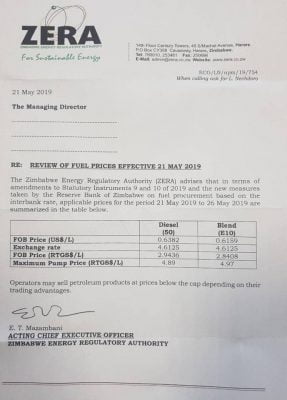
Government has liberalised the importation of fuel by allowing mining firms, transport operators and large corporates with capacity to procure the product on their own so as to ease pressure on the central bank.

Briefing journalists after a Cabinet meeting yesterday, Information minister Monica Mutsvangwa said mining companies and those who consume high volumes of fuel could now import on their own.

“Furthermore, Cabinet has given a greenlight to large companies such as those in the mining sector to use their funds to import fuel for their use,” she said.

Zimbabwe has been experiencing a fuel crisis since last year due to foreign currency shortages and this has resulted in long queues being witnessed across the country.

Energy and Power Development minister Joram Gumbo said the permission given to corporates to import their own fuel does not extend to individuals.

“This is not for individuals. At the moment, we are only allowing corporates,” he said. Cabinet also moved to change the Prisons Act and replace it with a new law that allows inmates to seek medical assistance from a medical doctor of their choice at their own expense as well as incorporate human rights issues as stated in the 2013 Constitution.

According to Justice minister Ziyambi Ziyambi, the proposed law, which will focus on the rehabilitation of offenders and integration of the same back into society, was aimed at conforming the country’s prison system to international standards.

“This new law provides for a mechanism that caters for vulnerable groups such as pregnant women, juvenile offenders as well as disabled and other special categories,” he said.

The new law would also broaden the scope of the parole system so as to accommodate all categories of prisoners to promote the establishment of correctional community centres throughout the country to cater for rehabilitated inmates upon release.

Cabinet further agreed to quicken the partial privatisation of State-owned Zupco and its capacitation through the introduction of electronic ticketing system in order to increase revenue collection and efficiency._NewsDay

Zim government urged to decriminalise artisanal mining

0

Zimabwean Coalition on Debt and Development (Zimcodd) has implored government to decriminalise
artisanal and small-scale mining (ASM) to enable the sector to fully contribute to economic
development, poverty alleviation and foreign currency retention.

In a statement, Zimcodd said government should promulgate an enabling legislative and regulatory
framework that decriminalises ASM which should be supported by objective, consistent, transparent
and non-discriminatory regulatory mechanisms which offer easy access to mining titles and legal
production channels.

This comes after a report showed that in 2018, ASMs contributed 65,5 percent of gold deliveries to
Fidelity Printers and Refineries, and this year’s Monetary Policy Statement showed that gold deliveries
from small- scale producers increased by 64,5 percent from 13,2 tonnes in 2017 to 21,7 tonnes in
2018.

“This amount is obviously an underestimation of their production levels considering that ASM is
criminalised in Zimbabwe. The contribution made by these miners under the unfavourable conditions
characterised by hide and seek operations is therefore a clear testimony that once decriminalised and
supported, it can turn around the economy,” Zimcodd said.

Zimcodd added that decriminalising ASM should be a quick win for the government in terms of
boosting foreign currency and export performance, because the informality of ASM does not only
sabotage the potential for turning around the economy but also have negative effects on the country’s
social, environmental and fiscal well-being.

“The government should use statistics highlighted in the monetary policy as a basis for incorporating
ASM as a strategic component for rural development which needs both technical and financial
support,” Zimcodd said. The government last month introduced the new monetary policy whereby
Real Time Gross settlements (RTGS) have been formalised to RTGS dollars and the exchange ratehas been officially pegged at 1: 2.5 to eradicate illegal foreign currency dealings, and promote foreign
currency retention.

However, small-scale miners have withheld their gold deliveries due to lower US dollar retention
barely five days after the announcement of the Monetary Policy Statement with only 20kg of gold
being delivered compared to the 60kg per day on average.

Zimcodd pointed out that an attempt by the government to increase the foreign currency retention
threshold for ASMs to 55 percent consistent with the bigger mining houses and proposed 30-day
amortisation period for redeeming the foreign currency retention may push off the ASMs to smuggling
and other alternative markets where they access 100 percent foreign currency for their proceeds.

There are approximately 500 000 artisanal and small-scale miners in Zimbabwe and over one million
people are dependent on the sub-sector._Daily News