Home Blog Page 92

Gold buying prices per gram in Zimbabwe, 26 June 2025

Gold buying prices per gram in Zimbabwe today, 26 June 2025, from the official gold buyer and exporter Fidelity Gold Refinery (FGR).

  • SG 90% and ABOVE US$100.81/g.
  • SG ABOVE 89% BUT BELOW 90% US$99.74/g.
  • SG ABOVE 80% BUT BELOW 85% US$98.68/g.
  • SG ABOVE 75% BUT BELOW 80% US$97.61/g.
  • SAMPLE BELOW 10g BUT ABOVE 5g US$96.01/g.

Fire Assay CASH $101.34/g.

NB: Fire Assay cash price is for gold above 100g; no sample is deducted.

A sample of not more than 10g is deducted for the Fire Assay Transfer price.

A 2% royalty is charged on all deposits (Small-scale miners).

A 5% royalty is set for Primary Producers.

In the Bush, Korokozas and Chinese Are Mining Our Future While We Watch From Cities

0

We left the tarred highway just past the outskirts of Bulawayo and headed towards Fort Rixon. It was a trip that seemed short on the map—just about 50 kilometres—but as the road narrowed into thick bushland and the occasional dust trail, we soon found ourselves swallowed by silence.

By Rudairo Mapuranga

For long stretches, there were no houses, no shops, no signs of community. The only notable structure we passed was a small police station, standing solitary in the middle of nowhere, like a checkpoint to forgotten potential.

I wasn’t there on official business, just tagging along with colleagues to check out a mining project in the area. But what I saw has stayed with me. It challenged something deep within me as a Zimbabwean who writes about mining every day but rarely steps into spaces like these.

In that forest, in what many might dismiss as “the middle of nowhere,” the ground is alive. Hidden among the trees was a busy, developing mine site. There were about seven Chinese nationals and a similar number of Zimbabweans on-site. From what I could see, this wasn’t your typical makeshift makorokoza operation—it was organised and structured. A decline shaft was being constructed. Rails were being laid. It was clear: this was a serious investment. Real money was going to be made.

And yet, as we stood there, watching this hive of activity, a disturbing thought crept into my mind: does anyone in government know what’s happening here? Do the mining inspectors come out this far? Do they even have the means to reach this place where roads demand off-road vehicles and where cellphone networks barely exist? And more importantly—who owns this?

This isn’t a story about illegal mining. It’s not even about corruption in the conventional sense. It’s about our absence. It’s about how, as Zimbabweans, we are not where we should be. We sit in Harare, in Gweru, in Mutare, in Bulawayo, comfortable in our city offices, scrolling through headlines about gold smuggling and illicit financial flows. We complain about the lack of opportunity. We say we’re being sidelined. But here, in the bush—where the real work is being done—we are ghosts.

We’ve left our forests to the Chinese and the makorokoza.

These forests—once dismissed as wilderness—are now hubs of opportunity. The Chinese are living there. The makorokoza have built lives there. They wake up every day and work with purpose. And meanwhile, we’ve convinced ourselves the money isn’t there. We say mining is for the well-connected. We say we can’t do it because we didn’t go to school for it. But the truth is, we don’t even try.

What struck me most wasn’t the sight of the rough-looking Chinese and Zimbabwean miners. It was the silence. The complete lack of a “presence” in any structured, sustainable way. Where are the young Zimbabwean entrepreneurs? Where are the geologists, the small-scale license holders, and the community cooperatives? Where are we in our own forests?

We need to change the narrative. We need to stop waiting for capital injections from overseas, for government schemes that never come, for donor-funded programs that benefit everyone except us. The wealth is there—right under our feet. The difference is that some are willing to live in tents, to endure the heat, to take the risk, while the rest of us only see forests and danger.

We speak often about the value chain, about formalising the sector, about beneficiation and exports. But what value chain are we part of if we are not present at the source? What beneficiation are we doing when we don’t even own the pickaxe?

Our children should be learning not just chemistry and economics, but geology and shaft development. We need to teach them that wealth isn’t in stock markets alone—it can also come from mastering what lies beneath our forests. We should be introducing them to the tools of extraction, to the economics of processing, to the ownership of resources. Instead, we teach them to wait for opportunities in the city.

The road to Fort Rixon is not paved. It will punish your car. It will make you question whether anything worthwhile could lie beyond the next turn. But in that roughness is something pure. Something unclaimed. Something deeply Zimbabwean.

And it’s being taken, quietly.

By people who saw the forest not as a barrier, but as a beginning.

So let us stop blaming those who go there. Let us stop calling them invaders when we have chosen to be absent. Let us find our way back—not in anger, but in conviction.

Because what we think is missing in our economy is not actually gone. It’s waiting for us. In the bush.

BREAKING: Mines and Minerals Bill Gazetted

0

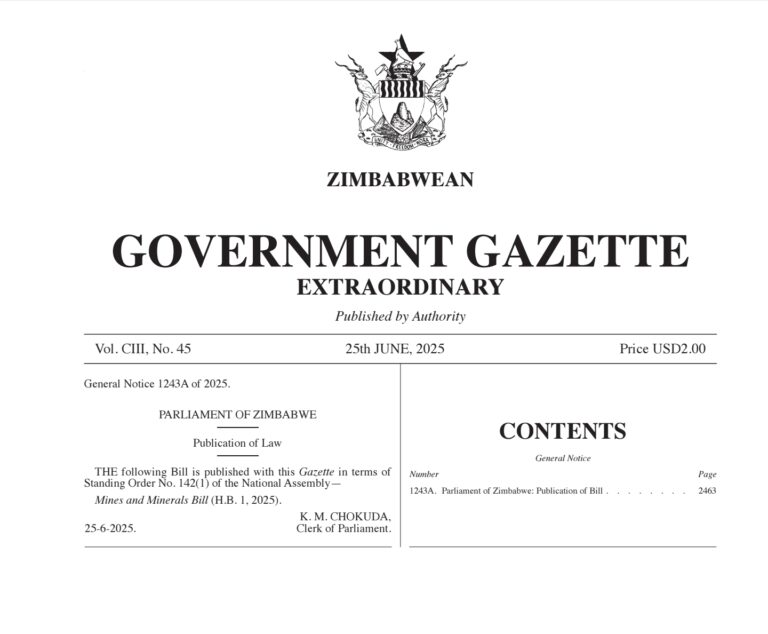
The long-awaited Mines and Minerals Bill (H.B. 1, 2025) has officially been gazetted, marking the latest chapter in Zimbabwe’s drawn-out journey to reform its colonial-era mining legislation, Mining Zimbabwe can report.

By Rudairo Mapuranga

Published in today’s Government Gazette by Clerk of Parliament K. M. Chokuda, the Bill is being introduced in terms of Standing Order No. 142(1) of the National Assembly. The development is significant as Zimbabwe’s mining industry—key to the country’s economy—continues to operate under the outdated Mines and Minerals Act of 1961, which stakeholders have for years described as unfit for the current socio-economic and environmental context.

This is not the first time the Mines and Minerals Bill has been gazetted. Over the past decade, several versions have been tabled, debated, and shelved—either lapsing in Parliament or stalling before receiving Presidential assent. This has fuelled uncertainty in the mining sector, especially among investors seeking a consistent and transparent legal framework.

What the 2025 Mines Bill Seeks to Address

The newly gazetted Bill proposes to:

  • Replace the Mines and Minerals Act [Chapter 21:05] with a more modern framework aligned with national development goals.
  • Establish a Mining Affairs Board to guide decision-making processes.
  • Introduce clearer rules on mining title management, particularly in terms of cadastre and exploration rights.
  • Strengthen environmental compliance and land rehabilitation obligations.
  • Improve governance through transparency and accountability mechanisms in the allocation of mining rights.
  • Define and protect community rights, including benefit-sharing and land access protocols.
  • Address concerns about exclusive prospecting orders (EPOs) and introduce frameworks that enable small-scale and artisanal miners to be formally recognised and supported.
  • Align the mining law with Zimbabwe’s Vision 2030 and other international obligations, particularly in the extractives sector.

While the Bill appears comprehensive, stakeholders are expected to scrutinise it heavily, especially in light of past concerns that previous versions lacked adequate provisions on resource nationalism, community participation, and state equity in major mining operations.

Will This Be the Final Push?

Despite having gone through various iterations under different Ministers of Mines and multiple parliamentary sessions, the Mines Bill has yet to be signed into law by the President. Its continued failure to cross the final legal threshold has drawn criticism from civil society, miners, and lawmakers alike, who argue that its passage is crucial to unlocking the full potential of Zimbabwe’s US$12 billion mining economy.

As the latest version of the Bill enters the parliamentary process, hopes are high but cautious. The big question remains: Will this be the year the Mines and Minerals Bill finally becomes law?

Gold buying prices per gram in Zimbabwe, 25 June 2025

Gold buying prices per gram in Zimbabwe today, 25 June 2025, from the official gold buyer and exporter Fidelity Gold Refinery (FGR).

  • SG 90% and ABOVE US$100.33/g.
  • SG ABOVE 89% BUT BELOW 90% US$99.27/g.
  • SG ABOVE 80% BUT BELOW 85% US$98.21/g.
  • SG ABOVE 75% BUT BELOW 80% US$97.15/g.
  • SAMPLE BELOW 10g BUT ABOVE 5g US$95.55/g.

Fire Assay CASH $100.86/g.

NB: Fire Assay cash price is for gold above 100g; no sample is deducted.

A sample of not more than 10g is deducted for the Fire Assay Transfer price.

A 2% royalty is charged on all deposits (Small-scale miners).

A 5% royalty is set for Primary Producers.

Survey is the Heart of a Mine: Why Surveying is Central to Zimbabwe’s Mining Future

0

From pegging new claims to guiding production underground, surveying remains the heartbeat of Zimbabwe’s mining sector. No shaft is sunk, no ore is blasted, and no plan is implemented without the critical input of a mine surveyor.

By Rudairo Mapuranga

As Zimbabwe intensifies its push for greater mining sector efficiency and order, the importance of mine surveying has come into sharper focus—technically, legally, and economically.

Surveyors are no longer just line-markers or underground mappers. They are now integrated data specialists, helping mines navigate the intersection of geology, engineering, compliance, and production. From exploration through to mine closure, every stage of the mining lifecycle relies on the precision and oversight of trained surveyors.

“Without surveying, there is no mine. You can’t mine what you haven’t measured, and you certainly can’t plan what you can’t map accurately,” said a senior mine planning engineer during a recent Association of Mine Surveyors of Zimbabwe (AMSZ) technical visit.


Why Surveying is Central to the Mining Value Chain

Zimbabwe’s mining sector continues to evolve, but at the centre of every successful operation is a survey-controlled process. Here’s how:

  • Pegging and Licensing: The first step of any mining venture begins with pegging. Mine surveyors define and secure the physical extent of a mining claim, ensuring legal title is backed by precise, professional mapping.

  • Exploration and Resource Modelling: Working alongside geologists, mine surveyors assist in accurate drill positioning and 3D mapping of ore bodies, which informs resource classification and investor reporting.

  • Mine Planning: Survey data feeds directly into open-pit and underground designs. Surveyors help determine how much ore can be mined, how safely, and over what timeframe.

  • Production and Monitoring: On a daily basis, surveyors track volumes moved, ore extracted, and stope progression, ensuring production targets are met and reconciled with plans.

  • Compliance and Safety: From blasting clearance to dump placement, mine surveyors ensure operations stay within legal boundaries, avoid encroachment, and support environmental and safety standards.

  • Closure and Rehabilitation: When the mining ends, it’s the survey department that validates volumes mined, facilitates closure planning, and provides data for rehabilitation and compliance audits.


Policy Shift: Handheld GPS Banned in Favour of Survey-Grade Instruments

Recognising the central role of surveying, and the damage caused by inaccurate data, the Ministry of Mines and Mining Development recently moved to ban the use of handheld GPS devices for capturing mine coordinates.

In a General Notice issued in June 2025, the Provincial Mining Director for Midlands instructed that all mining title holders must submit coordinates captured using survey-grade instruments, under the supervision of registered mine surveyors, starting 1 July 2025.

“Handheld GPS is a navigation tool, not a survey instrument. It has an error margin of up to 5 metres, which is completely unacceptable in high-stakes boundary work.”

This move follows years of disputes caused by overlapping claims, illegal pegging, and title inaccuracies—most of which stemmed from reliance on imprecise handheld tools. While a fully operational digital cadastre system is yet to be implemented in Zimbabwe, the government’s push for professionalised coordinate submission is a foundational step toward its success.


Students and Innovation: The Future of Surveying is Already Here

During a recent AMSZ technical visit to Blanket Mine in Gwanda, the association’s Secretary General Takunda Paul Mubaiwa said students and young professionals will shape the future of mine surveying in Zimbabwe. He called on students across universities and polytechnics to join the association, saying it opens access to real-world knowledge, mentorship, and entrepreneurial opportunities.

“Surveyors are no longer just underground workers. They are data scientists, consultants, even hardware and software developers,” Mubaiwa said. “We encourage students to think beyond the diploma.”

He emphasised that surveyors are now expected to not only capture data, but also process and interpret it in ways that drive decision-making—linking their work directly to production, revenue, and profitability.


The Case for Respecting Survey Work

Surveying has historically been treated as a support service in mining. But that perception is changing. As Zimbabwe moves to modernise and formalise its mining sector, surveying is now a core operational and strategic function.

  • It underpins legal title security

  • It drives investor confidence through reliable data

  • It supports cost control by linking inputs to outputs

  • It enables mine safety and environmental compliance

  • It is key to building a functional mining cadastre system

AMSZ is also advocating for the broader use of modern survey software like Deswik, already in use at Blanket Mine, which allows multi-departmental integration of planning, geology, and survey data.


Surveying is Not Optional, It’s Foundational

Zimbabwe’s mining ambitions—from $12 billion sector targets to greenfield lithium developments—depend on accurate, verifiable spatial data. That means surveying must take its rightful place as a profession of high responsibility, governed by standards, and supported by legislation.

“Surveying is the heart of a mine. Everything starts and ends with a coordinate, and only professionals should handle that responsibility,” Mubaiwa said.

As the government enforces accuracy, and the industry embraces digital transformation, surveyors are poised to lead Zimbabwe’s next mining chapter—with precision, professionalism, and pride.

Arcadia Lithium’s Goromonzi Project Recognised in China for Innovation in Community Development

0

Arcadia Lithium Mine’s Goromonzi Community Development Project, spearheaded by Huayou Cobalt, has been awarded a prestigious spot in the “2025 Innovative Cases of Business for Good” at the Family Philanthropy Inheritance Exchange Conference held in China, Mining Zimbabwe can report.

By Rudairo Mapuranga

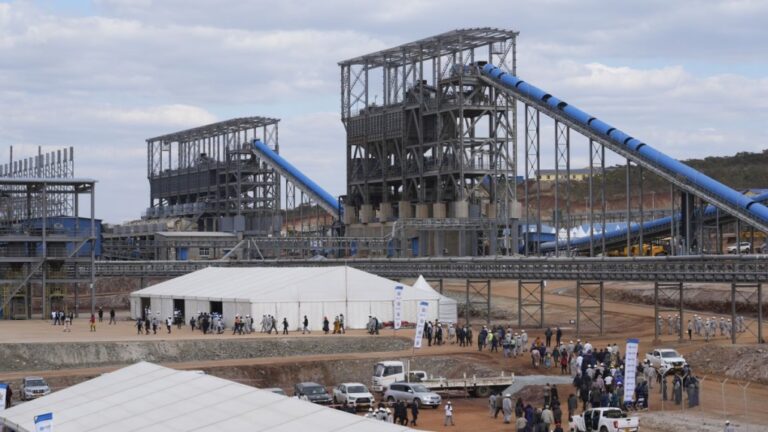
The recognition places Zimbabwe at the centre of a global conversation on inclusive mining and corporate social responsibility (CSR). Arcadia Lithium, owned by Prospect Lithium Zimbabwe (PLZ) — a subsidiary of Shanghai-listed battery metals giant Huayou Cobalt — is not only known for running one of the largest hard-rock lithium processing plants in Africa, but is also fast gaining respect for embedding community impact at the heart of its operations.

The event, hosted by the Family Culture Inheritance and Charity Trust Committee of the China Charity Federation, included Huayou Cobalt’s Goromonzi Community Development Project — which supports the community surrounding its lithium operations in Zimbabwe — among the “2025 Innovative Cases of Business for Good.”

Arcadia Lithium Mine is operated by Prospect Lithium Zimbabwe (PLZ), a subsidiary of China’s Huayou Cobalt, which acquired the mine in 2022.


Community Projects Cited for Practical Model

The recognition highlights Huayou’s approach to community support in Goromonzi, where the company is implementing a range of social development initiatives aligned with broader sustainability goals. The project was promoted in collaboration with the UN Global Compact’s Sino-African Sustainable Development Action Network, alongside input from three Chinese-listed companies and the University of Zimbabwe.

According to the organisers, the Goromonzi initiative was recognised for its “innovative practice model and measurable community outcomes” — particularly in health education, skills training, women’s empowerment, and local energy access.


What the Project Covers

The Goromonzi Community Development Project is structured around four core areas:

  • Health Promotion: Community programmes to raise awareness about basic health and hygiene, mainly targeting children.

  • Youth Skills Development: Vocational training aligned with local employment needs.

  • Women Empowerment: Sewing skills training with access to income-generating orders.

  • Access to Renewable Energy: Support for decentralised power supply to schools, homes, and small businesses.

According to sources familiar with the programme, the projects were selected following feasibility studies and stakeholder consultations, including with some local residents.


Recognition Comes Amid Broader ESG Push in Mining

While the recognition is notable, industry observers say it also comes at a time when ESG (Environmental, Social and Governance) expectations are rising in Zimbabwe’s mining sector.

Though still largely voluntary, CSR activities are becoming more central to how mining companies are evaluated — both locally and globally. In that context, Arcadia Lithium’s efforts are consistent with a broader trend among producers seeking to align operations with development priorities.


A Measured Step, Not a Benchmark

While the Goromonzi recognition helps shine a light on social investment practices in Zimbabwe’s mining sector, experts say context is important.

“Recognition doesn’t always mean replication,” said one mining analyst in Harare. “What works in Goromonzi may not work in Hwange or Zvishavane. But it’s a signal that companies are expected to do more than extract.”

In practical terms, this also highlights the need for stronger community engagement models, especially around high-value minerals like lithium, which are now central to the global energy transition.

Huayou’s approach, in this case, includes working with academic institutions and tapping into multilateral development networks — a move some believe could shape how other new entrants structure their CSR.

The recognition of Arcadia Lithium’s Goromonzi community development efforts in China reflects a growing shift in how mining projects are assessed — not just by production figures, but by their social footprint.

For Zimbabwe, it’s a reminder that resource development is now closely tied to how well companies engage communities, build skills, and contribute to local resilience. While not perfect or universal, Arcadia’s example offers a case study worth monitoring.

Everjoy Ngomamiti Returns to Lead Kavango’s Zimbabwe Mining Operations as GM

0

Kavango Resources Plc has appointed Everjoy Ngomamiti as General Manager of its Zimbabwe mining operations, marking a major boost to the company’s local leadership.

By Ryan Chigoche

Bringing nearly two decades of global mining experience across Africa and Australia, Ngomamiti returns home with the expertise needed to advance Kavango’s gold projects and drive the company’s growth in Zimbabwe’s evolving mining sector.

Ngomamiti, a Zimbabwean national, previously served as Mining Manager at Barrick Gold’s high-grade Bulyanhulu Mine in Tanzania, where he oversaw daily gold production of around 20 kg and managed a 600-person team.

Before that, he spent nine years working in gold and copper mines across Western Australia, gaining exposure to world-class mechanised mining systems.

Kavango has three gold projects in Zimbabwe, with the company focusing on its most promising asset—the Hillside Project—which consists of 44 gold claims covering 503 hectares in the Filabusi Greenstone Belt. The company’s other two projects are the Nara Gold and Leopard Projects.

Explaining his decision to return, Ngomamiti said it was driven by both personal and professional convictions.

“The biggest question people ask me is why I joined Kavango, coming from Barrick’s Bulyanhulu Mine. There, we were moving about 4,500 tonnes of material daily. Here, Kavango is currently producing only 30 tonnes. But for me, home is the best—I’m born and bred in Zimbabwe,” he said.

He added that Kavango’s vision also played a major role in his return.

“We’re sitting on the Filabusi Greenstone Belt, a 10-million-ounce complex. I believe in the next five years this will be a tier-one mine producing over 500,000 ounces annually. I’m excited to bring in the knowledge I’ve gathered abroad to help make that happen.”

Kavango’s Chief Executive Officer, Ben Turney, welcomed the appointment as a critical step forward in the company’s Zimbabwe strategy.

“We are certain that Everjoy’s experience will prove to be invaluable as Kavango seeks to introduce modern mechanised mining across its gold portfolio,” said Turney.

“Our goal was to find a Zimbabwean with deep international exposure to modern mining. Everjoy is a seasoned leader with an impressive operational record, and his return marks the beginning of Kavango’s next growth phase.”

“This is a first-class appointment for Kavango and marks the beginning of our move towards much more significant mining. Everjoy returns to help build something transformative in this country’s goldfields.”

Ngomamiti’s appointment signals Kavango’s shift from early-stage exploration to operational execution, as the company moves to build a significant gold-producing footprint in Zimbabwe.

The Filabusi Greenstone Belt, home to the Hillside Project, is historically rich in gold but remains largely underexplored using modern techniques.

With Ngomamiti’s experience and Kavango’s growing project pipeline, the company is well-positioned to unlock meaningful value and contribute to Zimbabwe’s mining revival.

Blanket Mine’s High-Grade Drilling Results Signal Resource Growth and Life Extension

0

One of the country’s leading gold producers, Caledonia Mining Corporation Plc, has reported further encouraging high-grade results from its ongoing resource expansion drilling programme at its 64%-owned Blanket Mine in Zimbabwe.

By Ryan Chigoche

The latest results are expected to significantly enhance the mine’s mineral resource base and potentially extend its operational life.

The drilling campaign, which commenced in January 2024, is aimed at evaluating the continuity of mineralised zones within three of Blanket Mine’s key orebodies: Blanket, Eroica, and Lima.

These efforts are focused on increasing confidence in existing resources and expanding the mineral resource estimate below the 34 level of the mine (1,110 metres).

This positive development at Blanket Mine comes at a time when gold prices are surging globally and are widely expected to continue rising. Driven by ongoing geopolitical conflicts and economic uncertainties, gold’s status as a safe-haven asset is strengthening investor demand. As a result, the potential increase in high-grade resources and extended mine life at Blanket positions Caledonia well to benefit from a favourable market environment, enhancing both production prospects and long-term value for shareholders.

Between January 2024 and the end of April 2025, Caledonia completed 6,976 metres of underground drilling, which confirmed that the Blanket and Eroica orebodies contain grades and widths that are generally better than previously expected.

Drilling also shows that the Lima orebody continues below the 22 level (750 metres). Additionally, a new potential orebody has been intersected in the Blanket orebody area, returning particularly strong early results.

Commenting on the development, Caledonia CEO Mark Learmonth said the company anticipates an increase in the mineral resource estimates thanks to the drilling results.

“Our ongoing drilling campaign continues to demonstrate encouraging results, further improving our confidence in the Blanket Mine mineral resource and pointing to additional future mineral resource growth. The grades and widths we are seeing from this drilling campaign are as good as, and in some cases considerably better than, results from previous drilling campaigns, which is highly encouraging. We anticipate that the positive grades and widths will result in an increased overall mineral resource estimate, which in due course should result in the extension of the existing life of mine. We have invested heavily in Blanket Mine over the last seven years to increase production capacity, resulting in a mine infrastructure that can sustain production beyond the current production horizon.”

The company said the increased density of drilling intersections is expected to upgrade existing inferred resources to the indicated category or higher, strengthening the foundation for long-term mine planning.

With deeper crosscuts developed to access the steeply dipping orebodies, Caledonia is now able to optimally drill and evaluate the mineralised zones at depth.

Current underground drilling is targeting the Blanket, ARM, and ARS orebodies down to the 38 level (1,230 metres below surface), representing a major push to identify deeper mineral potential.

At the same time, Caledonia has initiated a surface exploration programme within the Blanket Mine lease area, focused on a Banded Iron Formation (BIF) that runs in a north-westerly direction.

This BIF structure has historically supported gold production at nearby operations such as Vubachikwe and Sabiwa. Initial Induced Polarisation (IP) and Ground Magnetic (GM) surveys over a selected area delineated anomalies across a 600-metre strike. Follow-up mapping and shallow pitting confirmed the presence of quartz-filled shear zones within the BIF.

Grab samples from surface pits returned assay results ranging from 0.59 g/t to 32.12 g/t, based on analysis conducted at Blanket Mine’s onsite laboratory.

To further assess the potential of this surface target, Caledonia plans to undertake trenching at 50-metre spacing across the anomalous zone and initiate reverse circulation (RC) drilling to evaluate the presence of shallow oxide resources during 2025.

With both underground and surface exploration programmes delivering robust early-stage results, Caledonia is confident that Blanket Mine remains on a growth path, with additional high-grade discoveries enhancing the outlook for sustained production well into the future.

Oil Price Surge Threatens Zimbabwe’s Fragile Economy Amid Gulf Tensions

0

International oil prices have climbed to their highest levels in five months, with Brent crude briefly jumping 5.7% to US$81.40 a barrel before easing to US$78.39. Meanwhile, U.S. West Texas Intermediate rose 2.6% to US$75.76.

By Ryan Chigoche

The price spike follows U.S. airstrikes over the weekend targeting Iran’s nuclear sites at Fordow, Natanz, and Isfahan.

These strikes have intensified an already volatile situation in the Middle East, sparked two weeks ago by Israeli attacks on Iranian targets.

In response, Iran has threatened to shut down the Strait of Hormuz, a vital shipping lane that handles about 20% of global oil and 30% of liquefied natural gas.

The potential closure has sent global energy markets into disarray, raising fears of rising costs across fuel, freight, and consumer goods.

For Zimbabwe, which already endures the highest fuel prices in Africa, this global disruption is likely to lead to further local price hikes and economic stress.

The U.S. airstrikes, ordered by President Donald Trump, aimed to cripple Iran’s nuclear program and came shortly after Israel’s June 13 assault on Iranian military infrastructure. That Israeli offensive prompted a barrage of over 180 ballistic missiles from Iran in retaliation.

Amid this escalation, Iran’s parliament voted to consider shutting the 21-mile-wide Strait of Hormuz.

The waterway is a crucial route for oil exports from countries like Saudi Arabia, Iraq, Kuwait, and Iran itself, which pumps around 3.3 million barrels daily. A shutdown would pose a serious threat to global energy supplies.

The implications are particularly severe for Zimbabwe, which depends heavily on imported fuel sourced via South African ports and the Feruka pipeline from Mozambique’s Beira port.

As international oil prices surge, Zimbabwe’s import costs rise in tandem, adding pressure to an already strained economy that is battling persistent structural challenges and repeated external shocks.

The country’s fuel sector, already precarious, now faces a worsening outlook. In May 2025, petrol and diesel were priced at US$1.53 per litre—already among the highest in the Southern African Development Community (SADC) region—despite a prior drop in global oil prices earlier in the year.

The situation is further complicated by the role of the National Oil Company of Zimbabwe (NOCZIM), which oversees bulk fuel procurement.

The company has a troubled track record, with previous mismanagement contributing to erratic fuel supplies.

In past shortages, supply levels dropped to just 40% of demand, crippling both business operations and public transport.

With oil prices rising again, Zimbabwe could face a repeat of such supply disruptions, especially as the country continues to struggle with limited access to foreign currency, which is essential for importing fuel.

Zimbabwe’s multicurrency system—where the U.S. dollar dominates alongside the ZiG—adds another layer of complexity.

Fuel importers, already battling currency scarcity, now face soaring procurement costs that are likely to further deplete the country’s thin foreign reserves.

The economic impact will ripple across key sectors. Agriculture and mining, the two pillars of Zimbabwe’s economy, are highly vulnerable to fuel price volatility.

The 2024 El Niño-induced drought reduced agricultural output by 15%, leaving 7.7 million people food insecure.

For farmers reliant on diesel for irrigation and machinery, rising fuel costs will intensify production challenges, particularly as Zimbabwe’s fuel prices already exceed those in neighbouring countries such as Zambia and Botswana.

Higher shipping costs, driven by rising oil prices, also threaten to raise the price of maize imports—an essential staple for millions of households.

The industrial sector is equally exposed. Zimbabwe’s manufacturers are already grappling with chronic power cuts due to low water levels at Lake Kariba.

Blackouts lasting up to 12 hours a day have forced many factories to rely on diesel-powered generators. A jump in fuel prices will push operating costs even higher, undermining production and profitability.

Mining, one of Zimbabwe’s top export earners—especially through gold—may also take a hit. Increased transport and energy costs could squeeze margins, posing a setback to the government’s ambition of transforming the sector into a US$12 billion industry by 2030.

In the face of these converging pressures, Zimbabwe’s economy remains deeply exposed to global oil market shocks, especially when geopolitical instability in the Gulf region sends energy prices surging.


Gold buying prices per gram in Zimbabwe, 24 June 2025

Gold buying prices per gram in Zimbabwe today, 24 June 2025, from the official gold buyer and exporter Fidelity Gold Refinery (FGR).

  • SG 90% and ABOVE US$102.70/g.
  • SG ABOVE 89% BUT BELOW 90% US$101.62/g.
  • SG ABOVE 80% BUT BELOW 85% US$100.53/g.
  • SG ABOVE 75% BUT BELOW 80% US$99.44/g.
  • SAMPLE BELOW 10g BUT ABOVE 5g US$97.81/g.

Fire Assay CASH $103.25/g.

NB: Fire Assay cash price is for gold above 100g; no sample is deducted.

A sample of not more than 10g is deducted for the Fire Assay Transfer price.

A 2% royalty is charged on all deposits (Small-scale miners).

A 5% royalty is set for Primary Producers.