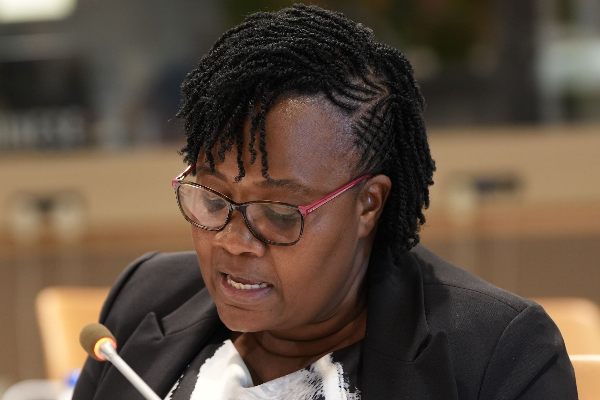
In an effort to ensure the rights of communities, artisanal miners and small-scale miners are protected regarding the proposed critical minerals framework in the Mines and Minerals Amendment Bill, Blessing Hungwe, the patron of the Zimbabwe Association of Women in Mining Associations (ZAWIMA), has raised urgent concerns about the potential displacement of discoverers of strategic mineral deposits, Mining Zimbabwe can report.
By Rudairo Mapuranga
Speaking at a ZAWIMA awareness session on the proposed legislation funded by the UK’s Foreign, Commonwealth and Development Office (FCDO), Hungwe emphasised that small-scale miners, particularly women, often serve as the initial discoverers of valuable strategic minerals but risk being excluded from the benefits when larger investors enter the picture.
“We, the small-scale miners, are the ones who discover this strategic mineral,” stated Hungwe. “Right now, I mine. I’m the one who unlocks the strategic minerals. How safe are we that we might not be displaced tomorrow because the State is saying they have to partner with somebody with the money? What about me, the small-scale miner? We have discovered the mineral, yet it’s silent about the small-scale miners on that.”
Her concerns centre on provisions in the bill that designate certain minerals as “strategic” and grant the minister significant discretion in determining who can mine them, typically requiring proof of substantial financial capacity that excludes small-scale operators.
The proposed legislation comes at a time when Zimbabwe is positioning itself to benefit from global demand for critical minerals essential for clean energy technologies, particularly lithium, which has seen significant discoveries in areas like Mberengwa, where artisanal miners have historically operated.
Internationally, approaches to compensating communities and small-scale discoverers of mineral resources vary significantly, offering potential models for Zimbabwe’s consideration:
In Australia, the mining industry operates under native title agreements that provide Indigenous communities with financial compensation, employment opportunities, and business development support. Recent lithium mining agreements in Western Australia have included structured benefit-sharing arrangements that provide traditional owners with royalty streams and equity participation in mining ventures, creating long-term wealth generation beyond immediate compensation for land use.
The United States operates under the General Mining Law of 1872, which establishes a system of locatable minerals on federal lands. While this system has been criticised for its historical approach, modern practice increasingly includes benefit-sharing agreements with Indigenous communities. Recent critical minerals initiatives under the Biden administration have emphasised community benefit agreements and environmental justice components, ensuring that mining projects deliver tangible benefits to local populations.
Across Africa, several nations have developed innovative approaches. In Ghana, the Mineral Development Fund allocates a portion of mining royalties to local communities and traditional authorities, creating a direct benefit stream from mining operations. Similarly, Botswana’s mining revenue-sharing model has been praised for directing a significant percentage of diamond mining revenues to local development projects and national savings.
South Africa’s Mining Charter includes specific provisions for community participation, requiring that mining rights holders facilitate meaningful participation from affected communities through equity ownership, mine community development, and human resource development.
Hungwe’s advocacy extends beyond traditional compensation models, suggesting that communities and discoverers should receive equity in mining ventures. “Although communities don’t have titles for the land, after compensation with houses and other land, maybe for farming, they should also be included in the shareholding structure,” she asserted, pointing toward a more sustainable model of benefit sharing.
This approach aligns with emerging best practices in resource governance that recognise mineral wealth as a national asset that should benefit all citizens, particularly those directly affected by extraction. Equity participation ensures that communities share not just in the burdens of mining operations but also in the long-term wealth generation.
Legal experts note that incorporating such provisions would require specific amendments to the Mines and Minerals Bill, potentially including:
- Clear definitions of artisanal and small-scale miners that recognise their role in mineral discovery
- Provisions for preferential rights for discoverers of mineral deposits
- Mandatory community equity participation in strategic mineral projects
- Establishment of a benefit-sharing mechanism that directs a percentage of mining revenues to local development
- Protection against the arbitrary displacement of artisanal miners who have discovered strategic minerals
The ZAWIMA dialogue highlighted particular concerns about how women miners might be excluded from the benefits of strategic mineral development. Hungwe noted that “many women just take sands from the riverbeds and then they wash and they get gold,” yet these activities are not properly recognised or protected in the current legal framework.
The absence of gender-responsive provisions in the mining legislation could perpetuate existing inequalities in the sector, where women often participate in the most labour-intensive and least lucrative aspects of mining while being excluded from decision-making processes and higher-value opportunities.
Research from other mining jurisdictions shows that including gender perspectives in mineral governance leads to more equitable outcomes and more sustainable community development. Mechanisms such as reserving a percentage of small-scale mining licences for women, ensuring women’s representation in community mining committees, and designing benefit-sharing schemes that address women’s specific needs can help create a more inclusive mining sector.
As Zimbabwe moves to finalise its Mines and Minerals Amendment Bill, stakeholders like ZAWIMA are advocating for provisions that balance the need to attract investment in strategic minerals with the imperative to protect the rights of artisanal miners, small-scale operators, and local communities.
The inclusion of clear mechanisms for equity participation, benefit sharing, and protection of discoverers’ rights could position Zimbabwe as a leader in equitable mineral governance while ensuring that the benefits of the country’s mineral wealth are broadly shared.
With global demand for critical minerals projected to grow exponentially in the coming decades as the world transitions to clean energy, establishing fair and transparent governance frameworks now will determine whether Zimbabwe’s mineral endowment becomes a source of inclusive development or further inequality.
The ongoing consultations on the Mines and Minerals Amendment Bill represent a critical opportunity to embed principles of equity and justice at the heart of Zimbabwe’s mining sector, ensuring that those who discover and live alongside strategic mineral deposits are not merely compensated for displacement but become genuine partners in the development of these resources.