




Key Takeaways: Zimbabwe’s 2026 Lithium Export Ban
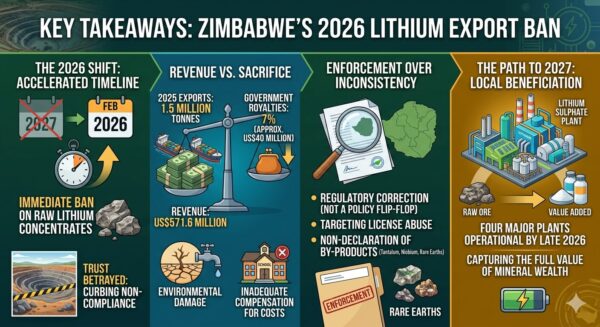
- The 2026 Shift: In February 2026, Zimbabwe accelerated its original 2027 timeline, imposing an immediate ban on raw lithium concentrates. This move aims to curb “trust betrayed” by companies allegedly under-declaring minerals and stockpiling resources across borders.
- Revenue vs Sacrifice: Despite exporting 1.5 million tonnes of lithium in 2025 (generating US$571.6 million), the government received only 7% in royalties (approx. US$40 million)—a figure considered inadequate given the environmental and social costs of extraction.
- Enforcement over Inconsistency: The ban is framed as a regulatory correction rather than a policy flip-flop, targeting widespread license abuse and the non-declaration of valuable byproducts such as tantalum, niobium, and rare-earth minerals.
- The Path to 2027: The government is transitioning the industry toward local beneficiation, with four major lithium sulphate plants expected to be operational by late 2026 to ensure Zimbabwe captures the full value of its mineral wealth.

In the weeks since Zimbabwe suspended all raw lithium concentrates and mineral exports, a narrative has emerged that the government acted abruptly, changing the rules without warning. But this framing misses a fundamental truth: the ban was not a policy reversal. It was the inevitable consequence of trust betrayed.
By Rudairo Maparanga
For years, the government extended an extraordinary level of trust to mining companies, particularly Chinese lithium producers, granting them 100 per cent ownership of mining rights, allowing them to employ their own personnel, and providing a regulatory environment that treated them as partners in national development. No country in the world gives foreign investors such unfettered access to its strategic resources without expecting reciprocal responsibility.
That trust, it appears, was misplaced.
The PGMs Example: What Responsible Players Do
The platinum group metals (PGMs) sector provides a stark contrast. Companies like Zimplats, Mimosa, and Unki operate in Zimbabwe with a clear understanding of their obligations. When they export concentrates, they declare the full range of minerals found in their ore bodies. They adhere to international Environmental, Social, and Governance (ESG) standards. They recognise that integrity is not optional, it is the price of doing business.
“PGM players declare the minerals found in their cake concentrates. But why weren’t lithium players doing the same?”
The answer, according to the Ministry of Mines and Mining Development, lies in a systematic failure to comply with existing law.
The Law Was Clear: Declare What You Find
Zimbabwean law has long required miners to declare all minerals discovered in their operations. This is not a new regulation. It is a basic principle of resource governance: a nation cannot benefit from what it does not know it has.
Yet the lithium sector, despite being dominated by major international companies, some listed on respected stock exchanges, all claiming adherence to rigorous ESG standards, chose to ignore this fundamental obligation.
“They were trusted to do the right thing, and they bothered not to,” Permanent Secretary of the Mines Ministry, Pfungwa Kunaka, said in a recent address to Parliament.
Why Enforcement Became Necessary
The government was not equipped to conduct day-to-day monitoring of every mining operation across the country. In a mature, responsible industry, such constant oversight should not be necessary. Companies operating in Zimbabwe are not artisanal miners working in the shadows. They are sophisticated, well-capitalised corporations with dedicated compliance departments, sustainability reports, and public commitments to ethical operations.
But when trust is abused, the calculus changes.
Kunaka outlined the specific factors that forced the government’s hand:
Multi-mineral deposits being stripped of value: Studies revealed that Zimbabwe’s lithium ore bodies contain significant quantities of other valuable elements, rare earth minerals, tantalum, niobium, and others, that were being exported without declaration, depriving the country of their value.
Widespread license abuse: Temporary export permits, granted to allow companies time to build processing capacity, were being recycled endlessly, with a single license used dozens of times by multiple operators.
Misdeclaration and falsification: Minerals were being exported under false descriptions, with high-grade lithium declared as low-grade waste to evade taxes.
Illicit stockpiling across borders: Disturbing reports emerged of substantial quantities of Zimbabwean lithium stockpiled in neighbouring countries, awaiting export without any benefit to Zimbabwe.
The 2027 timeline is being abused: The government had announced a 2027 deadline for the transition to local processing, expecting companies to use the intervening years to build capacity. Instead, many used the window to extract and export as much raw material as possible before the deadline.
“This behaviour amounts to nothing less than the plunder of our national heritage,” government spokesperson Nick Mangwana said at the time. “It is a direct undermining of our sovereignty and our collective economic future.”
The Numbers: What Was Zimbabwe Getting?
Let us examine the returns Zimbabwe received before the ban.
In 2025, Zimbabwe exported over 1.5 million tonnes of lithium, generating approximately US40 million.
For context, consider what Zimbabwe gives up in exchange for that US$40 million. Mining, by its nature, destroys the environment. It consumes vast quantities of water in water-scarce regions. It displaces communities. It degrades land that could otherwise support agriculture. It creates health risks for workers and nearby residents. And it depletes a non-renewable resource that future generations will never see.
Is US$40 million adequate compensation for that level of sacrifice? The answer is self-evident. And that calculation does not even account for the value of the undeclared minerals, the rare earths, the tantalum, the niobium, that were shipped out without any contribution to Zimbabwe’s treasury.
No Country would tolerate this
Nowhere in the world would such arrangements be accepted. In Australia, Canada, Chile, or any other major mining jurisdiction, companies that systematically under-declare their production, falsify export documents, and abuse permits would face not just regulatory action but criminal prosecution.
Zimbabwe extended trust. It offered 100 per cent ownership, a favourable fiscal regime, and the confidence that comes from a stable policy environment. It asked only that investors comply with the law and act with integrity.
That trust was repaid with plunder.
The Ban: A Necessary Correction
The suspension of raw mineral exports is not a policy inconsistency. It is policy enforcement. It is the government finally doing what it should have done years ago: closing the loopholes that allowed a few operators to enrich themselves at the expense of the nation.
The ban creates space for several critical interventions:
Day-to-day monitoring will be established, with MMCZ officers now stationed at border posts and equipped with testing technology to verify every shipment.
New legislation is being developed to criminalise the non-declaration of minerals, creating real consequences for those who choose to operate outside the law.
A legal framework will ensure that companies are held accountable for what they extract, not just what they choose to declare.
Processing capacity will be developed, with at least four lithium sulphate plants expected to be operational by the end of 2026, ensuring that Zimbabwe finally captures the value of its resources.
The Role of Chinese Investors
The Chinese companies that dominate Zimbabwe’s lithium sector have made substantial investments. They have built relationships. They have contributed to the economy. But they have also, according to government findings, been central to the practices that necessitated the ban.
Chinese-owned firms were among those granted temporary export permits and those found to be abusing them. Chinese investors were implicated in the undervaluation of exports through transfer pricing. Chinese buyers were the primary cash purchasers at the border, fueling the parallel market that drained Zimbabwe of its resources.
When the government says it was betrayed, it is not speaking in abstractions. It is speaking about specific companies, specific practices, and specific individuals who chose short-term profit over long-term partnership.
The ban is not the end of the story. It is the beginning of a new chapter, one in which Zimbabwe’s resources will be processed in Zimbabwe, where the full value of multi-mineral deposits will be captured, and where companies that operate here will be held to the same standards as they would be in any other jurisdiction.
The PGMs sector shows what is possible. Zimplats, Mimosa, and Unki have demonstrated that world-class mining and compliance with Zimbabwean law are not mutually exclusive. They have built processing capacity. They employ Zimbabweans at senior levels. They declare what they find. And they are profitable.
There is no reason the lithium sector cannot do the same.
Trust, But Verify
The adage is now government policy: trust, but verify. Companies that wish to mine Zimbabwe’s resources will be trusted to comply with the law. But where that trust is abused, the government will act.
The ban on raw mineral exports is not about chasing away investment. It is about ensuring that the investment that remains is the kind that benefits Zimbabwe. It is about integrity. It is about accountability. And it is about a nation finally demanding what it should have demanded all along: that those who take from the country also give back.
As one government official put it: “We gave them everything, the right to own 100 per cent, to employ their people, to operate in a stable environment. They gave us betrayal. The ban is not a policy change. It is a response to that betrayal.”
The era of trust without accountability is over. The era of enforcement has begun.

