Home Blog Page 212

British investor to acquire a major interest in Sandawana

0

Cluff Resources Africa (CRA), owned by veteran British miner Algy Cluff, is seeking to acquire a major interest in the rich lithium camp of Sandawana Mining Lease 3 and is currently negotiating with the Mutapa Investment Fund, Country Manager and Consultant Geologist Mark Tsomondo has revealed to Mining Zimbabwe.

Rudairo Mapuranga

Tsomondo stated that Dr. John Mangudya, the CEO of Mutapa will release more information about the negotiations in due course.

He mentioned that Cluff Resources Africa intends to explore, develop the mine, and process the resource according to the standards set by the Sovereign Wealth Fund.

“We are negotiating with the Mutapa Investment Fund to acquire Sandawana Mines. We anticipate receiving useful updates from the CEO of Mutapa Investment Fund this week, and I would prefer not to comment further until these delicate negotiations are concluded, as they involve third parties. However, we are very interested and excited about the prospect of entering the Sandawana environment, where we believe we can conduct exploration, mine development, and processing to the standards befitting the Sovereign Wealth Fund,” he said.

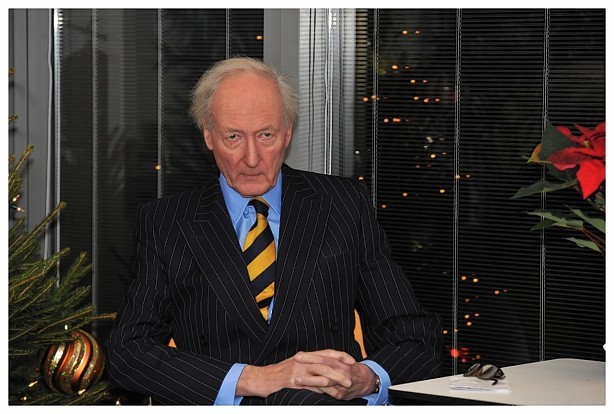
The top geologist said Cluff visited Sandawana in April where he presented his vision and desire to list on the local and external stock markets.

“Algy Cluff visited Sandawana Mines this April and met with Mine Management. There, he presented his vision and goals that include employee shareholding and listing the entity on the local and external bourses.

Sandawana Mines, which is one of the assets under Kuvimba Mining House (KMH), is sitting on an estimated 100 million tonnes of lithium resources, making it one of the biggest lithium assets in the world.

Harare Eager to Promote EVs in Zimbabwe

0

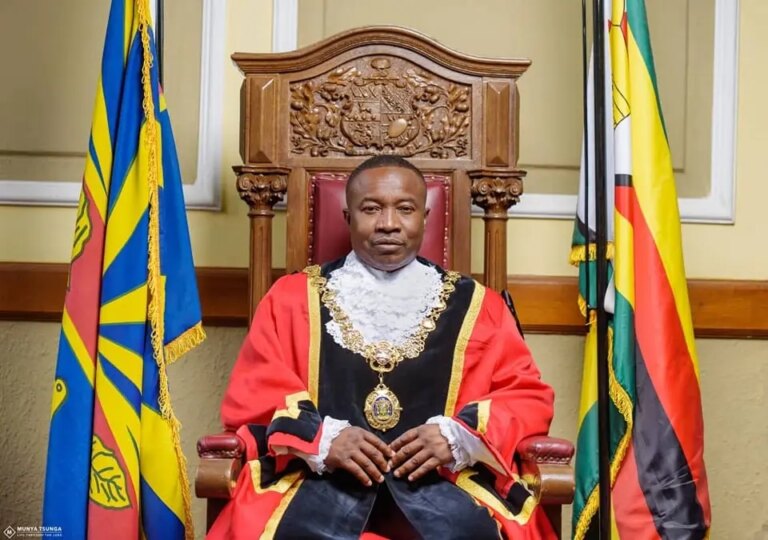
The capital city of Zimbabwe, Harare, is poised to lead the charge in promoting electric vehicles (EVs) as part of its commitment to fostering a green energy revolution, announced the city’s Mayor, Jacob Mafume.

Mayor Mafume unveiled bold initiatives aimed at placing Harare on the map for clean energy, aligning with global efforts to achieve Sustainable Development Goals (SDGs) by 2030.

Under the City Council’s Energy policy, approvals for new service stations will now require the inclusion of clean energy equipment, such as vehicle charging ports.

Mayor Mafume emphasized the importance of integrating EV infrastructure into the city’s urban landscape, ensuring that every new service station provides charging ports for electric vehicles. This proactive approach underscores Harare’s commitment to embracing sustainable transportation alternatives and reducing carbon emissions.

Speaking about the city’s vision for promoting EV adoption, Mayor Mafume highlighted the need for strategic planning and collaboration across various sectors. “Every service station will have to have a charging port for electric vehicles going forward,” he stated.

“We are also going to add more incentives towards the use of electric cars as we go forward.”

The Mayor said that Harare aims to incentivize electric vehicle ownership by providing designated parking slots for EVs in urban areas. This initiative not only encourages residents to transition to electric transportation but also contributes to reducing traffic congestion and air pollution in Harare’s bustling streets.

Harare’s vision aligns with global trends towards sustainable energy and transportation. The International Energy Agency (IEA) projects a significant increase in electric vehicle adoption over the coming decades, with EVs accounting for a substantial portion of new vehicle sales worldwide. As countries strive to meet their climate targets and reduce dependence on fossil fuels, the transition to electric mobility is becoming increasingly imperative.

Zimbabwe, like many nations, has committed to achieving the SDGs by 2030, with Goal 7 specifically focusing on ensuring access to affordable, reliable, sustainable, and modern energy for all. By promoting EVs and investing in clean energy infrastructure, Harare is taking proactive steps towards fulfilling this global mandate and contributing to a more sustainable future for its citizens.

Harare’s “eagerness to promote EVs signifies a paradigm shift towards sustainable transportation and energy solutions. By embracing electric mobility and integrating EV infrastructure into its urban landscape, the city is not only driving the green energy agenda forward but also positioning itself as a leader in sustainable development within the region,” Mayor Mafume said.

As Zimbabwe strives to achieve its SDGs and address the challenges of climate change, initiatives like these demonstrate the transformative power of local action in shaping a cleaner, greener, and more resilient future for all.

However calls for Zimbabwe to produce Lithium batteries which are key to the storage of energy, grow louder and louder every day.

Miners Celebrate as ZMF Secures Major EV Deals in China, cars will be sold on a loan scheme to members

0

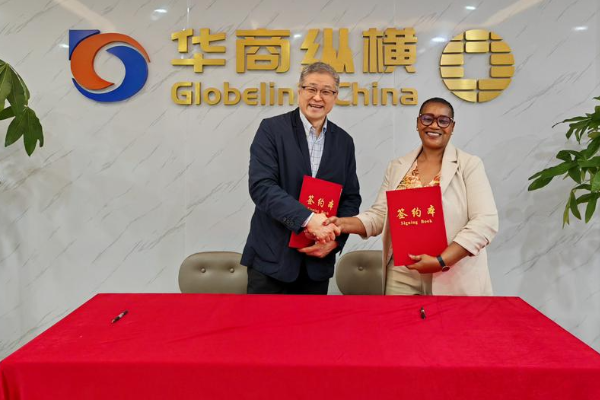
The Zimbabwe Miners Federation (ZMF) is abuzz with excitement following the organisation’s President Ms Henrietta Rushwaya‘s successful negotiations in China in securing an electric vehicle (EV) scheme for the organisation’s members.

Brand new EV cars will be sold on a loan scheme to ZMF members and non-members, with ZMF members benefiting from a discounted rate. The schedule for the cars will be unveiled soon, but gleaned information indicates that the cars will be sold for less than USD$8,000.

Morgan Mugawu, Secretary-General of ZMF, lauded Rushwaya’s achievements, emphasizing the tangible benefits that EV adoption will bring to ZMF members.

Under the newly established scheme, ASM participants can acquire EV motorcycles at an affordable rate, with a minimal $300 deposit and a convenient payment plan of $200 monthly for three months.

Expressing gratitude toward President Rushwaya for her leadership and vision, Mugawu highlighted the need for continuous innovation in equipment manufacturing. He envisions a future where not only transportation but also mining equipment operates on electricity, further reducing reliance on fossil fuels and contributing to Zimbabwe’s green revolution agenda.

The Secretary for Youths, Darlington Ndhlovu, supported this achievement as a revolutionary milestone in the mining sector, aiding toward the attainment of Vision 2030, where no one will be left behind and every miner, especially the youths, will be given an equal opportunity to prove their mettle.

The ZMF National Chairman, Mr. Tichaona Mharadze, said ZMF will never be the same again with such initiatives being created for the small-scale miners by its leadership.

The National Secretary for Women, Madam Jesica Mazivazvose, applauded the move, advising all women to capitalize on the current good price of gold and gave this example: sell 5 grams of gold to Fidelity, and you get your deposit for the motorbike. As for the balance, you only need to raise less than 8 grams in two months. You need 12 grams to be a proud owner of an electric motorbike, Mazivazvose said.

Building on this momentum, ZMF recently launched an equipment and consumables scheme in Zvishavane, specifically targeting the empowerment of youth and women engaged in ASM activities. This initiative reflects ZMF’s dedication to fostering inclusivity and sustainability within the mining sector, ensuring that all members have access to resources and opportunities for growth.

The ZMF EV scheme will be unveiled in June at the ZMF AGM, which will be graced by the Mines and Mining Development Minister, Hon. Winston Chitando.

Rushwaya’s initiative marks a significant stride toward promoting green energy within the artisanal and small-scale mining (ASM) sector, aiming to curb carbon emissions in Zimbabwe. In line with the nation’s Sustainable Development Goals (SDGs), Rushwaya’s efforts underscore the commitment to foster sustainable practices within Zimbabwe’s mining industry.

Rushwaya could not be reached for comment as she is still in China.

ZiG hits Harare streets

0

The Reserve Bank of Zimbabwe (RBZ) began circulating the new Zimbabwe Gold (ZiG) banknotes this Tuesday, with individuals permitted to withdraw only ZiG3,000 per week and companies ZiG30,000 per week.

Patricia Rwafa

On April 5th, the new RBZ governor, John Mushayavanhu, launched the ZiG currency, backed by reserves of US dollars and precious metals, particularly gold, aiming to replace the Zimbabwe dollar, which had been decimated by relentless inflation.

RBZ Governor John Mushayavanhu stated that all necessary information about money distribution and withdrawal limits has been relayed to commercial banks.

In an update on April 29th, Dr. John Mushayavanhu, RBZ Governor, confirmed that authorities had finalized distribution systems by the end of business.

“We will see the new notes and coins effective this Tuesday. All modalities are complete, and Zimbabweans can begin using the currency tomorrow morning (Tuesday), depending on each bank’s logistics.

“There is a need for Zimbabweans to use ZiG. I urge the nation to adopt a currency preservation system for ease and convenience in Zimbabwe. Confidence is crucial, and as the central bank, we guarantee confidence in the economy,” said Dr. Mushayavanhu.

Zimbabweans started withdrawing cash and coins from their bank accounts today.

Schools, hospitals, clinics, and local governments can withdraw up to ZiG 250,000 each month, while government ministries have a higher limit of ZiG 300,000. Notably, there are no restrictions on cash withdrawals for parliament, courts, and international organizations.

Customers with a valid need to withdraw cash above the stipulated limit are expected to apply for permission from the RBZ’s Financial Intelligence Unit, which recently launched a crackdown on money changers in conjunction with the police.

Bikita Minerals loses fight over ‘stolen’ lithium ore

0

Lithium producer Bikita Minerals has lost a case in which it had approached the High Court seeking an interdict against Aurion Resources over some lithium ore it claimed had been stolen from its mine, Zim Independent has reported.

Bikita Minerals dragged Aurion Resources, the officer in charge ZRP CID Flora and Fauna Unit in Masvingo and the officer commanding ZRP Masvingo province to the High Court over the ore.

However, Justice Sunsley Zisengwe in his determination said Bikita Minerals in its draft order did not state that second tests be done in South Africa.

He said Bikita Minerals sought the indulgence of the court to make the amendments to its draft order with the insertion of South Africa as the exclusive source of the second tests.

“Such a wholesale attempt to amend the terms of the order sought can only mean one thing. That such a course of action was never in the contemplation of the parties when they agreed to a second opinion in respect of the lithium ore samples.

“Ultimately, therefore, I do not believe the applicant has established a clear right to have the samples sent exclusively to South Africa for a second opinion.

“A second opinion has already been procured albeit one not favourable to the applicant. The application, therefore, stands to be dismissed on that basis,” Justice Zisengwe ruled.

He also dismissed the application for the interdict on account of Bikita Minerals’ failure to establish a clear right.

“Even if he had established a clear right the application would still have failed on the basis of the failure by the applicant to show absence of an alternative remedy.

“Accordingly, the application for a final interdict is hereby dismissed with applicant meeting first respondent’s costs of suit,” the judge ruled.

The core of the matter was a dispute over the origins and ownership of a consignment of lithium ore seized by police on May 8 last year.

Bikita Minerals and Aurion Resources are both into lithium ore mining while the latter also sources lithium ore from small-scale miners.

According to the application, Bikita Minerals on May 5 last year, received information from the police that some lithium ore suspected to have been extracted from its mine, was at Aurion Resources’ premises.

The police seized the lithium ore, three days later, on suspicions that it had been stolen.

An agreement was made between the parties and the police that samples be subjected to metallurgical testing by a government assayer to establish if the lithium ore belonged to Bikita Minerals.

The test compared the seized lithium ore with samples originating from the Bikita Minerals and Aurion Resources mines.

There are three types of lithium ore namely Petalite, Spodumene and Lepidolite.

A metallurgical technician Netsai Makanga from the government’s Department of Metallurgy conducted the tests and the results were not supporting Bikita Minerals’ claim.

Criminal proceedings were also instituted against the person who was found in possession of the ore on the basis that the mineral had been stole.

However, the court ordered that the ore be released to Aurion Resources but Bikita Minerals challenged the release opting for a second test.

The second tests were then conducted by Glenda Farirepi, the chief chemist at the Department of Metallurgy with the results indicating that the ore did not belong to Bikita Minerals.

Bikita Minerals, however, insisted that the second tests did not constitute a second report arguing that they were obtained from the same institution.

The miner suggested that the second tests be done in South Africa saying that the purported second opinion did not qualify as a second opinion.

However, Aurion Resources challenged the move arguing that the timeline for the obtainment of a report from South Africa could not be met because of the red-tape involved in government systems which required Cabinet authority for samples to be taken abroad for analysis.

Aurion Resources insisted that it owns the disputed lithium ore arguing that Bikita Minerals filed a police report under the mistaken belief that the ore belonged to it.

It also argued that Bikita Minerals was constantly changing goal posts in the sense that what was agreed was that a second opinion be obtained to determine the origins of the disputed lithium ore.

Kuvimba Mining House Group CEO Simba Chinyemba to leave Kuvimba for Mutapa Investment Fund

0

Kuvimba Mining House (KMH) Chief Executive Officer (CEO) Simba Chinyemba is set to leave the diversified mining company to join Mutapa Investment as Chief Investment Officer (CIO), Mining Zimbabwe has learnt.

According to sources Chinyemba was headhunted for the Chief Investment Officer position and will be overseeing state-owned enterprises that include Net One, National Railways of Zimbabwe, Air Zimbabwe, TelOne, Cottco, Zupco, Defold Mine, Kuvimba Mining House, Silo Investments, National Oil Company of Zimbabwe, Cold Storage Commission Limited, Petrotrade, People’s Own Savings Bank, ZESA, Fidelity Gold Refinery, Homelink, Arda Seeds, Zimbabwe Power Company, PowerTel Communications, Allied Timbers, Telecel, Industrial Development Corporation and Hwange Colliery Company.

Chinyemba was Chief Operating Officer (COO) of Kuvimba where he oversaw the creation of the mining group before he was promoted to be its CEO taking over from David Brown in 2021. He was tasked with overseeing the company’s large array of assets either as 100% owner or as a majority shareholder. These include top gold producer Freda Rebecca Gold Mine, Bindura Nickel Corporation, Shamva Mining Company, Jena Mines, Elvington Mine, Sandawana Mine, Zimbabwe Alloys Limited, Great Dyke Investments and Homestake Mines.

Under his leadership, KMH has seen a notable turnaround from a company burdened by negative perceptions and struggling assets to becoming a leading force in the mining sector.

Chinyemba’s tenure began amid skepticism about KMH’s credibility within the Zimbabwe mining industry however, he swiftly spearheaded transformative initiatives that reshaped the company’s trajectory.

One of Chinyemba’s standout achievements was streamlining KMH’s operations by consolidating fragmented mining entities. This restructuring not only streamlined processes but also highlighted the company’s commitment to efficiency, leadership development and gender diversity, with a notable insistence on a quota representation of women in operational roles.

Furthermore, Chinyemba’s dedication to Corporate Social Responsibility (CSR) shone through KMH’s initiative to sponsor University education for six underprivileged students demonstrating his commitment to youth empowerment and gender equity.

Prior to his role as Kuvimba CEO, Chinyemba who by profession is a qualified actuary with the Institute and Faculty of Actuaries (U.K) by held various leadership and board roles in the United Kingdom, Asia, the Middle East and various African countries.

His appointment as Chief Investment Officer signifies a new chapter in one of Zimbabwe’s rising stars and in his illustrious career. He will oversee a diversified investment portfolio of the country’s most important asset holdings. This elevation recognizes his outstanding contributions and underscores his strategic acumen in navigating complex business landscapes.

MMCZ-ZSM Gemstone Cutting and Polishing Training Centre Officially Opened

0

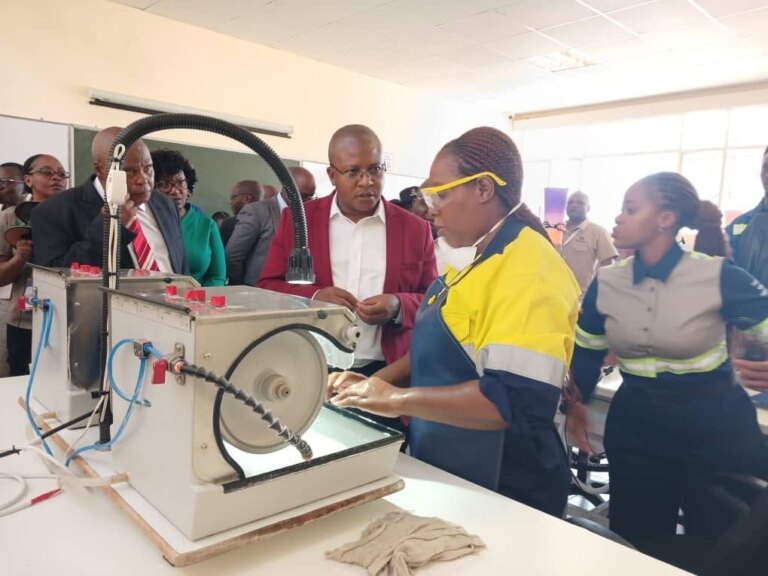
The Deputy Minister of Mines and Mining Development, Engineer Polite Kambamura, unveiled the Minerals Marketing Corporation of Zimbabwe (MMCZ)Zimbabwe School of Mines (ZSM) Gemstone Cutting and Polishing Training Centre on Thursday last week.

Aligned with the National Development Strategy 1 (NDS1) for 2021-2025, aimed at promoting value addition and beneficiation, MMCZ collaborated with ZSM to establish a gemstone cutting and polishing centre offering a training program tailored to empower miners in the gemstone sector.

This initiative employs a multi-faceted approach, including:

1. Encouraging Formalization of the gemstone sector: Equipping miners with knowledge and education on the gemstone regulatory framework and avenues for selling gemstones through official channels, thereby reducing mineral leakages.

2. Boosting Gemstone Production: Providing miners with the necessary knowledge and skills to enhance their gemstone output.

3. Maximizing Recovery Rates: Training focusing on improved techniques to minimize gemstone loss during extraction and processing.

4. Greater control over the value chain: Allowing miners to be more engaged in the gemstone processing process, granting them increased control over their earnings.

5. Creating new income opportunities: The capacity to produce finished gemstones can unlock fresh markets and income streams for our miners and the nation as a whole.

Speaking at the unveiling of the centre, Deputy Minister of Mines and Mining Development Engineer Polite Kambamura commended MMCZ and ZSM for their strategic roles in both the mining sector and national economic development.

He stressed the importance of the mining sector’s growth in cultivating skilled human capital, underscoring ZSM’s pivotal role in this endeavour.

Engineer Kambamura also emphasized the significance of innovation in industrialization, aligning with the 2024 ZITF theme, “Innovation as a Catalyst for Industrialization in Trade.” He urged ZSM to embrace innovation and modern technological trends, aligning its curriculum with global standards to prepare students for the fifth industrial revolution in mining.

“With the growth in the mining sector, ladies and gentlemen, we anticipate exponential growth in human capital with the right skills. The role of the Zimbabwe School of Mines cannot be overemphasized. We applaud MMCZ for partnering with the school to achieve the national goal of mining school development in the mining industry. Most importantly, the objective of empowering youth and women to set up their own value-addition centres across the country. This ceremony is taking place on the margins of the 2024 ZITF theme, Innovation as a Catalyst for Industrialization in Trade. It is a fact that the world has moved into a fourth industrial revolution, characterized by innovation and high-end industrial advancements. Zimbabwe is no exception, as the country has already adopted a new education curriculum, Education 5.0, inclined towards modern technological trends. In that regard, the school is encouraged to promote innovation and benchmark itself with local and international universities in mining to tap the expertise and knowledge required in the fifth industrial revolution for the mining industry,” Eng Kambamura said.

Speaking at the same event, MMCZ Board Chairperson Mr Jemister Chininga emphasized the alignment of this initiative with the national agenda, striving for Zimbabwe to attain upper middle-income status by 2030.

Recognizing ZSM’s integral role in nurturing mining professionals and MMCZ’s commitment to Corporate Social Investment, Mr Chininga highlighted the collaboration’s goal to address gaps in the local gemstone mining value chain. This move is in accordance with the National Development Strategy 1 (NDS1), emphasizing value addition and beneficiation.

The donated equipment, including Trim Saws, Faceting Units, Calibrating Machines, Dual Grinders, Wet Belt Sanders, Cabochon machines, and a Beads drilling machine, aims to empower trained miners to establish their own gemstone cutting and polishing factories, aligning with the government’s focus on value addition and beneficiation.

“As you might be aware, ZSM, a longstanding partner of MMCZ’s Corporate Social Investment program, has nurtured generations of mining professionals for the regional and global markets. However, as MMCZ, we identified a gap in the local gemstone mining value chain, wherein our local artisanal gemstone miners were losing out due to a lack of capacity to efficiently mine and value-add their products. Because of this and in line with the National Development Strategy 1 (NDS1) for 2021-2025 to promote value addition and beneficiation, MMCZ partnered with ZSM to set up a gemology centre which offers a training program designed to empower miners in the gemstone sector.

“Today, we are witnessing fruits born from this partnership. The collaboration being celebrated today aligns perfectly with the country’s economic blueprint, the NDS1 – a roadmap to achieving Vision 2030, which seeks to create a middle-class economy. The first phase involved the procurement and installation of state-of-the-art cutting, grinding, and polishing machines which include; Trim Saws, Faceting Units, Calibrating Machines, Dual Grinders, Wet Belt Sanders, Cabochon machines, and a Beads drilling machine. It is hoped that before the end of the year, the second phase of the project will have been completed, enabling ZSM to enrol and capacitate more miner students. The ultimate goal is to capacitate the trained miners to set up their own gemstone cutting and polishing factories, striving towards achieving the government’s focus on gemstone value addition and beneficiation,” he said.

Mining Accounts for 18% Projected Investment Value in Q1 2024

0

The mining sector accounted for 18% of the projected investment value based on the number of licenses issued, as stated by Zimbabwe Investment Development Agency (ZIDA) CEO Tafadzwa Chinamo.

By Rudairo Mapuranga

Chinamo noted that the services sector had the highest projected investment, accounting for 25%, while the construction industry followed at 23%, with mining ranking third at 18%.

A total of 143 licenses were issued during the quarter, with a total projected investment value of US$622.18 million.

The services sector had the highest projected investment value at US$155.78 million, while manufacturing had the highest number of licenses issued but with a projected investment of US$47.41 million.

“We were also encouraged by the spread of sectors investors showed interest in. The quarter was notable in that the services sector had the highest projected investment value, accounting for 25% of all investments. At 23%, the construction sector was second, with the mining sector third at 18%. Investors from China accounted for 77% of all investment licenses approved during the quarter,” said Chinamo.

“Our work in the coming quarters will be guided by our 2024 Strategic Plan which, among other targets, emphasizes value addition, streamlining, and automating investor-related processes and investor compliance laws and regulations,” Chinamo emphasized.

Investors of Chinese origin numbered 92, with a projected investment of US$286.16 million, while Switzerland had 1 investor licensed with a projected investment value of US$130 million. Four investors from Zimbabwe were licensed with a projected investment of US$74.96 million, while three investors originally from the USA were licensed with a projected investment of US$34.34 million. Five investors from South Africa were licensed with a projected investment of US$22.71 million, while 2 investors from Mauritius were licensed with a projected investment of US$14.75 million. Two investors of Russian origin were licensed with a projected investment of US$12.80 million.

Implats is considering reducing its workforce by 3,900

0

ZIMPLATS‘ parent company, Implats is considering reducing its workforce by 3,900 to streamline operations and reduce costs.

Patricia Rwafa

As announced last week, Impala Platinum, a leading South African mining company and the world’s second-largest platinum producer announced plans for significant restructuring on Friday. This restructuring could impact up to 9% of their employees across various locations, including mines and corporate offices. The goal is to streamline operations and reduce costs, with a targeted 30% decrease in head office expenses, affecting approximately 3,900 positions.

According to Chief Executive Nico Muller,

“Platinum Group metal pricing has declined sharply since the start of 2023, which, together with persistent inflation pressures on input costs, has resulted in significant pressure on profitability and cash flow across the entire PGM sector, including our operations.

Global macroeconomic uncertainty and rising geopolitical tensions have further added to downside risks to industry sustainability. As a result of these pressures, the Group has assessed and revised its business planning parameters and completed various measures to optimize operational efficiencies and resources.

“Cost-saving, capital-deferment, and voluntary labour reduction initiatives to date have not sufficiently offset the impact of persistently lower prices. This has significantly undermined Implats’ financial position, which in turn threatens the future job security of the entire workforce.

It must be emphasized that Implats is committed to a fair and transparent environment, and no final decision will be taken prior to full and proper consultation with affected employees and their representatives, in compliance with the LRA. During the consultation process, all viable alternatives to job losses will be considered.”

The objective of Implats’ operational and expenditure response to prevailing PGM price weakness is to ensure each of its business units contributes sustainably and profitably through the fluctuations of PGM cycles, to ensure the long-term viability of the business and its significant commitments to its key stakeholders.

“Implats is facing a double whammy: plunging prices for platinum and other valuable metals they mine (PGMs), combined with rising costs across the board. This financial strain is threatening their profits and cash reserves.

Platinum prices have plummeted over the past 12 months, with futures down 17%. In early 2021, platinum futures peaked close to $1,300, compared with the current price of around $923.

The proposed streamlining follows a string of similar actions by South African peer Sibanye-Stillwater.

Arcadia Lithium Mine Moves to Produce Battery-Grade Lithium

0

Feasibility studies for a lithium sulfate plant are currently underway at Arcadia Lithium Mine, owned by Huayou Cobalt’s Prospect Lithium Zimbabwe (PLZ), the country’s largest lithium spodumene producer.

PLZ General Manager Henry Zhu stated that the Arcadia Lithium Mine in Goromonzi is being evaluated for this purpose.

Despite a downturn in investment due to declining prices, PLZ, boasting Africa’s largest hard rock lithium processing plant, aims to adhere to local processing regulations by establishing the lithium sulfate facility. The government’s directive to lithium producers to add value to their output aligns with PLZ’s plans.

Zhu highlighted that the feasibility studies aim not only to boost Arcadia’s lithium production but also to contribute to the nation’s economy. He expressed enthusiasm about the potential of the proposed plant, emphasizing its positive impact on both production capabilities and economic growth.

“I am excited to announce that we are currently doing feasibility studies for a state-of-the-art lithium sulfate plant. This plant will not only enhance our production capabilities but also contribute to the overall well-being of our country and economy,” Zhu said.

Celebrating two years of operation, Zhu acknowledged the challenges faced by the company but emphasized its resilience and adaptability in overcoming them.

In 2022, Zimbabwe prohibited the export of lithium ore, prompting miners to focus on setting up processing facilities. Finance Minister Mthuli Ncube set a deadline until March for miners to submit plans for further value addition to produce battery-grade lithium.

A compliance report from the Competition and Tariff Commission noted that Prospect had initiated the scoping study phase, scheduled for completion in the first half of 2024, meeting the prescribed timeline for establishing a sulfate plant, a condition tied to the Huayou takeover.