Home Blog Page 220

Former Caledonia CEO, Steve Curtis, to step down from Board

0

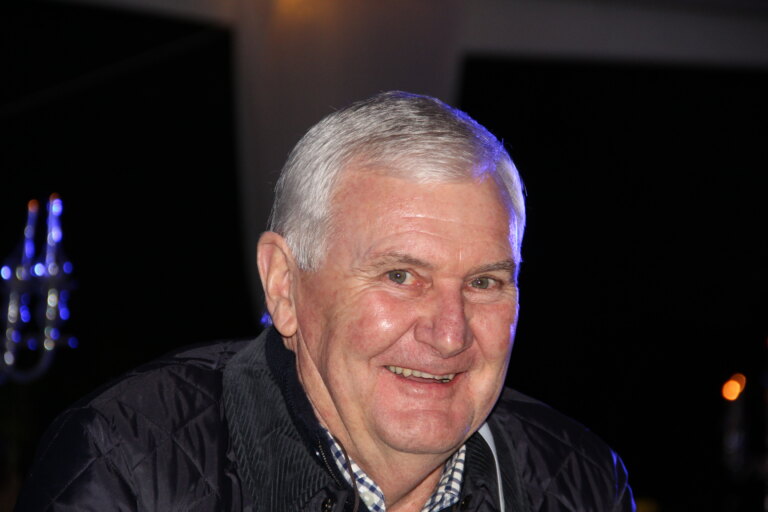
Steve Curtis, the former Chief Executive Officer of Caledonia Mining Corporation, is set to step down from the company’s Board of Directors, the company has announced.

Curtis, who retired as CEO in June 2022, has been serving on the Board in a non-executive capacity since stepping down. However, he has decided not to seek re-appointment as a Director at the next annual general meeting of the Company.

In a statement Caledonia said, Curtis’s decision to leave the Board will come into effect following the company’s annual general meeting, marking. His departure from the Board signifies a significant transition for the company, as the gold miner moves forward under new leadership.

During his tenure as CEO, Curtis played a pivotal role in guiding Caledonia Mining Corporation through various challenges and opportunities in the mining industry. His leadership and strategic vision contributed to the company’s growth and success, establishing it as a player in the gold mining sector.

Caledonia owns Blanket Mine one of the country’s leading gold producers.

ZIMPLATS offers voluntary retrenchment packages

0

To address ongoing challenges created by plummeting mineral prices, Zimbabwe’s biggest Mine ZIMPLATS is offering a voluntary retrenchment package for all employees wishing to be considered.

In a statement seen by Mining Zimbabwe, ZIMPLATS Chief Executive Officer (CEO) Mr Alex Mhembere said the platinum miner is taking proactive measures to ensure sustainability and navigate through the current headwinds.

“We have been communicating through our usual platforms about the difficult operating environment that we face. PGM prices remain very weak and this situation is projected to last for the next 12-18 months. We have been working with all teams across the board in implementing various cost containment and cash preservation programmes. I wish to thank all team members for diligently rallying behind our efforts in this regard. I am confident that as a team we will successfully navigate through the headwinds,” the statement read in part.

“While our cost containment and cash preservation programmes yield expected results, the company’s situation remains difficult and therefore additional measures still need to be undertaken,” the statement continued.

Acknowledging the severity of the situation, Mhembere said the company has decided to introduce a voluntary retrenchment exercise for all employees interested in participating. This initiative aims to mitigate the need for compulsory retrenchment and offers employees the opportunity to make a voluntary exit under favourable terms.

“One of the measures that the company will implement is a voluntary retrenchment exercise for all employees wishing to be considered. If successful, this will mitigate the need for a compulsory retrenchment. Those wishing to be considered for the voluntary retrenchment package should approach the respective Divisional HR Department for the application form beginning Tuesday 19 March 2024. The completed forms must be submitted to the respective HR Department by 22 March 2024,” the statement continued.

The Platinum miner said the decision to undergo voluntary retrenchment is entirely optional and individuals wishing to be considered must submit their application forms to the respective Divisional HR Department starting from Tuesday, 19th March 2024, with a deadline of 22nd March 2024 for submission.

“It is important to point out at the outset that management reserves the right to approve or decline any application based on business requirements and this is not subject to an appeal process.

The voluntary retrenchment package will be as follows:

  • Two week’s pay for every completed year of service
  • One-month notice pay
  • Minimum guaranteed package of three months for employees whose retrenchment package is less than three months.
  • All statutory requirements will be paid out together with the package.

Mhembere said the HR Team will facilitate the process and provide comprehensive details regarding the application procedure and the packages offered. He said Successful applicants will receive a voluntary retrenchment agreement outlining the terms and conditions, including all entitlements and payments due.

Accordingly, the Platinum miner said employees who opt for voluntary retrenchment will be regarded as “good leavers” and will remain eligible for re-employment in the future should suitable opportunities arise, or the situation normalises.

The ‘basket price’ of platinum-group metals sank by 38% last year, leaving “roughly half of global PGM mine supply operating at a loss.

Tariro Gadzikwa joins Caledonia’s Board of Directors

0

PRESS RELEASE: Caledonia Mining Corporation Plc  is pleased to announce that Tariro Gadzikwa has joined Caledonia’s Board of Directors as an Independent Non-Executive Director with effect from March 15, 2024.

It also announces that Steve Curtis, who retired as Chief Executive Officer of the Company in June 2022 and remained on the Board as a Director in a non-executive capacity since then, has decided to step down from the Board and as such will not be seeking re-appointment as a Director at the next annual general meeting. He will therefore leave the Board with effect from the next annual general meeting of the Company.

Mr John Kelly, Chairman of the Board, commented:

“I am delighted to welcome Tariro to Caledonia’s Board.  She has significant board experience and particular expertise in audit, risk management, corporate finance and finance strategy development. Her skills will be of great value to the Board. As a Zimbabwean national based in Johannesburg, Tariro will add further depth to the Board’s considerable experience in Southern Africa. I look forward to working with her.

I would also like to thank Steve for his continued contribution to the Board in a non-executive capacity since stepping down as Chief Executive Officer in June 2022 and am pleased he has agreed to remain a consultant to Caledonia, where management can continue to benefit from his experience and insight.”

Tariro Gadzikwa

Tariro is a chartered accountant and the Founder and Chief Executive Officer of MWJ Consulting Proprietary Limited, an advisory firm specialising in financial reporting and due diligence for listed and private equity clients within the mining, oil and gas and energy sectors.

Prior to founding MWJ, she was Group Chief Financial Officer of Efora Energy Ltd (“Efora”, formerly SacOil Holdings) at which she held various executive roles in the finance team over eight years. She started her career at PwC in Zimbabwe and subsequently worked in the Johannesburg, Baltimore and London offices, where she provided audit and financial advisory services including financial due diligence and strategy development to medium and large corporates in Zimbabwe, South Africa, the US and UK.  

She has held a number of board positions, including most recently at Efora and several of its subsidiaries in South Africa, Seychelles, Nigeria and Botswana, and currently serves on the board of Structured Risk Solutions where she chairs the Nominations Committee.

She graduated from Rhodes University, South Africa with a B.Com in accounting in 2001.

BREAKING: Chinyere appointed MRAZ President

0
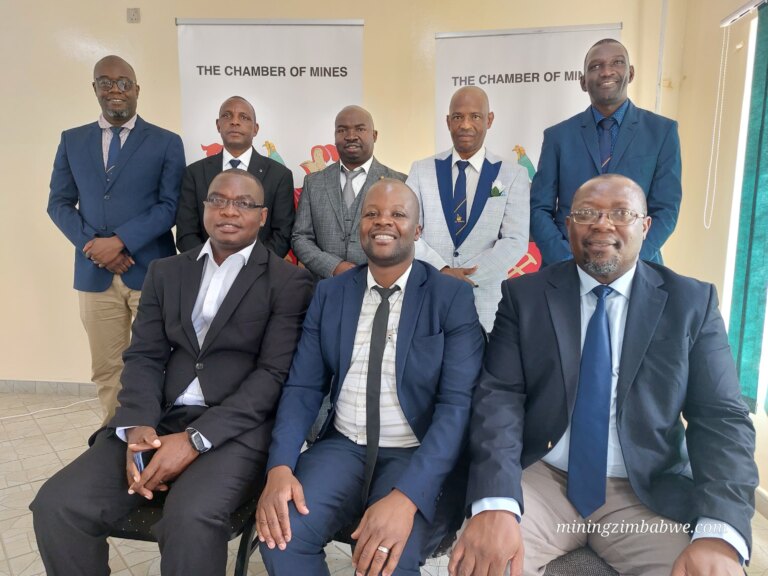
Dr Alfred Chinyere has been appointed incoming President of the Mine Rescue Association of Zimbabwe (MRAZ) at the organisation’s ongoing Annual General Meeting (AGM) in Zvishavane.
Chinyere replaces outgoing President Eng Elton Gwatidzo of Caledonia Mining Corporation.
The following were elected MRAZ Working Party
  • Dr A.Chinyere (Freda Rebecca) President
  • A.Mapako(Freda Rebecca) North Zone Coordinator
  • P.Hill(Blanket Mine) West Zone 
  • M.Mwene(Unki Mines) South Zone
  • E.Chigwa( RZM Murowa Diamonds) Publicity 
  • R.Bhunu National Coordinator
  • C.Ganduri Fresh Air Teams Coordinator
  • M.Ruzvidzo(National Trainer)
  • D.Matyanga Chamber of Mines Secretariat 
  • E.Gwatidzo Past President

A surge in Mining Accidents: 237 Fatalities Reported in 2023

0

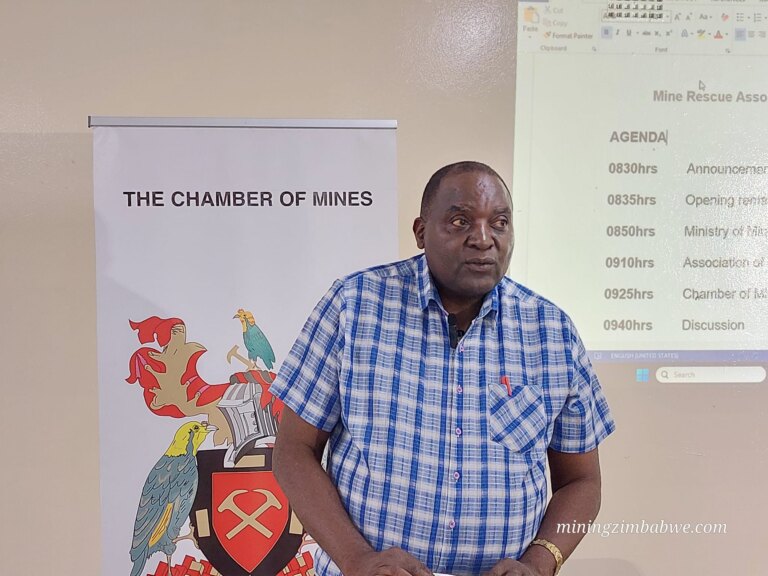
Deputy Chief Government Mining Engineer Tapererwa Paswavaviri has expressed grave concern over the rising number of accidents and fatalities plaguing the mining sector.

Kelvin Sungiso

Drawing attention to the alarming statistics at the Mine Rescue Association of Zimbabwe (MRAZ) Annual General Meeting 2024 underway in Zvishavane, Engineer Tapererwa Paswavaviri underscored the urgent need for collective action to address safety lapses within the industry.

“Mr. President (MRZ), as the Ministry of Mines and Mining Development, it is to our huge concern that serious accidents and fatalities are increasing each day,” stated Paswavaviri highlighting the severity of the issue.

Paswavaviri revealed that in 2023 alone, the mining sector witnessed 212 accidents and 237 fatalities, marking a significant rise compared to previous years.

Of particular concern were the disparities in accident rates among different mining operations. “14% were from mines registered under the Chamber of Mines, 71% from illegal mines not registered under the Chamber of Mines, and 15% being legal miners,” noted the engineer Paswavaviri.

He further emphasized the concerning trend of escalating fatalities.

“From 2022 to 2023, the fatal accidents statistics sharply increased by 28%,” revealed the engineer, signalling a troubling trajectory in safety outcomes within the sector.

However, amidst these challenges, the Engineer said so far in 2024 fatalities have reduced by 23%

“In this year from January to date, accidents and fatalities have reduced by an average of 23% compared to 2023,” he said

To address the root causes of accidents, the Ministry of Mines and Mining Development has ramped up its intervention measures Paswavaviri announced.

“My office has increased the frequency in mine inspections and SHE (Safety, Health, and Environment) awareness campaigns,” he said.

One notable initiative highlighted in the speech was the Small Scale Miners Training program, launched to equip miners with essential safety knowledge and practices.

“In February, we embarked on a nationwide program for Small Scale Miners Training,” the engineer revealed, underscoring the ministry’s commitment to promoting a safety culture across all mining operations.

He concluded with a call to action for all stakeholders to prioritize safety and collaborate in mitigating risks within the mining sector.

“Together, we must redouble our efforts to ensure the safety and well-being of all miners,” Paswavaviri urged.

The Mine Rescue Association of Zimbabwe (MRAZ)

The Mine Rescue Association has been in existence since around 1973. Its mandate is to coordinate mine rescue activities in the country. The work of the association is coordinated through the Mine Rescue Working party. This working party brings together the Chairman appointed by the Association of Mine Managers of Zimbabwe, zone coordinators, the national trained, the national coordinator, a representative of the Chamber of Mines and a committee member.

The mandate of the working party is to organise and coordinate activities of the association to ensure that the teams are at all times in conditions to undertake rescues in irrespirable foul atmospheres. The decision to have a mine rescue team rests with the authority of ach operation. Mines that are at risk of underground fires are encouraged to operate mine rescue teams. The Mine Rescue Association of Zimbabwe is organised as follows:

  1. i.North Zone: Bindura Nickel, Redwing Mine

  2. ii.Central Zone: ZIMPLATS Ngezi, ZIMASCO Shurugwi

  3. iii.South Zone : Renco Mine, Gaths Mine, Mimosa Mine

  4. iv.West Zone : Hwange Colliery 1, Hwange Colliery 2, How Mine

Cartographer shortage hits MashonalandWest

0

THE lack of a full complement of cartographers at Mashonaland West’s Ministry of Mines and Mining Development office is hindering the pace of mine registration, which has at times triggered ownership disputes.

The shortage of cartographers, whose work involves drawing or producing maps, has caused a huge backlog of applications for registration of mining titles.

A cartographer is the entry point in the mining verification and registration process with their major role being to produce cartography diagrams.

The Mashonaland West Mines ministry office is currently operating with a single cartographer, a development that has delayed the formalisation of artisanal and small-scale miners’ operations.

Speaking during the ministry’s consultation programme on Mineral Development Policy, Value Addition and Beneficiation, and Artisanal and Small Scale Gold Mining (ASGM) strategies this week, stakeholders lamented the cumbersome process under which miners go through before being awarded licences.

Pikirayi Chinoramba-Chimurenga of Norton highlighted the bureaucratic bottlenecks at the mines office, amid consensus from participants to decentralise operations to districts in the true spirit of the government’s devolution agenda.

Stakeholders decried the slow pace at which applications for mine title registration are processed, which the authorities defended pointing to a shortage of cartographers who are integral in the process, in addition to a lack of field vehicles and fuel.

Responding to the concerns raised during the meeting, Mashonaland West provincial mining director, Sibongubuhle Mpindiwa confirmed the shortage of cartographers that is hampering the ministry’s field operations, coupled with resource constraints facing the only cartographer available.

“Mashonaland West is a busy mining province and there has been a significant rise in the interest in mining as everyone dares to try their luck in small-scale mining. The ground verification process and the interest of plenty of people have resulted in a mining title registration backlog.

“Ground verification process needs resources and there was a moment some four to five years back when we were struggling as a ministry although it is now improving.

“We sometimes go for months without processing these papers due to limited resources to do the ground verification process. The smooth flow of the process is then held up by a shortage of cartographers as the Mashonaland West office currently operates with one,” Mpindiwa said.

“However, efforts are being made through our permanent secretary to ensure that we are capacitated,” she added.

Mpindiwa reiterated her office’s commitment to clear the mounting backlog of mine title registration.

The ministry’s senior minerals development officer, Taurai Dhliwayo, said through the Mineral Development Policy, the government was working to introduce a computerised cadastral system known for effective service delivery to the mining industry.

The cadastral system collects data relating to official and legal documentation concerning the quantity, dimensions, location, value, tenure, and ownership of individual parcels of land, thereby curtailing disputes over mining claims.

ZMF invites council members to its AGM

0

The Zimbabwe Miners Federation (ZMF) has extended invitations to its council members for its Annual General Meeting (AGM) scheduled for March 22, 2024.

Patricia Rwafa

The event will take place at the prestigious Hippodrome in Braeside, Harare.

In a statement, ZMF Secretary General Morgan Mugawu, emphasized the importance of this gathering, citing section 20.3 of the mining body’s constitution. According to Mugawu, the AGM is a critical platform for stakeholders to convene, deliberate, and chart the course for the mining industry’s future.

The ZMF centres its AGM on discussions focusing on pertinent issues facing the mining sector, as well as strategic planning for sustainable growth and development. Council members are urged to mark their calendars for March 22, 2024, with the meeting scheduled to commence at 10:00 AM.

The Federation meets as Zimbabwe is currently grappling with mine accidents which are befalling the Artisanal and Small-scale miners, a sector ZMF represents.

Zimbabwe Miners Federation’s birth was marked to represent and contribute to the development, growth, and empowerment of the artisanal and small-scale (ASM) miners in Zimbabwe. Established in 2003, the ZMF seeks to bring ASM into the mainstream economy through lobbying and support of ASM operations.

Part of the ZMF objectives is lobbying for the formalization and regularisation of artisanal miners and small-scale miners. ZMF ensures that legislation in the country is conducive for ASM mining operations and at the same time developing a good rapport with the government.

ZMF links on a day-to-day basis, with its partners who are stakeholders which include but not limited to government, investors, mining service providers, suppliers, and tertiary training institutions who complete the mineral value chain. ZMF has a total of 60 affiliate associations at the district and provincial levels. The total number of miners being represented is currently at 1,500,000.

De Beers’ 2024 Q2 Sales Spark Surge in Diamond Revenue

0

Anglo American‘s diamond subsidiary, De Beers, has reported a significant increase in diamond revenues despite the rough sales for its latest sales cycle.

De Beers last year announced that the seventh sales cycle of 2023, which took place between 14 and 29 August, generated only $370 million in sales. This is a drop from the previous cycle’s $411 million and $456 million, and a significant decline from the seventh cycle of 2022, which generated $638 million.

According to De Beers CEO, Al Cook, the decline in revenues can be attributed to the current macroeconomic environment, which has led to the reduction in diamond jewellery in key consumer markets. The retail recovery in China remains slow, voluntary import moratorium on rough diamonds into India will see extended Diwali holidays and factory closures in the world’s largest diamond-cutting centre. In recognition of these conditions, De Beers continued with reduced rough diamond availability in the ninth sales cycle of 2023.

De Beers maintained support for its Sightholders with full purchase flexibility as the midstream re-establishes an equilibrium between wholesale supply and demand.

The diamond company De Beers sold $430 million of rough diamonds in the second sales cycle of this year.

Sales were higher than the $374 million of rough diamonds sold in the first quarter of this year but lower than the $497 million in rough diamonds sold in the second sales cycle of 2023.

“I’m pleased to see a further increase in demand for De Beers’ rough diamonds during the second sales cycle of 2024. However, ongoing economic uncertainty in the US has led to retailers restocking conservatively after the 2023 holiday season.

“Consumer demand for diamond jewellery is growing in India but remains sluggish in China. Overall, we expect that the ongoing recovery in rough diamond demand will be gradual as we move through the year,” he said.

President Mnangagwa slams G7 for diamond restrictions

0

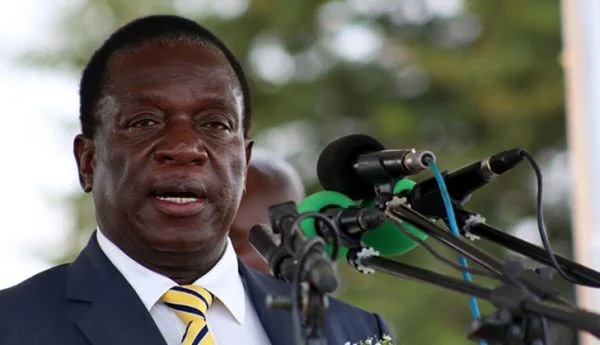
The President Emmerson Mnangagwa, has voiced opposition to decisions seemingly made by G7 countries to propose restrictions on the trade of diamonds without consulting African players or the Kimberley Process Certification Scheme (KPCS).

In his official opening remarks at the 9th General Meeting of the African Diamond Producers Association (ADPA) Council of Ministers on Thursday, the President said ADPA should assert the African position on matters of diamond production, trade, and pricing.

He stated that western countries should respect Africa’s decisions and not propose restrictions on the trade of natural diamonds without consulting Africa.

“I challenge you, as representatives of our countries, to assert the African position on matters of diamond production, trade, and pricing. We are an independent continent, and those from overseas must talk to us as equals and respect us. The proposed restrictions on the trade of natural diamonds being imposed by some market players are unacceptable. The benefits and interests of our people should be respected. We are the guide and key when it comes to the exploitation of our abundant natural resource elements. It is commendable that key decisions have been made at this forum,” Dr. Mnangagwa said.

Moses Engadu, Secretary-General of the Africa Minerals Strategy Group, said the G7 countries should leave trade restrictions to the Kimberley Process and not bring confusion into the matrix.

He said the G7 is not supposed to issue restrictions without engaging the KP, as this will undermine the authority of the KP in diamond trading.

He further stated that the restrictions undermine sovereign African governments’ ability to send their gemstones directly to their chosen market. It also undermines legitimate local industry beneficiation and could encourage smuggling, which the WFDB says would be counterproductive.

“In December, the G7 nations of Canada, France, Germany, Italy, Japan, the U.K., and the U.S. declared an outright ban on Russian diamonds, effective from Jan. 1. That is to be followed by the gradual implementation of restrictions on indirectly imported Russian diamonds starting from March 1. By September, a new system for verifying the origins of these gems is expected to be in place, although details regarding the verification process and its location remain uncertain.”

Some diamond producers are calling for more explicit guidance and a more global, collaborative approach to ensure transparency and ethical sourcing without disproportionately impacting the broader industry. They stress the need for solutions that do not centralize trade to a single point (such as Antwerp) and request the adoption of technology that could support the ethical tracking of diamonds across all regions, including support for artisanal and small-scale miners.

Bravura’s Kamativi tailings dump processing is 95% complete

0

Pan African mining company, Bravura, is upbeat about becoming one of the major lithium producers in Zimbabwe in the next 3 years with its state-of-the-art processing plant now 95 percent complete.

Rudairo Mapuranga.

The company, which has the rights to process tailings left by the Kamativi tin mine to extract lithium spodumene, is in the process of creating an AI-instructed plant manufactured in South Africa, which will be installed in Zimbabwe in about 3 months.

Speaking to Mining Zimbabwe on the sidelines of a Ministerial visit by the Minister of Mines and Mining Development, Hon Zhemu Soda, the head of the project, Dr. Tafadzwa Murinzi, said the 30-tonne-per-hour processing plant will take about 7 months to be commissioned.

“Our plant is being manufactured by a contractor in South Africa. It’s about 95% complete and ready for translocation to Zimbabwe. Here on site, we have started the civil works in preparation for the plant’s receipt. So, what we have to do is create the plant foundations. And then, once the plant arrives, it will be installed and commissioned.

“We expect that once we get the necessary permits, the plant should be in Zimbabwe within the next two to three months. It’s a modular plant, so it will come in different modules. And once the components are all on-site, we expect it will take us about four months for the installation and commissioning. So, we’re looking at roughly seven to eight months,” she said.

Dr. Murinzi said the tailings dump spans about 8 years with an estimated 25 million tonnes of dump to be processed by the mining company.

She said in full operation, the mine will employ 500 people, but initially will start with 25 percent.

“Our plant is a 300-tonne-per-hour plant, which translates to about 1.1 million tonnes of tailings being processed, and this translates to about 30,000 tonnes of spodumene concentrate per annum, which is about 25 million tonnes, and it is a spodumene grade of approximately 5%, which translates to lithium of about 0.6%. We’re expecting that with our plant capacity, we can mine it over 8 to 10 years. We will employ about 400 to 500 people, but obviously, we’ll begin in the initial phase, employing about 25% of that, and then we’ll only ramp up to about 400 to 500 people when the plant is now operating at a steady state,” Dr. Murinzi said.

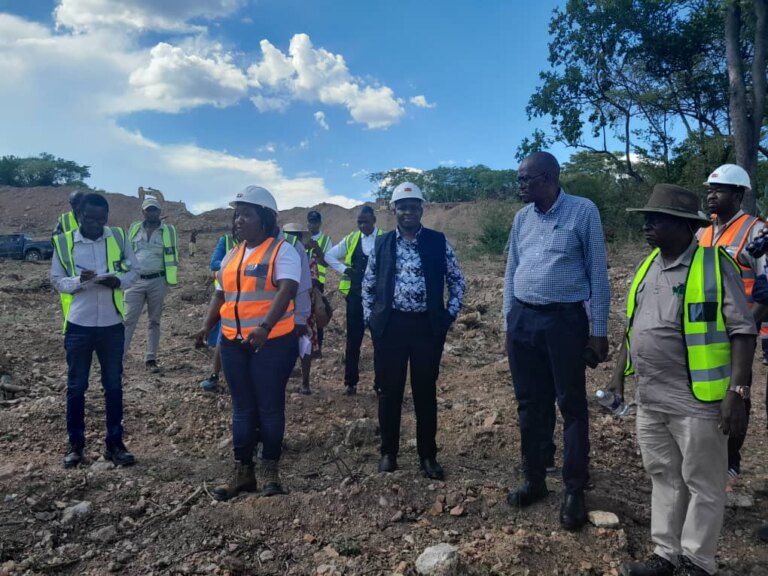
The Minister of Mines, Hon Zhemu Soda, speaking at the tour, said the coming in of Bravura to process the dump is of importance towards the realization of the 2030 vision.

“This is a major contribution, given that we are looking forward to the mining industry being a significant contributor towards the realization of our vision 2030. You might also have noticed that this dump was waste and they are salvaging what used to be waste, and now a mineral. And I recall the conversation that we held earlier on. You know, as technology continues to advance and new uses of minerals are discovered, it’s not surprising that even after 100 years, we’ll be coming back. We’re coming here again to scavenge or salvage from the dump that will be produced as waste from the spodumene that they are now working towards. So, we continue to be upbeat about the efforts by Bravura that they can make a contribution towards the realization of our vision. They also intend to employ some people, and obviously that fits into the mantra by His Excellency of leaving no one and no place behind. Once there is some work here, obviously the local people will start to benefit through employment and also through CSR projects,” Hon Soda said.