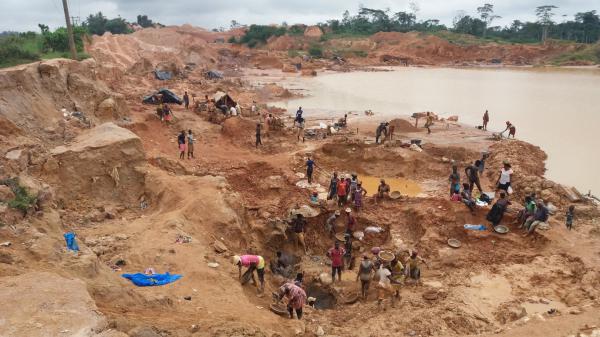
A GROUP of people, who recently invaded Dandee 5 mine in Kezi, Matabeleland South, are reportedly threatening Kezi prosecutor Mufaro Ndirayire, who is handling the case.
The invaders, believed to be from Harare, overran the mine last month and the mine owner Ndodana Moyo has alleged that the invaders were being backed by a senior government official, whom he did not name.
Moyo told NewsDay that the invaders were threatening the prosecutor who is dealing with the case.
“On April 27, we were supposed to attend a court case in Kezi. On our arrival the prosecutor said she was being called by a certain individual who is threatening her, demanding that she must drop the case or get fired by her superiors. The invaders are also creating stories trying to get us arrested,” he claimed.
He also alleged that the invaders were heavily armed.
“We did not do anything or engage in any violence. They are the ones who were armed with machetes and axes.”
Ndirayire declined to comment on the matter saying she was not allowed to talk to the Press.
“You can check with my superiors, I am not allowed to talk to the Press,” she said.
The gang, armed with machetes, chased away Moyo’s mine workers when it invaded the mine.
THE Zimbabwe School of Mines (ZSM) is expected to play a leading role in the beneficiation and value addition of minerals as the country drives towards achieving a US$12 billion mining industry milestone by 2023, Mines and Mining Development Deputy Minister, Polite Kambamura, has said.
The Second Republic is pushing for value addition of the country’s natural resources including precious minerals for the country to benefit more from its resources.
As a mining training centre, Deputy Minister Kambamura, said ZSM should be well equipped to unlock more opportunities in the sector.
Speaking during handover of critical equipment in the Metallurgical Assaying Laboratory by Mimosa Mining Company last Thursday, Deputy Minister Kambamura said Vision 2030 demands that ZSM responds by providing skills, particularly in the emerging minerals being mined in Zimbabwe.
“Therefore, a fully equipped laboratory plays a critical role in training of human capital.
Furthermore, on servicing the industry the laboratory has also been very useful to the mining and related industries, providing services that include water analysis for EMA regulations compliance, gold, silver and base metals analysis, coal analysis and metallurgical tests works,” he said.
Zimbabwe School of Mines
Mimosa donated a range of equipment for the geological department that includes four geological microscopes equipment with a camera and digital connectivity to enable online sharing of thin section images by lecturers and students.
The metallurgy department was equipped with a single pot ring mill and machinery for sample analysis.
With the current expansion in the mining industry, Deputy Minister Kambamura said ZSM is expected to conduct test work in the new mining processing methods on emerging mineral such as base metals.
“We expect ZMS to match international standards by being assessed and successfully accredited by the Southern Africa Development Community Acceptation Services (SADCAS) on an ISO/EC17025:2005, which will demonstrate that it is technically competent and able to produce precise and accurate tests and analyses of minerals,” he said.
“Accreditation of this Metallurgical Laboratory requires this equipment in line with industry standardisation needs.”
However, ZSM cannot achieve its responsibilities alone as its needs partners with other players in the industry, said the Deputy Minister.
“The Government of Zimbabwe pleads with the mining industry sector to partner with technical institution of this nature in retooling laboratories,” he added.
“In line with the 2021-2025 Strategic Plan the Metallurgical Assay Laboratory has been infused as a strategic Business Development Unit, therefore donations of the equipment is perfectly suited in the grand strategy.”
The mining industry is a key pillar of Zimbabwe’s economy as it generates much of the needed foreign currency.
ZSM principal, Mr Edwin Gwaze, said since their laboratory was fully equipped, the training centre is now able to operate at a commercial level where both solid and liquid samples are processed.
He said the donation confirms Mimosa’s commitment to ensure that ZSM provides unrelenting quality services to the mining industry.
Over the years, Mimosa has made several donations, which include a 29-seater bus, assisted in training assets for the library and boulder for the mining museum.
Mimosa head of engineering, Mr Admire Makuvaro, said their support is intended to capacitate ZSM to continue producing quality graduates.
“As Mimosa we have responded to the needs of the Zimbabwe School of Mines through various developmental partnerships over the years and we remain committed to working with the institution as it develops and continue to improve its service to the mining industry,” he said.
“We urge the Zimbabwe School of Mines to make use of the equipment in line with the Governments vision for the institution to become a hub for experimentation and research in mining.”
Trafigura Group and Zimbabwe’s government have discussed a deal that would give the commodities trader control over output from some of the nation’s biggest mines as repayment for debts.
Under the agreement, Trafigura will be paid US$225.6 million by nickel- and gold-mining subsidiaries of state-run Kuvimba Mining House for fuel bills Zimbabwe owes Trafigura on contracts dating back to 2016, documents show. Zimbabwe’s government was represented by the Finance Ministry in the agreement.
Trafigura is one of the world’s biggest oil and metals traders, with a history of deals in Africa that have drawn scrutiny from authorities, including in South Sudan and South Africa. Zimbabwe, which has racked up more than US$10 billion in external debt that it’s struggling to service, has been heavily dependent on Trafigura for fuel supplies.
Reports have linked Kuvimba to Kudakwashe Tagwirei, a Zimbabwean tycoon who’s been sanctioned by the US and UK over corruption allegations, and who was part-owner of many of the mining assets that are now part of Kuvimba. Zimbabwe hasn’t explained how it obtained the assets, and says that Tagwirei has no role in Kuvimba. Tagwirei is also an adviser to Zimbabwe President Emmerson Mnangagwa.
The Singapore-based trading house confirmed a deal in which it will be repaid by Zimbabwe for credit it extended for imports of fuel products. It said it ended a previous fuel-trading business relationship it had with Tagwirei in 2019, before he was sanctioned.
“Trafigura Zimbabwe has provided credit on petroleum product deliveries into Zimbabwe and is scheduled to receive payments,” the company said. “Trafigura operates a robust compliance program, aligned with international standards. In accordance with this program, Kuvimba has undergone and satisfied our strict KYC requirements,” it said, referring to so-called “know your customer” policies meant to prevent engagement with people involved in money laundering or other financial crimes.
Unpaid bills, incurred by the Reserve Bank of Zimbabwe, would be transferred to the Finance Ministry, which has control over Kuvimba.
The agreement was drawn up by the London branch of law firm Reed Smith LLP and gives Trafigura exclusive access to a large portion of two of Zimbabwe’s biggest exports.
According to the deal, Kuvimba would pay Trafigura US$6 million a month and retain 40% of payments to the Freda Rebecca and Shamva gold mines, as well as the nickel mines owned by Bindura Nickel Corporation, in collection accounts. Freda Rebecca, Shamva and Bindura Nickel are subsidiaries of Kuvimba.
Trafigura would also have the right to approve buyers of the metal selected by Bindura and would have right of first refusal on the metal, the documents show. It would also have the right to buy the gold produced by Freda Rebecca and Shamva. Trafigura didn’t respond to queries about those arrangements.
The payments won’t be subject to tax and the transaction documents won’t need to be lodged with any authority in Zimbabwe, the agreement says. Reed Smith didn’t respond to requests for comment.
Private shareholders
Kuvimba’s assets were previously listed as being owned by Sotic International, in which Tagwirei had a stake. Tagwirei didn’t respond to text messages and emails and didn’t answer his mobile phone when contacted by Bloomberg.
The government hasn’t disclosed how it came to own 65% of Kuvimba or who holds the 35% private stake. Trafigura didn’t answer a question on whether the private shareholders had assented to the agreement.
The agreement includes clauses prohibiting any of the parties involved in the agreement from entering into “any transactions with any person which is a sanctioned person.” Trafigura said such language was “common and prudent business practice” in commercial arrangements. The Kuvimba subsidiaries involved in the deal are also not allowed to change their shareholding.
Invictus Energy Limited (ASX:IVZ) unveiled its financial and operational performance report for the quarter ended 31 March 2022.
The Company is opening one of the last untested large frontier rift basins in onshore Africa, the Cabora Bassa Basin.
Mukuyu Prospect drilling is anticipated to commence in July 2022.
Shares of Invictus Energy Limited (ASX:IVZ) traded up by a whopping 21%, mid-day last Friday.
IVZ quoted A$0.23, with a trading volume of over 4 million shares and a market capitalisation of A$126.76 million. The significant uptick in share price seemed to have been propelled by the independent upstream oil and gas company’s financial and operational performance report for the quarter ended 31 March 2022.
Invictus is opening one of the last untested large frontier rift basins in onshore Africa, the Cabora Bassa Basin, in northern Zimbabwe through a high impact exploration programme.
Its principal asset, Special Grant 4571 (SG 4571), contains the world class Mukuyu prospect which is the largest un-drilled prospect onshore Africa – independently estimated to contain 8.2 Tcf and 247 million barrels of conventional gas condensate (gross mean unrisked basis). Mukuyu Prospect drilling is anticipated to commence in July 2022.
Agreements & contracts
In the March 2022 quarter, the Company’s 80% owned subsidiary Geo Associates executed a Heads of Agreement with the Sovereign Wealth Fund of Zimbabwe to increase the SG 4571 licence area from 100,000 hectares to 709,300 hectares. Currently, customary government gazettal is awaited.
There were other deals made towards the Cabora Bassa Project development-
To drill the Mukuyu-1 exploration well, Invictus executed a binding drilling rig contract with Exalo Drilling SA. There is also an option for an additional exploration well. The Exalo #202 rig might mobilise from Tanzania to the Project in May. Notably, casing, wellheads, and ancillary long lead items for the two-well drilling campaign have already been secured.
The Company awarded Baker Hughes the integrated well services contract following completion of a competitive tender and evaluation process.
ERC Equipoise Pte Ltd was appointed to conduct an independent prospective resource update for the Project.
Cluff Energy Africa’s (CEA) request to extend its farm-in option expiry was granted- from 31 March to 30 April 2022. Recently, Invictus received three farm-in offers for the Project including an updated bid from CEA. Additional parties are conducting ongoing due diligence and internal approvals, which may result in further bids being received.
Cabora Bassa Project progress
Under the Heads of Agreement with Geo Associates, Invictus has agreed to increase the minimum work program obligation for the current second exploration period to drill two exploration wells, including the Mukuyu-1 prospect and one exploration well in the expanded area.
Besides, Invictus largely completed its interpretation of the newly acquired seismic data of the 2021 Cabora Bassa 2D Seismic Survey (CB21 survey), as well the concurrently reprocessed data of the 1990 legacy Mobil dataset. Notably, Mukuyu Prospect has now been clearly delineated as a large, robust, 4-way dip anticline, with the seismic data confirming prospectivity, including extensive seismic anomalies identified at multiple levels.
Management updates
In the March 2022 quarter, Invictus appointed Barry Meikle as Country Manager. Additionally, the Board travelled to Zimbabwe for a series of on-the-ground engagements in March.
Together with JV partner One-Gas, presentations and meetings were held with the local community leaders and senior government ministers. Tours of Community Social Responsibility projects were implemented in the Muzarabani and Mbire districts.
The highest bid for lithium at an online sale surged by 140% in just six months, an indication the stampede for supplies of the main ingredient used in electric vehicle batteries could get even more intense.
By Sophia Takuva
Pilbara Minerals Ltd.’s auction of spodumene concentrate — a partly-processed form of lithium — attracted a top bid of $5 650/t on Wednesday for a cargo of 5 000 t. That compares with $2 350 at the previous sale in late October on the Australian miner’s Battery Metal Exchange.
The surging prices are unnerving battery makers and EV firms. Tesla Inc. CEO Elon Musk said this month that lithium had gone to “insane levels” and is the “fundamental limiting factor” for EV adoption, adding the car giant might consider mining or refining it directly. Contemporary Amperex Technology, the world’s largest battery maker, said last week it had won exploration rights for a lithium clay deposit in China.
“The pricing received on the BMX sales trading platform is indicative of the critical shortage that exists in respect of lithium raw material supply,” Pilbara Minerals said in a statement. It’s the company’s fourth online spodumene sale.
The jump in the auction bid is roughly in line with the increase in lithium carbonate — a chemical used in battery production — in China. It started rising in the middle of last year as the global recovery from the pandemic coincided with a surge in EV demand.
The rally has lost momentum in recent weeks — prices are currently at 467 500 yuan ($71 182) a ton, according to Asian Metal Inc. — as the worsening virus outbreaks upended supply chains and clouded the consumption outlook. The auction result suggests Chinese lithium compound prices are unlikely to drop below 400 000 yuan a ton, Daiwa Capital Markets’ analysts Dennis Ip and Leo Ho said in a note.
Miners are cranking up production to meet the skyrocketing demand and also enjoying bumper profits. Chinese producer Ganfeng Lithium Co. reported a more than 600% jump in first-quarter net income from a year earlier, while Pilbara’s share price rose as much as 6.5% on Wednesday.
The Perth-based miner said it plans to hold the auctions more frequently as it ramps up production at its Ngungaju mine in Western Australia. However, it also warned that virus-related labor disruptions may result in output being in the lower half of the 340 000 t to 380 000 t guidance for the year through June.
The board of MC Mining has appointed former South African Finance Minister Nhlanhla Nene as chairperson and former Anglo Coal leading light Godfrey Gomwe as CEO of the London Aim-, Sydney ASX- and Johannesburg JSE-listed South African coal exploration, development, and mining company.
The key projects of MC Mining include metallurgical and thermal coal asset Uitkomst Colliery, the hard coking coal Makhado project, the semi-soft coking and thermal coal asset Vele Colliery, and the coking and thermal coal Greater Soutpansberg projects.
Anglo Coal-experienced Mathews Senosi, who is CEO of the Overlooked Mining Group – a producer of 7.5-million-plus tonnes of thermal coal a year for the export and domestic markets – has been appointed nonexecutive director with immediate effect. Through Senosi Group Investment Holdings, Senosi is beneficially interested in 38 363 909 shares in the company.
Resolutions to appoint Nene and Gomwe as nonexecutive directors were passed at an extraordinary general meeting on April 11, ahead of which former chairperson Bernard Pryor and former nonexecutive director and interim CEO Sebastiano Randazzo resigned. Nene replaces Khomotso Mosehla, who served as interim chairperson following Pryor’s resignation.
Nene, 63, holds current directorships/partnerships in eight other organisations, including Thebe Investment Corporation and Access Bank South Africa.
Gomwe, 66, holds directorships/partnerships in 11 other organisations, including AECI and Econet Wireless Zimbabwe.
Senosi, 44, holds directorships/partnerships in 32 other organisations, including Dorstfontein Coal Mines, Forzando Coal Mines, Katlego Coal, Newcastle Coal Mines and JA Engineering.
Gomwe’s commencement began on Wednesday at an annual gross base remuneration of R5 724 500. The annual bonus eligible to him is an amount of up to 100% of base remuneration, dependent on business performance and board approval.
In terms of the performance rights plan, Randazzo is considered a ‘good leaver’ and the board approved the 4 871 406 unvested performance rights vested on his resignation as a director. Shareholders approved the granting of performance rights to Randazzo at the 2021 annual general meeting, MC Mining stated in a release to Mining Weekly a South African publication.
Zimbabwe’s uncompetitive formal market could derail the government’s ambitious gold mobilisation programme as compliance will be low, the Chamber of Mines of Zimbabwe has said.
This week the government launched the gold mobilisation programme as part of efforts to encourage local miners to comply voluntarily.
But, the Chamber of Mines of Zimbabwe CEO, Isaac Kwesu, said the formal market must be competitive.
“Voluntary compliance is an issue of market forces that ensures that miners are paid timeously at a fair price. And naturally you have no incentive to participate in illegal markets when the formal market is competitive,” Kwesu said.
He said output will be increased by mobilising gold that is already being produced but not sold through formal markets.
“Remember, we account for gold deliveries through Fidelity but some of the output that are being produced is not being delivered to fidelity. So if all output found its way to the formal market that would be a quick win,” Kwesu said.
The development comes at a time miners are selling their gold in the lucrative black market, where payments are done timeously.
Recently, Mines and Mining Development minister, Winston Chitando, said the government was optimistic gold output will exceed 100 tonnes in 2023 following the mobilisation programme.
Fidelity Printers and Refineries’ acting general manager Peter Magaramombe was also confident that the numbers can be achieved.
“We are going to make sure that we are giving the right price to miners. As you can see right now in terms of our prices of the small-scale miners we are paying some very good prices.
“Secondly, we are making sure that we have got cash readily available. If you don’t have cash, the miners will go to the next person which is black market.
So, basically, those are two main key issues that we need to deal with,” Magaramombe said.
The gold mobilisation programme, which began on Monday this week, seeks to enforce compliance by gold dealers, increase accountability by stakeholders with the main goal of boosting gold deposits to Fidelity, the country’s sole gold buyer and marketer of gold.
Government is targeting to have a mining industry worth US$12bn by 2023.
Chitando said there is potential to far exceed the target.
RioZim Limited has proposed a partnership with Government for its multi-million dollar coal fired power project in Sengwa, Gokwe North, as the firm seeks sovereign guarantee to break barriers to external funding.
The Sengwa North project is part of several independent power projects the Government has licensed to promote initiatives that help reduce the country’s acute power deficit.
Zimbabwe requires about 2 200 megawatts at peak of demand, but limited investment in power projects and aged facilities has restricts reliable output to just 1400MW.
Government is working on several projects to bridge the deficit including the 300MWx2 Hwange Power Station extension, 300MW Hwange upgrade and 2 400MW Batoka Gorge hydro initiative jointly developed with Zambia.
Presently, a yawning gap between supply and demand forces power utility Zesa to effect hours long rationing, which seriously disrupts industrial, commercial and household activities.
RioZim has since the early 1990s hit multiple brick walls in its quest to unlock the millions of US dollars in external funding it requires to implement its 2 800MW megawatts coal plant in Sengwa.
Industrial and Commercial Bank of China (ICBC) was the latest major prospective financier to pull the plug on discussions for potential financing of the power project.
In April 2020, it was reported RioZim would build the plant with China Gezhouba Group Corp., a subsidiary of Power China. It was reported the plant would ultimately be constructed in four phases of 700 MW each, totaling 2 800 MW. In May 2020, it was confirmed that Sinosure was on board to provide risk insurance.
In June 2021, ICBC notified Go Clean ICBC, a campaign coalition of 32 environmental groups, that it wouldn’t be moving forward with financing for the project.
While ICBC’s withdrawal from the project financing had still to be formally announced, it was reported that RioEnergy is seeking alternative financiers.
A highly placed RioZim board member told this publication that following ICBC’s pullout, the company had made a proposal to make Government a partner in the project.
“We are trying to find alternatives. They (ICBC) withdrew their funding, so we are back at the drawing board looking for funding from all the different sources.
“Right now, we are negotiating with several prospective funders, but we have as yet found anything concrete. We think things will change, even internationally people are reconsidering coal.
“As a company, we really need the power because there is (no enough) power in Zimbabwe, so we want more support from the Government.
“So, what we have done is we are asking the Government to become partners (in the project). We have written to the Government proposing a have a PPP (Public Private Partnership) on this project.
“It needs Government support, we are waiting for their response, the Government has to invest in that as well, so, they are yet to come (back to us with a response).
“Anyone who invests in funding the project requires a guarantee that they will be repaid in foreign currency, if you borrow US$1 billion or US$2 billion you must repay in US dollars.
“If you do not have a Government guarantee, that becomes a problem because at current law, all the foreign currency belongs to the Government,” the source said.
“We want the guarantee, as a private company, the Government cannot guarantee a private company, so we are saying why can’t we become partners so that there is justification for guaranteeing,” he said.
Efforts to get comments from Energy and Power Development Minister Zhemu Soda or his the secretary for Energy and Power Development Engineer Gloria Magombo were not successful.
Dr Magombo, who said she was in a meeting when contacted yesterday, had not responded to questions sent to her by the time of going to print.
RioZim has in the past said efforts to secure funding from China, where financiers are still keen to support coal projects, have failed due to Zimbabwe’s sovereign debt.
In October 2021, RioZim said in its half-year trading update that the project remained alive despite the challenges, adding it would continue to look for alternative financing while it also progresses its new solar power stations in Zimbabwe.
The firm holds four independent power licences for establishment of solar power plants at Renco, Cam and Motor, Dalny Mine and Murowa Diamonds Mine.
Platinum group-metals (PGMs) giant, Zimplats, says the implementation of its major projects under the US$1,8 billion investment strategy is progressing according to plan as it seeks to boost production and beneficiation capacity.
Zimplats, as part of their overall capital investment strategy last year approved a budget of US$1,8 billion to be implemented over a 10-year-period.
In a trading update for the quarter ended March 31, 2022, Zimplats said the implementation of the Mupani Mine development project, the upgrade of Bimha Mine and the construction of the Third Concentrator Plant progressed according to plan during the quarter.
“Cumulative project expenditure of US$241 million was incurred and commitments of US$130 million at period end, compared to a combined budget of US$562 million,” it said.
According to the group, the Mupani Mine development and Bimha Mine upgrade are replacement mines for Rukodzi, Ngwarati, and Mupfuti mines that will be depleted in FY2022, FY2025 and FY2028, respectively.
Zimplats said commissioning of the Third Concentrator Plant will increase milling capacity by 0.9 million tonnes per year, equivalent to circa 80 000 6E ounces and is expected to be commissioned in August 2023.
The company said the US$521 million smelter expansion and SO2 abatement plant projects have commenced and commitments for major contracts were made during the quarter.
“The project includes the construction of a 38MW furnace and establishment of an acid plant for the abatement of sulphur dioxide generated by the smelter operations.”
Zimplats noted that the US$37 million Phase 1 implementation of the 185MW solar project received board approval during the quarter.
It said the 35MW Phase 1 plant at Selous Metallurgical Complex is scheduled for completion in FY2024.
“In total, the project has four implementation phases with the final phase scheduled for completion in FY2027 at an estimated total project cost of US$201 million,” said the company.
During the quarter under review, the Group’s mined volumes improved by two percent quarter-on-quarter and were two percent weaker year-on-year mainly due to lower trackless mining equipment availability at Mupfuti Mine during the current quarter that has since been addressed.
The company said the new trackless equipment maintenance service provider has now scaled up operations to optimum level. 6E head grade improved marginally to 3.40g/t from 3.39g/t while milled tonnes decreased marginally to 1,71 million tonnes due to fewer operating days than in the prior quarter.
“Milled volumes were, however, stable year-on-year.” 6E metal in the final product increased by 6 percent to 148 541 ounces from the prior quarter and increased by 8 percent year-on-year.
Zimplats said production benefitted from a positive smelter inventory movement and the treatment of concentrates stockpiled during the furnace shutdown in the prior quarter.
The group’s total operating cash costs for the period increased by three percent from the prior quarter, impacted by inflation on major production inputs.
The company noted that a total of US$4.3 million was transferred from opening stocks to operating costs during the period as a result of the smelting of concentrates stockpiled during the routine furnace taphole inspection shutdown in the prior quarter.
“This resulted in the cost of metal produced rising by 8 percent compared to the prior quarter,” said the company.
The group noted that volume gains partly offset inflationary pressures and resulted in a two percent increase in unit cost from US$735/oz to US$752/oz.
Year-on-year unit cost increase of 6 percent reflected the mitigating benefit of higher production volumes on the 15 percent cost increase.
The group highlighted that a total of US$0.9 million was spent on exploration projects, with a further US$1.8 million committed as at 31 March 2022.
The exploration activities included mineral resource evaluation, comprising approximately 5 740 metres of surface diamond drilling over existing projects on the two mining leases.
“Exploration activities increased geological and geotechnical confidence in production schedules,” the group said.
Zimplats said it achieved two million fatality free shifts during the quarter. However, two lost-time injuries, including a fatality one, were reported in the period under review.
What do you do when your company has claims of close to half a billion US dollars against it? Strip its assets and hide them under another company.
Internal documents obtained by newZWire reveal how the Zimbabwe government plans to strip assets from its state-owned mining company to stave off US$467 million in claims from creditors.
Through the Zimbabwe Mining Development Corporation (ZMDC), the government holds mining assets, from gold, to precious stones and lithium. But the government is shifting some of the company’s remaining assets into another vehicle, Defold Mine, hoping to escape legal trouble.
It’s a case that raises fresh questions over the government’s stewardship of the country’s mineral resources, and goes back to controversial decisions made by Zimbabwe years ago to take away assets from investors.
The claims
In 2016, Grandwell Holdings, registered in Mauritius, lost its 50% joint venture with ZMDC in Mbada Diamonds when government cancelled all licences in the Marange diamond fields. The company went to court for damages, and, according to correspondence, it is claiming US$378 million.
Another former diamond investor, Canadile, has also made a claim of US$3 million against the government.
Government also faces a US$12 million from ShinZim. This was a 2006 joint venture, called Global Platinum, between ZMDC and China’s Norinco, to mine platinum claims once held by Zimplats in Selous. The venture was also cancelled, resulting in the claim.
In 2011, Amari, a company registered in the British Virgin Islands, had its joint venture with ZMDC cancelled. The company lost its platinum and nickel claims in Selous. In 2019, Amari won the right to seize Zimbabwean assets worth US$65.9 million in compensation, in a ruling by the International Court of Arbitration in Lusaka. With interest, Amari is now owed US$73 million.
The claims were awarded to Bravura, a company owned by Nigerian billionaire Benedict Peters. Bravura has plans to develop a new platinum mine on the claims, and claims to have already raised US$1 billion for the initial phase to bring the site to production. But Bravura has had to delay the project because of the Amari lawsuit.
Under pressure from President Emmerson Mnangagwa to develop the claims or lose them, Peters initially negotiated with Amari to settle part of the debt. Ian Small-Smith, a lawyer acting for Amari, told Bloomberg in 2019 that Peters had approached Amari to thrash out a settlement. But, after initially agreeing to the deal and signing off on an escrow account to allow payment, the Zimbabwe government pulled out of the deal.
On January 17 this year, Treasury Secretary George Guvamatanga wrote to the Ministry of Mines, ordering the closure of the escrow account into which Amari’s payments would have been made. He also rejected a proposal by the Ministry of Mines for government to take over the debt, saying this would encourage more suits against the government.
“Transferring of this obligation will expose a wider array of government assets to additional litigation,” Guvamatanga wrote to Mines secretary Onesimo Moyo.
The asset transfer
Now, unable to hive off the debts to the taxpayer, the Ministry of Mines has hatched a new plan; Mines Minister Winston Chitando has ordered that ZMDC’s assets be spirited away into a new government company, Defold. This time, the Ministry got the support of Guvamatanga at Treasury.
Most of ZMDC’s projects are idle. This includes two that are subject of a letter by Guvamatanga, in a letter to the Ministry of Mines on April 14, which lifted the lid on the asset plan. These are the Kamativi tin mine in north-western Zimbabwe, and Todal-Bokai, which hosts platinum claims on the country’s mineral-rich Great Dyke.
Guvamatanga, in the letter, grants the Mines Ministry authority “for the transfer of Zimbabwe Mining Development Corporation’s effective 93% shareholding in Kamativi Tine Mines (Pvt) Ltd and 40% shareholding held in Todal (Pvt) Ltd to Defold Mine.”
Justifying this call, Guvamatanga says Cabinet had approved the transactions at a meeting in December. While Guvamatanga, in his letter, says the Cabinet decision was reached on December 21, the matter was discussed at Cabinet’s last meeting of 2021, held a week earlier.
Cabinet’s public statement after that meeting does not disclose the extent of the authorization given on the asset transfer.
On Kamativi, Cabinet said: “The Minister of Mines and Mining Development briefed Cabinet on the current state of the tailings dump and reopening of underground operations at Kamativi Tin Mines. Cabinet noted the need to ensure that these two projects get into production as soon as possible so that they contribute to the US$12 Billion Mining Industry milestone. The Minister of Mines and Mining Development was tasked to follow up on the issues accordingly.”
Cabinet made similar announcements on the Todal-Bokai Platinum Project: “Cabinet also considered the need to get the Todal-Bokai Platinum Project next to Unki Mine into production as soon as possible so that it contributes to the US$12 Billion Mining Industry milestone. The Minister of Mines and Mining Development was also tasked to follow up on the issue accordingly.”
ZMDC’s old mines are desperate for investors, but quality buyers stayed away
The ZMDC sell-off
The government has been selling off parts of ZMDC, since 2018, when it first issued a tender for six mines held by the company.
In 2020, the government announced Landela Mining as the winning bidder for ZMDC’s gold assets and Sandawana Mine. Last year, the same ZMDC assets – including Jena and Sabi gold mines – were handed to another new company, Kuvimba Mining House, whose ownership has been controversial.
The shares in Todal, a long-delayed platinum project, and Kamativi, are now among ZMDC’s remaining investments.
At Kamativi, Canada-listed Chimata Gold’s local Zimbabwean partner, Jimbata, holds 60% of the Kamativi Tailings Company, which plans to treat the dumps at the old tin mine to recover lithium. The remaining 40% is held by Kamativi Tin Mines, a unit of ZMDC. It is that 40% that government now wants to move to Defold.
These would not be the first state assets to be put under Defold. The company already holds 100% of the Zimbabwe Diamond Consolidated company, the country’s biggest gem producer.
ZMDC: Not in our interest
An internal ZMDC assessment of the order to surrender assets to Defold says the move should be rejected. The ZMDC board, concerned that the asset transfer would be illegal and against its interest, in February asked its legal department to investigate.
“It is difficult to see how a disposal of assets that does not comply with the procurement laws of the country, gives no direct benefit to the corporation itself but to a different entity altogether, Defold Mining, and at the expense of ZMDC and or its subsidiaries can be said to be lawful or in the national interest,” the ZMDC cautions.
ZMDC lawyers say moving the assets will not solve the company’s debt fix.
“The fact that the government of Zimbabwe is the sole shareholder in Defold Mining makes no material difference as the corporation’s responsibility does not lie with the shareholders only but the other stakeholders, including employees,” the lawyers say.
Pushing the assets to another company may be illegal, and may incriminate company officials, the lawyers warned.
“The fact that the donation - for that is what it would be if there is no exchange in value - is meant to be in compliance with a ministerial directive does not exonerate the corporation’s directors or officers from wrongdoing if it is apparent that they did not act in the best interests of the corporation.”
The Minister’s order to transfer the assets was against the ZMDC Act, which demands that the board be consulted before directives are issued. “Therefore, the directive has to be lawful - in the sense of asking the corporation to do something that it is actually empowered by law to do - and in the national interest.”
The ZMDC advisory says: “It is highly unlikely that disposing of the corporation’s (or subsidiary’s) assets for no consideration and for the benefit of another company when it has debts of its own which have not been satisfied can be said to be in its best interests. In fact, the indications appear to be that the corporation’s liabilities actually exceed its assets. This simply means that the corporation is not in a financially viable enough position to make a donation of such magnitude.”
To provide the best experiences, we use technologies like cookies to store and/or access device information. Consenting to these technologies will allow us to process data such as browsing behavior or unique IDs on this site. Not consenting or withdrawing consent, may adversely affect certain features and functions.
Functional
Always active
The technical storage or access is strictly necessary for the legitimate purpose of enabling the use of a specific service explicitly requested by the subscriber or user, or for the sole purpose of carrying out the transmission of a communication over an electronic communications network.
Preferences
The technical storage or access is necessary for the legitimate purpose of storing preferences that are not requested by the subscriber or user.
Statistics
The technical storage or access that is used exclusively for statistical purposes.The technical storage or access that is used exclusively for anonymous statistical purposes. Without a subpoena, voluntary compliance on the part of your Internet Service Provider, or additional records from a third party, information stored or retrieved for this purpose alone cannot usually be used to identify you.
Marketing
The technical storage or access is required to create user profiles to send advertising, or to track the user on a website or across several websites for similar marketing purposes.